July 23, 2026
The Chokepoint That Holds the World Hostage
Energy markets have long operated under a structural vulnerability that geopolitical analysts have warned about for decades: the concentration of roughly one-fifth of global oil supply through a single, narrow maritime corridor. The Strait of Hormuz, stretching just 21 nautical miles at its narrowest point, connects the Persian Gulf to the Gulf of Oman and represents the jugular vein of global energy supply chains. When that corridor comes under threat, oil markets do not simply react to the present moment. They price in worst-case scenarios, historical precedents, and the compounding uncertainty of military escalation dynamics.
That structural fragility moved from theoretical risk to active market crisis in late July 2026, as oil rises as Trump threatens strikes on Iranian infrastructure became the dominant headline driving crude benchmarks sharply higher. Understanding why requires examining not just the immediate trigger, but the deeper architecture of how geopolitical fear translates into energy price movements. For broader context, the crude oil price analysis emerging throughout this period reveals compounding pressures that extend well beyond a single escalation event.
When big ASX news breaks, our subscribers know first
How the Strait of Hormuz Became a Live Flashpoint in 2026
The Geography of Risk
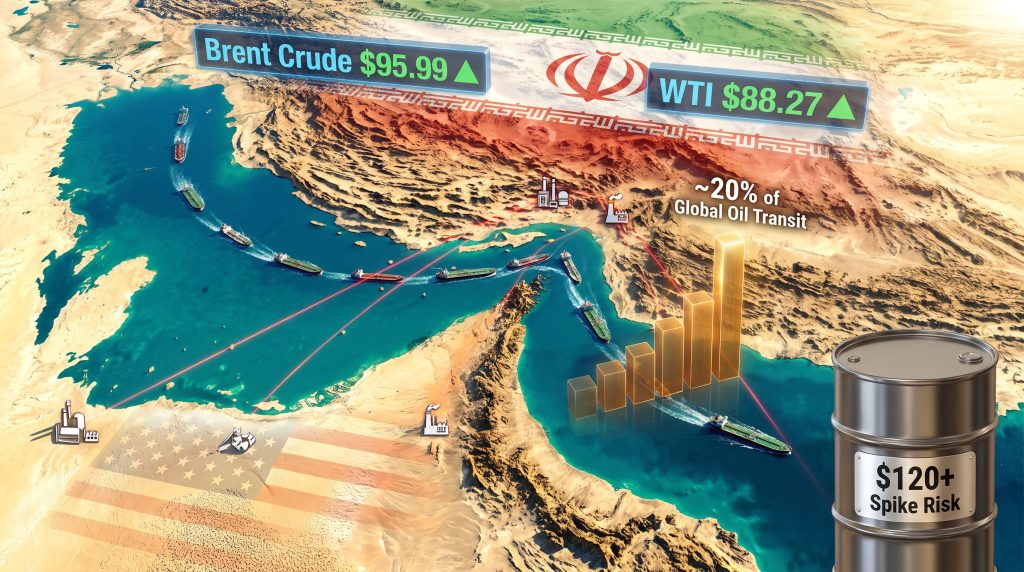
The Strait of Hormuz functions as the world's most consequential maritime bottleneck. Approximately 20% of global oil supply transits this corridor daily, representing flows from Saudi Arabia, Iraq, Kuwait, the United Arab Emirates, and Iran itself. Any sustained interference with passage through this strait does not merely affect a regional market. It sends supply shocks cascading across Asia's manufacturing economies, Europe's energy-import dependent nations, and global commodity futures simultaneously.
The strait's strategic importance has made it a recurring instrument of leverage in Iranian foreign policy. Tehran has periodically threatened closure during periods of heightened tension with Western powers, understanding that even the credible threat of disruption carries significant market consequences without a single weapon being fired.
The Ceasefire That Collapsed
A fragile ceasefire arrangement had been in place governing shipping through the strait, but that framework began fracturing around July 7–8, 2026. Iranian attacks on vessels transiting the strait prompted U.S. retaliatory strikes, setting off the escalation cycle that has now drawn direct presidential involvement. A senior analyst at HSBC described the deteriorating situation in a note published late Wednesday, observing that the recent oil price rally reflects renewed concerns about Hormuz passage following the ceasefire breakdown, and that the trajectory now depends heavily on whether diplomatic channels can restore reliable shipping flows.
The same analyst identified a core structural tension that had been building beneath the surface: as traffic volumes through the U.S.-managed Omani shipping lane increased over time, this arrangement became progressively less acceptable to Iran. The growing utility of an alternative passage framework that bypassed Iranian influence over transit conditions was, in retrospect, a predictable source of escalation. Whoever controls the conditions of passage controls a critical lever of economic influence over the entire region.
Trump's Infrastructure Strike Ultimatum: What It Actually Signals
Unpacking the Presidential Warning
U.S. President Donald Trump issued a direct public ultimatum stating that any future Iranian attack on vessels transiting the Strait of Hormuz, regardless of the weapon system used, would trigger American strikes against Iranian bridges and power plants. This framing is significant beyond its immediate military implications. According to reporting on Trump's threats against Iran, the ultimatum explicitly extended to the capture of oil and gas infrastructure, adding further weight to market anxieties.
Infrastructure targeting ultimatums of this specificity represent a sharp departure from the more ambiguous deterrence language typically employed in Middle Eastern diplomacy. By naming civilian infrastructure categories explicitly, the statement creates a defined escalation threshold that constrains future diplomatic flexibility on both sides. Markets responded accordingly.
Iran's Counter-Escalation Doctrine
Tehran's response was swift and deliberately broad in geographic scope. An unnamed Iranian military source told state-run Tasnim News Agency that if the U.S. strikes Iranian bridges or power plants, Iran would respond by targeting infrastructure and bridges across the region, including energy facilities where American interests are present. This is not simply a symmetric threat. It represents a deliberate broadening of the potential conflict zone beyond Iranian territory, introducing uncertainty about which regional assets might be caught in any retaliatory exchange.
The asymmetric nature of Iran's counter-threat reflects a core element of its deterrence doctrine: if direct military confrontation with U.S. forces is not viable, the response will extend to economically significant targets across a wider theatre, maximising the cost of escalation for all parties involved. Furthermore, the oil markets under trade war conditions had already been under stress, meaning this geopolitical layer compounded pre-existing vulnerabilities.
Oil Price Movements: Reading the Market's Fear Response
What the Numbers Reveal
The crude price reaction following Trump's ultimatum was immediate and measurable. The table below captures the key benchmark movements and their drivers:
| Benchmark | Price Level | Session Movement | Primary Driver |
|---|---|---|---|
| Brent Crude (September Futures) | $95.99 per barrel | +2.0% | Hormuz attack threat |
| WTI Crude (Front Month) | $88.27 per barrel | +1.7% | Supply disruption risk |
| Hormuz Transit Volume | ~20% of global oil | High sensitivity | Ceasefire breakdown |
These gains reflect what traders call the geopolitical risk premium — the additional price buffer markets build into crude benchmarks when the probability of supply disruption rises materially, even before any actual disruption occurs.
Why Traders React to Threats, Not Just Events
A commonly misunderstood aspect of oil market psychology is that futures prices do not require a supply event to move significantly. The credible possibility of disruption is itself sufficient to reprice risk. Options markets in particular become active during geopolitical escalation cycles, as traders seek to hedge against tail scenarios that may have low probability but extreme price consequences.
It is also notable that gains partially eased during sessions when signals emerged suggesting preliminary U.S.–Iran discussions might still be occurring. This pattern confirms that traders are not simply pricing military risk in isolation. They are continuously re-weighting the probability distribution between escalation and diplomatic resolution, making diplomatic signals as market-relevant as military ones.
The Diplomat's Role in Oil Pricing
Secretary of State Marco Rubio's public assessment that Iran was not approaching negotiations with sufficient seriousness, while Washington maintained its commitment to diplomatic channels, added another layer of ambiguity to market positioning. When official statements simultaneously signal both diplomatic persistence and scepticism about the counterpart's intentions, markets treat this as an elevated-uncertainty environment and price in wider outcome ranges. In addition, oil rises as Trump threatens strikes on Iranian infrastructure have been widely covered across energy sector media, reinforcing the sustained nature of this market repricing.
Global Supply Chain Exposure: Who Bears the Risk?
The Ripple Architecture of a Hormuz Disruption
A Hormuz closure would not distribute its economic pain evenly. The countries and economies most exposed to a Persian Gulf supply shock include:
- Japan and South Korea, which import the overwhelming majority of their crude from Gulf producers via Hormuz-dependent shipping lanes
- China, whose energy security infrastructure is heavily reliant on Middle Eastern crude, particularly from Saudi Arabia and Iraq
- India, which has rapidly expanded its Gulf oil import volumes and lacks fully developed alternative supply redundancy
- European economies, which would face secondary price shocks through global benchmark repricing even if their direct Hormuz exposure is lower
OPEC Spare Capacity and Strategic Reserve Limits
A frequently overlooked dimension of Hormuz risk is the mismatch between the global strategic petroleum reserve system and the scale of potential disruption. Strategic reserves, while substantial in aggregate, were architected primarily to buffer short-duration supply shocks — such as weather-related infrastructure damage or brief political interruptions. Consequently, OPEC's market influence becomes a critical variable in assessing how quickly any supply shortfall could be offset.
A sustained Hormuz closure exceeding 30 days would create supply deficits that strategic petroleum reserve drawdowns alone could not fully offset. The arithmetic of daily consumption versus reserve volumes makes prolonged disruption fundamentally different in kind from the shocks these systems were designed to absorb.
OPEC spare capacity, while present, is itself geographically concentrated in the Gulf region, meaning that any scenario severe enough to close Hormuz would likely also complicate the logistics of deploying that spare capacity to market. The redundancy that appears to exist on paper becomes operationally constrained in precisely the scenarios where it is most needed.
Diplomatic Scenarios and Their Price Implications
Three Pathways Forward
Oil market participants are effectively trading across three broad scenario sets, each carrying distinct price implications:
| Scenario | Probability Assessment | Estimated Oil Price Impact |
|---|---|---|
| Full diplomatic resolution and Hormuz shipping normalisation | Low to Moderate | Significant benchmark price decline |
| Sustained stalemate with periodic incidents and partial disruption | Moderate to High | Elevated volatility, persistently high prices |
| Military escalation with infrastructure strikes and retaliation | Low to Moderate | Severe supply shock, potential spike beyond $120 per barrel |
The stalemate scenario is arguably underappreciated by retail market participants, who tend to focus on binary outcomes. A prolonged period of elevated tension without full resolution represents a structural floor under crude prices that could persist for months, affecting inflation dynamics, central bank calculations, and equity market sector allocations.
The next major ASX story will hit our subscribers first
Investor Frameworks for Navigating Geopolitical Oil Volatility
Reading the Risk Premium
Sophisticated energy market participants employ several analytical frameworks during geopolitical escalation cycles:
-
Risk Premium Monitoring — Tracking the spread between spot and forward futures prices provides a real-time read on how much geopolitical fear is embedded in current pricing versus longer-term supply-demand fundamentals. A widening contango or backwardation shift during escalation periods reveals the market's directional read on duration risk.
-
Diplomatic Signal Scanning — Official statements from both the U.S. State Department and Iranian foreign ministry, UN Security Council activity, and back-channel reporting through regional intermediaries like Oman function as leading indicators of potential price relief. Markets have consistently demonstrated sensitivity to even preliminary ceasefire language.
-
Supply Disruption Hedging — Investors with energy sector exposure should evaluate whether their portfolio risk tolerance is calibrated for a prolonged elevated-price environment. Energy equities, commodity ETFs, and options strategies each offer different risk-adjusted exposure profiles during sustained geopolitical volatility cycles.
-
Correlation Mapping — During Middle East escalation events, correlations between crude oil, defence sector equities, and safe-haven assets shift materially. For instance, gold as a safe haven has historically attracted significant capital flows during precisely these kinds of supply-shock scenarios. Understanding these dynamic correlations helps prevent portfolio construction errors that assume historical correlation stability.
Historical Precedents Worth Examining
Past Middle Eastern escalation cycles offer instructive, if imperfect, analogies. The 1973 Arab oil embargo, the 1979 Iranian revolution, the 1990 Gulf War, and the 2019 Abqaiq drone strikes on Saudi Arabian processing facilities all produced distinct oil price responses shaped by the specific supply volumes at risk and the speed of diplomatic or military resolution. In each case, the initial price spike overestimated the eventual supply impact, but the period of uncertainty itself had lasting economic consequences.
The 2026 Hormuz escalation differs from some historical precedents in one critical respect: the U.S. has issued an explicit, infrastructure-specific deterrence ultimatum rather than a general warning. This specificity reduces diplomatic ambiguity in some respects, but it also reduces the flexibility of both parties to de-escalate without appearing to capitulate — a dynamic that can extend the duration of standoffs.
Frequently Asked Questions: Oil Prices, Iran, and the Strait of Hormuz
Why did oil prices rise after Trump threatened Iran?
Oil markets rose because Trump's ultimatum materially increased the perceived probability of military confrontation near the Strait of Hormuz. Since approximately 20% of global oil flows through that corridor, even a partial disruption scenario justifies a significant risk premium in crude prices. Markets price expected value across scenarios, not just the most likely outcome.
What happens to oil prices if the Strait of Hormuz is blocked?
A full closure would remove roughly 20 million barrels per day of transit capacity from global supply chains. Economists and energy analysts have estimated that a sustained closure could push Brent crude well beyond the $120 per barrel threshold, depending on duration and the degree to which alternative supply sources and strategic reserves can offset the shortfall. However, a total closure remains historically rare precisely because all parties, including Iran, bear economic consequences from extended disruption.
Has Iran actually attacked ships in the Strait of Hormuz?
Yes. Iranian attacks on vessels transiting the strait preceded the current escalation cycle and were part of what caused the ceasefire framework to break down in early July 2026. The VLCC Mobassa B was among the vessels reported to have been struck by Iranian cruise missiles while transiting the strait, according to reporting citing UAE defence ministry statements.
What is the U.S.-managed Omani lane and why is it controversial?
The U.S.-managed Omani shipping lane represents an alternative transit corridor developed to provide a degree of separation from areas of Iranian interdiction risk. As traffic volumes through this lane increased, it became a source of strategic concern for Tehran because it reduced Iran's leverage over shipping flows through its primary zone of influence. The growing utility of this alternative pathway was, in retrospect, a contributing factor to Iran's decision to resume attacks on vessels using the main strait corridor.
How does a U.S.–Iran conflict affect energy costs more broadly?
Global crude benchmark prices serve as the foundation for fuel costs across transport, agriculture, manufacturing, and consumer goods supply chains worldwide. When Brent crude rises 2% in a single session, the downstream effects propagate through petrol prices, airline fuel surcharges, freight costs, and ultimately consumer price indices in economies that import oil. The inflationary transmission mechanism from geopolitical crude spikes to household costs typically operates on a lag of four to eight weeks for fuel prices and longer for broader goods inflation.
The Structural Lesson Behind the Current Crisis
Energy Architecture and Its Inherent Fragility
The 2026 Hormuz escalation is not simply a bilateral confrontation between Washington and Tehran. It is a stress test of the global energy architecture's most fundamental design flaw: the concentration of irreplaceable transit volume through geography that remains permanently exposed to regional political volatility.
Decades of investment in liquefied natural gas infrastructure, pipeline diversification, and renewable energy transition have not meaningfully reduced the world's short-term dependence on Gulf crude transit. The infrastructure timelines required to build genuine supply route redundancy operate on decade-long horizons, while geopolitical crises can materialise within days.
Why Geopolitical Risk Is Becoming Structurally Embedded in Oil Pricing
The frequency of Hormuz-related escalation cycles has increased across the 2020s, reflecting broader instability in the regional political order. Each cycle adds to a cumulative market conditioning that keeps the geopolitical risk premium as a permanent feature of crude pricing rather than a temporary shock premium that fades as tensions ease.
For energy market participants, portfolio managers, and economic policymakers alike, the implication is clear. Oil rises as Trump threatens strikes on Iranian infrastructure will remain a recurring market narrative for as long as the underlying structural vulnerabilities persist. Integrating political risk as a structural variable rather than an episodic adjustment factor has consequently become a core competency requirement for anyone navigating energy market exposure in the current decade.
Disclaimer: This article is intended for informational purposes only and does not constitute financial or investment advice. Oil price forecasts and geopolitical scenario assessments involve significant uncertainty and should not be relied upon as the basis for investment decisions. Readers should conduct their own research or consult a qualified financial adviser before making any investment decisions.
Want to Capitalise on the Next Major Resource Discovery Before the Market Moves?
While geopolitical volatility continues to reshape global energy markets, Discovery Alert's proprietary Discovery IQ model scans ASX announcements in real time, instantly notifying subscribers of significant mineral discoveries across more than 30 commodities — turning complex data into actionable investment opportunities the moment they emerge. Explore how historic discoveries have delivered extraordinary returns on Discovery Alert's dedicated discoveries page, and begin your 14-day free trial today to position yourself ahead of the broader market.