July 23, 2026
The Geography of Leverage: Why a 33-Kilometre Passage Holds the World Economy Hostage
Long before the current crisis erupted, strategists and energy economists had identified the Strait of Hormuz as the single point of failure most capable of destabilising the global economy. No pipeline network, no alternative shipping corridor, and no strategic reserve system has ever been designed with sufficient scale to fully compensate for its closure. That structural vulnerability, baked into decades of energy infrastructure decisions, is now being tested under live-fire conditions.
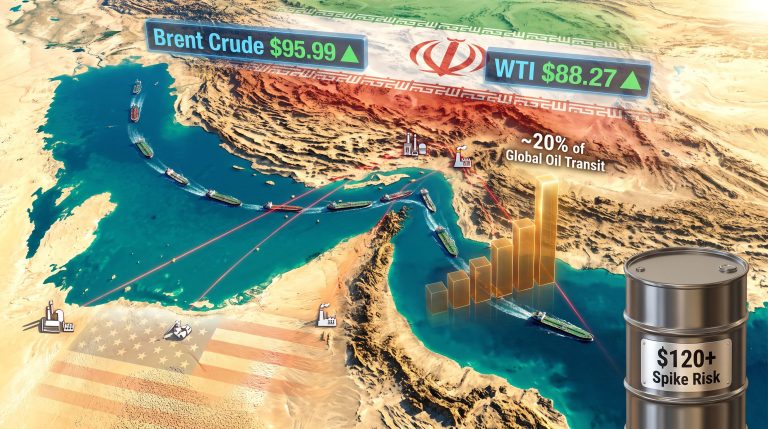
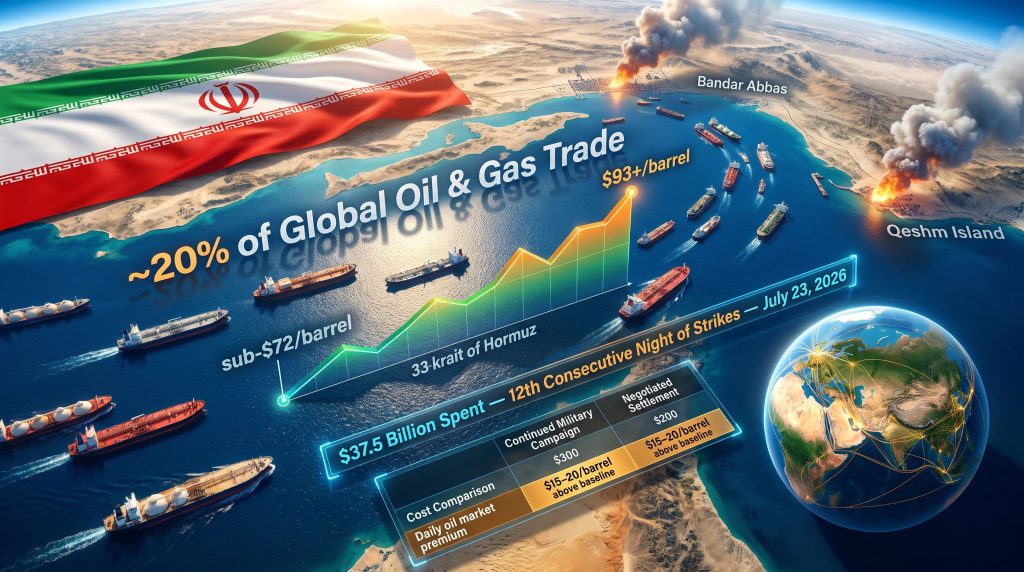
The strait connects the Persian Gulf to the Gulf of Oman through a navigable channel approximately 33 kilometres wide at its narrowest usable point. During peacetime, roughly one-fifth of all globally traded oil and liquefied natural gas transits this corridor, making it categorically more consequential than any other maritime chokepoint on Earth, including the Suez Canal and the Malacca Strait. The numbers alone explain why US strikes on Iran and the Strait of Hormuz have become the defining geopolitical story of mid-2026.
What is less commonly understood is that the strait's vulnerability is not merely physical. It is also legal, diplomatic, and psychological. The moment a state credibly threatens to disrupt passage, war-risk insurance premiums spike, shipping companies reroute or delay, and commodity futures markets begin pricing in a supply shock that may never fully materialise. The economic damage from perceived closure can begin well before a single vessel is actually blocked. For broader context on how such shocks transmit through markets, the oil price volatility guide provides useful historical calibration.
When big ASX news breaks, our subscribers know first
Historical Precedents: What Hormuz Disruption Actually Costs
The strait has been threatened, partially disrupted, and used as geopolitical leverage repeatedly across modern history. Each episode offers a calibration point for understanding the current escalation.
| Historical Event | Duration of Disruption | Approximate Oil Price Impact |
|---|---|---|
| Tanker War (1984-1988, Iran-Iraq conflict) | Multi-year partial disruption | Sustained volatility; price collapse by 1986 due to OPEC factors |
| Gulf War I (1990-1991) | Brief closure threat | Brent surged from ~$17 to $40/barrel within weeks |
| Iranian mining threats (2011-2012) | Threat without closure | Brent rose approximately 10-15% on threat alone |
| Current 2026 escalation | Ongoing as of July 23 | Brent moved from below $72/barrel to above $93/barrel, a ~29% surge |
The 2026 price trajectory is particularly instructive. Unlike previous episodes where threat and reality diverged, the current conflict involves confirmed, sustained US strikes on Iran targeting Strait of Hormuz-adjacent infrastructure, Iranian retaliatory attacks on Gulf energy assets, and the active assertion by Tehran that it holds authority over the waterway's traffic management. The combination of kinetic reality and legal uncertainty has produced a more durable price premium than threat-only scenarios historically generate.
Furthermore, the LNG supply outlook has deteriorated sharply given the strait's central role in global gas transit, compounding pressure on energy-importing economies already managing elevated costs.
Critical Context: A sustained Hormuz closure would represent a supply shock materially larger than the 1973 Arab oil embargo. Current throughput volumes through the strait dwarf those of 1973, and strategic petroleum reserve drawdown capacity across consuming nations is insufficient to bridge a closure lasting more than several weeks.
What the US Military Is Actually Targeting: Beyond the Headlines
US Central Command has framed its operations as efforts to degrade Iran's capacity to threaten civilian mariners and commercial vessels transiting regional waters. However, the confirmed target architecture reveals a campaign considerably broader than vessel protection.
Confirmed strike categories include:
- IRGC missile and drone launch infrastructure positioned along Iran's southern coastline
- Coastal radar installations and air-defence battery networks
- Command-and-control communication nodes
- Fast-attack naval vessel facilities used for harassing commercial shipping
- Naval command infrastructure at Bandar Abbas and Qeshm Island
- IRGC missile facilities near Sirik
- Broad air-defence and surveillance networks across Hormozgan Province
The campaign entered its 12th consecutive night of strikes as of July 23, 2026, a tempo and duration that signals a strategic intent beyond reactive retaliation. This is not a punitive strike cycle. It represents a sustained attempt to structurally degrade Iran's ability to project force into the strait. Reuters reported that Iran's formal declaration of closure came in direct response to this sustained operational posture.
The Infrastructure Deterrence Doctrine: A Significant Strategic Shift
Perhaps the most consequential development in the current campaign is the explicit targeting formula announced by President Trump: one Iranian bridge or power plant destroyed for every Iranian attack on a commercial vessel in the Strait of Hormuz. This moves US military doctrine from a purely military-target framework toward the deliberate use of civilian infrastructure as a coercive instrument.
International humanitarian law, specifically the laws of armed conflict codified in the Geneva Conventions and their Additional Protocols, generally prohibits the destruction of civilian infrastructure unless it actively serves a military function at the time of attack. The legal debates this doctrine will generate are likely to outlast the conflict itself.
Iranian Health Ministry figures, which are independently unverified, reported that US strikes across the first 11 days of the campaign killed 53 people, including six women and three children, and wounded approximately 600 others.
Iran's Retaliatory Strategy: Targeting Water as a Weapon
Iran's counter-escalation posture has followed a logic that deserves careful analysis. Rather than concentrating retaliatory fire on US military assets, which would invite direct and overwhelming response, Tehran has shifted toward attacking the infrastructure that underpins civilian life in neighbouring Gulf states.
Energy infrastructure and desalination plants have become primary Iranian retaliation targets. In a region where multiple countries rely on seawater desalination for the majority of their municipal drinking water supply, this represents an attack on a resource with no immediate substitute. The strategic calculation is clear: by threatening water security rather than purely energy exports, Iran creates domestic political pressure within Gulf nations that cannot easily be resolved through military means alone.
The geographic spread of Iranian retaliatory actions as of late July 2026 illustrates this expanding footprint:
- Aqaba, Jordan: Four Iranian missiles intercepted by Jordanian air defences; two others landed in uninhabited zones. Smoke plumes were visible from Israel's city of Eilat, raising concerns about conflict widening.
- Bahrain: Missile alert triggered, creating civilian alarm across the island nation that hosts the US Navy's Fifth Fleet.
- Dammam, Saudi Arabia: Residents warned to seek shelter before Saudi authorities confirmed the immediate threat had passed.
Iranian Foreign Minister Abbas Araghchi publicly committed Tehran to a retaliatory posture matching any strike on Iranian infrastructure with a powerful and decisive response. Parliament Speaker Mohammad Bagher Qalibaf, who has been involved in back-channel negotiations with the US, stated publicly that the strait's conditions would not return to those that existed before the conflict began.
Iran's Hormuz Toll Claim: No Legal Standing
One of the most legally significant developments in the current conflict is Iran's assertion that it holds authority to manage traffic flow through the Strait of Hormuz and to impose transit fees on vessels using the waterway.
Legal Framework: The United Nations Convention on the Law of the Sea (UNCLOS) enshrines the right of transit passage through international straits used for international navigation. Iran's claim to toll-collection authority over Hormuz has no recognised basis under UNCLOS or any other binding international maritime law framework. The strait was open to all vessels and entirely toll-free before the current conflict.
US Secretary of State Marco Rubio articulated precisely why the US views this claim as a threat extending well beyond the Middle East. Allowing any nation-state to unilaterally control an international waterway, charge transit fees, and use force against non-compliant vessels would establish a precedent replicable in the South China Sea, the Malacca Strait, and other strategically vital corridors worldwide. That global precedent argument is central to understanding why Washington has committed to such a sustained and costly campaign. The oil and trade tensions already reshaping supply chains make this precedent even more consequential for energy-dependent economies.
The Fiscal and Human Cost: $37.5 Billion and Four Flag-Draped Coffins
The economic dimensions of the current conflict extend far beyond oil prices. Defense Secretary Pete Hegseth confirmed in Senate testimony that the United States had expended approximately $37.5 billion on the Iran military campaign as of late July 2026. The House of Representatives subsequently adopted a $95 billion supplemental package to fund continued operations alongside other administration priorities.
President Trump travelled to Dover Air Force Base on July 22, 2026, for the arrival of the remains of four US service members, a moment that placed a human dimension alongside the financial accounting.
| Dimension | Metric |
|---|---|
| US campaign expenditure (to late July 2026) | $37.5 billion |
| House-approved supplemental war funding | $95 billion |
| Brent crude pre-conflict | Below $72/barrel |
| Brent crude at peak (July 2026) | Above $93/barrel |
| Price increase percentage | Approximately 29% |
| Iranian reported casualties (11-day period) | 53 killed, ~600 wounded |
| US service member fatalities confirmed | 4 (remains received July 22) |
A secondary chokepoint risk has emerged simultaneously. Houthi rebels in Yemen have threatened to target Saudi shipping in the Red Sea, potentially creating a dual chokepoint scenario compressing both Hormuz and Suez-adjacent traffic. The compounding effect on global freight costs and energy supply chains would be considerably more severe than either disruption in isolation. Consequently, the oil price impact on downstream industries is already being felt across manufacturing and transport sectors globally.
Diplomacy in the Dark: The Mediation Landscape
Pakistan has emerged as the primary diplomatic conduit between Washington and Tehran. Iranian Interior Minister Eskandar Momeni travelled to Islamabad specifically to sustain dialogue channels, though no substantive framework has emerged publicly. Iran's Interior Ministry confirmed that message exchanges were ongoing without providing any detail on their content.
The broader mediation coalition includes Gulf states, Turkiye, and Pakistan collectively applying pressure for de-escalation. However, an Arab diplomat, speaking anonymously given the sensitivity of the situation, characterised the regional outlook as increasingly pessimistic, describing the prospects for finding an exit pathway as bleak.
Any realistic negotiated settlement would likely need to address the following elements in sequence:
- Iranian formal withdrawal of its transit-fee claim under international maritime law
- Verifiable cessation of IRGC-directed attacks on commercial vessels transiting the strait
- US suspension of active strike operations against Iranian territory
- Third-party monitoring mechanism for Hormuz passage compliance
- Parallel nuclear enrichment discussions as a confidence-building component
The sequencing problem is severe. Each side's opening condition is the other side's final concession, creating a classic negotiating deadlock that mediators have so far been unable to bridge.
The next major ASX story will hit our subscribers first
The Nuclear Threshold: Pickaxe Mountain and What Comes Next
The conflict carries a dimension that transcends conventional military confrontation. Trump signalled that US forces may soon target a facility known as Pickaxe Mountain, an under-construction nuclear site situated on the southern perimeter of Iran's Natanz enrichment complex. The Natanz site itself was struck during the 12-day Iran-Israel conflict in 2025, but Pickaxe Mountain has remained untouched despite continued Iranian excavation activity at the location.
Iran maintains its nuclear programme is entirely peaceful while simultaneously having resumed uranium enrichment to near weapons-grade levels following US withdrawal from the 2015 Joint Comprehensive Plan of Action during Trump's first term.
Striking an active nuclear construction site would represent a qualitative escalation threshold that carries consequences well beyond the current conventional military exchange:
- Immediate IAEA engagement and potential UN Security Council emergency sessions
- International legal debate over the legality of pre-emptive strikes on declared nuclear facilities
- Near-certain Iranian retaliation against Gulf energy infrastructure at a scale exceeding previous actions
- Effective foreclosure of any near-term diplomatic resolution pathway
Scenario Watch: Energy markets are already pricing in elevated risk. A confirmed US strike on Pickaxe Mountain would likely push Brent crude toward the $110 to $120 per barrel range in the immediate aftermath, based on the scale of supply uncertainty such an action would generate.
Three Scenarios: Where the Strait of Hormuz Conflict Goes From Here
Investors, policymakers, and energy strategists tracking US strikes on Iran Strait of Hormuz developments should be monitoring three distinct trajectory scenarios.
Scenario 1: Escalation Continuation
US strikes intensify, targeting Pickaxe Mountain or additional civilian infrastructure. Iran expands retaliatory operations across Gulf energy and water assets. Brent crude breaches $100/barrel. Domestic US political pressure from rising gasoline prices ahead of midterm elections intensifies on the administration to either resolve or decisively escalate.
Scenario 2: Frozen Conflict
Both sides reduce strike frequency without formal agreement, creating an unstable equilibrium. Shipping war-risk premiums remain elevated. Oil prices stabilise in the $85 to $95 range. The strait operates at reduced commercial capacity under an informal and fragile understanding. This is arguably the most likely near-term outcome and the most difficult to plan for.
Scenario 3: Mediated Settlement
Pakistan or a Gulf coalition brokers a framework that restores international passage rights in exchange for a US operational pause and renewed nuclear dialogue. Oil prices normalise over a 30 to 90-day window as shipping insurance rates recover and commercial vessel traffic resumes normal patterns. Al Jazeera's live coverage of the IRGC closure declaration illustrates how rapidly this situation can shift between scenarios.
Key Indicators to Monitor
- Weekly Brent crude price movements as a real-time conflict intensity signal
- IAEA statements on Iranian nuclear site activity, particularly at the Natanz perimeter and Pickaxe Mountain
- Congressional approval timelines and disbursement of the $95 billion supplemental war package
- Houthi threat posture in the Red Sea as a secondary chokepoint risk multiplier
- Any formal diplomatic statement from Pakistan or Turkiye suggesting a substantive breakthrough in back-channel negotiations
- Iranian parliament speaker statements on Hormuz management, which have served as the clearest indicator of Tehran's non-negotiable positions
The conflict unfolding across the Strait of Hormuz is simultaneously a test of military doctrine, international maritime law, energy market resilience, and great-power credibility. In addition, the broader energy transition pressures that were already reshaping global investment patterns may accelerate as consuming nations reassess long-term dependence on Gulf supply routes. Its resolution, or its continuation, will shape the structure of global energy security for years beyond the last strike.
Disclaimer: This article contains forward-looking scenario analysis based on publicly reported information as of July 23, 2026. Geopolitical situations evolve rapidly, and readers should not treat scenario projections as predictions. Energy price forecasts are speculative and subject to material revision as events develop. This article does not constitute financial or investment advice.
Want to Stay Ahead of the Market Opportunities Emerging From This Energy Crisis?
Discovery Alert's proprietary Discovery IQ model delivers real-time alerts on significant ASX mineral discoveries, instantly identifying actionable opportunities in the commodities and energy sectors being reshaped by this Hormuz crisis — explore historic discovery returns on Discovery Alert's discoveries page to understand the scale of potential outcomes, then begin your 14-day free trial at discoveryalert.com.au to position yourself ahead of the broader market.