July 23, 2026
The Chokepoint Economy: When Maritime Geography Dictates Energy Security
Global energy markets have always been hostage to geography. Long before the era of pipelines and subsea cables, the physical configuration of oceans, straits, and coastlines determined which nations could sell their resources and at what price. Today, that same geographic logic is playing out in one of the most consequential corridors in world trade, and the consequences are rippling across African export economics in ways that deserve far closer attention than they typically receive.
The Nigeria LNG Bab el-Mandeb transit story unfolding in mid-2026 is not simply a shipping news item. It is a window into the structural fragility of global energy supply chains, the compounding risks of simultaneous chokepoint pressure, and the asymmetric vulnerabilities carried by export-dependent African energy producers navigating a world of intensifying maritime insecurity. Furthermore, understanding these dynamics is essential for anyone tracking the natural gas supply outlook across global markets.
When big ASX news breaks, our subscribers know first
Understanding Bab el-Mandeb: The Chokepoint That Controls Global Energy Flow
What Makes Bab el-Mandeb a Critical Node in the Global LNG Supply Chain?
At just 29 kilometres wide, the Bab el-Mandeb Strait connecting the southern Red Sea to the Gulf of Aden is one of the narrowest passages through which a meaningful share of the world's energy supply must travel. Historically, approximately 10% of global seaborne LNG trade has transited this corridor, making it not merely a geographic convenience but an infrastructural dependency baked into long-term supply contracts, vessel scheduling, and port logistics across three continents.
For West African LNG exporters, and Nigeria specifically, the strait represents the most economically rational pathway to South and Southeast Asian import markets. The alternative is a voyage around the Cape of Good Hope at Africa's southern tip, a route that adds significant time, fuel consumption, and logistical complexity to every cargo movement.
The freight economics tell a stark story:
| Route | Approximate Distance (Nigeria to Bangladesh) | Estimated Extra Days | Cost Premium |
|---|---|---|---|
| Via Bab el-Mandeb / Suez Canal | ~11,000–12,000 nautical miles | Baseline | Baseline |
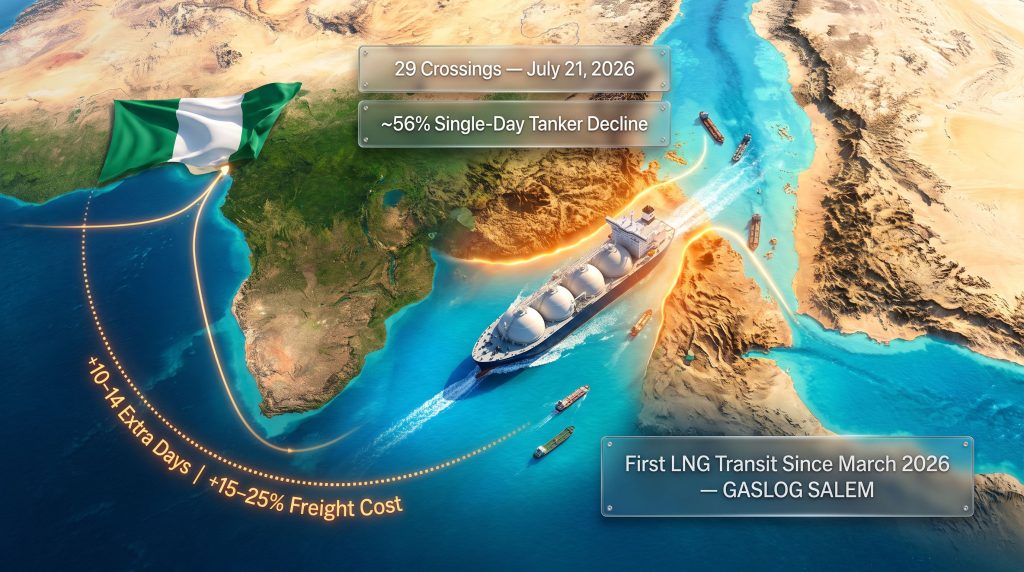
| Via Cape of Good Hope | ~15,000–16,000 nautical miles | +10–14 days | +15–25% freight cost |
That 15–25% freight cost premium is not abstract. Across a full year of cargo movements, it translates into hundreds of millions of dollars in additional logistics expenditure absorbed somewhere along the supply chain, whether by the exporter, the shipping operator, or ultimately the end buyer.
The Two Chokepoints Now Threatening Global Energy Shipping Simultaneously
What makes the current moment particularly dangerous for global energy trade is not the disruption at Bab el-Mandeb in isolation. It is the simultaneous pressure being applied at two of the world's most critical maritime chokepoints at the same time.
-
Strait of Hormuz: Escalating tensions in the Persian Gulf have created elevated uncertainty around the passage through which a substantial share of Gulf crude and LNG exports must transit. Saudi Arabia, already managing complex export logistics, has been increasingly reliant on its Red Sea infrastructure as a result.
-
Bab el-Mandeb: Houthi-driven disruption has progressively removed commercial shipping confidence from the southern Red Sea corridor, with LNG transit volumes declining sharply from late 2023 through 2024 and eventually reaching a near-complete cessation by early 2026.
When both chokepoints face concurrent disruption, the compounding effect on Asian energy importers is severe. Countries like Bangladesh, India, and Pakistan, which depend heavily on seaborne LNG to meet industrial and residential energy demand, face both supply routing uncertainty and elevated delivered costs simultaneously. These pressures compound existing energy export challenges already weighing on global markets.
How Severe Is the Houthi Threat to Red Sea Shipping in 2026?
Quantifying the Security Deterioration: What the Traffic Data Reveals
The scale of the deterioration at Bab el-Mandeb became sharply visible on July 21, 2026, when S&P Global Commodities at Sea published its Market Impact Report documenting a single-day traffic collapse that few analysts had anticipated in its speed and severity.
Total vessel crossings at Bab el-Mandeb fell from 41 to 29 in a single day, representing a decline of approximately 29%. Tanker traffic experienced an even more acute contraction, dropping from 16 crossings to just 7 within the same 24-hour window, a 56% single-day collapse that represents one of the most dramatic short-term disruption signals recorded at this chokepoint since Houthi maritime operations began.
Key Data Point: According to S&P Global Commodities at Sea's Market Impact Report dated July 22, 2026, the tanker crossing data from July 21 provided the first measurable market behavioural response to the Houthi embargo announcement targeting Saudi Arabian Red Sea ports made the previous day. This speed of response, within 24 hours of the announcement, illustrates how sensitised commercial operators have become to Houthi threat signalling.
The Houthi Maritime Embargo: What Was Announced and Why It Matters
On July 20, 2026, Yemen's Houthi movement announced a maritime embargo specifically targeting Saudi Arabian port infrastructure within the Red Sea. The practical and psychological effects were near-immediate. Multiple vessels that had departed Saudi Arabia's Yanbu oil terminal, a major Red Sea export facility, subsequently reversed course or reduced speed significantly, signalling that commercial operators were not willing to test the credibility of the threat.
This raises an important analytical distinction that shipping risk professionals frequently emphasise but that general commentary tends to flatten:
Analytical Distinction: There is a meaningful difference between a geopolitical pressure tool and an operationally enforced blockade. The Houthi embargo announcement functions primarily in the former category, but the commercial shipping response to it is effectively equivalent to the latter. When vessel operators change behaviour based on a threat announcement alone, the economic impact of an enforced blockade is achieved without a single additional strike.
The strategic logic of Yanbu's vulnerability is worth understanding. Saudi Arabia has been routing an increasing share of its crude exports through Red Sea infrastructure precisely because Hormuz tensions made that route appear safer. The Houthi embargo announcement inverts that calculus, creating a situation where both primary export corridors carry elevated and intersecting risks.
Comparing Houthi Disruption Phases: 2024 vs. 2026
| Period | Nature of Threat | LNG Traffic Impact | Tanker Rerouting Rate |
|---|---|---|---|
| Late 2023 – 2024 | Vessel attacks, drone strikes | Significant decline in transits | High Cape of Good Hope diversion |
| Early–Mid 2026 | Embargo declarations, renewed threats | Near-zero LNG transits (4-month gap) | Accelerating diversion signals |
| July 2026 | Embargo on Saudi Red Sea ports | 29% single-day vessel decline | Vessels reversing from Yanbu |
The progression across these phases reveals something important: the disruption mechanism has shifted from kinetic attacks requiring physical response to announcement-based deterrence that achieves route avoidance without requiring Houthi forces to intercept a single vessel. This evolution makes the threat harder to price, harder to counter, and harder to time as a recovery scenario. The broader geopolitical risk landscape affecting commodities and trade routes continues to intensify across multiple regions simultaneously.
Nigeria LNG's Strategic Position: Africa's Largest Exporter Navigating a Fractured Shipping Environment
Nigeria's LNG Export Dependency and the Routes That Sustain It
Nigeria holds the position of Africa's largest LNG exporter, and its liquefied natural gas revenues represent a critical pillar of the country's foreign exchange earnings. The Nigeria LNG facility on Bonny Island, operated as a joint venture involving Nigerian National Petroleum Company Limited and international partners, has long-term supply agreements spanning European and Asian markets.
The routing economics for these cargoes vary significantly by destination:
-
European markets are served primarily via the Atlantic, a relatively direct voyage that is largely unaffected by Red Sea disruption.
-
South Asian markets (Bangladesh, India, Pakistan) have historically been served via the Bab el-Mandeb and Suez Canal corridor, making Nigerian LNG particularly exposed to Red Sea instability.
-
Southeast Asian markets require even longer voyages regardless of route, meaning the freight cost differential between the Bab el-Mandeb and Cape routes is proportionally significant.
The Bab el-Mandeb route becomes financially viable for Nigerian LNG once the combination of war risk insurance premiums, potential interdiction risk, and operational complexity exceeds the Cape of Good Hope diversion cost of 15–25% additional freight expenditure. That threshold has clearly been breached since at least early 2026.
What the GASLOG SALEM Transit Actually Tells Us and What It Doesn't
The vessel at the centre of this story, the GASLOG SALEM, completed a Nigeria-origin LNG cargo discharge into Bangladesh before transiting the Bab el-Mandeb Strait, making it the first LNG vessel to pass through the corridor since March 2026, according to S&P Global Commodities at Sea data published July 22, 2026. The vessel had spent approximately a week anchored off Sri Lanka before proceeding toward the Red Sea.
Understanding what this transit actually represents requires precision. Several factors distinguish this movement from a normal commercial laden passage:
-
The cargo had already been delivered. The vessel was in ballast repositioning mode, not carrying an active LNG cargo through the strait.
-
The cargo had no Saudi Arabian origin or connection. S&P Global's analysis explicitly noted this distinction, assessing the transit as carrying lower direct exposure to the Houthi embargo announcement which specifically targeted Saudi-related shipping.
-
Shipping analysts were explicit that one transit does not constitute a trend. The four-month LNG transit blackout reflects a fundamental reassessment of security risk by commercial operators, and that underlying calculus has not changed based on a single ballast repositioning voyage.
Critical Analytical Point: Interpreting the GASLOG SALEM's movement as a signal of commercial resumption would be a significant analytical error. The conditions that made this specific transit lower-risk, no active cargo, no Saudi connection, post-delivery positioning, do not apply to regular commercial laden passages from Nigeria to South Asian buyers.
The Four-Month LNG Transit Gap: A Structural Shift, Not a Temporary Pause
The absence of any LNG vessel transiting Bab el-Mandeb between March 2026 and July 2026 represents something more significant than a temporary operational pause. Four consecutive months without a single laden LNG passage through a corridor that historically carried roughly 10% of global seaborne LNG trade is a structural signal.
For vessel scheduling and charter party management, a four-month Cape of Good Hope diversion programme adds meaningful complexity:
-
Vessel utilisation rates change as effective voyage distances increase by 30–40%
-
Charter parties may require renegotiation to account for extended voyage durations
-
Port scheduling at destination terminals becomes harder to maintain with precision
-
Cumulative freight cost premiums absorbed by Nigerian LNG exporters and their counterparties across this period are substantial, though precise aggregate figures depend on cargo volumes and specific charter arrangements
What Does This Mean for Global LNG Trade Economics?
Freight Cost and Insurance Premium Dynamics Under Prolonged Route Disruption
War risk insurance premiums for Red Sea and Gulf of Aden transits have evolved considerably since 2023. What began as modest additional cost loadings have, through successive escalation cycles, grown into material components of voyage economics. For LNG carriers, which represent some of the most valuable vessels in the global fleet carrying cargoes worth tens of millions of dollars, insurers price the interdiction and damage risk premium at levels that can materially shift route economics.
The relationship between extended route disruptions and LNG spot price spreads between the Atlantic and Pacific basins is one of the less-discussed mechanisms through which maritime insecurity transmits into energy markets. When West African LNG cannot efficiently reach Asian markets via the Red Sea:
-
Atlantic basin spot prices receive some upward support as Nigerian cargoes that might otherwise flow east are redirected or delayed
-
Pacific basin spot prices face supply pressure as effective delivery volumes decline and voyage times extend
-
The Atlantic-Pacific spread widens, creating arbitrage opportunities that are themselves difficult to exploit precisely because the routing problem that created the spread is the same problem preventing its resolution
In addition, global trade disruptions originating from geopolitical conflict are increasingly compounding these freight market pressures in ways that are difficult to model or anticipate.
Saudi Arabia's Exposure: Why Hormuz Plus Bab el-Mandeb Pressure Is Uniquely Dangerous
Saudi Arabia's strategic pivot toward Red Sea export infrastructure as Hormuz tensions escalated created what risk analysts would recognise as a concentration vulnerability. By increasing dependence on Yanbu and other Red Sea terminals, Saudi Arabia reduced its exposure to one threat vector while inadvertently increasing exposure to another.
The knock-on effects of Saudi Arabia being forced to reroute Asia-bound crude around the Cape of Good Hope are significant for global energy freight markets broadly:
-
Longer Saudi crude voyages increase effective tanker demand, tightening the global tanker market
-
Tighter tanker markets push freight rates higher across all crude and product trades, not just Saudi flows
-
Higher tanker freight rates increase delivered energy costs across Asia, compressing refinery margins and potentially influencing end-user energy prices
These interconnections mean that LNG freight markets and crude tanker markets are not isolated. Pressure on one propagates through the other via shared vessel supply pools, freight rate dynamics, and destination market economics. Consequently, the supply chain pressure from these converging disruptions is being felt across industries well beyond energy shipping.
African LNG Exporters in a Disrupted Shipping World: Structural Implications
Nigeria's position carries a paradox that is rarely articulated clearly. Prolonged Red Sea disruption simultaneously increases Nigeria's logistics costs for Asian-bound cargoes while improving Nigeria's competitive position in European markets. The Cape of Good Hope route from Nigeria to Europe is not dramatically longer than from the Gulf to Europe via the Cape, meaning that relative freight economics can actually shift in Nigeria's favour for Atlantic basin buyers when Red Sea disruption removes Gulf LNG's routing advantage.
For Mozambique, whose LNG sector is in the earlier stages of development with projects targeting first production in the coming years, Red Sea instability creates a complex planning environment. Mozambican LNG will face route decisions similar to Nigeria's for Asian-bound cargoes, making the long-term security trajectory of Bab el-Mandeb a genuine infrastructure planning variable for East African export programmes.
How Should Shipping Operators and Energy Traders Assess the Risk Going Forward?
A Framework for Evaluating Bab el-Mandeb Transit Risk in 2026
Shipping operators and energy traders navigating this environment benefit from a structured risk assessment approach rather than reactive decision-making based on individual threat announcements.
Step 1: Cargo Origin Assessment
Determine whether the cargo has any connection to Saudi Arabian, Iranian, or Houthi-embargoed origin points. Assess whether the vessel flag, ownership structure, or operator history creates targeting exposure under current Houthi operational criteria.
Step 2: Vessel Positioning vs. Loaded Passage Distinction
Ballast repositioning transits carry meaningfully different risk profiles than fully laden commercial passages. The GASLOG SALEM case illustrates that a post-delivery repositioning voyage can proceed under conditions where a laden passage of the same cargo would not be commercially viable. Insurance cost differentials between these two scenarios should be explicitly modelled.
Step 3: Real-Time Traffic and Intelligence Monitoring
The July 21, 2026 crossing data, where total daily crossings fell to 29 from 41 and tanker crossings collapsed from 16 to 7, provides a useful behavioural baseline. Furthermore, Bab el-Mandeb transits data from Lloyd's List Intelligence confirms the sustained downward trajectory of commercial traffic through this corridor. Sustained crossing volumes below these thresholds signal deteriorating operator confidence and should trigger reassessment of passage plans.
Step 4: Alternative Route Cost-Benefit Modelling
Model Cape of Good Hope diversion costs against current war risk premiums with explicit scenario analysis across a range of threat persistence assumptions. Factor in port scheduling delays, charter party implications, and demurrage exposure.
Step 5: Contractual and Force Majeure Review
Long-term LNG supply agreements should be reviewed for route flexibility clauses and force majeure provisions applicable to security-driven rerouting. The four-month LNG transit blackout almost certainly triggered contractual discussions between Nigerian LNG exporters and Asian buyers that may have ongoing implications for cargo scheduling and pricing arrangements.
The next major ASX story will hit our subscribers first
Key Statistics Summary: Bab el-Mandeb Disruption and Nigeria LNG Context
| Metric | Data Point | Source / Date |
|---|---|---|
| LNG transit gap at Bab el-Mandeb | ~4 months (March – July 2026) | S&P Global Commodities at Sea, July 22, 2026 |
| Total vessel crossings, July 21, 2026 | 29 (down from 41 the prior day) | S&P Global Commodities at Sea |
| Single-day crossing decline | ~29% | S&P Global Commodities at Sea |
| Tanker crossings, July 21, 2026 | 7 (down from 16 the prior day) | S&P Global Commodities at Sea |
| Tanker traffic single-day decline | ~56% | S&P Global Commodities at Sea |
| Cape of Good Hope freight premium | ~15–25% over Bab el-Mandeb/Suez route | Industry estimates |
| Additional voyage duration, Cape route | ~10–14 extra days | Industry estimates |
| Strait width at Bab el-Mandeb | ~29 kilometres | Geographic reference |
Frequently Asked Questions: Nigeria LNG and Bab el-Mandeb Transit
Why did an LNG vessel transit Bab el-Mandeb for the first time in four months?
The GASLOG SALEM, which had carried a Nigeria-origin LNG cargo to Bangladesh, transited the Bab el-Mandeb Strait after completing its delivery and spending approximately a week anchored off Sri Lanka. The transit was a repositioning movement in ballast rather than a laden commercial passage, and S&P Global's analysis indicated the voyage carried lower Houthi targeting exposure because the cargo had no Saudi Arabian connection, which is the primary focus of the July 20, 2026 embargo announcement.
Does this transit mean LNG shipping through the Red Sea is resuming normally?
No. Shipping intelligence analysts, including those at S&P Global Commodities at Sea, were explicit that a single vessel transit does not indicate a broader resumption of LNG traffic through the corridor. The four-month absence of LNG transits reflects a structural reassessment by commercial operators of the security risks involved, and nothing about the GASLOG SALEM's specific circumstances changes the underlying risk calculus for regular laden commercial passages.
How much has Houthi activity reduced shipping through Bab el-Mandeb?
According to S&P Global Commodities at Sea data from July 21, 2026, total vessel crossings at Bab el-Mandeb fell by approximately 29% in a single day, from 41 to 29 crossings. Tanker traffic experienced a sharper contraction, declining from 16 to just 7 crossings within the same 24-hour window, representing a 56% single-day decline. Moreover, Red Sea shipping disruptions documented by the U.S. Department of Energy confirm that these attacks have materially increased shipping times and freight rates across the affected corridors.
What alternative route do Nigerian LNG carriers use when avoiding Bab el-Mandeb?
Nigerian LNG vessels destined for Asian markets that bypass the Red Sea corridor are routed around the Cape of Good Hope at Africa's southern tip. This adds approximately 10–14 days to voyage duration and increases freight costs by an estimated 15–25% compared with the Bab el-Mandeb and Suez Canal route.
How does Bab el-Mandeb disruption affect Nigeria's LNG export revenues?
Prolonged disruption increases voyage costs and war risk insurance premiums for Nigerian LNG cargoes destined for Asian markets. While international demand for non-Gulf LNG alternatives remains structurally robust, elevated logistics costs compress margins for Nigerian exporters. Paradoxically, the same disruption can improve Nigerian LNG's competitive position in European markets by altering the relative freight economics between West African and Gulf suppliers serving the Atlantic basin.
What is the Houthi maritime embargo and which vessels does it target?
Yemen's Houthi movement announced on July 20, 2026 a maritime embargo targeting Saudi Arabian Red Sea port infrastructure. The announcement prompted immediate behavioural changes, with multiple vessels departing Saudi Arabia's Yanbu terminal reversing course or significantly slowing. The embargo primarily targets Saudi-origin or Saudi-destined cargoes, but the broader uncertainty it generates has suppressed overall traffic volumes across the strait regardless of cargo origin.
Disclaimer: This article contains forward-looking analysis, market assessments, and scenario projections based on publicly available shipping intelligence data. It does not constitute financial or investment advice. Readers should conduct their own due diligence before making any commercial or investment decisions based on the information presented. Freight cost estimates and voyage duration figures are indicative industry approximations and may vary based on specific vessel, cargo, and market conditions.
Want to Stay Ahead of the Next Major Resource Discovery Driving Global Energy Markets?
Discovery Alert's proprietary Discovery IQ model delivers real-time alerts on significant ASX mineral discoveries — instantly translating complex resource data into actionable opportunities for investors at every level, from short-term traders to long-term position builders. Explore how historic discoveries have generated extraordinary returns on Discovery Alert's dedicated discoveries page, and begin your 14-day free trial today to position yourself ahead of the broader market.