July 23, 2026
The Hidden Mechanics Behind India's Seasonal Coal Supply Crunch
Every year, with near-clockwork predictability, the arrival of the southwest monsoon exposes a fault line running through the core of India's power sector. It is not a fault born of ignorance — policymakers, utilities, and coal producers all understand the pattern intimately. Yet understanding a structural weakness and resolving it are two very different things. The India power stations coal stock shortage that re-emerges each monsoon season is less a supply emergency and more a mirror reflecting the compounded tensions between a rapidly growing electricity grid, a logistics network under strain, and a coal supply chain that cannot fully absorb seasonal disruption without consequence.
When big ASX news breaks, our subscribers know first
Why the 26-Day Norm Exists and What It Actually Measures
To appreciate why the current inventory position matters, it helps to understand what the normative coal stock benchmark is actually designed to do. The 26-day requirement is not an arbitrary bureaucratic target. It is an engineering buffer calculated to absorb simultaneous shocks: transport delays caused by flooding, temporary mine closures during heavy rainfall, and the elevated power demand that monsoon conditions paradoxically generate.
Thermal power plants are designed to operate continuously, and any interruption to fuel delivery creates an immediate knock-on effect across the grid. The 26-day norm gives plant operators a window wide enough to manage short-term supply disruptions without being forced to reduce generation output or implement emergency load management.
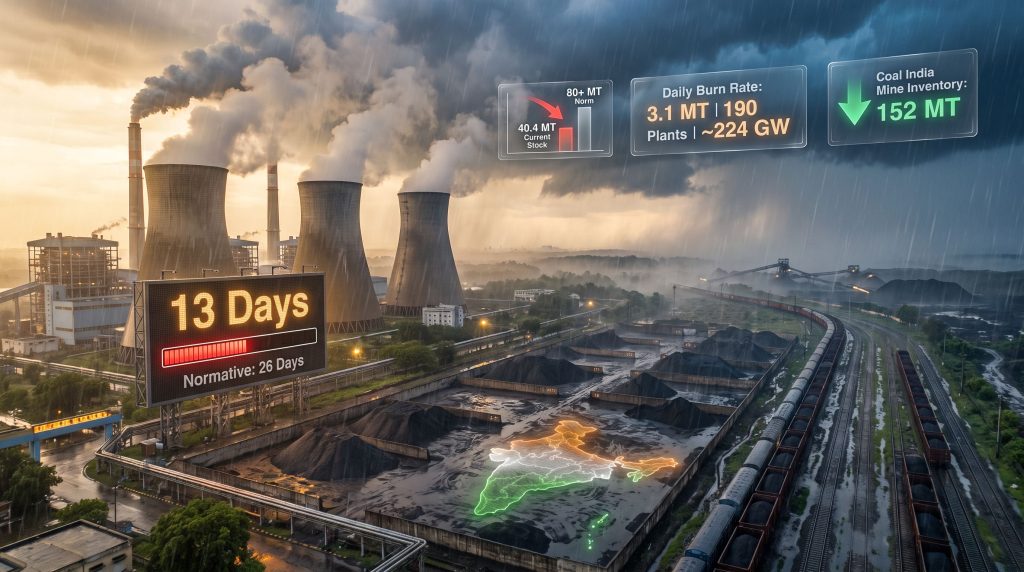
At an 85% plant load factor (PLF) across India's monitored thermal fleet, the daily coal requirement across 190 power plants with a combined installed capacity of approximately 224 GW works out to roughly 3.1 million tonnes per day. This figure is not static. It rises with demand, and India's electricity consumption has been climbing consistently, adding pressure to both the supply chain and the storage buffer.
The 85% PLF threshold is significant from a planning standpoint. It represents the generation rate at which coal consumption calculations are benchmarked. When actual grid demand pushes plants to operate closer to full capacity, coal burn accelerates, compressing the effective days of stock even when physical tonnage remains unchanged.
India's Thermal Coal Inventory Position: July 2026 Snapshot
Data drawn from the National Power Portal reveals the scale of the current shortfall with considerable precision. The figures paint a picture of a system operating at half its intended safety margin.
| Metric | Current Position | Normative Benchmark |
|---|---|---|
| Coal stock days at power stations | ~13 days | 26 days |
| Total coal stock at power plants | ~40.4 million tonnes | ~80+ MT (implied norm) |
| Daily coal requirement at 85% PLF | ~3.1 MT | — |
| Power plants under monitoring | 190 plants | — |
| Installed capacity under review | ~224 GW | — |
| Coal India mine-side inventory | ~152 MT | — |
The headline figure is stark: plant-side coal stocks represent exactly 50% of the normative requirement. With a daily burn rate of 3.1 MT and only 40.4 MT in reserve across all monitored facilities, the operational runway is approximately 13 days before plants would need to begin drawing down below even current critically low levels.
What makes this particularly consequential is the asymmetry between where coal sits and where it needs to be. Coal India Limited and associated mining entities are holding approximately 152 MT of coal inventory at mine-side locations as of July 2026. On paper, this represents more than 49 days of coal at current burn rates. In practice, however, mine-side inventory and plant-side availability are separated by a logistics infrastructure that cannot always move fast enough to close the gap. Furthermore, understanding the broader coal supply challenges facing the sector helps contextualise why this gap persists year after year.
The Logistics Gap: Why Mine Inventory Does Not Equal Plant Security
One of the least-discussed dimensions of India's recurring coal stock crisis is the distinction between aggregate national coal holdings and the operationally available supply at generation facilities. This gap is primarily a rail problem.
Indian Railways is the dominant carrier of coal from collieries to power stations. During monsoon season, the same weather patterns that disrupt mine operations also affect rail freight operations. Track flooding, reduced speed restrictions on vulnerable sections, and competing freight priorities can all slow dispatch rates precisely when plant-side inventories are under the greatest pressure.
The journey from mine to power station involves several intermediate steps that each carry their own delay risks:
- Coal extraction and sizing at the colliery
- Washing and beneficiation at washery facilities where applicable
- Loading at railway sidings adjacent to mines
- Rail transit over distances that can span hundreds of kilometres
- Unloading and stacking at plant-side coal yards
Each of these stages can experience bottlenecks simultaneously during peak monsoon conditions. A 152 MT mine inventory that cannot be converted into plant-side delivery at the required rate provides only theoretical comfort. The supply chain impacts of such logistical constraints extend well beyond India's borders, influencing international coal markets and procurement decisions globally.
The distinction between mine-side stock and plant-side availability is one of the most critical and commonly misunderstood elements of India's coal supply chain. Aggregate national inventory figures can mask localised shortfalls at specific facilities, particularly those located further from major colliery clusters.
Monsoon Season as a Structural Amplifier, Not an Unpredictable Shock
Perhaps the most striking aspect of India's power stations coal stock shortage is that it is entirely predictable. The monsoon arrives on roughly the same schedule each year. Mining operations in key coal-bearing states including Jharkhand, Odisha, and Chhattisgarh face documented disruptions during heavy rainfall periods. Power demand, driven by agricultural irrigation pumping and cooling loads in urban centres, peaks during summer months immediately before and during the early monsoon period.
The logical response to this pattern would be aggressive pre-monsoon stock build-up at plant level, ensuring facilities enter the June-to-September window with inventories well above the 26-day norm. This has historically proven difficult to execute consistently, for several reasons:
- Rail capacity competition: Pre-monsoon coal dispatch competes with other freight categories for scarce rail slots
- Storage infrastructure limitations: Many older power stations lack the coal yard capacity to hold significantly more than their current operational stock
- Financial constraints at distribution companies (discoms): State electricity distribution companies, many of which carry significant accumulated losses, sometimes limit advance coal procurement due to working capital pressures
- Coal quality variability: High-moisture coals dispatched from certain mines during wet season conditions have lower calorific values, requiring larger physical volumes to deliver equivalent energy output
This last point carries an important technical nuance. India's domestic coal, predominantly sourced from Gondwana-age formations, typically carries higher ash content and variable moisture compared to international benchmark grades. During monsoon operations, surface moisture in run-of-mine coal can increase significantly, reducing the effective energy content per tonne delivered. Plants burning higher-moisture coal must consequently consume greater physical volumes to maintain equivalent generation output, which accelerates the rate at which stored inventory is depleted.
Historical Patterns Confirm a Recurring Vulnerability
The current shortfall does not exist in isolation. India has cycled through comparable coal inventory stress events across multiple recent monsoon seasons.
| Period | Reported Stock Days | Severity Level | Primary Response Mechanism |
|---|---|---|---|
| 2021 Coal Crisis | Fewer than 4 days (some plants) | Critical | Emergency dispatch orders, imports |
| Mid-2022 Shortage | ~8-10 days (estimated) | Serious | Rail freight prioritisation |
| July 2026 (Current) | ~13 days | Below-norm | Joint ministerial monitoring panel |
The 2021 episode represented a genuinely acute emergency. Dozens of thermal plants simultaneously fell to single-digit day stocks, with some facilities reportedly holding fewer than four days of coal. The combination of a post-pandemic demand surge, uneven pre-monsoon stockpiling, and logistical strain produced a crisis that required emergency intervention, including expedited coal imports at elevated spot prices.
The 2026 position, while concerning, sits materially above those crisis-level thresholds. Thirteen days of stock provides a buffer that, if dispatch rates are maintained, allows time for corrective action. However, it leaves virtually no margin for unexpected disruption. Tracking the latest coal price update is therefore essential for utilities making emergency procurement decisions.
The next major ASX story will hit our subscribers first
Government Coordination Mechanisms and Their Limitations
India's response framework for coal supply management involves coordinated oversight across three central ministries: the Ministry of Power, the Ministry of Railways, and the Ministry of Coal. A joint panel drawn from these bodies monitors coal dispatch volumes and plant-side inventory levels on a daily basis, with data published through the National Power Portal.
What the Ministry Confirmed to Parliament
The Ministry of State for Coal and Mines confirmed to Parliament in July 2026 that thermal power plants were receiving sufficient coal to meet their daily operational requirements, and that the 152 MT mine-side inventory represented an available buffer. The cross-ministerial panel mechanism exists precisely to prevent the kind of coordination failure that can allow mine-side abundance to coexist with plant-side shortage.
However, monitoring and resolution are not synonymous. The panel can identify dispatch shortfalls in near-real-time, but its ability to accelerate physical coal movement is constrained by the same infrastructure bottlenecks that created the problem. Railway capacity cannot be conjured through ministerial directive; it must be planned and allocated well in advance. Furthermore, proposals such as the India coal trading exchange could, in future, improve price transparency and procurement efficiency across the sector.
Downstream Risks If the Buffer Erodes Further
Should coal dispatches slow materially during peak monsoon conditions, the consequences would not be distributed uniformly across the economy. The impact cascade would likely follow a predictable sequence:
- Industrial and commercial consumers are typically the first category subject to demand-side management when generation capacity comes under pressure
- Agricultural pumping loads present a particular complication during monsoon, as farmers require reliable power for irrigation operations during planting season, creating social and political dimensions to any load-shedding decision
- Imported coal as an emergency backstop remains available but carries significant cost implications; international thermal coal prices are denominated in US dollars, exposing Indian utilities to foreign exchange risk while adding to the financial strain on already-stressed distribution companies
The imported coal lever deserves specific attention. India has capacity to blend imported coal with domestic supply at coastal and some inland plants. However, the cost differential between domestic and imported coal can be substantial depending on prevailing seaborne thermal coal prices, and procuring emergency import volumes on short notice typically requires paying a premium above spot benchmark levels.
India's Coal Dependency in the Energy Transition Context
The structural persistence of India's coal stock challenges sits awkwardly alongside the country's stated renewable energy ambitions. India has committed to significant expansion of solar, wind, and other clean energy capacity. Yet with 224 GW of coal-fired installed capacity forming the backbone of grid stability, thermal power plants cannot simply be bypassed during periods of renewable generation variability.
Coal currently provides the dispatchable baseload that intermittent renewables cannot reliably replicate without large-scale battery storage, which remains years away from deployment at grid-relevant scale in India. This creates an energy transition in mining paradox: the urgency of renewable expansion is real, but so is the continued operational dependency on coal-fired generation during the transition period.
Every monsoon season effectively stress-tests the structural resilience of India's coal-dependent grid. Until storage technology and grid flexibility improve dramatically, thermal coal will remain the fuel of last resort when renewable generation underperforms relative to demand.
The recurring India power stations coal stock shortage is therefore not simply a logistics management problem. It is a structural signal about the limits of a grid architecture that remains heavily dependent on a single fuel source delivered through a logistics network with finite and weather-sensitive capacity. Resolving it sustainably will require investment in plant-side storage infrastructure, sustained improvement in rail freight capacity, and mechanisms that ensure pre-monsoon stock build-up targets are met before the window for preparation closes each year.
Disclaimer: This article presents analysis of publicly available data and structural observations regarding India's coal supply chain. It does not constitute investment advice. Figures relating to coal stock positions, generation capacity, and inventory levels reflect reported data as of July 2026 and are subject to change. Readers should consult primary government sources including the National Power Portal for the most current operational data.
Want to Track the Commodities Driving Global Energy Markets in Real Time?
Discovery Alert's proprietary Discovery IQ model delivers instant notifications on significant ASX mineral discoveries across more than 30 commodities — including coal and energy-related stocks — transforming complex market data into clear, actionable insights for both short-term traders and long-term investors. Explore how major mineral discoveries have historically generated substantial returns on Discovery Alert's discoveries page, and begin your 14-day free trial today to position yourself ahead of the market.