July 23, 2026
The Chokepoint No One Can Replace: Understanding the Strait of Hormuz Capacity Crisis
Global energy infrastructure has always carried a fundamental paradox at its core: the more efficient a system becomes, the more catastrophically fragile it grows. Nowhere is this more visible than in the Persian Gulf, where decades of optimised tanker routing have concentrated an extraordinary share of the world's daily oil supply through a single narrow waterway. Understanding oil price volatility trends is essential context here, as when that waterway becomes contested, the consequences ripple through every economy that depends on seaborne crude.
That is the situation playing out in real time across the Gulf in 2026. The onset of conflict involving Iran has transformed the Strait of Hormuz from a geographic feature into a geopolitical weapon, and the race to build alternative export infrastructure has accelerated accordingly. The scale of what is being attempted, and the structural limits of what can realistically be achieved, defines one of the most consequential infrastructure stories in modern energy history.
When big ASX news breaks, our subscribers know first
How Much Oil Actually Flows Through the Strait of Hormuz?
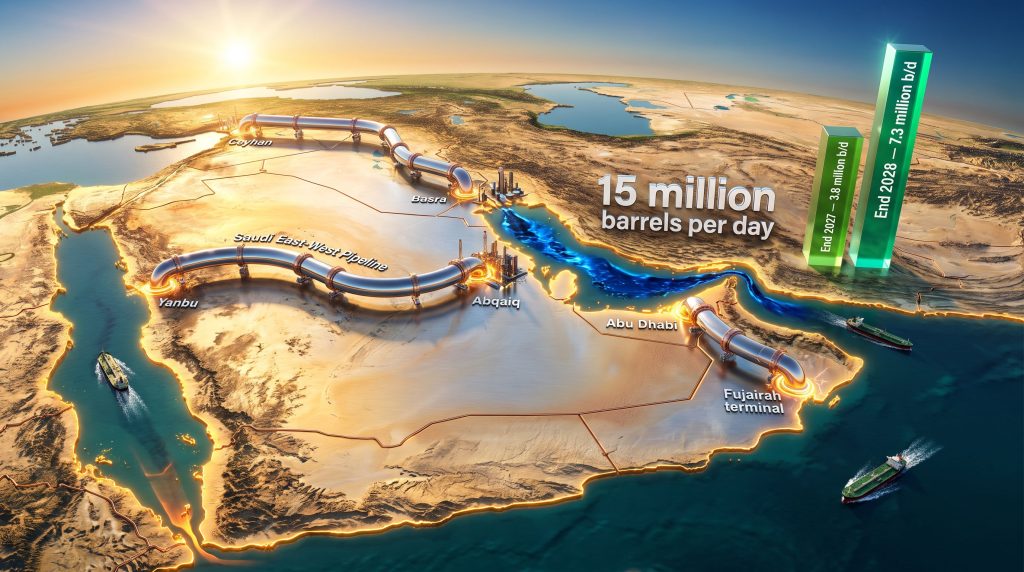
Before hostilities disrupted normal shipping patterns, approximately 15 million barrels of Persian Gulf crude oil moved through the Strait of Hormuz every single day. That figure is difficult to contextualise without framing: it represents a volume so large that no existing alternative corridor, or even combination of corridors, can absorb it under any realistic short-term scenario.
The strait's physical geography explains why it became so dominant. It is the only maritime exit point from the Persian Gulf, and it borders Iran's southern coastline for much of its length. That geographic fact gives Tehran inherent and asymmetric leverage over all tanker traffic, regardless of which nation's oil is being transported.
The threat does not even require active military interdiction. The credible possibility of disruption is itself sufficient to reshape global shipping insurance premiums, tanker routing decisions, and long-term infrastructure investment calculations. Furthermore, OPEC's global oil influence compounds this vulnerability, as producer decisions interact directly with the chokepoint's strategic importance.
Why Hormuz Creates Systemic Risk Across Multiple Economies Simultaneously
The strait's importance extends beyond crude oil. Before the conflict, roughly one-fifth of the world's total liquefied natural gas supply also transited Hormuz, with Qatar accounting for the dominant share of that LNG volume. This dual dependency, covering both oil and gas, means that a sustained closure threatens the energy supply chains of dozens of importing nations simultaneously.
For Gulf producers themselves, the fiscal exposure is acute:
- Iraq derives approximately 90% of its national government revenues from oil sales, making uninterrupted export access an existential budget requirement
- Saudi Arabia, despite having more diversified bypass options, still relied on Hormuz for a meaningful share of its total export volume before the East-West Pipeline reached full utilisation
- Smaller Gulf exporters with limited bypass infrastructure face the most acute near-term vulnerability
- The concentration of export dependency across multiple sovereign economies creates systemic fragility that bilateral agreements alone cannot resolve
Which Countries Can Actually Bypass the Strait of Hormuz?
The ability to redirect oil away from Hormuz varies dramatically across Gulf producers. The following table maps current alternative route availability and estimated throughput capacity:
| Country | Bypass Route | Destination | Estimated Capacity |
|---|---|---|---|
| Saudi Arabia | East-West Pipeline | Yanbu (Red Sea) | ~5 million b/d nameplate |
| UAE | Abu Dhabi Crude Oil Pipeline | Fujairah (Gulf of Oman) | ~1.5 million b/d |
| Iraq | Northern Export Route | Ceyhan, Turkey (Mediterranean) | Limited / partial |
| Iran | Goreh-Jask Pipeline | Jask Terminal (Gulf of Oman) | Partial domestic use |
| Oman | Direct Gulf of Oman access | N/A | Structurally insulated |
Oman's structural insulation from Hormuz disruption is a lesser-known dimension of Gulf energy geography. Because Oman's coastline extends directly onto the Gulf of Oman without transiting the strait, its exports are naturally bypassed from the chokepoint. This gives Oman a quietly significant geopolitical advantage during any Hormuz disruption scenario.
The Critical Capacity Gap That No One Can Bridge Quickly
Despite the presence of multiple bypass corridors, the arithmetic is sobering. Combined available diversion capacity in a disruption scenario is currently estimated at approximately 2.6 million to 5.5 million barrels per day under full utilisation of existing Saudi and UAE pipeline infrastructure. Against a pre-disruption Hormuz throughput of 15 million barrels per day, the shortfall is enormous.
Featured Snippet Answer: Can Mideast oil producers bypass the Strait of Hormuz entirely? No. Saudi Arabia and the UAE have the most developed alternative routes, but their combined nameplate capacity covers only a fraction of total Hormuz throughput. Iraq and Iran have narrower alternatives, and no existing infrastructure can replicate strait volume at scale.
Saudi Arabia's East-West Pipeline: The Region's Most Important Bypass Asset
The most consequential single piece of bypass infrastructure in the Gulf predates the current crisis by four decades. Saudi Arabia's East-West Pipeline was constructed during the 1980s Iran-Iraq War, purpose-built to hedge against exactly the kind of Hormuz disruption now unfolding. Its existence today reflects a strategic foresight that other Gulf producers did not replicate at the same scale.
The pipeline carries crude from the massive Abqaiq processing facility across the Arabian Peninsula to Yanbu on the Red Sea coast. From Yanbu, tankers can proceed either south toward the Arabian Sea or north through the Suez Canal. The pipeline is now operating near full capacity following the Hormuz disruption, validating the original strategic rationale behind its construction.
What is less widely appreciated is the degree to which Abqaiq functions as a system-critical processing node. The facility handles a disproportionate share of Saudi Arabia's crude stabilisation and processing functions. Any disruption to Abqaiq, whether from pipeline damage or external attack, would constrain East-West throughput regardless of pipeline capacity. This interdependency between processing infrastructure and export routing is a vulnerability that nameplate pipeline capacity figures alone do not capture.
What Infrastructure Is Being Built to Reduce Hormuz Dependency?
At least seven significant pipeline and port infrastructure projects are currently under construction, in advanced planning, or under active discussion across the Gulf region. As Reuters reports, this represents a structural pivot from contingency planning toward proactive capital deployment at a scale rarely seen outside wartime.
Project 1: Abu Dhabi's USD $3 Billion Parallel Pipeline to Fujairah
The most advanced new construction project is Abu Dhabi's USD $3 billion, 300-kilometre pipeline running parallel to the existing Abu Dhabi Crude Oil Pipeline toward Fujairah on the Gulf of Oman.
Key project parameters:
- Investment value: USD $3 billion
- Length: 300 kilometres
- Capacity addition: More than 1.2 million barrels per day of incremental Fujairah export capacity
- Construction status: Approximately 50% complete as of mid-2026
- Target completion: Early 2027, though mid-2027 is considered more realistic given port expansion requirements at Fujairah
The project predates the current conflict but has been dramatically accelerated in response to the Hormuz disruption. According to analysis from Kpler, the ambitious construction timeline has only become achievable in the context of the Hormuz blockade creating urgent political and commercial imperatives. The port expansion requirement at Fujairah is a frequently underestimated constraint. Adding pipeline capacity without corresponding berth and storage capacity at the receiving terminal creates a bottleneck that limits effective throughput below nameplate capacity.
Project 2: Iraq's Basra-to-Ceyhan Pipeline Corridor
Iraq currently exports more than 3 million barrels per day through the Basra oil terminal, all of which transits Hormuz. The proposed Basra-to-Ceyhan pipeline would connect southern Iraqi fields directly to Ceyhan on Turkey's Mediterranean coast, eliminating Hormuz exposure for a significant share of Iraq's export base.
A branch extension toward the Mediterranean port of Baniyas in Syria is also under active discussion, with potential throughput of up to 2 million barrels per day through that corridor. The US State Department has described the Baniyas route as a critical energy corridor, and Iraqi officials are pursuing related projects in partnership with US energy companies.
Project 3: Iraq-Jordan Pipeline to Aqaba
A long-discussed pipeline from Basra to Aqaba on Jordan's Red Sea coast has been revived with renewed urgency. From Aqaba, oil would access both Asian and European markets through the Red Sea and Suez Canal respectively. Bilateral discussions between Iraq and Jordan have gained meaningful momentum in the current geopolitical environment. However, the oil markets under trade war pressures add a further layer of complexity to these negotiations, as competing economic interests complicate alignment between transit nations.
What Are Goldman Sachs' Projections for New Bypass Capacity?
Goldman Sachs analysts have modelled the cumulative impact of current and planned pipeline projects, producing a phased capacity trajectory through 2028:
| Timeline | New Bypass Capacity Added | Cumulative Impact |
|---|---|---|
| End of 2027 | ~3.8 million barrels per day | Partial insulation of Gulf exports |
| End of 2028 | ~7.3 million barrels per day | ~60% of prewar Gulf exports insulated |
Strategic Implication: If Goldman Sachs projections hold, approximately 60% of the Gulf's total prewar export volume of 23 million barrels per day could be structurally insulated from a Hormuz closure by the end of 2028. That would represent a fundamental reconfiguration of global energy supply chain architecture, though it would still leave a substantial residual volume dependent on the strait.
The 40% not insulated by 2028 is the figure that rarely receives adequate analytical attention. Even under the most optimistic infrastructure build-out scenario, hundreds of millions of barrels of annual Gulf oil supply would remain exposed to Hormuz disruption beyond the end of the decade.
The next major ASX story will hit our subscribers first
Are Alternative Routes Actually Safe? The Secondary Risk Landscape
Diverting oil flows away from Hormuz does not eliminate supply disruption risk. It redistributes that risk across different geographic corridors, each carrying distinct and often underappreciated threat profiles.
The Houthi Threat to Red Sea Shipping Lanes
Iran-backed Houthi rebels in Yemen have demonstrated a sustained capability to disrupt Red Sea shipping, including a stated blockade on Saudi-linked vessels transiting the Red Sea. Critically, Saudi Arabia's East-West Pipeline itself is not immune from attack: a Houthi drone strike in May 2019 successfully shut down the pipeline, demonstrating that overland infrastructure carries its own vulnerability profile.
Any incremental oil volumes piped to Yanbu and loaded onto tankers face exposure to Houthi interdiction at the Bab el-Mandeb Strait, the narrow passage connecting the Red Sea to the Gulf of Aden. This creates a scenario in which Mideast oil producers bypass the Strait of Hormuz only to encounter a secondary chokepoint further down the supply chain.
The Suez Canal's Structural Tanker Limitation
A technical constraint that is frequently overlooked in discussions of Red Sea routing: the Suez Canal cannot accommodate Very Large Crude Carriers (VLCCs), the industry's largest tanker class capable of carrying up to 2 million barrels per vessel.
VLCCs represent the most cost-efficient option for long-haul crude transport to Asian markets. Their exclusion from the Suez route means that ships unable to use the canal must route around the Cape of Good Hope at Africa's southern tip, adding substantial voyage time and freight cost to every cargo. For Asian refiners who previously relied on efficient Hormuz-routed Gulf crude, this routing shift represents a structural increase in landed crude costs with downstream implications for refinery margins and fuel pricing.
Iranian Paramilitary Reach Beyond Hormuz
Even pipeline infrastructure located well beyond Iran's immediate geographic sphere is not categorically insulated from disruption. Iran's Islamic Revolutionary Guard Corps and affiliated regional proxy networks maintain a demonstrated capability to strike energy infrastructure across the broader Middle East. The 2019 Abqaiq attack, which temporarily knocked out approximately 5% of global daily oil supply in a single strike, illustrated both the vulnerability and the speed with which such disruptions can materialise. In addition, the broader geopolitical trade disruptions now reshaping global commerce mean that energy infrastructure operates within an increasingly unstable strategic environment.
The Unresolved LNG Problem
While enormous capital and political energy is directed toward oil bypass infrastructure, a parallel and arguably more structurally complex problem remains largely unaddressed. Approximately one-fifth of the world's total LNG supply transited the Strait of Hormuz before the conflict, with Qatar as the dominant source. Consequently, the global LNG supply outlook has been fundamentally complicated by these disruptions in ways that pipeline investment alone cannot address.
Unlike crude oil, LNG cannot be redirected through overland pipelines with comparable flexibility. The cryogenic requirements of liquefied gas transport, combined with the specialised nature of LNG terminal infrastructure, make ad hoc rerouting far more technically constrained than crude oil diversion.
Residual Vulnerability: No credible large-scale LNG bypass infrastructure is currently under construction or in advanced planning. This means the global LNG market retains a significant structural exposure to Hormuz disruption that the current pipeline investment surge does not address. LNG-importing nations in Europe and Asia face a risk profile that is structurally different from, and in some ways more difficult to hedge than, oil supply disruption.
The Asian Import Geography Problem
A structural complication for the world's largest oil-importing nations deserves deeper examination than it typically receives. Pipelines routing Gulf crude to Mediterranean terminals such as Ceyhan and Baniyas send oil in the opposite geographic direction relative to Asian demand centres.
Oil reaching Mediterranean ports must then travel around the Cape of Good Hope to reach Asian buyers, a substantially longer and more expensive voyage than the direct Hormuz-to-Asia routing that previously prevailed. This geographic inefficiency is not merely a theoretical concern. It represents a measurable and persistent increase in the cost of crude delivery to the world's fastest-growing oil import markets.
For Asian refiners operating on thin margins, the shift from short-haul Hormuz-routed imports to Cape of Good Hope-routed Mediterranean crude fundamentally changes the economics of crude procurement. Refineries optimised around a specific crude slate and a specific landed cost structure face both pricing pressure and potential feedstock adjustment requirements. According to The Guardian, this reconfiguration of trade flows is expected to persist even if a diplomatic resolution to the Hormuz situation is eventually reached.
Strategic Scenario Analysis: Three Pathways to a Post-Hormuz Gulf Energy Architecture
Scenario 1: Partial Bypass Success by 2027
- Abu Dhabi's Fujairah pipeline reaches completion, adding 1.2 million b/d of Gulf of Oman capacity
- Combined Saudi-UAE bypass capacity reaches approximately 6 to 7 million b/d
- Roughly 40 to 45% of prewar Hormuz oil volumes can be redirected
- Oil markets remain structurally tight with persistent price premiums for non-Hormuz-routed crude
Scenario 2: Full Pipeline Build-Out by 2028 to 2029
- Iraq's Basra-Ceyhan corridor becomes operational, adding 2 or more million b/d of Mediterranean-routed capacity
- Goldman Sachs' 7.3 million b/d projection is realised
- Approximately 60% of Gulf exports are insulated from Hormuz closure
- Asian buyers face structurally higher landed crude costs due to longer routing requirements
Scenario 3: Secondary Chokepoint Escalation
- Houthi interdiction of Red Sea shipping intensifies, neutralising Saudi Red Sea bypass capacity
- Bab el-Mandeb effectively becomes a secondary functional chokepoint
- Net bypass capacity available to global markets is materially reduced despite infrastructure investment
- Oil price volatility intensifies and energy security planning shifts focus toward Cape of Good Hope routing as a primary rather than contingency option
Frequently Asked Questions: Mideast Oil Producers Bypass Strait of Hormuz
What is the Strait of Hormuz and why does it matter for global oil supply?
The Strait of Hormuz is a narrow waterway between the Persian Gulf and the Gulf of Oman, bordered by Iran to the north and Oman and the UAE to the south. It functions as the world's most consequential oil transit chokepoint, through which approximately 15 million barrels of crude oil flowed daily before the current Iran conflict. It also carried roughly one-fifth of global LNG supply.
Which Middle Eastern countries have the best alternatives to the Strait of Hormuz?
Saudi Arabia and the UAE hold the most developed bypass capacity. Saudi Arabia's East-West Pipeline routes crude to Yanbu on the Red Sea, while the UAE's Abu Dhabi Crude Oil Pipeline delivers crude to Fujairah on the Gulf of Oman. Oman is structurally less exposed because its exports do not rely on the strait. Iraq and Iran have substantially more limited bypass options.
How much oil can be diverted away from the Strait of Hormuz right now?
Current combined bypass capacity across Saudi Arabia and the UAE is estimated at approximately 3.5 to 5.5 million barrels per day under full utilisation. Both pipelines are now operating near full capacity against a pre-disruption Hormuz flow of 15 million barrels per day.
When will new bypass pipeline capacity be ready?
Abu Dhabi's new parallel pipeline to Fujairah, a USD $3 billion project, is approximately 50% complete and targeted for early to mid-2027 completion. Iraq's Basra-to-Ceyhan pipeline represents a longer-horizon project. Goldman Sachs projects total new bypass capacity of 3.8 million b/d by end-2027 and 7.3 million b/d by end-2028.
Is Qatar's LNG also affected by the Hormuz situation?
Yes. Approximately one-fifth of global LNG supply transited Hormuz before the conflict, with Qatar as the primary source. Unlike crude oil, LNG cannot be easily rerouted through overland pipelines, and no large-scale LNG bypass infrastructure is currently under construction. This remains a structurally unresolved vulnerability in global energy supply chains.
Are alternative oil routes safe from attack?
No route is fully secure. Red Sea shipping faces interdiction risk from Houthi rebels, who previously struck Saudi pipeline infrastructure and disrupted tanker traffic at Bab el-Mandeb. Mediterranean-routed pipelines face exposure from Iranian-aligned proxy networks. The bypass strategy is best understood as risk redistribution rather than risk elimination.
Key Takeaways: The New Architecture of Gulf Energy Export
- The Hormuz disruption has catalysed the most significant restructuring of Gulf energy export infrastructure in at least four decades
- Saudi Arabia and the UAE hold the region's most developed bypass capacity, but combined throughput remains well below pre-disruption Hormuz volumes
- At least seven major pipeline and port projects are underway, with Goldman Sachs projecting 7.3 million b/d of new bypass capacity by end-2028
- Alternative routes carry their own distinct geopolitical risk profiles across the Red Sea, Bab el-Mandeb, and Mediterranean corridors
- The LNG bypass problem remains structurally unresolved, representing the most significant residual vulnerability in global energy markets
- Even the most optimistic 2028 infrastructure scenario leaves roughly 40% of prewar Gulf export volumes still exposed to Hormuz disruption
- Port terminal capacity constraints, particularly at Fujairah, represent a bottleneck that nameplate pipeline figures alone do not capture
- For Asian refiners, the geographic mismatch between Mediterranean export terminals and Pacific demand centres creates a structural and persistent increase in landed crude costs that will reshape refinery economics across the region
Disclaimer: This article is intended for informational purposes only and does not constitute financial or investment advice. Projections, timelines, and capacity figures referenced in this article reflect analyst estimates and modelling at the time of writing and are subject to change based on geopolitical developments, construction progress, and market conditions. Readers should conduct their own due diligence before making any investment or commercial decisions based on the information presented here.
Want to Capitalise on the Next Major Resource Discovery Before the Market Moves?
The geopolitical forces reshaping global energy infrastructure are creating significant ripple effects across commodity markets worldwide — and Discovery Alert's proprietary Discovery IQ model scans the ASX daily to identify significant mineral discoveries the moment they are announced, delivering real-time alerts that turn complex resource data into actionable investment opportunities. Explore historic discoveries and their market-defining returns, then begin your 14-day free trial to ensure you are positioned ahead of the broader market.