June 13, 2026
The Infrastructure Bottleneck Quietly Undermining Africa's Electric Vehicle Revolution
Picture a continent that supplies the raw materials powering the world's most transformative energy transition, yet struggles to charge a single electric vehicle beyond its major city limits. This is not a hypothetical scenario. It is the operational reality facing Africa's growing EV fleet today, and Africa EV charging infrastructure represents one of the most consequential infrastructure mismatches of the current decade.
The global EV market posted remarkable momentum in 2023, with sales climbing 35% year-on-year and an additional 3.5 million units finding buyers worldwide. Africa participated in this wave, with electric car sales on the continent more than doubling to nearly 11,000 units in 2024, according to the United Nations Economic Commission for Africa's 2026 Economic Report on Africa. Yet behind that headline growth sits a charging network so thin it borders on non-functional at the continental scale.
Understanding why this gap exists, what it costs the continent economically, and how specific nations are beginning to close it requires looking beyond the sales figures into the structural mechanics of infrastructure deployment, financing, and industrial policy.
When big ASX news breaks, our subscribers know first
Quantifying Africa's EV Charging Infrastructure Deficit
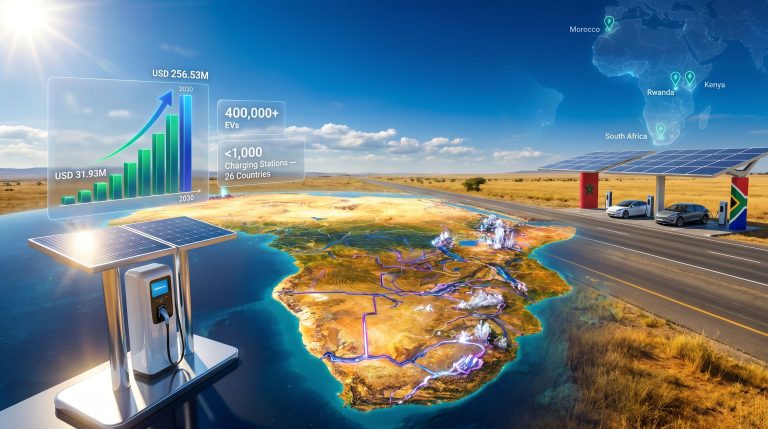
The numbers are stark when placed alongside global comparisons. As of early 2025, fewer than 1,000 public EV charging stations were operational across 26 African countries, serving a fleet already exceeding 400,000 electric vehicles. That ratio makes routine long-distance EV travel practically impossible across most of the continent.
The international context makes the disparity even more confronting:
| Region | Public Charging Infrastructure | Reference Period |
|---|---|---|
| Africa | Under 1,000 stations (26 nations) | Early 2025 |
| Europe | 600,000+ public charging points | End of 2023 |
| United States | 192,000+ publicly accessible ports | 2024 |
| China | ~70% of global light-vehicle charging stock | 2023 |
Europe is projecting further expansion to 2.7 million public charging points by 2035, while the United States was installing approximately 1,000 new stations every single week throughout 2024. Africa has not yet approached that pace at any national level, let alone continental scale.
The economic cost of this underinvestment is measurable. Research cited by UNECA indicates that each EV deployed generates roughly $12,000 in lifetime fuel savings, $3,500 in benefits for electricity grid users, and approximately $7,000 in broader economic gains. None of that value can be fully captured without accessible, reliable charging infrastructure enabling real-world vehicle utilisation.
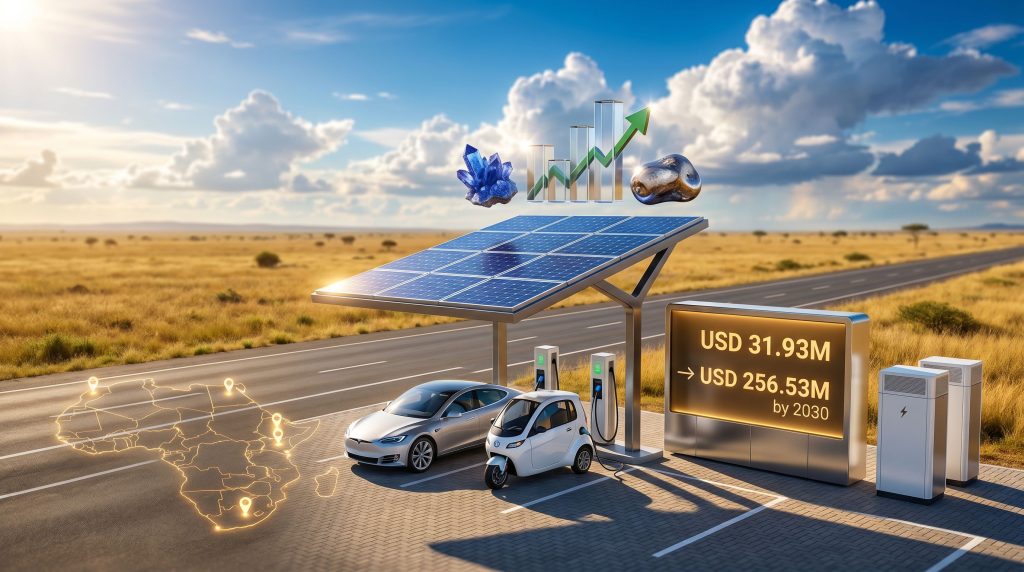
Africa's EV charging market was valued at USD 31.93 million in 2022. Forecasts project this will reach USD 256.53 million by 2030, representing more than eightfold growth in under a decade. The broader African EV market is expected to hit $314 million by 2029, growing at an annual rate of 10.6%. The commercial opportunity is real. The infrastructure to capture it remains severely underdeveloped.
Furthermore, the battery metals investment landscape globally is evolving rapidly, adding further urgency to Africa's need to build domestic charging capacity before it falls further behind.
The Four Structural Barriers Blocking Charging Network Expansion
Grid Reliability: The Foundation Problem
Fast-charging and ultra-fast DC chargers require stable, high-capacity grid connections that much of Sub-Saharan Africa cannot consistently guarantee. Where grid reliability is uncertain, commercial charging operators face a business case that collapses before a single cable is laid. This creates a structural catch-22: the regions that most need charging investment are precisely those where the grid conditions make private operators most reluctant to commit capital.
Off-grid and solar-integrated charging architectures are emerging as the practical response to this reality, particularly along rural transport corridors and in peri-urban zones where centralised grid extension remains years away.
Capital Intensity and the Fast-Charging Financing Gap
DC fast chargers carry substantially higher upfront costs than AC slow chargers, creating a financing barrier that deters private operators in markets where EV penetration remains modest. AC slow chargers offer a lower-cost entry point but are fundamentally insufficient for enabling intercity EV travel at scale.
Development finance institutions are beginning to bridge this gap with meaningful results. South Africa's Zero Carbon Charge secured funding from the Development Bank of Southern Africa (DBSA) to deploy 120 charging stations across major national routes, embedding solar microgrids and battery storage into each site to reduce grid dependency and improve operational resilience. EV charging infrastructure in Africa is increasingly being shaped by such innovative financing models.
Regulatory Fragmentation Across 54 Markets
Of the 26 African countries surveyed by UNECA, only 28% had established formal national EV targets. Some nations, including South Africa, Nigeria, and Ethiopia, have adopted legally binding emissions and electrification measures. Many others rely on aspirational targets or isolated pilot programmes that offer insufficient certainty to attract private infrastructure investment.
The absence of harmonised standards across Africa's 54 jurisdictions creates a fragmentation problem that limits corridor-level charging network development. An EV driver attempting to travel across national borders encounters not just physical infrastructure gaps but incompatible regulatory environments that complicate cross-border operator licensing and equipment standardisation.
Low Vehicle Ownership Rates Suppressing Commercial Demand Signals
UNECA's analysis found that 76% of African countries in the lower-maturity tier have vehicle ownership rates too low to generate the commercial incentive structures needed to attract private charging investment ahead of demand. Without a critical mass of EVs on the road, the financial return on charging infrastructure extends beyond acceptable thresholds for most private developers, creating a classic chicken-and-egg dynamic that requires external intervention to break.
A Three-Tier Continental Market: One Strategy Does Not Fit All
UNECA's market maturity classification provides a useful framework for understanding why a single continental approach to Africa EV charging infrastructure would be inadequate.
| Market Tier | Example Nations | Primary EV Focus | Core Constraint |
|---|---|---|---|
| Emulators | Morocco, South Africa, Mauritius, Seychelles | Passenger EVs, full market development | Charging density, financing access |
| Innovators | Kenya, Rwanda | Electric two- and three-wheelers | Corridor infrastructure, payment interoperability |
| Laggards | Majority of Sub-Saharan Africa | Early pilot programmes | Policy frameworks, vehicle ownership rates |
Each tier requires a fundamentally different intervention logic:
-
Emulator markets need dense urban charging networks and long-distance corridor infrastructure to convert growing EV fleets into high-utilisation assets that generate meaningful economic returns.
-
Innovator markets require standardised charging points compatible with two- and three-wheeler formats, deeply integrated with mobile payment systems and the fintech ecosystems that already underpin financial inclusion in these economies.
-
Laggard markets benefit most from regulatory clarity and demonstration-scale projects capable of attracting development finance before commercial operators are willing to commit.
Country Profiles: Where Africa's Charging Progress Is Actually Happening
Morocco: Policy Depth Driving Market Leadership
Morocco has built the most sophisticated EV ecosystem on the continent through a combination of industrial capacity, consumer incentives, and long-range policy planning. In 2023, electric vehicles represented 4.5% of Morocco's total automotive market, with 7,165 units sold from a total of 161,504 vehicles, a 25.3% year-on-year increase.
The Moroccan EV market is forecast to grow at a 10.8% compound annual rate, reaching $163.4 million by 2029. Morocco's National Electric Mobility Development Plan 2021–2030 targets 150,000 EVs on Moroccan roads by 2030, supported by:
-
Full customs duty and VAT exemptions on EV imports
-
Consumer purchase incentives designed to lower the upfront cost barrier
-
Preferential nighttime electricity tariffs to encourage home charging adoption
Morocco's industrial base amplifies these consumer-facing measures. The country has annual vehicle production capacity of approximately 700,000 units, including 70,000 electric vehicles. The automotive sector employs more than 220,000 people and hosts 11 of the world's 20 largest automakers within the Tanger Med industrial zone. The Oxford Business Group estimated the automotive sector accounted for 19% of GDP in 2019, underlining the depth of Morocco's industrial position in this space.
Critically, Morocco's EV transition carries significant climate implications beyond market economics. Modelling suggests that increased EV adoption could reduce emissions to around 2.6 million tonnes of CO2 equivalent annually by 2050, compared with approximately 30 million tonnes under a business-as-usual trajectory, while cutting hydrocarbon demand by roughly 2 billion litres of fuel per year.
South Africa: The Most Active Charging Deployment Market
South Africa leads the continent in charging station count, with more than 300 charging locations publicly mapped. Mercedes-Benz committed R40 million to South African charging station expansion, while Zero Carbon Charge's 120-site corridor rollout along routes including the strategically critical Johannesburg-Durban N3 highway represents the continent's most advanced example of solar-powered charging infrastructure at operational scale.
The Free State provincial government partnered with Zero Carbon Charge to extend corridor infrastructure coverage to both passenger vehicles and electric freight operators, demonstrating that public-private collaboration can unlock deployment at a pace that neither sector achieves independently. In addition, EVs transforming mining operations in South Africa are creating secondary demand for reliable charging infrastructure beyond urban centres.
Ethiopia: The World's Boldest Electrification Commitment
Ethiopia occupies a unique position in the global EV story. In 2024, it became the first country in the world to ban imports of internal-combustion passenger vehicles, a policy signal with no precedent in any other national market. Domestic manufacturing capacity now spans:
-
1,350 passenger cars per year
-
700 three-wheelers per year
-
350 minibuses per year
-
100 buses per year
-
100 four-wheel mini-cars per year
Production utilisation remains well below 50% across most segments, constrained by weak domestic demand and operational inefficiencies. This underutilisation underscores a critical insight: policy ambition without parallel charging infrastructure investment cannot unlock the consumer confidence needed to drive fleet growth. Ethiopia's manufacturing capacity sits largely idle while the charging network remains insufficient to reassure potential buyers.
Kenya and Rwanda: The Fintech-Enabled Two-Wheeler Model
Both countries are classified by UNECA as Innovators, pioneering electric two-wheelers and three-wheelers rather than conventional passenger cars. Their strong fintech ecosystems enable mobile-payment-integrated charging and pay-as-you-go EV financing models that bypass traditional banking barriers entirely. For last-mile delivery operators and commercial motorcycle riders, the EV economics are already competitive with petrol alternatives, making these markets the fastest path to meaningful electric fleet volumes on the continent.
Solar-Powered Charging: Africa's Most Rational Infrastructure Strategy
The conventional charging deployment model — anchoring infrastructure to centralised grid connections — is fundamentally misaligned with Africa's energy geography. Solar-integrated charging with co-located battery storage is not a workaround. In many African contexts, it is the most economically rational architecture available.
Decoupling charging infrastructure from grid dependency reduces both capital risk and operational vulnerability simultaneously, while aligning EV infrastructure investment with Africa's parallel renewable energy transition agenda.
The Zero Carbon Charge N3 corridor project in South Africa is the most documented operational example of this model, combining solar generation, battery storage, and multi-vehicle charging capability to deliver 24-hour service without grid reliance. This model also creates co-investment opportunities that span both the energy and transport sectors, potentially unlocking blended finance structures that neither sector could attract independently.
Urban charging networks alone cannot enable the intercity EV travel necessary to drive mass adoption. Corridor infrastructure along major freight and passenger routes, powered by solar microgrids, can unlock intercity EV viability on a timeline that does not depend on national grid upgrade programmes measured in decades. BMW's charging stations in Africa and similar private-sector commitments are helping to demonstrate this solar-integrated model at commercial scale.
The next major ASX story will hit our subscribers first
The Critical Minerals Paradox: Exporting the Inputs, Importing the Technology
Africa holds substantial reserves of cobalt (concentrated particularly in the Democratic Republic of Congo), manganese, and lithium, all foundational inputs for EV battery manufacturing. Despite this resource endowment, the continent remains largely absent from battery cell production, EV component manufacturing, and charging equipment fabrication.
This creates a structural paradox with direct implications for Africa EV charging infrastructure economics: African nations export the raw materials that underpin the global EV industry, then import the finished charging equipment and battery systems at prices that reflect the full value-added processing they did not capture. The broader relationship between critical minerals and energy transition goals makes this paradox even more consequential for the continent's long-term development.
UNECA's 2026 Economic Report explicitly frames this as a strategic opportunity rather than simply a competitive disadvantage. Moving from raw material extraction into battery-grade processing, cell manufacturing, and electrical component production would simultaneously strengthen domestic EV supply chains and reduce the import costs that currently constrain charging infrastructure deployment economics.
However, global cobalt production dynamics are shifting, and African nations face a narrowing window to position themselves as value-added processors rather than commodity exporters. Consequently, policy frameworks that link mineral revenue to domestic industrial investment are becoming increasingly urgent.
The charging infrastructure deficit and the critical minerals export dependency are two expressions of the same underlying structural challenge. Resolving either without addressing the other leaves Africa permanently dependent on imported technology to service a market built on its own exported resources.
Advances in battery recycling breakthroughs globally are, furthermore, adding a new dimension to this equation, as African nations could potentially develop secondary processing capacity from recycled battery materials alongside primary mineral extraction.
A Five-Lever Framework for Accelerating Africa's Charging Network
Based on the patterns emerging across leading markets and the structural analysis provided by UNECA, five discrete intervention levers can meaningfully accelerate Africa EV charging infrastructure development:
-
Regulatory harmonisation across borders, developing continent-wide charging standards and interoperability protocols to enable cross-border corridor networks that match actual vehicle travel patterns.
-
Development finance mobilisation at scale, expanding DBSA-style concessional financing models to additional countries and transport corridors to reduce the private-sector risk premium at the deployment frontier.
-
Solar-storage integration requirements at new charging sites, reducing grid dependency and improving energy resilience while aligning charging investment with renewable energy transition goals.
-
Local manufacturing investment channelling critical minerals revenue into battery cell and charging equipment production, directly reducing the import cost burden that currently inflates charging infrastructure deployment costs.
-
Demand-side activation through consumer incentive programmes modelled on Morocco's framework, accelerating EV fleet growth to improve the commercial case for private charging operators who currently cannot justify investment ahead of demand.
Frequently Asked Questions: Africa EV Charging Infrastructure
How many EV charging stations are operating across Africa?
As of early 2025, fewer than 1,000 public EV charging stations were operational across 26 African countries, serving a fleet exceeding 400,000 electric vehicles. South Africa holds the highest station count, with more than 300 publicly mapped charging locations.
Which African country leads in EV charging infrastructure?
Morocco and South Africa lead by different measures. Morocco leads in policy depth, market penetration, and industrial capacity. South Africa leads in deployed charging station count and active corridor infrastructure development, supported by both private investment and development bank financing.
What is Africa's EV charging market worth?
The market was valued at USD 31.93 million in 2022 and is projected to reach USD 256.53 million by 2030, representing more than eightfold growth over eight years.
Why does Africa have so little charging infrastructure despite growing EV adoption?
The primary constraints are grid reliability challenges across Sub-Saharan Africa, high upfront capital costs for fast-charging equipment, fragmented regulatory environments spanning 54 separate jurisdictions, and low vehicle ownership rates that reduce the commercial incentive to invest ahead of demand.
Is solar-powered EV charging a viable solution for Africa?
Yes. Solar-integrated charging with battery storage co-location is increasingly recognised as the most practical and economically rational deployment model for Africa, particularly along rural corridors and in areas with unreliable grid supply. South Africa's N3 corridor project is the continent's most advanced operational example.
What minerals does Africa produce that are essential for EV batteries?
Africa holds significant reserves of cobalt (most notably in the DRC), manganese, and lithium, all critical inputs for EV battery manufacturing. Despite this resource base, the continent currently exports the majority of these materials as raw or minimally processed commodities, rather than capturing value through domestic battery-grade processing or cell production.
Want to Know Which ASX Miners Are Supplying the Minerals Powering Africa's EV Revolution?
Discovery Alert's proprietary Discovery IQ model scans ASX announcements in real time, instantly identifying significant mineral discoveries in cobalt, lithium, manganese, and the other battery metals underpinning the global EV transition — explore historic discovery returns on Discovery Alert's discoveries page to see what early positioning in major finds has delivered, then begin your 14-day free trial at Discovery Alert to ensure you never miss the next transformative ASX mineral announcement.