
June 12, 2026
The Hidden Mechanics Behind European Long Steel's Second-Half Reckoning
Steel markets rarely move in straight lines. The history of long steel pricing in Europe is one of cyclical whipsaws driven by energy shocks, trade policy shifts, and the perpetual mismatch between what buyers expect and what the underlying economy can absorb. The pattern playing out across European rebar and wire rod markets in mid-2026 is a clear example of European longs steel weaker second half dynamics, following a familiar script with several compounding variables that make this inflection point particularly instructive.
What makes this moment analytically interesting is not simply that prices are softening, but why they rose so sharply in the first place, and why the foundations of that rally were always more fragile than headline figures suggested.
When big ASX news breaks, our subscribers know first
Anatomy of a Supply-Shock Rally: What Actually Drove H1 2026 Long Steel Prices
The sharp appreciation in European long steel prices between March and May 2026 was not the product of a genuine construction boom or a structural uplift in end-user demand. It was, in large part, a procurement anxiety event dressed in the clothing of a price rally.
When conflict erupted in the Middle East in early March 2026, electric arc furnace mills across Europe found themselves acutely exposed. EAF steelmaking is electricity-intensive by nature, with power costs representing a substantial share of production economics. Energy price spikes therefore translate directly into margin compression at the mill level, creating an immediate impulse to push offer prices higher.
Simultaneously, two regulatory triggers were compressing the supply side from a different angle:
- The EU's Carbon Border Adjustment Mechanism (CBAM), which introduced carbon-adjusted pricing on steel imports into Europe, incentivised buyers to accelerate purchases ahead of cost increases
- Announced tightening of EU and UK steel import safeguard quotas, effective 1 July 2026, added further urgency to restocking activity as traders sought to lock in competitive import volumes before tighter controls reduced availability
The combined effect of geopolitical anxiety and regulatory front-running produced an inventory build across the trading chain that inflated apparent demand well beyond genuine consumption levels. According to price assessments published by Argus Media, Italian rebar prices rose by €167.50/t ($194/t) between the start of March and the end of May 2026, while German and Spanish rebar prices each gained €100/t over the same period.
| Market | Price Increase (March to May 2026) | Basis |
|---|---|---|
| Italy (Rebar) | +€167.50/t (+$194/t) | Delivered |
| Germany (Rebar) | +€100/t | Delivered |
| Spain (Rebar) | +€100/t | Delivered |
A critical detail that underscores the artificial nature of this rally is the behaviour of finished product prices. Throughout the same March to May window, prices for finished long steel products failed to keep pace with the gains recorded at the mill level. This divergence is a structural signal: it indicates that end-users were not absorbing the full cost pass-through, meaning the price uplift was being carried by intermediaries whose inventory gains would eventually reverse.
The June 2026 Correction: Reading the Early Signals
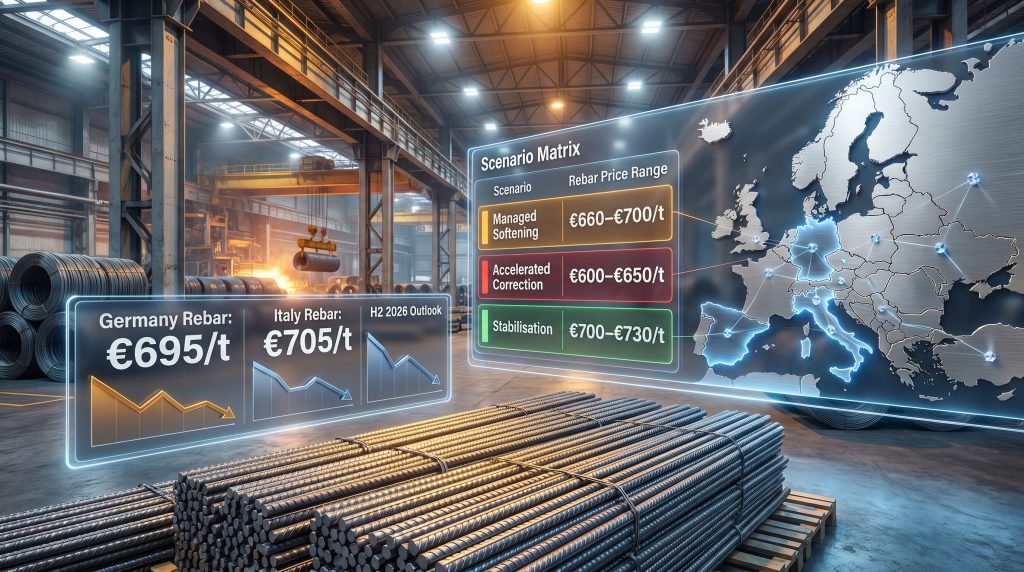
By the second week of June 2026, the initial signs of price normalisation were already visible across key European markets. Argus Media's monthly German rebar assessment declined by €15/t on 10 June 2026, settling at €695/t delivered. Italian domestic rebar, assessed on a weekly basis, had fallen by €25/t within June alone, reaching €705/t ex-works as of the same date.
These may appear to be modest corrections relative to the scale of the preceding rally, but the direction and pace of movement carry significance beyond the raw figures. The softening reflects a market transitioning from inventory accumulation mode to hand-to-mouth procurement, a shift in buyer psychology that tends to be self-reinforcing once established.
Wire rod markets are exhibiting the same softening trajectory. Import offers from Turkish and Egyptian producers into European markets have moved lower, adding competitive pressure to a market already dealing with sluggish domestic consumption. Furthermore, mills in major producing countries are encountering meaningful buyer resistance on forward price offers, signalling that the price discovery process has shifted decisively in favour of buyers. The European long steel market has been navigating these demand pressures for some time, with weak consumption becoming an increasingly persistent structural feature.
Market Psychology Note: When buyers transition to hand-to-mouth procurement strategies, price discovery accelerates to the downside. Sellers lose leverage because buyers have no urgent restocking need, and any inventory overhang held by traders creates additional pressure as holders seek to reduce exposure before further depreciation.
Why European Long Steel Faces Structural Demand Weakness in H2 2026
The European construction sector is the dominant consumption channel for long steel products, particularly rebar and wire rod. Understanding why this sector is underperforming is essential to any credible assessment of the European longs steel weaker second half thesis.
The ECB Rate Decision and Its Cascading Effect on Construction
The European Central Bank's interest rate increase in June 2026 introduces a significant structural headwind for construction activity precisely when the sector was already struggling. Higher borrowing costs affect construction demand through several compounding channels:
- Development project viability deteriorates as financing costs rise, reducing the number of projects that meet internal return thresholds
- Housing affordability declines for end-buyers, weakening demand for new residential units and dampening developer confidence
- Infrastructure project financing becomes more expensive, slowing the pipeline of public and private capital works
- Investor appetite for property assets compresses, reducing speculative development activity
When these financing pressures are layered on top of already-elevated material and logistics costs, the resulting squeeze on project economics creates a structural drag on steel consumption that is unlikely to unwind quickly. Construction projects already in development tend to proceed, but new project starts represent the variable that matters most for future steel demand, and that pipeline is contracting.
Buyer Behaviour: The Restocking Cycle Is Exhausted
Market participants built significant inventories ahead of both CBAM implementation and the July quota tightening. Those who held stock when prices surged in March 2026 benefited substantially from the appreciation. That inventory cycle is now functionally complete.
Buyers across the trading chain are operating with elevated stock levels relative to consumption requirements and have little incentive to add further volume at current prices. The procurement posture that has taken hold is characterised by minimal forward commitment and purchasing limited strictly to covering near-term operational requirements. This hand-to-mouth approach compresses order books, reduces mill capacity utilisation visibility, and removes the speculative buying premium that supported prices during the restocking phase.
How Mills Are Navigating the Softening Environment
Italian steelmakers, facing subdued trading activity and consistent buyer pushback against higher offer levels, have responded by reducing or slowing output volumes. This production discipline strategy is not a demand-response mechanism but rather a deliberate effort to manage available supply relative to weak consumption, thereby preventing a more disorderly price correction.
This approach has historical precedent in European steel markets. During periods of demand contraction, EAF mills have greater operational flexibility than blast furnace producers because they can adjust output more rapidly without the same fixed-cost burden. This flexibility becomes a critical tool for managing the speed and severity of any price decline.
Industry Insight: EAF mills carry a structurally different cost profile than integrated blast furnace producers. Their primary variable costs are scrap metal and electricity, which means energy price movements flow directly into production economics with minimal lag. This direct energy exposure explains both the upside sensitivity during the March energy spike and the potential for cost relief if energy prices fall materially in H2 2026.
Market Desensitisation to Geopolitical Risk
One of the more analytically significant developments in mid-2026 is the market's diminished sensitivity to escalating Middle East conflict. Intensified military activity, including expanded US strikes in Iran during the week of 10 June 2026, produced virtually no measurable reaction in either European steel or oil markets. This desensitisation represents a recalibration of the geopolitical risk premium that had been embedded in prices since early March.
However, market participants are focused on a different geopolitical scenario that could introduce deflationary pressure rather than inflationary support. Many traders are concerned about the potential medium-term consequences of a Strait of Hormuz reopening. If suppressed oil supply were suddenly released into global markets, the resulting price decline could reduce EAF energy costs but simultaneously accelerate broader commodity deflation, potentially amplifying steel price weakness beyond what current demand fundamentals alone would produce.
Scenario Framework: Three Pathways for European Long Steel in H2 2026
| Scenario | Key Drivers | Estimated Rebar Range (Germany) | Estimated Rebar Range (Italy) |
|---|---|---|---|
| Managed Softening (Base) | Post-restock normalisation, partial mill discipline, quota support | €660–€700/t | €670–€710/t |
| Accelerated Correction (Downside) | Deep construction slowdown, oil deflation, import competition | €600–€650/t | €600–€650/t |
| Stabilisation and Recovery (Upside) | Conflict de-escalation, infrastructure stimulus, supply discipline | €700–€730/t | €700–€730/t |
The base case of managed softening rests on three assumptions: that mill production discipline prevents disorderly oversupply, that the July quota tightening partially restricts competitive import flows, and that construction activity does not deteriorate beyond current levels. The downside scenario becomes credible if ECB rate pressure drives a meaningful increase in project cancellations or if energy cost deflation accelerates faster than anticipated.
The next major ASX story will hit our subscribers first
Trade Policy Measures: Partial Support, Not a Demand Cure
The tightening of EU and UK steel import safeguard quotas from 1 July 2026 will reduce the volume of lower-cost foreign steel entering European markets. In a balanced demand environment, this would provide meaningful price floor support by limiting competitive pressure from Turkish, Egyptian, and other exporting nations.
In the current context, however, the protective benefit is constrained. Trade policy instruments address the supply side of the equation. They cannot manufacture end-user demand that does not exist. The steel trade tariff impacts felt across global markets have similarly demonstrated that protective measures alone cannot substitute for genuine consumption-side recovery.
CBAM continues to reshape the import cost calculus over the medium term by applying carbon-adjusted pricing to steel entering Europe from less regulated production environments. For domestic producers whose cost structures incorporate cleaner energy inputs, this provides a pricing advantage that grows as the mechanism matures. The EU steel action plan outlines broader ambitions for shoring up European producer competitiveness, though in a weak demand period, the price-supportive effect of CBAM is partially offset by buyers' willingness to reduce total purchasing volumes rather than absorb higher costs.
Furthermore, the China steel market remains a source of export pressure that complicates efforts to stabilise European pricing. Excess Chinese capacity seeking international outlets continues to undercut domestic European producers in contested trade corridors. In addition, the longer-term transition toward hydrogen iron reduction and green steel pricing dynamics will reshape production cost structures across European mills, though these structural shifts offer limited near-term relief from the demand weakness characterising the current cycle.
Key Monitoring Indicators for the Remainder of 2026
| Indicator | Why It Matters |
|---|---|
| ECB interest rate trajectory | Directly shapes construction financing costs and project start viability |
| EU construction PMI | Leading indicator for rebar and wire rod consumption |
| Natural gas and electricity prices | Primary variable cost driver for EAF mill economics |
| Strait of Hormuz status | Key geopolitical variable for energy and commodity price direction |
| EU and UK safeguard quota utilisation rates | Signals intensity of import competitive pressure |
| Italian and German mill capacity utilisation | Proxy for supply discipline and price floor sustainability |
| Scrap metal price direction | Feedstock cost signal for EAF production economics |
Frequently Asked Questions: European Long Steel H2 2026
What is the difference between rebar and wire rod in long steel markets?
Rebar, or reinforcing bar, is embedded in concrete structures during construction to provide tensile strength that concrete alone cannot supply. Wire rod is a coiled intermediate product rolled from billets and used as feedstock for an extensive range of downstream manufactured goods including fasteners, welding wire, mesh reinforcement, and cables. Both products share broadly similar demand drivers, with construction activity representing the primary consumption channel for each.
Why did finished product prices lag mill-level gains during the March to May rally?
The gap between mill offer prices and achievable transaction prices for finished long steel products reflects insufficient end-user demand to absorb the full cost pass-through. When supply anxiety drives mill pricing but construction buyers are not accelerating consumption, distributors and traders absorb the margin compression rather than passing costs forward. This divergence is a reliable signal that a price rally lacks genuine demand underpinning.
Will safeguard quotas prevent a disorderly price collapse?
Quota measures can limit the volume of competitively priced imports entering the European market, providing a partial price floor. However, they function as a supply-side instrument in a market where the primary weakness is on the demand side. Their effectiveness in preventing significant price erosion is constrained when construction activity is subdued and buyers are operating hand-to-mouth procurement strategies.
What would shift the outlook toward the upside scenario?
A meaningful de-escalation of Middle East conflict that reduces energy cost volatility and restores business confidence would improve the operating environment for construction activity. Any acceleration in publicly funded infrastructure spending across major European economies would provide a demand stimulus with direct implications for rebar consumption. Sustained mill production discipline maintaining tighter supply conditions would support price floors even in a weak demand environment.
This article is intended for informational and analytical purposes only. Price ranges, scenario projections, and market assessments referenced herein reflect conditions as reported and analysed as of mid-June 2026. Commodity markets are inherently volatile and subject to rapid change. Nothing in this article constitutes investment advice. Readers are encouraged to consult primary market data sources and professional advisors before making commercial or investment decisions. Price data referenced in this article is sourced from Argus Media's steel market assessments.
Want To Stay Ahead of Major Commodity Market Shifts?
Discovery Alert's proprietary Discovery IQ model delivers real-time alerts on significant ASX mineral discoveries, instantly converting complex commodity data into actionable investment insights — explore historic examples of exceptional discovery returns to understand the magnitude of opportunities that early identification can unlock, then begin your 14-day free trial at Discovery Alert to position yourself ahead of the broader market.