June 12, 2026
The Industrial Logic Behind Europe's Most Contested Commodity Debate
Few debates inside the European Union reveal the structural fault lines of its sanctions architecture quite like the question of alumina. Unlike oil pipelines or semiconductor supply chains, alumina rarely commands headlines. Yet this white powder, refined from bauxite ore and processed into the primary aluminium that underpins everything from aviation frames to armoured hulls, sits at the precise intersection of industrial economics and geopolitical strategy that the EU has struggled most to navigate.
Understanding why Estonia calls to halt EU alumina exports to Russia requires looking beyond the diplomatic language and into the chemistry of aluminium production itself, and then into the commercial interests that have kept this particular loophole open.
When big ASX news breaks, our subscribers know first
What Alumina Actually Is and Why It Matters Upstream
The Refinery-to-Smelter Pipeline Explained
Aluminium does not exist in a form that can be smelted directly from the earth. Bauxite ore must first undergo the Bayer Process, a chemical refining method that strips away impurities and produces aluminium oxide, commonly called alumina. Only then can this intermediate product be fed into electrolytic smelters using the Hall-Heroult process to produce primary aluminium metal.
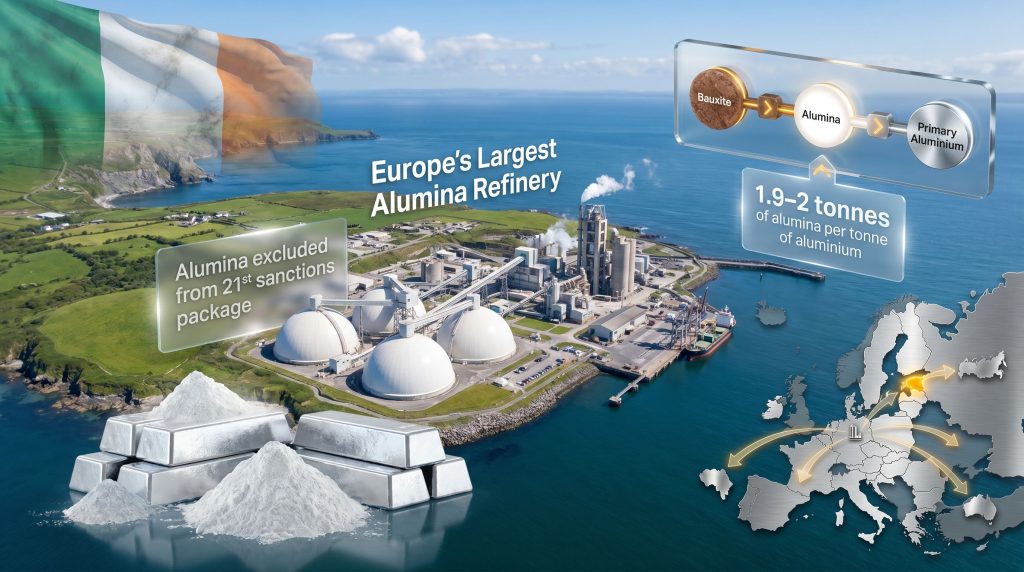
The tonnage relationship is significant. Producing one tonne of primary aluminium requires approximately 1.9 to 2 tonnes of alumina, making the refinery stage a critical chokepoint in the entire supply chain. For a broader bauxite production overview, it is worth understanding how upstream ore supply shapes downstream aluminium capacity at the global level. Control over alumina flow is, functionally, control over aluminium output.
Russia operates one of the world's largest primary aluminium industries. Its smelters are predominantly powered by Siberian hydroelectric infrastructure, which gives Russian aluminium one of the lowest carbon footprints of any major global producer. That green credential has become commercially valuable as industrial buyers in Asia and Europe face tightening sustainability procurement standards. But those same smelters require continuous alumina input, and that is precisely where European trade policy intersects with Russian industrial capacity.
Primary aluminium produced by Russian facilities flows directly into aerospace manufacturing, defence systems, armoured vehicle construction, and missile component production. This upstream dependency is what drives Estonia's formal advocacy for an EU-wide prohibition on alumina exports reaching Russia.
Why Alumina Escaped Sanctions Classification for So Long
One of the less discussed aspects of the EU sanctions debate is how alumina managed to avoid restriction across multiple sanctions packages despite aluminium's acknowledged importance to Russia's military-industrial base. Several structural factors explain this:
-
Alumina has historically been classified as a general industrial input rather than a dual-use or controlled material, meaning the legal machinery for restricting it was simply not designed with it in mind.
-
European refinery operators with commercial exposure to alumina trade flows have exercised significant influence over the pace and scope of sanctions discussions.
-
The unanimity requirement embedded in EU treaty law means every single one of the 27 member states must agree before any new commodity is added to the sanctions regime, creating structural friction that commercially exposed nations can exploit through delay rather than outright opposition.
-
Alumina was absent from the EU's 21st sanctions package, despite Baltic state pressure, indicating that opposition from key member states remains sufficient to block inclusion.
The absence of alumina from EU sanctions is not an oversight. It reflects the deliberate negotiating calculus of member states with direct commercial exposure to Russia-linked alumina trade flows, combined with a legal architecture that systematically favours inertia over rapid expansion of restricted commodities.
Estonia's Policy Position and the Mechanics of Its Advocacy
What Estonia Is Formally Requesting
Estonia's Foreign Minister Margus Tsahkna has formally renewed the call for a bloc-wide ban on alumina exports to Russia, positioning the measure as a logical extension of the EU's existing strategy to erode Russia's war-sustaining industrial capacity. The core argument is a dual-use one: alumina enables aluminium production, and aluminium is a structural material in Russian defence manufacturing.
Estonia's advocacy does not stop at alumina. Tsahkna has simultaneously pushed for swifter adoption of an ambitious 21st EU sanctions package and called for reinforcing the existing Russian oil price cap through stricter restrictions on maritime service providers linked to Russian energy exports. The combined position reflects a broader Baltic-bloc strategy of treating industrial raw materials, energy logistics, and financial services as an integrated system requiring coordinated restriction.
The Unanimity Problem: Structural Friction in EU Sanctions Reform
The EU's sanctions decision-making process requires consensus across all 27 member states, a threshold that consistently produces slower outcomes for economically sensitive commodities. Countries with direct commercial stakes in alumina trade flows face genuine domestic economic considerations when evaluating export bans, and those considerations can translate into negotiating resistance that stalls or dilutes proposals.
Baltic states, including Estonia, Latvia, and Lithuania, have historically occupied the most hawkish positions within EU sanctions debates. Their geographic proximity to Russia and historical experience under Soviet-era occupation produce a threat perception that diverges sharply from Western European member states with deeper commercial ties to Russian industrial supply chains. This divergence in security calculus is not merely rhetorical. It consistently delays Baltic-led proposals by 12 to 24 months before broader consensus emerges, if it emerges at all.
The Ireland Question: Europe's Most Contested Alumina Trade Flow
Aughinish Alumina and Its Strategic Significance
The most commercially significant node in the EU's alumina export debate is Aughinish Alumina, a refinery located in County Limerick, Ireland, that holds the distinction of being Europe's largest alumina production facility by capacity. The refinery's historical ownership and operational ties to Rusal, Russia's dominant aluminium producer, have placed it at the centre of sanctions circumvention concerns raised by Estonia and other member states.
The tension here is acute. Ireland's industrial economy has a meaningful employment and export dependency on the Aughinish facility, creating a sovereign economic consideration that sits in direct conflict with the geopolitical objectives being advanced by Baltic member states. This is not merely a hypothetical conflict of interest; it is the structural reason alumina has remained outside the EU sanctions perimeter despite sustained advocacy from Estonia. Furthermore, EU and Ukraine pressure on Ireland over these alumina trade flows has intensified, adding a diplomatic dimension to what was previously framed primarily as a commercial question.
Current State of the Trade Flow
| Trade Variable | Current Status |
|---|---|
| EU-wide alumina export ban | Not enacted as of mid-2026 |
| Aughinish Alumina ownership | Linked to Russian-affiliated entities |
| Alumina in 21st sanctions package | Excluded from current negotiations |
| Unanimity requirement | All 27 member states must agree |
| Estonia's formal advocacy | Active, renewed June 2026 |
| Baltic-bloc position | Hawkish, pushing for swift inclusion |
The Green Aluminium Paradox: A Policy Contradiction With Global Consequences
Russia's Low-Carbon Aluminium Credentials
Russia's aluminium industry derives its competitive sustainability advantage from its hydroelectric power base. Siberian river systems supply the electricity that drives Russian smelters, producing aluminium with a carbon intensity profile that compares favourably to coal-powered producers in China and other markets. This low-carbon credential has become commercially strategic as green procurement standards tighten across industrial supply chains globally. Consequently, understanding green metals pricing dynamics is essential context for evaluating how sanctions on Russian alumina could reshape competitive positioning across global markets.
The primary buyers of Russian low-carbon aluminium are India and China, both of which are scaling up manufacturing commitments that increasingly require access to low-embodied-carbon primary metal. For these buyers, Russian aluminium is not simply a cost-competitive option. It is, in many procurement frameworks, a qualifying product that meets sustainability thresholds that higher-carbon alternatives do not.
The Unresolved Substitution Problem
If EU alumina export restrictions successfully curtail Russian smelter output, the global market faces a structural deficit in low-carbon primary aluminium that cannot be quickly resolved. The substitution options available to Indian and Chinese buyers each carry significant complications:
-
Source higher-carbon aluminium from alternative producers at the cost of contradicting their own sustainability mandates and potentially triggering internal procurement compliance issues.
-
Pay a significant premium for limited low-carbon supply from non-Russian hydropower-based producers such as Canada, Norway, or Iceland, none of which have the spare capacity to absorb a large-scale Russian supply reduction in the near term.
-
Accelerate domestic low-carbon smelting investment, a pathway that is structurally sound but requires multi-year capital deployment timelines and policy frameworks that are not yet fully in place.
The EU's effort to restrict Russia's industrial capacity through alumina sanctions may inadvertently tighten global low-carbon aluminium supply at the precise moment when green manufacturing demand is accelerating fastest. This policy paradox has implications that extend well beyond European borders and may produce unintended consequences in Asian industrial procurement markets.
Medium-Term Rerouting Risk
Even if an EU alumina ban is enacted, Russia possesses theoretical alternative supply routes. Guinea, Australia, and China are all significant alumina producers outside the EU sanctions framework. However, operationalising these alternatives is not instantaneous. Logistics rerouting, new supply contracts, refinery qualification processes, and infrastructure investment typically require 12 to 36 months to execute at full industrial scale. This creates a meaningful medium-term supply disruption window even if long-term alternatives exist.
Three Scenarios for EU Alumina Policy
Mapping the Possible Outcomes
Scenario 1: Full Export Ban Enacted
Alumina is added to the EU sanctions framework through unanimous member state agreement. Ireland's Aughinish refinery is required to fundamentally restructure its commercial operations. Russian smelter output contracts over a 12 to 24 month transition period. Global low-carbon aluminium prices rise and non-Russian hydropower producers in Norway, Canada, and Iceland experience demand uplift.
Scenario 2: Partial Restrictions Introduced
Volume caps or export licensing requirements are applied to alumina rather than an outright ban. Trade flows are reduced but not severed. Sanctions circumvention risk persists through third-country rerouting via non-EU alumina producers. Political pressure on Ireland continues but immediate economic disruption is moderated.
Scenario 3: Status Quo Maintained
Alumina is excluded from the 21st sanctions package due to failure to achieve unanimity. Estonia continues advocacy and Baltic-bloc pressure intensifies in subsequent package negotiations. The EU's credibility on closing strategic commodity loopholes faces external criticism. Russia maintains aluminium output and preserves its low-carbon market positioning in Asian markets.
The next major ASX story will hit our subscribers first
What This Debate Reveals About the EU's Sanctions Architecture
From Energy to Industrial Raw Materials: The Next Sanctions Frontier
Since 2022, the EU's sanctions approach has progressively targeted upstream inputs rather than finished goods alone, moving from energy and financial instruments into dual-use technology and now toward the raw material supply chains that sustain Russia's industrial economy. Alumina represents the logical next stage of this escalating approach. In addition, the broader EU metals action plan signals that European policymakers are increasingly treating metals supply chains as a strategic security matter rather than a purely commercial one.
The 21st sanctions package currently in preparation is a live negotiation, with Estonia positioning alumina as a priority inclusion and commercially exposed member states maintaining their resistance. Additional contested measures under discussion include expanded maritime service restrictions on energy-carrying vessels, tighter financial controls on third-country entities facilitating circumvention, and broader dual-use classifications for additional industrial raw materials.
The Deeper Structural Lesson
The alumina debate is ultimately a case study in how the EU's institutional architecture creates asymmetric influence between large, commercially engaged member states and smaller states with acute security interests. The unanimity requirement, designed to protect national sovereignty, simultaneously protects commercial interests that conflict with the bloc's stated geopolitical objectives. Whether alumina enters the 21st sanctions package or is deferred once again will serve as a direct indicator of how far the EU is willing to extend its industrial supply chain restrictions into territory that imposes meaningful domestic economic costs on its own members.
Key structural observations from this debate:
-
The unanimity threshold remains the single greatest constraint on the EU's ability to rapidly close strategic commodity loopholes in its sanctions architecture.
-
Russia's low-carbon aluminium positioning adds a sustainability dimension that complicates straightforward restriction arguments and gives commercially exposed member states an additional rhetorical tool.
-
Estonia's calls to halt EU alumina exports to Russia reflect a broader Eastern European push to categorise industrial raw materials as strategic assets subject to the same rigorous controls applied to energy and advanced technology exports. The aluminium market impact of similar trade restrictions in other jurisdictions offers instructive precedent for what supply disruptions of this kind can produce.
-
The outcome of alumina's inclusion or exclusion from the 21st package will function as a bellwether for how the EU resolves the tension between geopolitical ambition and member state commercial protection in future sanctions cycles. Furthermore, the aluminium industry leaders most exposed to these policy shifts are already adjusting their strategic planning frameworks in anticipation of potential supply chain realignment.
This article provides analysis of publicly available policy positions and trade dynamics. It does not constitute investment advice. Forecasts and scenario projections are speculative and subject to change as EU negotiations evolve. Readers should conduct independent research before making decisions informed by policy analysis.
Want To Stay Ahead Of Major Mineral Discoveries Reshaping Global Supply Chains?
As geopolitical shifts increasingly disrupt critical commodity supply chains — from alumina to aluminium — Discovery Alert's proprietary Discovery IQ model instantly identifies significant ASX mineral discoveries, translating complex market data into clear, actionable investment opportunities for both short-term traders and long-term investors. Explore how historic discoveries have generated substantial returns on Discovery Alert's dedicated discoveries page, and begin your 14-day free trial today to position yourself ahead of the next major market-moving find.