August 25, 2026
Africa's Gold Heartland: Why Ghana's Mining Sector Demands Attention in 2026
Across the global mining landscape, few countries have managed to sustain the kind of structural production momentum that Ghana has demonstrated over the past decade. While commodity cycles routinely reshape the fortunes of resource-dependent economies, Ghana's mineral sector has consistently defied the gravitational pull of cost inflation, regulatory friction, and shifting demand patterns. Understanding why requires looking beyond headline output numbers and into the deeper mechanics of how the country's multi-commodity base actually functions.
Ghana mineral output expected to climb significantly in 2026 is not merely an optimistic industry projection. It reflects a measurable shift in the sector's structural composition, a recalibration of governance frameworks, and an unprecedented realignment of production responsibility between large-scale operators and artisanal miners. The implications extend far beyond national output statistics and into questions of fiscal sustainability, investment competitiveness, and long-term sector governance.
When big ASX news breaks, our subscribers know first
Ghana's Structural Position as Africa's Leading Gold Producer
Ghana's dominance in West African mining is not accidental. It rests on a combination of geological endowment, entrenched infrastructure, and a regulatory environment that, while imperfect, is considerably more mature than most peer jurisdictions on the continent.
The Birimian greenstone belts that cut across southern Ghana are among the most prolific gold-bearing geological formations on Earth. These Proterozoic-age rock sequences, formed approximately 2.1 to 2.2 billion years ago, host the majority of Ghana's large-scale gold deposits and continue to attract exploration capital from major international producers. The structural geology of these belts creates the kind of shear zone-hosted orogenic gold deposits that consistently deliver high-tonnage, economically viable mineralisation.
Beyond geology, Ghana's role as Africa's top gold producer is underpinned by its broader mineral portfolio:
- Gold (both large-scale and artisanal) as the dominant revenue and export earner
- Manganese as a strategically important industrial metal with growing battery sector relevance
- Bauxite as the upstream feedstock for Ghana's long-term aluminium ambitions
- Diamonds as a legacy commodity undergoing structural reassessment
Together, these four commodities form a production base that contributed more than 68% of Ghana's total merchandise exports in 2025, cementing the sector's role as the country's primary engine of foreign exchange generation.
"The mining and quarrying sector functions as Ghana's largest source of direct domestic tax revenue, making its performance a macroeconomic variable with national consequences far beyond the mine gate."
2025 Gold Performance: A Benchmark Year That Resets the 2026 Starting Line
Any credible analysis of Ghana's 2026 production outlook must begin with an honest accounting of what the sector actually achieved in 2025, because the numbers fundamentally alter the analytical baseline.
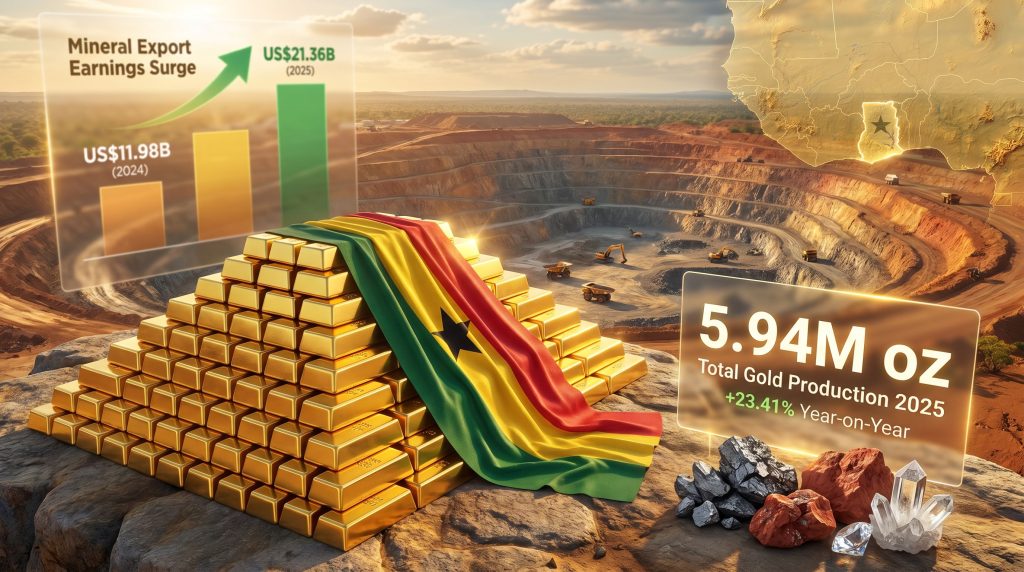
Total attributable gold production expanded from 4.82 million ounces in 2024 to 5.94 million ounces in 2025, a year-on-year increase of 23.41%. This figure materially exceeded the early 2025 consensus forecast of approximately 5.1 million ounces, meaning that actual performance outpaced projections by nearly 840,000 ounces. For forward-looking analysts, this gap matters: forecasters who anchor their 2026 models to historical patterns must now recalibrate to a significantly higher production floor. Furthermore, the gold price record highs sustained throughout much of 2025 amplified the dollar value of these gains considerably.
The Small-Scale Mining Surge: A Structural Rebalancing a Century in the Making
The most consequential development within Ghana's 2025 gold performance was not the aggregate output figure. It was the seismic shift in who produced it.
Small-scale gold output expanded by 63.82% to reach 3.11 million ounces in 2025, up from approximately 1.9 million ounces in 2024. For the first time in recorded Ghanaian mining history, spanning more than a century of formal production, artisanal and small-scale mining (ASM) accounted for more than half of the country's total gold output, reaching a share of 52.4% of national production.
"This crossing of the 50% threshold by small-scale operators is not simply a production milestone. It represents a fundamental rebalancing of Ghana's gold sector architecture, with profound and enduring consequences for governance, revenue capture, environmental stewardship, and investment strategy."
A critical enabler of this transformation was the establishment of the Ghana Gold Board, a government-led formalisation mechanism designed to integrate artisanal operators into regulated market streams. By providing structured purchasing channels, documentation frameworks, and market access pathways, the Ghana Gold Board effectively converted a significant portion of previously informal production into quantifiable, taxable output.
This has important implications for both revenue integrity and the accuracy of historical production comparisons, since some portion of the 2025 ASM growth reflects formalisation of activity that was previously unrecorded rather than purely new production.
Large-Scale Operations: The Countertrend Requiring Strategic Attention
While aggregate output surged, large-scale gold mining moved in the opposite direction. Production at corporate-operated mines declined by approximately 3%, from 2.92 million ounces in 2024 to 2.83 million ounces in 2025.
The structural drivers behind this contraction are well understood within the industry:
- Ageing mine profiles at several flagship operations, with declining ore grades requiring higher throughput to maintain ounce output
- Rising input costs across energy, labour, reagents, and equipment procurement, compressing margins and delaying sustaining capital decisions
- Lease renewal delays creating uncertainty around mine life extensions and discouraging long-cycle investment
The divergence between large-scale contraction and small-scale expansion creates what might be called a dual-track governance challenge. The regulatory frameworks, environmental standards, and fiscal instruments designed for large corporate operators are poorly suited to managing a sector where the majority of production now comes from thousands of small, geographically dispersed operators.
The 2026 Multi-Commodity Production Forecast: What the Numbers Actually Mean
Against this backdrop, the production outlook for 2026 covers Ghana's full mineral portfolio. The Ghana Chamber of Mines presented the following forecast ranges at its 98th Annual General Meeting in Accra:
| Commodity | 2026 Production Forecast | Primary Driver |
|---|---|---|
| Large-Scale Gold | 3.2M – 3.4M ounces | Operational stabilisation, lease renewals |
| Small-Scale Gold | 2.9M – 3.5M ounces | Formalisation depth, Ghana Gold Board expansion |
| Manganese | 5.0M – 6.0M tonnes | Industrial demand recovery, operational expansion |
| Bauxite | 2.5M – 3.0M tonnes | Downstream processing interest, new capacity |
| Diamonds | 150,000 – 250,000 carats | Incremental operational recovery |
The use of ranges rather than point estimates is analytically significant. It reflects genuine regulatory and market uncertainty rather than modelling imprecision. The spread between the lower and upper bounds in each commodity represents the difference between a scenario where enabling conditions are met and one where structural headwinds persist.
The Chamber was explicit about the four prerequisites for achieving the upper end of these ranges:
- Policy certainty across the minerals regulatory environment
- Timely mining lease renewals for operations approaching licence expiry
- Improved ASM governance to sustain and deepen the formalisation gains of 2025
- Sustained capital deployment across the full minerals value chain
Ghana's Fiscal Architecture: Mining as an Economic Pillar
The economic footprint of Ghana's mining sector extends well beyond production volumes. The fiscal data from 2024 to 2025 illustrates the scale of the sector's contribution to national economic health:
| Fiscal Metric | 2024 | 2025 | Change |
|---|---|---|---|
| Mining sector tax contribution | GH¢20.87 billion | GH¢23.11 billion | +10.7% |
| Mineral export earnings | US$11.98 billion | US$21.36 billion | +78.3% |
| Mining share of merchandise exports | ~55% (est.) | >68% | Significant increase |
| In-country spending by producers | Not disclosed | ~US$7.14 billion | ~73% of realised revenue |
The near-doubling of mineral export earnings from US$11.98 billion to US$21.36 billion within a single year reflects both the volume gains driven by ASM formalisation and the tailwind from elevated global gold prices. Consequently, the gold market outlook for Ghana remains particularly favourable, with prices breaching the US$2,500 per ounce mark and sustaining above that level for extended periods, amplifying the dollar value of Ghana's export earnings even before accounting for volume growth.
The US$7.14 billion in domestic expenditure by producing companies, representing approximately 73% of their realised mineral revenue, underscores the local economic multiplier effect of large-scale mining. This figure includes payments to local contractors, labour costs, consumables procurement, and infrastructure investment, making the sector's economic footprint significantly broader than its direct tax contribution alone.
Four Structural Risks That Could Constrain the 2026 Outlook
Ghana's 2026 targets are achievable under the right conditions, but the gap between forecast and outcome will be determined by how effectively policymakers and industry address the following headwinds:
Rising Operating Cost Pressures
Energy remains the single largest controllable cost variable for large-scale mining operations in Ghana. The country's electricity grid has faced recurring reliability challenges, forcing many operators to invest in captive power generation at significant capital cost. Labour inflation, driven in part by competition with the expanding ASM sector for skilled workers, further compresses margins. For older, lower-grade operations, the combination of rising costs and declining ore grades creates a challenging economic equation that lease renewal uncertainty only compounds.
The Illegal Mining Challenge
The rapid expansion of formalised ASM activity does not eliminate the challenge of unregulated artisanal mining, commonly referred to in Ghana as galamsey. Water contamination from the use of mercury and other chemicals in informal processing remains a serious and documented environmental concern. River systems in Ghana's primary gold-producing regions have faced persistent degradation, affecting drinking water access for downstream communities and creating long-term rehabilitation liabilities.
A less commonly discussed dimension of the galamsey problem is its interaction with formal sector investment decisions. International mining companies operating in Ghana increasingly face reputational and ESG-related scrutiny from institutional investors over activities that occur within their licence areas but are not directly controlled by them. This creates a legal and regulatory ambiguity with tangible consequences for capital allocation. The mine reclamation importance of robust environmental oversight, therefore, cannot be overstated in this context.
Fiscal Burden and Royalty Regime Dynamics
Recent modifications to Ghana's mineral royalty structure have attracted attention from the investment community. While government revenue maximisation is a legitimate policy objective, the structure and predictability of the fiscal regime is as important to investment decisions as its absolute level. Investors in long-cycle mining projects price risk across mine life periods of 15 to 25 years.
Incremental fiscal changes, particularly those introduced without industry consultation or clear phase-in periods, compress projected internal rates of return and elevate the hurdle rate at which new projects become viable. Ghana competes directly for exploration and development capital with peer jurisdictions including Côte d'Ivoire, Tanzania, and Senegal. Maintaining a competitive fiscal environment is therefore a strategic necessity, not merely a concession to corporate interests.
Security of Tenure
Mining lease renewal delays represent perhaps the most acute near-term risk to large-scale production recovery. When companies cannot confirm the operating timeline for their assets, they rationally delay sustaining capital expenditure, mine development decisions, and exploration investment within existing licence boundaries. This creates a self-reinforcing cycle: delayed renewal leads to reduced investment, which leads to declining output, which ultimately reduces the tax and employment base that the government sought to protect through tighter oversight.
The next major ASX story will hit our subscribers first
Manganese, Bauxite, and Diamonds: The Diversification Story
Manganese: A Battery-Era Commodity With Industrial Roots
Ghana holds one of Africa's most significant manganese deposits, centred on the Nsuta deposit in the Western Region. Manganese has traditionally served as a critical input to steel manufacturing, where it improves hardness and wear resistance. However, the metal is gaining renewed strategic relevance through its role in lithium-manganese-iron-phosphate (LMFP) battery chemistry. Furthermore, the broader critical minerals demand trajectory positions manganese as a key strategic asset for Ghana's long-term industrial ambitions.
The 2026 forecast range of 5.0 to 6.0 million tonnes reflects both operational expansion ambitions and the logistical variables, particularly rail and port capacity at Takoradi, that historically constrain manganese export volumes.
Bauxite: Ghana's Most Significant Value-Addition Opportunity
The projected bauxite output of 2.5 to 3.0 million tonnes in 2026 represents a meaningful step up from recent production levels, but the more strategically significant story is downstream. Ghana's Integrated Aluminium Development Corporation (GIADEC) has articulated a long-term vision for domestic alumina refining and aluminium smelting that would capture a far greater share of the bauxite-to-metal value chain within Ghana's borders.
At present, Ghana exports raw bauxite ore, capturing only a fraction of the value that aluminium producers realise further along the processing chain. In addition, bauxite production trends across West Africa suggest growing regional competition for downstream investment, making Ghana's timing on domestic processing infrastructure increasingly strategic. Closing this value gap through domestic processing is one of the most consequential industrial policy opportunities available to Ghana, though it requires substantial infrastructure investment and reliable energy supply.
Diamonds: A Sector in Structural Reassessment
The diamond production forecast of 150,000 to 250,000 carats for 2026 reflects the structural pressures facing natural diamond production globally. The rapid scaling of laboratory-grown diamond production, which now commands significant market share in the jewellery segment, has created sustained pricing pressure on natural rough diamonds. For Ghanaian production, which is predominantly alluvial and therefore relatively high-cost per carat, the economics of the sector warrant honest strategic evaluation.
Key Performance Summary: Ghana Mining Sector
| Indicator | 2024 | 2025 | 2026 Forecast |
|---|---|---|---|
| Total gold production (oz) | 4.82M | 5.94M | 6.1M – 6.9M (combined) |
| Large-scale gold (oz) | 2.92M | 2.83M | 3.2M – 3.4M |
| Small-scale gold (oz) | ~1.9M | 3.11M | 2.9M – 3.5M |
| ASM share of total gold | ~39% | 52.4% | ~47% – 51% |
| Manganese (tonnes) | ~5.0M | Not disclosed | 5.0M – 6.0M |
| Bauxite (tonnes) | ~1.7M | Not disclosed | 2.5M – 3.0M |
| Diamonds (carats) | ~330,000 | Not disclosed | 150,000 – 250,000 |
| Mining tax revenue | GH¢20.87B | GH¢23.11B | Not forecast |
| Mineral export earnings | US$11.98B | US$21.36B | Not forecast |
The Policy Agenda: What the Next 12 Months Must Deliver
The window between now and the end of 2026 is critical for Ghana's mining sector. The production gains of 2025 have created a favourable starting point, but sustaining momentum requires targeted action across several dimensions:
- Accelerating lease renewal processing to eliminate the tenure uncertainty that suppresses large-scale capital deployment
- Expanding Ghana Gold Board capacity to match the operational scale demands of a sector where small-scale miners now represent the majority of gold output
- Establishing a transparent, long-term fiscal framework that balances government revenue objectives with investor return requirements across full mine life cycles
- Strengthening environmental enforcement mechanisms for both large-scale operators and the ASM sector, with particular attention to water system protection
- Progressing GIADEC's downstream processing agenda to begin capturing aluminium value chain benefits domestically
Ultimately, Ghana mineral output expected to climb further in 2026 rests on institutional delivery rather than geological constraint. With Ghana mineral output expected to climb across multiple commodities simultaneously, the sector stands at an inflection point where policy quality will determine whether the upper bounds of these forecast ranges are realised. The speed and coherence of regulatory action over the coming months will be the decisive variable.
Disclaimer: Production forecasts, financial projections, and commodity price references in this article are based on publicly available information and industry disclosures at the time of writing. They are subject to material change based on regulatory, market, and operational developments. This article does not constitute investment advice. Readers should conduct independent research before making any investment decisions.
Want to Track the Next Major Mineral Discovery Before the Market Does?
Discovery Alert's proprietary Discovery IQ model delivers real-time alerts on significant ASX mineral discoveries — transforming complex geological and commodity data into actionable investment insights for traders and long-term investors alike. Explore how historic discoveries have generated extraordinary returns on Discovery Alert's dedicated discoveries page, then begin your 14-day free trial to position yourself ahead of the broader market.