June 12, 2026
The Hidden Engine of European Metals: Why Recycled Aluminium Is Germany's Industrial Lifeline
Across the global metals industry, a quiet but profound restructuring has been underway for decades. The economics of recycling have shifted from marginal cost advantage to structural necessity, particularly in energy-intensive economies where primary smelting faces existential pressure from soaring electricity costs and tightening carbon regulations. Nowhere is this dynamic more visible than in Germany secondary aluminium production and consumption economy, where the secondary aluminium sector has become not just a complement to primary production but the foundation upon which the entire national supply chain rests.
Understanding this industrial reality requires moving beyond simple recycling narratives. This is a story about industrial architecture, feedstock geopolitics, energy economics, and the emerging circular supply chains that will define European manufacturing competitiveness through the rest of this decade.
When big ASX news breaks, our subscribers know first
Germany's Aluminium Economy: Scale, Structure, and Strategic Dependence
Germany holds the position of the third-largest aluminium consumer globally, sitting behind only China and the United States. National aluminium consumption runs at approximately 2.1 million tonnes annually, supporting an industrial base that employs more than 60,000 workers and generates roughly €24 billion in annual turnover. By 2026, industry revenue estimates had climbed to approximately €16.6 billion, driven partly by elevated metal prices and persistent supply chain instability in preceding years.
The production split between primary and secondary aluminium tells a revealing story about Germany's industrial constraints. In 2023, domestic secondary aluminium output reached approximately 478,200 tonnes, while primary production lagged considerably at roughly 189,500 tonnes. This gap is not accidental. Germany lacks significant domestic bauxite resources and faces some of the highest industrial electricity costs in the European Union, making energy-intensive primary smelting economically marginal at scale.
The broader aluminium industry, including semi-finished product manufacturing, recorded a combined production volume of approximately 2.7 million tonnes in 2024, though this represented a 2% year-on-year decline — a figure that signals growing structural pressures rather than temporary fluctuation. Furthermore, these pressures are reshaping investment decisions across Europe, with European aluminium investment increasingly tilting towards secondary and recycled capacity rather than new primary smelting projects.
Germany's industrial aluminium economy is structurally dependent on recycled metal, not as a supplement, but as the primary production pathway. This distinction matters enormously when assessing the sector's vulnerabilities and long-term investment dynamics.
The Physics and Economics Behind Secondary Aluminium's Dominance
Why Recycling Is Not Just a Policy Choice, But a Physical Imperative
Aluminium possesses a metallurgical property that distinguishes it from most other structural metals: it can be recycled indefinitely without any degradation in mechanical properties or alloy performance. This infinite recyclability, combined with extraordinary energy economics, makes secondary production the rational default for any economy serious about industrial competitiveness.
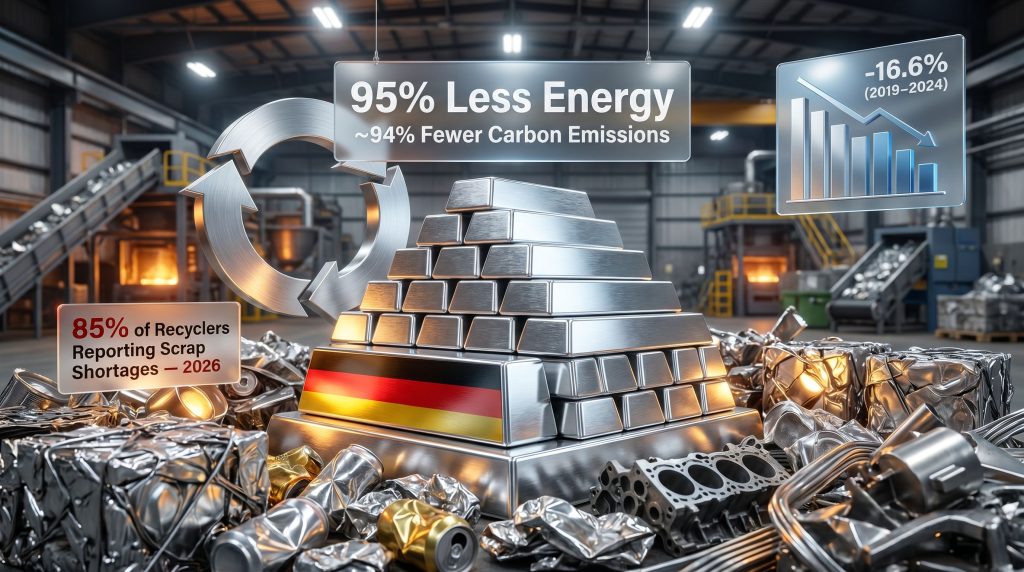
The numbers are striking. Recycling aluminium from scrap consumes approximately 95% less energy than smelting primary metal from bauxite ore. Associated carbon emissions fall by roughly 94% compared to the primary production pathway. For Germany, where industrial electricity prices persistently rank among Europe's highest, this energy differential is not an environmental talking point but a hard cost advantage. The mining decarbonisation benefits associated with secondary production are consequently central to Germany's broader industrial sustainability strategy.
Comparative Efficiency: Primary vs. Secondary Production
| Metric | Primary Aluminium | Secondary Aluminium |
|---|---|---|
| Relative Energy Consumption | 100% (baseline) | ~5% of primary |
| Carbon Emission Profile | Baseline | ~94% lower |
| Feedstock Dependency | Bauxite and alumina imports | Post-consumer and industrial scrap |
| Strategic Vulnerability | High (import-dependent) | Moderate (scrap availability constraints) |
| EU Green Policy Alignment | Low to Moderate | High |
One dimension often overlooked in mainstream analysis is the alloy quality challenge embedded within secondary production. Unlike primary aluminium, which begins as chemically pure metal, recycled aluminium arrives as heterogeneous scrap streams carrying varying compositions of alloying elements, coatings, and contaminants. Advanced sorting technologies, including sensor-based separation and eddy current systems, are increasingly critical to recovering high-specification alloys from mixed scrap inputs.
The ability to produce tight-tolerance wrought and cast alloys from secondary feedstock is a genuine technical frontier, and facilities that master this capability command significant commercial advantages. In addition, according to global primary aluminium production data, the overall balance between primary and secondary output continues to shift in favour of recycled metal across mature industrial economies.
Production Trends: A Decade of Pressure and the 2024 Reality
Structural Decline Across the Production Base
Germany's secondary aluminium output has not followed a smooth growth trajectory. Between 2019 and 2024, industry-wide production declined by approximately 16.6%, falling to roughly 2.74 million tonnes across the combined production base. In the opening quarter of 2026, recycled aluminium output stood at 684,564 tonnes, indicating continued operational activity but within an environment marked by compounding cost and supply pressures.
Several distinct forces are driving this contraction simultaneously:
- Energy cost burden: Germany's industrial electricity tariffs remain among the EU's highest, disproportionately squeezing the remelting and refining operations at the core of secondary production
- Automotive demand softness: The sector that absorbs approximately 48% of secondary aluminium consumption has experienced weakening order volumes, reducing the pull-through demand that secondary smelters depend on
- Construction sector contraction: Architectural and structural aluminium applications contracted meaningfully between 2023 and 2025, removing another significant demand channel
- Scrap export leakage: European aluminium scrap exports reached 1.2 million tonnes in 2024, diverting feedstock that would otherwise serve domestic remelters toward international buyers, particularly from Asia
- Collection system fragmentation: While some scrap categories achieve outstanding recovery rates, industrial and automotive aluminium scrap collection remains uneven, creating gaps in the domestic supply pipeline
The convergence of high energy costs, scrap export leakage, and weakening end-use demand creates a compounding structural risk for Germany's secondary aluminium supply chain that no single policy lever can resolve in isolation.
Downstream Demand Architecture: Where Recycled Aluminium Actually Goes
The 48% Automotive Dependency and What It Means
The automotive sector's dominance as the primary consumer of secondary aluminium in Germany is both a strength and a vulnerability. At approximately 48% of total secondary aluminium demand, the automotive industry's fortunes are inextricably linked to the health of the recycling ecosystem. Vehicle lightweighting strategies have driven sustained aluminium intensity growth per vehicle over the past two decades.
The ongoing transition to electric vehicles is expected to maintain or increase this intensity, since EV platforms require aluminium for battery housings, structural components, and thermal management systems. The aluminium energy transition underway in the automotive and power sectors is consequently reshaping both demand profiles and feedstock return cycles for secondary producers.
However, the automotive scrap return cycle creates a critical timing asymmetry. Because vehicles remain in service for roughly 10 to 15 years before entering end-of-life processing, the aluminium scrap available today reflects vehicle fleets assembled a decade ago — a period when aluminium content per vehicle was substantially lower than in current production. This means the full scrap dividend from today's aluminium-intensive vehicles will not reach recyclers until the mid-2030s.
Sector-by-Sector Demand and Scrap Return Dynamics
| End-Use Sector | Estimated Demand Share | Scrap Return Cycle | Growth Outlook (2025-2030) |
|---|---|---|---|
| Automotive | ~48% | Long (10-15 years) | Stable to Positive (EV transition) |
| Packaging (incl. beverage cans) | High circularity | Short (months to 2 years) | Stable |
| Construction | Moderate | Long (20-40 years) | Recovering post-2025 |
| Machinery and Engineering | Moderate | Medium (5-10 years) | Moderate |
Germany's 99% aluminium beverage can recycling rate deserves particular attention as a benchmark for circular economy performance. This figure represents near-maximum theoretical recovery efficiency and is one of the highest circularity rates achieved by any packaging material globally. The short return cycle for packaging scrap, measured in months rather than years, provides secondary producers with a relatively predictable, high-volume feedstock stream that partially offsets uncertainty in longer-cycle categories.
The Scrap Shortage Crisis: Causes, Consequences, and Industry Responses
An 85% Problem That Signals Systemic Stress
As of early 2026, domestic industry surveys indicated that 85% of German aluminium recyclers were actively experiencing feedstock shortages. This figure is not a transient supply disruption. It reflects the intersection of multiple structural forces operating simultaneously across the scrap value chain.
The root causes break down across several dimensions:
- International export competition: With European scrap exports at 1.2 million tonnes in 2024, Asian buyers are offering premium prices that domestic recyclers struggle to match, particularly given their higher operating cost bases
- Mixed scrap contamination: When scrap arrives in heterogeneous, poorly sorted streams, additional processing is required, reducing yield efficiency, increasing costs, and making certain alloy specifications difficult to achieve without blending with virgin metal
- Collection infrastructure gaps: Unlike the tightly organised beverage can return system, collection of industrial, construction, and end-of-life vehicle aluminium scrap operates through fragmented logistics networks with inconsistent recovery rates
- End-of-life vehicle timing lag: The 10 to 15-year vehicle service life means scrap supply currently reflects lower-aluminium-content vehicle generations, suppressing available volumes relative to what the future fleet will eventually yield
A less widely discussed dynamic is the role of alloy contamination in mixed automotive scrap. As modern vehicles incorporate increasingly complex aluminium alloy combinations, including high-strength series alloys for crash structures and softer alloys for body panels, the end-of-life scrap stream becomes progressively harder to sort into commercially viable monolithic alloy fractions without sophisticated processing infrastructure. The rising significance of secondary aluminium as a strategic feedstock has consequently elevated investment in advanced sorting technology across Europe.
The next major ASX story will hit our subscribers first
Germany in the European Recycling Landscape: A Comparative View
Positioned at the High End, Facing Shared Pressures
Germany's secondary aluminium production base is among Europe's largest, with recycled output substantially exceeding domestic primary production. Yet the pressures facing German recyclers are broadly mirrored across the continent, amplified in Germany's case by its particularly acute energy cost exposure and deep automotive sector dependency. For context on how Germany compares among the broader aluminium industry leaders, Germany's recycling-first model represents one of the most advanced circular economy structures globally.
| Indicator | Germany | European Average (Estimated) |
|---|---|---|
| Secondary vs. Primary Production Ratio | Significantly higher | Moderate |
| Beverage Can Recycling Rate | ~99% | ~75-80% |
| Scrap Feedstock Pressure | High (85% reporting shortages) | Moderate to High |
| Automotive Aluminium Dependency | ~48% of demand | ~35-40% |
| Energy Cost Pressure on Recyclers | Very High | High |
EU-level policy frameworks, including the Critical Raw Materials Act and the Carbon Border Adjustment Mechanism, are beginning to reshape the economics of scrap retention versus export. The CBAM in particular creates a structural pricing advantage for domestically recycled aluminium over imported primary metal by imposing carbon costs on high-emission imports. Similarly, the aluminium tariffs impact from major trade policy shifts is adding further complexity to the global scrap and primary metal supply dynamic.
These regulatory developments do not constitute direct project-specific support for any individual facility or company, but they are reshaping the broader commercial environment in ways that favour investment in European secondary production capacity.
Strategic Scenarios for Germany's Secondary Aluminium Sector Through 2030
Three Pathways, One Structural Choice
Scenario 1 — Managed Transition (Base Case): Scrap availability gradually stabilises as EU export regulations tighten, automotive demand recovers modestly on EV platform growth, and incremental renewable energy deployment provides partial energy cost relief. Secondary production recovers slowly from 2025 to 2026 lows without returning to peak output levels within the forecast period.
Scenario 2 — Accelerated Circular Integration (Optimistic): Policy-driven scrap retention measures reduce export leakage significantly. Investment in advanced sorting, alloy separation, and remelting technology improves yield efficiency and quality. EV adoption accelerates faster than expected, driving aluminium demand growth. Germany re-establishes a secondary production growth trajectory by 2028.
Scenario 3 — Structural Contraction (Downside Risk): Persistent high energy costs force consolidation among smaller secondary smelters. Scrap export volumes remain elevated, keeping feedstock prices structurally high. Automotive sector recovery is delayed by EV adoption headwinds, including charging infrastructure constraints and consumer cost sensitivity. Germany's secondary aluminium sector shrinks in absolute output terms through 2030.
The outcome across these scenarios will hinge significantly on two variables: the pace of EU scrap export regulation and the trajectory of German industrial electricity pricing. Both remain genuinely uncertain as of mid-2026.
Key Metrics: Germany's Secondary Aluminium Economy at a Glance
| Metric | Value |
|---|---|
| Annual aluminium consumption | ~2.1 million tonnes |
| Secondary aluminium output (2023) | ~478,200 tonnes |
| Primary aluminium output (2023) | ~189,500 tonnes |
| Broader industry production (2024) | ~2.7 million tonnes |
| Production decline (2019-2024) | -16.6% |
| Q1 2026 recycled output | 684,564 tonnes |
| Automotive demand share | ~48% |
| Beverage can recycling rate | ~99% |
| Recyclers reporting feedstock shortages (2026) | 85% |
| European scrap exports (2024) | 1.2 million tonnes |
| Energy saving vs. primary production | ~95% |
| Carbon emission reduction vs. primary | ~94% |
| Industry employment | 60,000+ workers |
| Estimated annual industry turnover | ~€24 billion |
Frequently Asked Questions: Germany Secondary Aluminium Production and Consumption
What is driving scrap shortages among German aluminium recyclers?
As of early 2026, approximately 85% of German recyclers reported active feedstock shortages, driven by elevated European scrap export volumes of 1.2 million tonnes in 2024, intense competition from international buyers, mixed scrap quality challenges, and gaps in domestic collection infrastructure.
How does secondary aluminium production compare to primary output in Germany?
In 2023, Germany produced approximately 478,200 tonnes of secondary aluminium compared to roughly 189,500 tonnes of primary aluminium, reflecting the country's limited bauxite resources and high energy cost environment. This ratio is central to understanding the Germany secondary aluminium production and consumption economy as a fundamentally recycling-led system.
Why does the automotive sector matter so much to Germany's secondary aluminium economy?
The automotive industry accounts for approximately 48% of secondary aluminium demand in Germany. Its long scrap return cycle of 10 to 15 years also means that feedstock supply today reflects vehicle aluminium intensity from a decade ago, creating a structural lag in scrap availability relative to current consumption levels.
What is Germany's aluminium can recycling performance?
Germany achieves approximately 99% aluminium beverage can recycling rates, one of the highest circularity performance levels for any packaging material globally.
How energy-efficient is aluminium recycling relative to primary smelting?
Recycling aluminium from scrap requires approximately 95% less energy and produces approximately 94% fewer carbon emissions than producing primary aluminium from bauxite ore. Consequently, secondary production remains the economically and environmentally preferred pathway in the Germany secondary aluminium production and consumption economy, particularly given the country's persistently high industrial energy costs.
Want To Profit From The Commodities Reshaping Industrial Supply Chains?
Discovery Alert's proprietary Discovery IQ model delivers real-time alerts on significant ASX mineral discoveries — including aluminium and other critical metals driving the global energy transition — turning complex market data into actionable investment insights for traders and long-term investors alike. Explore historic discoveries and their market returns, then begin your 14-day free trial at Discovery Alert to position yourself ahead of the market.