June 12, 2026
The Hidden Cost of Food Dependency: Why Grain-Importing Nations Are Rethinking Supply Strategy
For decades, the calculus of global food security rested on a deceptively simple premise: import cheap grain from wherever it grows most efficiently, and leave domestic production to fill the gaps. That logic has been systematically dismantled by a sequence of shocks — pandemic-era shipping disruptions, the Black Sea conflict corridor, currency crises across emerging markets, and the slow realisation that political stability in food-insecure nations is directly tied to the price of bread.
Few countries illustrate this vulnerability more acutely than Egypt. As one of the world's most import-dependent grain economies, Egypt has spent years exposed to exactly the kind of international price volatility that its procurement strategy is now designed to neutralise. The shift toward aggressive Egypt local wheat procurement is not simply an agricultural policy tweak. It represents a fundamental reassessment of where food security risk actually lives.
When big ASX news breaks, our subscribers know first
Understanding the Scale of Egypt's Wheat Import Exposure
To appreciate the ambition behind Egypt's current procurement push, it helps to understand just how exposed the country has historically been to external grain markets. Furthermore, the broader context of global trade pressures has only intensified the urgency of this strategic pivot.
Egypt imports roughly 10 million tonnes of wheat annually, placing it among the largest wheat-importing nations on earth. Approximately half of that volume is purchased directly by the state to supply a bread subsidy programme that serves around 70 million citizens — a scheme so politically entrenched that disruptions to its supply chain carry consequences far beyond the economics of grain trading.
The primary sourcing region for Egyptian wheat imports has long been the Black Sea basin, encompassing Russia and Ukraine. That geographic concentration created a single point of failure that has been exposed repeatedly since 2022. Even when physical shipments continued, price spikes and supply uncertainty forced Egyptian authorities to scramble for alternative sourcing, drawing down foreign currency reserves in the process.
| Metric | Figure |
|---|---|
| Annual wheat import volume | ~10 million tonnes |
| Government-purchased share | ~50% (subsidised bread programme) |
| Subsidised bread beneficiaries | ~70 million people |
| Primary sourcing region | Black Sea (Russia, Ukraine) |
| Black Sea wheat spot price (June 2026) | ~$234–$240 per tonne |
The structural tension is clear: a nation with limited foreign currency flexibility, a massive food subsidy obligation, and near-total dependence on a geopolitically volatile sourcing region has every incentive to grow more of its own wheat, even at a premium. The geopolitical landscape for commodities more broadly reflects similar patterns of vulnerability playing out across multiple resource categories.
How Egypt's State Procurement Architecture Actually Functions
Egypt's domestic grain purchasing system operates through a layered institutional structure that most international observers tend to oversimplify. The General Authority for Supply Commodities (GASC) sits at the apex of the procurement hierarchy, functioning as the primary state buyer responsible for sourcing wheat for the national subsidy programme.
Alongside GASC, several government-affiliated entities participate in procurement, with the Future of Egypt for Sustainable Development agency playing an increasingly prominent role in recent seasons. Procurement windows are deliberately aligned with Egypt's domestic harvest calendar, typically running from mid-April through mid-August — a relatively narrow window during which price signals and logistical capacity determine how much domestically grown grain the state can actually capture.
The Price Incentive Mechanism: How Above-Market Pricing Works in Practice
The operational logic of Egypt's procurement strategy centres on a straightforward but powerful mechanism: the state sets a purchase price above prevailing international benchmarks, making it financially rational for farmers to deliver grain directly to government buyers rather than selling to private traders or diverting supply toward animal feed markets.
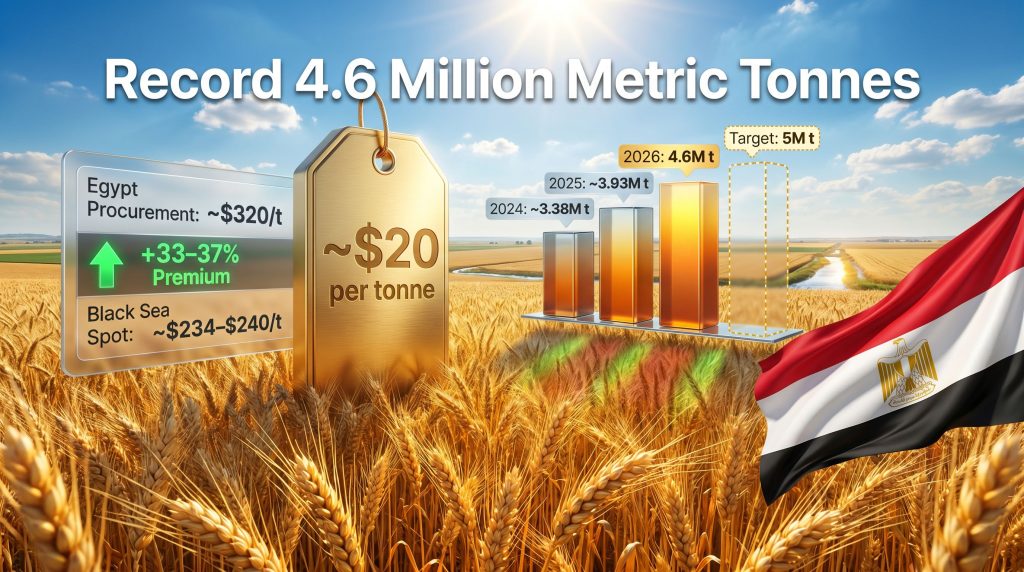
For the 2026 season, that procurement price reached approximately $320 per tonne — a figure that represents a premium of roughly $80–$86 per tonne over Black Sea wheat spot prices of $234–$240 per tonne recorded in June 2026. Expressed differently, Egypt is paying approximately 33–37% above global market rates to secure domestic supply.
| Price Reference | Per Tonne (USD) | Context |
|---|---|---|
| Egypt domestic procurement price (2026) | ~$320 | State-set above-market rate |
| Black Sea wheat spot price (June 2026) | ~$234–$240 | Primary international benchmark |
| Premium above international price | ~$80–$86 | Implicit farmer subsidy |
| Premium as % of international price | ~33–37% | Policy cost indicator |
In the preceding 2025 season, the procurement price was structured at 2,500 Egyptian pounds per ardeb — with one ardeb equating to 150 kilograms of wheat — reflecting a similar intent to attract supply away from private channels. According to reporting from the Daily News Egypt, the local procurement price has now surpassed global rates, underscoring the deliberate nature of this above-market strategy. The mechanism functions simultaneously as an agricultural subsidy to farmers and as a strategic reserve-building tool for the state.
What makes this approach analytically interesting is that it uses pricing not just as a procurement instrument but as a production incentive. By guaranteeing above-market returns before planting decisions are made, the state effectively pre-purchases a portion of the harvest before a single seed goes into the ground.
Egypt's 2026 Wheat Procurement Season: The Numbers Behind the Record
Egypt purchased a record 4.6 million metric tonnes of domestically grown wheat during the 2026 procurement season, surpassing the prior season's total of approximately 3.9 million tonnes and continuing a multi-year upward trend confirmed by USDA/FAS data. Prime Minister Mostafa Madbouly publicly confirmed that the 4.6 million tonne figure represented an all-time procurement high for the country.
With the procurement window remaining open through mid-August, the government's stated target of 5 million tonnes appeared achievable at the time of reporting. Detailed analysis of Egypt's domestic wheat procurement targets and progress is also documented in USDA/FAS reporting on Egypt's harvest season.
| Season | Procurement Volume | Year-on-Year Change |
|---|---|---|
| 2024 season | ~3.38 million tonnes (est.) | Baseline |
| 2025 season | ~3.93 million tonnes | +~16% |
| 2026 season (to date) | 4.6 million tonnes | +~17% |
| 2026 full-season target | 5 million tonnes | Target |
The consistency of the growth trajectory is notable. Three consecutive seasons of meaningful volume gains suggest this is a structural shift in Egypt's agricultural supply chain rather than a weather-driven anomaly.
What Drove the Expansion: Planted Area, Yields, and Farmer Economics
The production gains behind Egypt's record procurement season were driven by a combination of policy design and on-the-ground agricultural response. Ahmad Idam, head of the services sector at Egypt's agriculture ministry, confirmed to Reuters that wheat cultivation expanded to approximately 3.7 million feddans in the 2026 season, compared to roughly 3.1 million feddans in the prior year — an increase of around 600,000 feddans, or approximately 19%.
This area expansion did not happen by accident. The procurement price made wheat one of the most financially attractive crops available to Egyptian farmers, according to farmer Hussein Abu Saddam, who confirmed to Reuters that the pricing was sufficient to encourage record planted area. Critically, grain trader Hesham Soliman observed that the elevated state price also reduced the incentive for farmers to sell wheat to private traders or divert supply toward animal feed markets — two channels that have historically absorbed a portion of domestic production before it could reach state buyers.
Beyond price signals, improved seed varieties and favourable weather conditions contributed to stronger per-hectare yields during the 2026 season. An economist at Egypt's Agricultural Research Center noted that wheat productivity has been improving steadily over the past decade, supported by better agronomic practices and seed development programmes — a trend that amplifies the area expansion effect on total production volumes.
The combination of area expansion and yield improvement creates a multiplier effect that procurement pricing alone cannot fully explain. Egypt's wheat productivity gains reflect a decade of cumulative investment in agronomy that is now compounding alongside the price incentive mechanism.
The Future of Egypt Agency: State-Directed Agricultural Industrialisation
One of the most structurally significant developments within Egypt's 2026 procurement season is the dramatically expanded contribution of the Future of Egypt for Sustainable Development agency. This military-linked state body, whose mandate centres on desert land reclamation and large-scale agricultural development, supplied approximately 530,000 tonnes of wheat to the procurement system by mid-June 2026.
That figure compares to roughly 200,000 tonnes contributed by the same agency at the close of the previous full season — a near 165% increase in a single year. The agency's rapid scaling reflects the growing role of state-directed agricultural industrialisation as a food security instrument, separate from and complementary to smallholder farmer incentives.
| Procurement Channel | 2025 Season Role | 2026 Season Shift |
|---|---|---|
| GASC (state buyer) | Primary procurement authority | Continues as lead buyer |
| Future of Egypt agency | ~200,000 tonnes contributed | ~530,000 tonnes (+165%) |
| Private sector traders | Growing role in imports/handling | Reduced incentive to capture domestic supply |
| Animal feed market diversion | Historically absorbed some domestic wheat | Reduced by higher state prices |
The Future of Egypt agency's model represents a qualitatively different approach to food security than farmer price incentives. Rather than altering the economics of existing farmland, it creates entirely new productive capacity on reclaimed desert terrain, adding supply that would not otherwise exist within Egypt's agricultural system.
The next major ASX story will hit our subscribers first
Import Substitution Potential: How Far Can Egypt's Domestic Production Go?
With 4.6 million tonnes procured domestically against an annual import requirement of approximately 10 million tonnes, Egypt's domestic production currently satisfies roughly 46% of total national wheat demand. Achieving the 5 million tonne procurement target would push this coverage ratio toward 50% — a threshold with meaningful implications for foreign currency spending and supply chain resilience. Indeed, Australia's resource and energy export challenges demonstrate how commodity-dependent economies must similarly grapple with balancing domestic needs against external market exposures.
Hesham Soliman indicated that larger domestic stockpiles and replenished strategic reserves could meaningfully reduce government import requirements during the second half of 2026. However, analysts caution that the structural constraints on further expansion are real and significant.
| Scenario | Annual Domestic Production Needed | Gap vs. 2026 Procurement | Feasibility Assessment |
|---|---|---|---|
| 50% import substitution | ~5 million tonnes | Achievable in 2026 | High — on track |
| 70% import substitution | ~7 million tonnes | +2 million tonnes beyond target | Medium — requires sustained area expansion |
| Near self-sufficiency (90%) | ~9 million tonnes | +4.4 million tonnes beyond target | Low — land and water constraints significant |
Egypt's water scarcity, particularly the pressures on Nile basin allocation, represents a structural ceiling on agricultural expansion that pricing incentives alone cannot overcome. Any credible long-term self-sufficiency pathway must address irrigation efficiency and water productivity as primary constraints, not secondary ones.
The Bread Subsidy System and the Pending Reform Question
The strategic importance of Egypt's procurement programme cannot be understood independently of the bread subsidy system it supports. Egypt's in-kind food support programme — one of the largest of its kind in the developing world — channels government-procured wheat into subsidised loaves distributed to approximately 70 million beneficiaries. Stronger domestic procurement directly reduces the foreign currency expenditure required to maintain these stocks, easing pressure on Egypt's foreign exchange reserves.
However, the Egyptian government has signalled a potential structural transformation of this system, indicating a possible transition from in-kind food subsidies toward cash-based support mechanisms, with early implementation potentially beginning as soon as mid-2026. If implemented, this reform would fundamentally alter the logic of state wheat procurement.
Under a cash-transfer model, the government's need to physically hold and distribute wheat diminishes considerably. The state would no longer need to procure grain purely to supply subsidised loaves — instead, it would need to ensure that market prices remain stable enough for cash recipients to purchase bread commercially. That is a materially different procurement objective, with different volume requirements and different risk exposures.
Risks, Trade-Offs, and the Fiscal Sustainability Question
Egypt's procurement-led food security strategy involves genuine trade-offs that deserve careful analysis alongside the headline production gains.
Key structural risks include:
-
Fiscal sustainability: Paying a 33–37% premium above global prices is viable when international markets are relatively soft, but becomes increasingly costly if global wheat prices rise sharply
-
Water resource constraints: Expanding cultivated area in a water-scarce environment carries long-term sustainability risks, particularly given ongoing Nile basin allocation pressures involving multiple upstream nations
-
Yield plateau risk: While productivity has improved over the past decade, agronomic limits on output per feddan will eventually constrain the growth that area expansion alone cannot deliver
-
Currency mismatch: The cost of the procurement premium is paid in Egyptian pounds, while savings from reduced imports are denominated in US dollars — creating a structural currency asymmetry in the fiscal calculus
-
Subsidy reform uncertainty: The timing and design of any cash-transfer transition remains unclear, introducing policy risk into medium-term procurement planning
| Risk Factor | Probability | Impact | Mitigation |
|---|---|---|---|
| Global wheat price spike | Medium | High | Diversify sourcing; maintain strategic reserves |
| Water scarcity limiting expansion | High | Medium-High | Invest in irrigation efficiency |
| Fiscal cost of price premium | Medium | Medium | Tie prices to productivity benchmarks |
| Subsidy reform disrupting procurement logic | Medium | High | Phased transition with policy signalling |
| Private sector diversion of domestic supply | Low (currently) | Medium | Maintain price premium above private trade |
What Egypt's Strategy Reveals About the Future of Food Security Policy
Egypt's experience offers a template — and a cautionary tale — for other import-dependent economies navigating similar food security vulnerabilities. The core insight is that procurement pricing, when set sufficiently above international benchmarks, can generate a genuine agricultural supply response: more land planted, more supply directed toward state buyers, and more strategic reserves built. For comparison, Canada's energy and economic transition challenges illustrate how resource-dependent nations more broadly face comparable pressures when attempting to balance domestic production incentives against global market realities.
However, the strategy works precisely because international wheat prices are currently relatively low. A $320 per tonne procurement price represents a manageable premium over $234–$240 per tonne Black Sea spot prices. If global markets were to tighten toward $400 per tonne — a scenario that is not historically unprecedented — the fiscal arithmetic of above-market domestic procurement would become considerably more challenging.
This is a critically underappreciated dimension of Egypt's current success: the policy is working in part because of the external market environment, not only because of the policy design itself. Sustaining this approach through a global wheat price cycle will test whether the institutional architecture is robust enough to deliver results under less favourable conditions.
Egypt's record 4.6 million tonne domestic procurement season, the 19% expansion in cultivated wheat area, the near-165% surge in contributions from the Future of Egypt agency, and the Egypt local wheat procurement premium pricing strategy that underpins it all represent a significant and measurable step toward reducing the country's vulnerability to international grain market volatility. Whether that progress can be sustained, deepened, and eventually freed from its dependence on above-market pricing subsidies — in a manner comparable to how US fertiliser dependency reflects another nation's struggle with agricultural input vulnerability — will ultimately determine whether this season is remembered as a turning point or a temporary high-water mark.
Disclaimer: This article is intended for informational purposes only and does not constitute financial, investment, or policy advice. Forward-looking statements, procurement targets, and scenario projections involve inherent uncertainty and should not be relied upon as predictions of future outcomes. Readers are encouraged to consult primary sources and qualified advisors before making decisions based on the information presented here.
Want to Know Which Commodity Discoveries Could Signal the Next Major Market Opportunity?
Whilst Egypt's wheat procurement strategy highlights how supply chain vulnerabilities reshape entire economies, mineral commodity markets face equally transformative shifts — and Discovery Alert's proprietary Discovery IQ model delivers real-time ASX mineral discovery alerts straight to subscribers, turning complex commodity data into actionable investment insights. Explore historic discovery returns on Discovery Alert's dedicated discoveries page and begin your 14-day free trial to position yourself ahead of the broader market.