June 12, 2026
Europe's Primary Aluminium Gap and Why It's Becoming Impossible to Ignore
The global aluminium industry is undergoing one of its most significant structural shifts in decades. Decarbonisation mandates are tightening, procurement standards are rising, and the industrial buyers who once treated aluminium as a pure commodity are now demanding verified emissions credentials alongside every tonne they purchase. Against this backdrop, the Arctial low-carbon aluminium project in Finland emerges as a direct and concrete response to a continent navigating an increasingly uncomfortable supply vulnerability.
Europe consumes primary aluminium at scale, yet its domestic production base has been contracting rather than expanding for the better part of three decades. The combination of high energy costs, legacy infrastructure, and competitive pressure from lower-cost producers elsewhere has steadily eroded the region's self-sufficiency in a metal that now sits at the heart of electric vehicles, renewable energy infrastructure, aerospace systems, and sustainable packaging.
The question that European industrial policy has been slowly confronting is not whether domestic primary production capacity matters, but how to rebuild it in a way that aligns with the continent's decarbonisation commitments. Furthermore, Europe's critical minerals supply chain challenges make this question even more pressing.
When big ASX news breaks, our subscribers know first
What the Arctial Project Actually Is
Arctial is a proposed primary aluminium production facility being developed for the Kokkola-Kruunupyy region on Finland's west coast. The project is structured as a joint venture between seven partners, each contributing a distinct capability to the consortium:
| Partner | Strategic Contribution |
|---|---|
| Rio Tinto | AP60 advanced smelting technology access |
| Fortum | Low-carbon electricity sourcing and energy strategy |
| ABB | Industrial automation and electrification systems |
| Mitsubishi Corporation | Global trading networks and commercial structuring |
| Siemens Financial Services | Project financing and capital structuring |
| Tesi | Finnish Industry Investment anchoring and domestic capital |
| Vargas | Strategic development and project coordination |
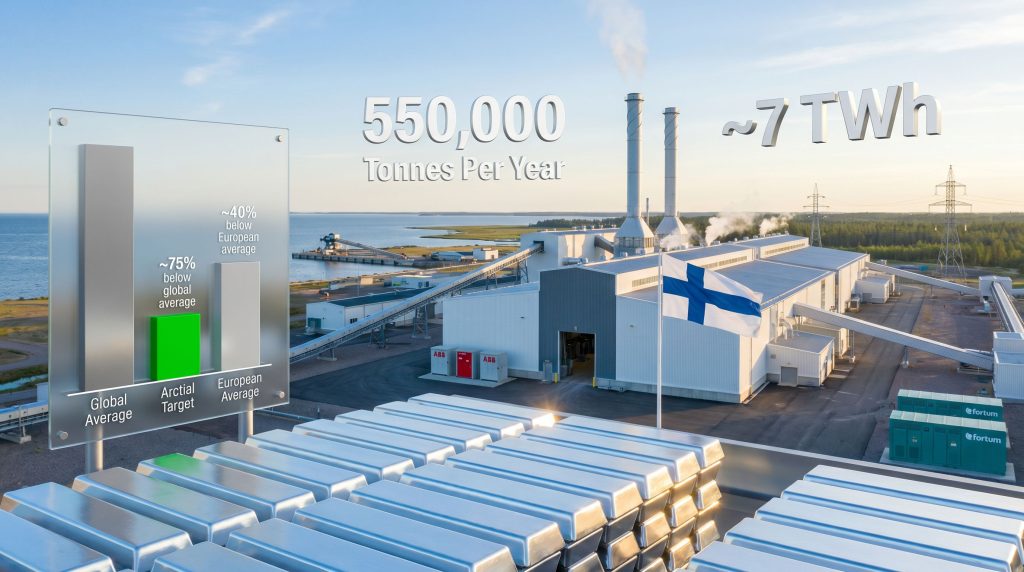
The facility is designed to produce approximately 550,000 tonnes of primary aluminium per year, consuming roughly 7 terawatt-hours of electricity annually. To contextualise that electricity demand, 7 TWh is comparable to the annual power consumption of a mid-sized European city, which speaks to both the industrial ambition of the project and the importance of securing reliable, low-carbon baseload power.
Following the successful completion of its Pre-Feasibility Study (PFS), the consortium has agreed to advance into detailed technical, commercial, and financial planning. The Environmental Impact Assessment was submitted in May 2026, with public hearings in the Kokkola-Kruunupyy region scheduled for summer 2026.
Why AP60 Technology Is Central to the Project's Commercial Logic
Technology selection in aluminium smelting is not a secondary consideration. The choice of reduction technology determines a smelter's energy consumption per tonne of output, its emissions profile, its maintenance economics, and ultimately its competitive position in markets where carbon credentials are becoming a pricing variable.
Rio Tinto aluminium operations have long been associated with advancing smelting efficiency, and the AP60 technology represents one of the most advanced commercial-scale smelting processes currently in deployment. It belongs to the AP family of smelting technologies, which are point-feeder prebake (PFPB) designs that have progressively improved amperage, cell efficiency, and emissions performance across successive generations.
The AP60 designation refers to an operating amperage of approximately 600 kiloamperes, which enables higher per-cell productivity while maintaining tighter process control compared to legacy Hall-Héroult designs operating at lower amperages. For the Arctial project, AP60 technology matters for several interconnected reasons:
- Higher amperage operation translates to greater aluminium output per reduction cell, improving capital efficiency at the facility level
- Improved process control reduces anode effects, which are a significant source of perfluorocarbon (PFC) emissions in conventional smelting
- Lower energy intensity per tonne of aluminium directly reduces the facility's electricity cost, which represents the dominant variable cost in any smelter operation
- The technology's emissions profile, combined with Finland's low-carbon grid, creates the conditions for genuinely differentiated product
This last point is where the strategic logic becomes most compelling. Aluminium's carbon footprint is determined primarily by two variables: the carbon intensity of the electricity used in reduction, and the efficiency of the reduction process itself. Arctial is attempting to optimise both simultaneously.
The Electricity Question: Why Finland's Grid Changes the Calculation
Primary aluminium production is extraordinarily energy-intensive. Producing one tonne of aluminium via the Hall-Héroult process typically requires between 13 and 15 megawatt-hours of electricity, making the carbon intensity of the local grid the single largest determinant of a smelter's lifecycle emissions profile.
Finland's electricity mix is among the lowest-carbon in Europe. The country's generation portfolio includes significant nuclear capacity, hydropower, wind, and a grid interconnected with the broader Nordic system. This combination creates a baseload electricity environment that is structurally well-suited to energy-intensive industrial operations seeking to minimise their emissions footprint.
Fortum's involvement in the Arctial consortium addresses this variable directly. As a major Nordic energy company with extensive low-carbon generation assets, Fortum brings both supply-side capability and the commercial expertise to structure long-term power purchase agreements that de-risk the smelter's operating economics. In capital-intensive industrial projects, long-term energy cost certainty is often as important to financing viability as the underlying technology.
The significance of Fingrid's signed Letter of Intent for grid connection should not be understated in this context. Grid connection at the scale Arctial requires is not a formality. Securing indicative grid access at the pre-feasibility stage represents meaningful de-risking of one of the project's most critical infrastructure dependencies.
Quantifying the Carbon Advantage: How Arctial Compares to Global Benchmarks
The emissions case for the Arctial low-carbon aluminium project rests on a combination of the AP60 process advantage and Finland's low-carbon electricity mix. The project targets a carbon footprint that sits roughly 40% below the European primary aluminium average and potentially up to 75% below the global average for primary aluminium production.
| Production Benchmark | Relative Carbon Intensity |
|---|---|
| Global primary aluminium average (coal-heavy grid baseline) | 100% |
| European primary aluminium average | Lower than global average |
| Arctial's projected output | ~40% below European average / ~75% below global average |
To understand why these figures matter commercially, consider that the aluminium sector is one of the most carbon-intensive industries in manufacturing, accounting for roughly 2% of global greenhouse gas emissions. The global average carbon footprint of primary aluminium production sits at approximately 16.5 tonnes of CO2-equivalent per tonne of metal, driven largely by coal-powered smelters in China and other markets.
European production is already cleaner on average, but even against that benchmark, Arctial's projected performance represents a meaningful step change. For industrial buyers facing Scope 3 emissions reporting obligations, and for sectors such as automotive and aerospace where product-level carbon declarations are increasingly required, the difference between Arctial's projected output and conventionally produced aluminium is not marginal. It is commercially significant.
Carbon Border Adjustment Mechanisms and the CBAM Effect
One of the less discussed but structurally important tailwinds for the Arctial low-carbon aluminium project is the European Union's Carbon Border Adjustment Mechanism (CBAM). CBAM is designed to impose a carbon price on imports of carbon-intensive goods entering the EU, with the explicit aim of preventing carbon leakage whereby European manufacturers face a competitive disadvantage against producers in jurisdictions with lower or no carbon pricing.
Aluminium is one of the sectors covered by CBAM. As the mechanism moves through its transitional phase and begins full implementation, imported aluminium from high-emissions jurisdictions will face an increasingly significant cost adjustment at the EU border. This has two interconnected effects on projects like Arctial:
- It narrows the cost advantage that high-emission foreign producers currently hold over domestically produced European aluminium
- It creates a price premium pathway for verified low-carbon domestic production by effectively penalising the emissions-intensive competition
For the Arctial consortium, CBAM represents a structural shift in the economics of European aluminium production rather than a temporary subsidy or policy preference. As carbon border pricing intensifies, the competitive positioning of a high-efficiency, low-carbon smelter operating on Finland's clean grid becomes progressively more defensible on pure commercial grounds.
The next major ASX story will hit our subscribers first
The Kokkola-Kruunupyy Location: Industrial Logic Behind the Choice
Site selection for a primary aluminium smelter involves balancing electricity access, port logistics for incoming alumina supply, grid connection capacity, workforce availability, and regulatory environment. The Kokkola-Kruunupyy region on Finland's west coast offers a combination of these factors that makes it a credible location for large-scale industrial investment.
The Kokkola industrial zone already hosts significant chemical and battery materials processing operations, which means the area has established precedent for energy-intensive industrial activity, existing grid infrastructure, and port access capable of handling bulk material imports. Aluminium smelting requires a continuous supply of alumina refined from bauxite, typically imported from producing regions in Australia, West Africa, and the Caribbean.
Finland's regulatory environment, while thorough, operates within EU industrial policy frameworks that have been progressively aligned with the need to accelerate domestic strategic materials production. The EIA process that Arctial entered in May 2026 reflects this regulatory context, with public hearings providing the community consultation mechanism required before any major industrial facility can proceed to construction approval.
Project Timeline: Where Arctial Stands and What Comes Next
Understanding where the Arctial project sits in its development lifecycle is important for contextualising the significance of recent milestones. Primary aluminium smelters are among the most capital-intensive industrial assets ever constructed, with development timelines typically spanning a decade or more from initial concept to first metal production.
Early 2025       → Feasibility study initiated
May 2026         → Environmental Impact Assessment submitted
Summer 2026      → Public hearings scheduled in Kokkola-Kruunupyy region
2026–2027        → Final Investment Decision (FID) expected
~2029            → Potential commencement of production (subject to FID)
Completing the Pre-Feasibility Study is a meaningful stage gate in this process. A PFS involves sufficient engineering, environmental, and commercial analysis to allow partners to make an informed decision about whether to commit the significantly larger resources required for a full Feasibility Study and ultimately a Final Investment Decision.
The consortium's agreement to proceed to the next phase signals that the PFS outcomes were sufficiently positive to justify continued investment. Arctial's CEO Torbjörn Sternsjö has acknowledged that the PFS completion, while a significant achievement, represents one milestone on a longer path. Substantial additional work across construction planning, energy contracting, and environmental approvals remains before a Final Investment Decision can be made.
What Still Needs to Happen Before a Final Investment Decision
Several critical workstreams must reach sufficient resolution before the Arctial consortium can commit to construction:
- Environmental approvals: The EIA process must run its course, incorporating public consultation outcomes and any design modifications required to satisfy regulatory requirements
- Construction planning: Detailed engineering and contractor procurement for a facility of this scale involves significant pre-FID investment in itself
- Energy contracting: Long-term power purchase agreement terms must be finalised to provide the cost and supply certainty required by project financiers
- Commercial offtake: While European demand for low-carbon aluminium is growing, binding commitments from industrial customers provide critical revenue certainty for financing
- Capital structure: Siemens Financial Services' involvement addresses this workstream, but assembling the combination of equity, debt, and potentially public financing instruments for a project of this magnitude is a complex undertaking
The resolution of these workstreams is interdependent. Financing cannot be finalised without offtake certainty; offtake discussions are influenced by the project's environmental approval status; construction contracts cannot be awarded without financing commitments. Managing these interdependencies is one of the defining challenges of large industrial project development.
Arctial's Significance for European Industrial Sovereignty
Board Chairman Pekka Vauramo has described the Arctial project as sitting at the forefront of Europe's re-industrialisation, with the potential to generate meaningful employment in the Kokkola-Kruunupyy region and contribute to Finland's broader economic development. This framing reflects a wider debate about European industrial policy that extends well beyond aluminium.
The European Commission's critical raw materials supply framework, established under the Critical Raw Materials Act which came into force in 2024, identifies aluminium as a strategic material and sets targets for domestic processing capacity as a share of European consumption. While this regulatory framework does not constitute project-specific support for Arctial, it does reflect the policy environment in which the project is being developed.
The broader re-industrialisation agenda encompasses several parallel sectors where Europe is attempting to rebuild domestic capacity:
- Battery cell manufacturing and critical mineral processing
- Semiconductor fabrication
- Clean hydrogen production
- Strategic metals refining
Aluminium sits within this cluster not only because of its strategic material classification but because it is a foundational input for the very technologies at the centre of Europe's energy transition. Electric vehicles require aluminium for lightweighting; wind turbines use aluminium components; solar installations rely on aluminium framing and inverter housings. A European primary aluminium supply deficit is therefore a constraint on the energy transition itself, not merely an industrial inconvenience.
The Certification Dimension: Proving the Carbon Claims
For low-carbon aluminium to command a price premium in European markets, the carbon credentials must be verifiable by buyers, not merely asserted by producers. This is where industry certification frameworks become commercially relevant.
The Aluminium Stewardship Initiative (ASI) provides a certification framework covering environmental, social, and governance performance across the aluminium value chain. ASI Performance Standard certification and ASI Chain of Custody certification together allow buyers to make verified claims about the sustainability attributes of the aluminium in their products.
Environmental Product Declarations (EPDs) provide a complementary mechanism, quantifying the lifecycle emissions of specific aluminium products in a format recognised by construction and manufacturing sectors for inclusion in building certifications and product carbon footprint disclosures. For Arctial's output to achieve commercial recognition as premium low-carbon metal, third-party verification through frameworks like these will be essential.
In addition, the broader competitive context is shifting. Among the top aluminium producers globally, those investing in certified low-carbon output are increasingly capturing premium market segments that legacy producers cannot easily access. Furthermore, comparable initiatives such as the low-carbon aluminium joint venture being pursued elsewhere demonstrate that Arctial is part of a wider industry movement rather than an isolated experiment.
The emissions performance numbers cited during project development must ultimately be backed by independently audited production data. ABB's involvement in the project underscores the industrial automation and electrification expertise being deployed to ensure that performance targets translate into verified operational reality.
Frequently Asked Questions: Arctial Low-Carbon Aluminium Project in Finland
What is the Arctial project in Finland?
Arctial is a proposed low-carbon primary aluminium production facility being developed for the Kokkola-Kruunupyy region on Finland's west coast. A seven-partner consortium including Rio Tinto, Fortum, ABB, and Mitsubishi Corporation is advancing the project toward a Final Investment Decision, with the objective of producing approximately 550,000 tonnes of aluminium per year at significantly below-average carbon intensity.
Who owns the Arctial aluminium project?
The project is structured as a joint venture between seven partners: Rio Tinto, Mitsubishi Corporation, Fortum, ABB, Vargas, Tesi (Finland's state-backed industry investment fund), and Siemens Financial Services. Each partner contributes specific expertise spanning smelting technology, energy supply, industrial automation, global trading, strategic development, and project financing.
When will the Arctial smelter begin production?
Subject to a positive Final Investment Decision, which the consortium anticipates between 2026 and 2027, production could potentially commence around 2029. The project is currently progressing through detailed feasibility, environmental assessment, and stakeholder consultation phases.
What technology will Arctial use?
Arctial will deploy Rio Tinto's AP60 smelting technology, one of the most energy-efficient commercial-scale aluminium reduction processes available, operating at approximately 600 kiloamperes with improved process efficiency compared to legacy reduction technologies.
How does Arctial's carbon footprint compare to existing production?
The project targets a carbon footprint roughly 40% below the European primary aluminium average and potentially up to 75% below the global average, driven primarily by Finland's low-carbon electricity mix and the efficiency advantages of AP60 technology.
Why was Finland chosen for the facility?
Finland offers a combination of low-carbon baseload electricity through its nuclear, hydro, and wind generation portfolio, established industrial infrastructure in the Kokkola region, grid connection capacity through Fingrid, and a stable regulatory environment within EU industrial policy frameworks.
Key Takeaways
- The Arctial low-carbon aluminium project in Finland represents the most advanced proposal for a new primary smelter on the European continent in over three decades, addressing a structural supply gap that European industrial policy has been slow to confront
- A seven-partner consortium structure distributes risk and brings together the specific capabilities required to develop a project of this technical and financial complexity
- AP60 technology and Finland's low-carbon grid together create the conditions for aluminium with a carbon footprint well below both European and global production averages
- CBAM is reshaping the economics of aluminium production in Europe, progressively reducing the cost advantage of high-emission imported metal and improving the commercial case for domestic low-carbon production
- The path to a Final Investment Decision involves resolving interconnected workstreams across environmental approval, energy contracting, commercial offtake, and capital structure
- If completed, a 550,000-tonne facility consuming 7 TWh annually would represent one of Europe's largest single-site primary aluminium operations and a concrete expression of the continent's re-industrialisation ambitions
This article is intended for informational purposes only and does not constitute financial or investment advice. Forward-looking statements regarding project timelines, production targets, and emissions performance are subject to material risks and uncertainties. Readers should conduct independent research before making any investment or commercial decisions based on information contained herein.
Want to Stay Ahead of Major ASX Mineral Discoveries Before the Broader Market Does?
Discovery Alert's proprietary Discovery IQ model delivers real-time alerts on significant ASX mineral discoveries across aluminium and over 30 other commodities, instantly translating complex mineral data into actionable investment insights for traders and long-term investors alike — begin your 14-day free trial today and gain a market-leading edge, or explore Discovery Alert's dedicated discoveries page to understand how historic mineral discoveries have generated substantial returns.