
June 24, 2026
The Invisible Drain: Understanding Africa's $89 Billion Illicit Financial Flows Crisis
Across global development discussions, a persistent misconception frames Africa as a continent dependent on external generosity. The reality is considerably more troubling. Africa illicit financial flows represent one of the most consequential and least understood drains on the continent's development potential. Africa is not a net recipient of global capital; it is, by most credible estimates, a net exporter of it. Every year, tens of billions of dollars quietly leave the continent through mechanisms that are poorly understood by the general public yet deeply consequential for African economies, public services, and long-term development trajectories.
The scale of this outflow is not a minor fiscal inefficiency. It represents a structural wound that undermines the continent's capacity to fund its own future, and addressing it requires far more than conventional anti-corruption campaigns or law enforcement crackdowns.
When big ASX news breaks, our subscribers know first
Africa's Resource Paradox: Wealth Without Revenue
Africa holds some of the world's most significant concentrations of natural resources. The continent accounts for a substantial share of global reserves in oil, gold, diamonds, cobalt, manganese, and a range of other strategically vital commodities. Furthermore, the critical minerals demand surge globally has only amplified the pressure on these resources. Yet governments across the continent consistently face widening gaps between the revenues they collect and the investment required to fund basic infrastructure, healthcare, and education.
This contradiction has a specific structural explanation. A significant portion of the economic value generated by Africa's resource wealth does not remain within African borders. It exits through a set of financial practices collectively described as illicit financial flows (IFFs), a term that encompasses everything from deliberate trade manipulation at the customs level to sophisticated multinational tax engineering conducted entirely within the letter of current law.
Understanding IFFs requires separating them into their component parts:
- Tax evasion and aggressive tax avoidance by multinational corporations operating in African jurisdictions
- Trade misinvoicing, where the declared value of imports and exports is manipulated to shift money across borders without detection
- Profit shifting and transfer pricing abuse, where related entities within the same corporate group transact at artificial prices to concentrate taxable income in low-tax jurisdictions outside Africa
- Criminal financial flows, including proceeds from illegal trade, fraud, and corruption-related payments
The critical insight from expert testimony delivered at the 2026 ECOWAS Parliament session in Abuja is that commercially driven activities account for at least 65% of all illicit outflows from Africa, according to representatives from the West African Tax Administration Forum (WATAF) and Tax Justice Network Africa (TJNA). This means the majority of Africa's IFF problem is not a crime wave. It is a structural feature of how global commerce and taxation currently interact with African economies.
Quantifying the Bleeding: The Key Numbers
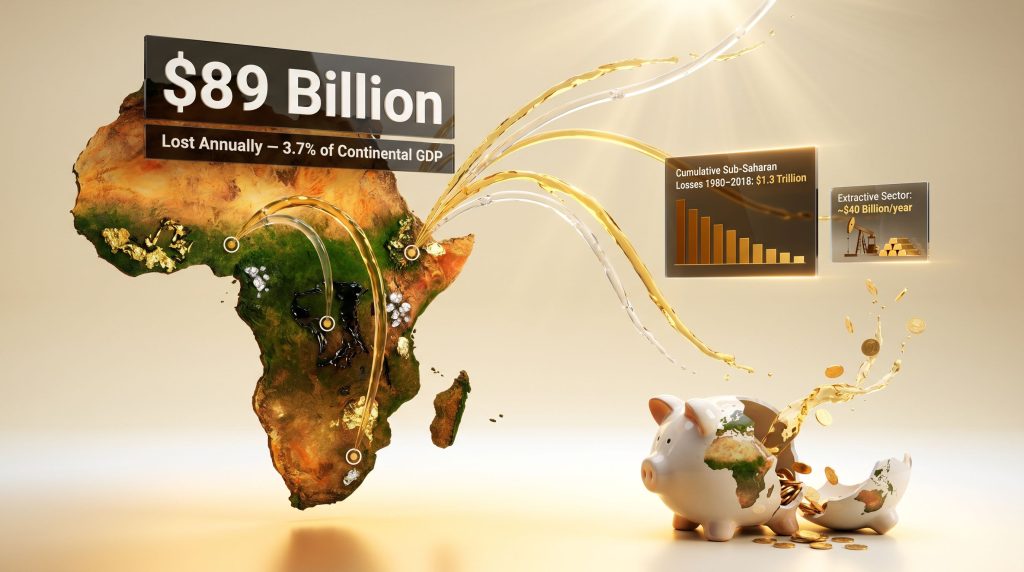
The aggregate figures involved are staggering. Africa loses an estimated $89 billion annually to illicit financial flows, a figure derived from UNCTAD analysis and widely cited across development finance literature. To contextualise that number:
| Metric | Estimated Figure |
|---|---|
| Annual IFF losses (UNCTAD estimate) | ~$89 billion |
| Annual domestic resource mobilisation gap | ~$194 billion |
| Share of IFFs from commercial activity | At least 65% |
| Potential development financing gap reduction if IFFs curtailed by one-third | ~33% |
The $194 billion domestic resource mobilisation shortfall, cited by WATAF and TJNA experts addressing ECOWAS lawmakers in May 2026, represents the gap between what African governments currently collect and what they need to fund development at a meaningful scale. The relationship between these two figures is direct: every dollar lost through illicit channels is a dollar unavailable for domestic investment. If IFF outflows were reduced by even one-third, analysts estimate it could close Africa's development financing gap by approximately 33%, reducing dependence on external borrowing and foreign aid.
Reducing Africa's illicit financial flows by one-third could close the continent's development financing gap by an estimated 33%, equivalent to unlocking tens of billions of dollars annually for infrastructure, healthcare, and public services without increasing external debt.
How Capital Leaves: The Primary Mechanisms
Trade Misinvoicing and Commodity Opacity
The most prevalent channel through which capital exits Africa is trade misinvoicing, a practice involving the deliberate misrepresentation of the price, quantity, or quality of goods in cross-border trade documentation. By understating the value of exports or overstating the value of imports, corporations and traders can move money across borders without triggering regulatory scrutiny.
This practice is particularly widespread in high-value commodity sectors. Oil, gold, and diamonds share a set of characteristics that make them especially vulnerable:
- High unit value relative to volume, enabling large sums to be shifted through small discrepancies
- Complex pricing structures that are difficult to independently verify at the point of customs inspection
- Long and opaque supply chains that create multiple intervention points for manipulation
- Limited in-country processing, meaning raw commodities often leave before value-adding stages that would generate additional taxable revenue
The opaque nature of these commodity markets means even well-resourced customs authorities struggle to detect systematic misinvoicing without access to detailed market intelligence and international trade data comparisons. Global Financial Integrity's research on trade-related illicit flows has documented the scale of this problem across African trade corridors, offering some of the most detailed available evidence on the phenomenon.
Base Erosion and Profit Shifting by Multinational Corporations
Transfer pricing abuse sits at the heart of the commercial IFF problem. When a multinational corporation sells goods or services between its own subsidiaries in different countries, it sets the price of those internal transactions. By pricing those transactions artificially, it can shift profits from high-tax African jurisdictions to low-tax jurisdictions elsewhere, reducing its taxable income in the country where the economic activity actually occurs.
The power asymmetry involved here is considerable. African tax authorities typically operate with far smaller budgets, less specialised staff, and inferior data systems compared to the multinational enterprises they are tasked with auditing. This creates a structural disadvantage that no amount of political will alone can fully overcome without institutional investment and international cooperation. The broader geopolitical mining landscape also shapes how these dynamics play out, as strategic resource competition intensifies pressure on African governments.
The IFF Composition Breakdown
| IFF Category | Estimated Share |
|---|---|
| Commercial activity (tax evasion, profit shifting, misinvoicing) | At least 65% |
| Criminal activity | ~30% |
| Corruption and bribery | ~5% |
This composition matters enormously for policy design. If criminal flows dominated the picture, the primary response would logically be law enforcement and anti-money laundering frameworks. Because commercial activities dominate, the more impactful interventions are tax transparency, multinational corporation oversight, and trade data verification.
Digital Assets as an Emerging IFF Vector
A newer challenge is the growth of digital asset markets across Africa. Kenya's domestic digital asset market is valued at an estimated $18.5 billion, and regulators are now moving to require cryptocurrency exchanges to disclose customer identities and transaction records under proposed new tax rules, according to Business Insider Africa. The potential for crypto-denominated transfers to obscure the origin and destination of capital flows represents a growing frontier in the IFF challenge, one that existing regulatory frameworks were not designed to address.
Geographic Concentration: Which Countries Bear the Greatest Burden?
IFF exposure is not evenly distributed across the continent. A significant proportion of total outflows is concentrated in a relatively small number of economies.
South Africa, Nigeria, the Democratic Republic of Congo, and Ethiopia collectively account for a majority of Africa's total illicit financial outflows, according to Brookings Institution analysis covering the period from 1980 to 2018. Angola has also been identified as a significant high-exposure economy, with extractive sector opacity and fiscal governance challenges compounding the problem.
However, a less commonly discussed dimension of the IFF picture is the disproportionate impact on smaller economies. Nations including Gambia, Sierra Leone, and São Tomé and Príncipe lose sums that, in absolute dollar terms, are smaller than those attributed to major economies, but which represent a far larger share of their total trade. When IFF losses exceed 40% or 50% of a small nation's total trade flows, the macroeconomic impact is catastrophic relative to the size of the economy.
The IFF burden on small African states is often overlooked in continental aggregates. Countries like Gambia and Sierra Leone may lose proportionally more to illicit flows than Nigeria or South Africa, even if the absolute dollar figures appear smaller.
The Extractive Industries Problem: Where the Losses Are Largest
The extractive sector, encompassing mining, oil, and gas production, accounts for a disproportionate share of Africa's total IFF exposure. The UN Economic Commission for Africa has estimated annual losses from this sector alone at approximately $40 billion.
Several structural features of the extractive sector drive this vulnerability:
- Opaque licensing arrangements that are rarely subject to meaningful public disclosure
- Tax incentive packages granted to attract foreign investment that are often excessively generous and inadequately monitored
- Weak beneficiation requirements, meaning raw resources are exported with minimal processing, leaving value-added revenue to be captured in foreign jurisdictions
- Transfer pricing susceptibility in commodity transactions between multinational parent companies and their African subsidiaries
Addressing this requires more than tightening royalty collection. Solomon Adoga, speaking at the May 2026 ECOWAS Parliament session, argued that Africa must actively protect its taxing rights over natural resources, with stronger scrutiny of tax incentives granted to extractive companies forming a central pillar of that effort, as reported by Business Insider Africa.
Zandile Ndebele, also addressing parliamentarians at the same session, made the case for domestic beneficiation legislation, noting that retaining processing and manufacturing activity within African borders offers a pathway to capturing resource revenues beyond what taxes on raw exports can deliver. Consequently, reforms to the mining claims framework and related regulatory structures in resource-rich jurisdictions are increasingly seen as models worth examining.
The next major ASX story will hit our subscribers first
West Africa's Response: The ECOWAS Tax Harmonisation Agenda
Why Regional Coordination Is Structurally Necessary
Within the ECOWAS bloc, inconsistent national tax systems create structural arbitrage opportunities that facilitate both smuggling and profit shifting. A corporation operating across multiple West African jurisdictions can exploit differences in tax rates, exemption rules, and transfer pricing regulations to minimise its overall tax burden across the region. Without harmonised rules, each individual member state is effectively competing against the others in a race that depresses collective tax revenue.
According to WATAF and TJNA representatives addressing the ECOWAS Parliament in Abuja, tax harmonisation functions as the foundational fiscal architecture of deeper regional integration. Without it, loopholes, smuggling, opacity, and profit shifting will continue to erode the regional revenue base, as Business Insider Africa reported. The African Development Bank's work on illicit financial flows similarly underscores how cross-border revenue leakage undermines the continent's broader development financing architecture.
The Five Pillars of Effective Implementation
WATAF's Jonas Igwe, speaking at the 2026 ECOWAS Parliament session, outlined the prerequisites for effective operationalisation of the ECOWAS tax harmonisation framework as reported by Business Insider Africa. These requirements cover five interconnected dimensions:
- Political commitment from heads of state and finance ministers across member states
- Institutional coordination between national tax authorities to align practices and share capacity
- Digital modernisation of tax administration systems to create auditable transaction records
- Sustained regional cooperation, recognising that progress requires multi-year consistency rather than one-off declarations
- Monitoring and evaluation frameworks to assess whether directives are being implemented in practice
Currency Union Is Not a Prerequisite
One important and underappreciated insight to emerge from the ECOWAS discussions is that meaningful progress on tax harmonisation does not require the adoption of a single regional currency. Experts from WATAF and TJNA were explicit on this point: transparency measures, information sharing arrangements, and digital tax reform can all be implemented while member states maintain separate national currencies. This matters because debates over monetary union often distract from achievable near-term fiscal coordination steps.
Dr. Nita Belemaobgo of WATAF emphasised that evidence-based policymaking and stronger regional cooperation could improve accountability and reform outcomes across the ECOWAS bloc, with WATAF actively supporting efforts to align tax directives among member states, according to Business Insider Africa's coverage of the session.
Countries including Nigeria, Ghana, and Côte d'Ivoire have been identified as active advocates within this framework, pushing for fairer allocation of tax rights and stronger regional coordination on transfer pricing rules.
Connecting IFF Losses to Africa's Development Financing Deficit
The $89 billion annual Africa illicit financial flows figure does not exist in isolation. It sits alongside a $194 billion domestic resource mobilisation shortfall that limits governments' ability to fund schools, hospitals, roads, and social safety nets. The arithmetic is straightforward but its implications are profound.
France's recently announced $27 billion Africa investment fund, declared at the Africa-France Partnerships Summit in May 2026, illustrates the scale problem. A pledged commitment of that size, large as it is in absolute terms, represents less than one-third of Africa's annual IFF losses. External investment pledges and development aid cannot substitute for the fiscal sovereignty that would come from retaining the capital that African economies generate in the first place.
Africa receives significant development finance pledges from international partners, but the continent loses more than three times France's recently announced $27 billion investment fund every single year through illicit financial flows alone.
This is why analysts and policymakers increasingly frame IFF reduction not as a technical compliance matter but as a prerequisite for African fiscal sovereignty and self-financed development, particularly in relation to Agenda 2063 and the Sustainable Development Goals, both of which depend heavily on domestic resource mobilisation rather than external borrowing.
What Structural Reform Requires
Tax Transparency and Beneficial Ownership
Beneficial ownership registries, which require companies to publicly disclose the actual human beings who ultimately control them, are among the most effective tools for reducing the ability of shell companies to obscure illicit flows. Without this transparency layer, identifying and challenging abusive transfer pricing or cross-border profit shifting is substantially harder for tax authorities operating with limited resources.
Automatic exchange of financial information between African jurisdictions and international financial centres would complement this, ensuring that capital moved offshore can be tracked and assessed for tax compliance. In addition, how companies manage their global taxes and royalties across multiple jurisdictions offers instructive lessons for policymakers seeking to understand the mechanics of cross-border tax minimisation.
Extractive Sector Legislative Reform
A priority reform agenda for the extractive industries would include:
- Mandatory public disclosure of all tax incentives granted to mining and energy companies
- Systematic review of existing incentive packages against international benchmarks
- Domestic beneficiation requirements embedded in mining legislation
- Revenue transparency as a non-negotiable operating condition for resource extraction licences
Furthermore, the role of mining private equity in structuring investment flows through jurisdictions with favourable tax treatment deserves closer regulatory attention as part of this broader reform agenda.
A Reform Timeline
| Reform Area | Short-Term Priority | Medium-Term Goal |
|---|---|---|
| Tax transparency | Beneficial ownership registries | Automatic information exchange |
| Extractive oversight | Incentive disclosure requirements | Mandatory beneficiation legislation |
| Digital economy | Crypto disclosure frameworks (e.g. Kenya model) | Digital transaction monitoring systems |
| Regional coordination | ECOWAS directive operationalisation | Harmonised transfer pricing rules |
| AML frameworks | Regulatory capacity building | Cross-border enforcement protocols |
Frequently Asked Questions
What are illicit financial flows in Africa?
Illicit financial flows from Africa encompass both strictly illegal transactions, such as the movement of criminal proceeds, and activities that may be technically legal under current rules but are widely recognised as harmful. The second category includes aggressive profit shifting by multinational corporations, trade misinvoicing, and tax avoidance strategies that exploit gaps between different national tax systems.
How much does Africa lose to illicit financial flows each year?
Africa loses approximately $89 billion annually based on UNCTAD estimates. Some methodologies place this figure higher, given the inherent difficulty of measuring flows that are deliberately concealed. This represents roughly 3.7% of continental GDP and is equivalent to more than three times the scale of France's $27 billion Africa investment fund announced in May 2026.
What is the biggest driver of illicit financial flows from Africa?
Commercial activity, specifically trade misinvoicing and multinational corporate tax practices including profit shifting and transfer pricing abuse, accounts for at least 65% of total IFF volume. This means the dominant IFF problem is structural and fiscal rather than primarily criminal.
Which African countries lose the most to illicit financial flows?
South Africa carries the largest absolute IFF burden, with Nigeria, the Democratic Republic of Congo, Ethiopia, and Angola also identified as high-exposure economies. Smaller states including Gambia and Sierra Leone experience comparatively lower absolute losses but face a disproportionate impact relative to their total economic output.
What is ECOWAS doing about illicit financial flows?
At the ECOWAS Parliament session in Abuja in May 2026, representatives from WATAF and Tax Justice Network Africa presented a comprehensive reform agenda to lawmakers, covering tax harmonisation, domestic resource mobilisation, stronger oversight of extractive industries, and digital modernisation of tax administration systems.
Can Africa reduce illicit financial flows without adopting a single currency?
Yes. Experts explicitly stated that tax transparency, information sharing, and digital reform can all proceed independently of monetary union. Fiscal coordination and monetary union are distinct policy domains, and the absence of a single currency is not a barrier to meaningful progress on IFF reduction.
From Revenue Haemorrhage to Fiscal Sovereignty
Africa illicit financial flows represent a well-documented structural constraint on development, one that affects every citizen who depends on public services funded by government revenue. The $89 billion annual figure likely understates the true scale, given the opacity that defines illicit flows by their very nature.
The path toward fiscal sovereignty runs through three interconnected imperatives:
- Institutional capacity building at the level of national tax authorities, equipping them to detect, challenge, and recover revenue lost through profit shifting and misinvoicing
- Legislative reform covering extractive industry oversight, beneficial ownership transparency, domestic beneficiation requirements, and digital asset disclosure
- Regional and international coordination, aligning ECOWAS fiscal frameworks with global standards while asserting Africa-centred taxing rights in multilateral forums
The ECOWAS Parliament discussions of May 2026 represent a meaningful step in this direction, bringing technical expertise from WATAF and Tax Justice Network Africa into direct dialogue with the lawmakers who have the authority to act. Whether that dialogue translates into legislative momentum will determine whether the $89 billion figure is simply a recurring headline or the beginning of a more fundamental fiscal reckoning.
This article incorporates data and expert perspectives reported by Business Insider Africa (May 12, 2026). The figures cited, including the $89 billion annual IFF estimate and the $194 billion domestic resource mobilisation gap, reflect estimates provided by WATAF and TJNA representatives at the ECOWAS Parliament session. These figures are subject to methodological limitations inherent in measuring illicit financial flows. Readers are encouraged to consult primary publications from UNCTAD, the UN Economic Commission for Africa, and Global Financial Integrity for the underlying research. Nothing in this article constitutes financial or investment advice.
Want To Capitalise On The Mineral Discoveries Driving Africa's Resource Wealth?
While billions of dollars flow out of Africa through illicit channels, the underlying mineral wealth driving those figures — from gold and cobalt to critical minerals — continues to generate significant market opportunities for informed investors. Discovery Alert's proprietary Discovery IQ model scans ASX announcements in real time, instantly identifying significant mineral discoveries and delivering actionable alerts before the broader market reacts — explore historic discovery returns on Discovery Alert's discoveries page and begin a 14-day free trial to secure a genuine market-leading edge.