
July 9, 2026
When Extreme Heat Becomes a Battery Problem: The Chemistry Shift Reshaping US Grid Storage
Grid-scale battery storage has long been dominated by a single electrochemical paradigm, and for most temperate climates, that paradigm has worked reasonably well. But the physics of lithium-ion chemistry carry an embedded weakness that becomes increasingly expensive the hotter the ambient environment gets. In the scorched flatlands of the American Southwest, where summer ground temperatures routinely exceed what active cooling systems can manage efficiently, the cost gap between conventional storage and emerging alternatives is no longer academic. It is showing up in project budgets, safety assessments, and, increasingly, in commercial agreements.
The Alsym and Juniper sodium-ion battery storage deal, announced in May 2026, is one of the clearest commercial signals yet that this shift is accelerating beyond the laboratory.
When big ASX news breaks, our subscribers know first
The Thermal Challenge That Lithium-Ion Cannot Easily Escape
Lithium-ion batteries are sensitive to heat in ways that compound across the project lifecycle. At the cell level, elevated temperatures accelerate electrolyte decomposition, increase internal resistance, and speed up the degradation of active materials. At the system level, this means that a battery energy storage system (BESS) deployed in a hot desert environment requires more aggressive thermal management, larger cooling infrastructure, greater energy consumption to run that cooling, and faster capacity replacement cycles than the same system installed in a milder climate.
The thermal runaway problem amplifies the safety dimension considerably. Thermal runaway is a self-reinforcing chain reaction within a lithium-ion cell in which heat generation exceeds the cell's ability to dissipate it. Once triggered, the reaction can propagate through a battery module, then a rack, then an entire container, producing intense heat, toxic gases, and fire. This risk is not theoretical. A short circuit in nickel manganese cobalt (NMC) batteries caused a fire at one of the UK's oldest grid-scale BESS projects in early May 2026, according to reporting by ESS News, underscoring that legacy lithium chemistries carry real-world consequences.
What Active Cooling Actually Costs a Desert Project
The economics of active thermal management in high-temperature environments are less frequently discussed than the safety dimension, but arguably more consequential for project developers. Active cooling systems, typically using vapour compression or liquid cooling loops, add capital expenditure upfront and consume electricity continuously throughout the operational life of the asset. In a Mojave Desert deployment where ambient temperatures can exceed 45 degrees Celsius during summer peaks, cooling loads are substantial and persistent.
Consider a 100 MWh BESS project in a high-temperature desert location using conventional lithium-ion technology. The active cooling infrastructure required adds meaningful upfront capital cost, occupies physical space within each battery enclosure, requires maintenance contracts, and draws parasitic power throughout the day. That parasitic consumption reduces the effective round-trip efficiency of the system and erodes the revenue the project can generate from grid services. Each percentage point of round-trip efficiency lost to cooling represents lost revenue across every cycle for the lifetime of the asset.
A sodium-ion system capable of passive cooling eliminates these costs. Furthermore, the balance of plant becomes simpler, procurement lead times shorten, and the energy consumed in thermal management is redirected to billable discharge. For desert deployments specifically, this is not a marginal advantage. It is a structural one.
What the Alsym and Juniper Sodium-Ion Battery Storage Deal Actually Involves
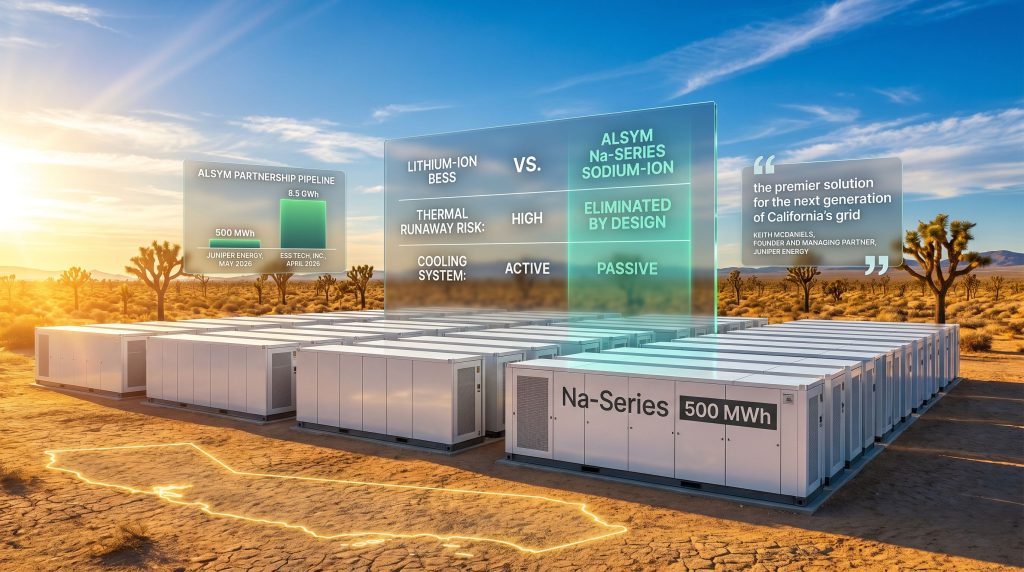
Alsym Energy and Juniper Energy announced a strategic partnership in May 2026 to deploy 500 MWh of sodium-ion battery energy storage systems across California, with an expected focus on Mojave Desert sites. Alsym Energy is headquartered in Massachusetts, while Juniper Energy is a California-based renewables developer.
The agreement centres on Alsym's Na-Series product platform, which the company officially launched in October 2025. The Na-Series is engineered around non-flammable, non-toxic electrochemistry and uses materials that are not sourced from foreign entities of concern, a classification that carries significant commercial implications in the current US trade environment.
Both parties have been explicit about why sodium-ion was chosen over lithium iron phosphate (LFP) or other conventional alternatives. From Alsym's perspective, the Na-Series eliminates thermal runaway risk by design and enables passive cooling operation, which removes the need for the energy-intensive active cooling systems that become progressively more expensive in extreme heat. From Juniper's perspective, the domestic US manufacturing base behind the Na-Series unlocks access to clean energy tax credits under the Inflation Reduction Act that would not be available for imported battery systems.
Mukesh Chatter, CEO and co-founder of Alsym Energy, stated that Juniper Energy recognises the inherent limitations of lithium battery technology in warmer environments and that the Na-Series was specifically built to deliver high-performance, fast-charging storage without requiring complex cooling infrastructure or creating community safety risks. He also highlighted that domestic US manufacturing enables faster and more profitable deployment for developer partners.
Keith McDaniels, founder and managing partner of Juniper Energy, described sodium-ion technology as the optimal solution for the next generation of California's grid, and pointed directly to the tax credit benefit as a project economics driver, noting that US-produced batteries allow the company to maximise available incentives while delivering more cost-effective storage assets to off-takers.
Inside the Na-Series: How Alsym's Sodium-Ion Chemistry Differs
Understanding why sodium-ion is gaining commercial traction requires a brief look at the electrochemical distinctions that matter most for grid-scale deployment. The battery metals landscape is, however, shifting rapidly as new chemistries compete for prominence alongside lithium.
Sodium-ion batteries operate on the same fundamental intercalation principle as lithium-ion cells, shuttling ions between a cathode and anode during charge and discharge cycles. The critical difference lies in the ion being shuttled. Sodium is a more abundant, geographically diversified, and cheaper raw material than lithium. More importantly for thermal management, the electrochemical properties of sodium-ion systems can be engineered to avoid the exothermic decomposition pathways that make lithium-ion cells prone to thermal runaway under stress or elevated ambient conditions.
The following table compares the key performance and safety characteristics relevant to grid-scale desert deployments:
| Feature | Lithium-Ion BESS | Alsym Na-Series Sodium-Ion |
|---|---|---|
| Thermal Runaway Risk | High | Eliminated by design |
| Cooling System | Active (energy-intensive) | Passive (simplified) |
| Balance of Plant Complexity | High | Reduced |
| Flammability | Yes | Non-flammable |
| FEOC Material Exposure | Significant | Avoided |
| Charge/Discharge Rate | Moderate to High | High (multi-cycle daily) |
| Cycle Life Degradation | Moderate | Extended |
The FEOC dimension deserves particular attention. Foreign Entity of Concern (FEOC) restrictions under the Inflation Reduction Act disqualify battery systems incorporating materials or components sourced from designated countries from receiving the full suite of clean energy tax credits. For developers building projects intended to qualify for domestic content bonuses, FEOC exposure is not merely a supply chain inconvenience. It can disqualify a project from credit stacking entirely and materially alter the project's financial model.
Alsym's claim that the Na-Series uses FEOC-free materials is therefore commercially significant beyond the pure technology story. It speaks directly to whether the tax credit mathematics work for project sponsors.
Fast Charging and Multi-Cycle Revenue Potential
One dimension of sodium-ion technology that receives less attention than safety is its rate capability. Sodium-ion cells can generally tolerate faster charge and discharge rates than LFP equivalents without the same degree of degradation. For grid-scale BESS projects, this has real revenue implications. A system capable of completing multiple full charge/discharge cycles per day can participate in more ancillary services markets simultaneously, capturing frequency regulation revenue in the morning, energy arbitrage during midday solar peaks, and capacity payments in the evening demand window.
California's grid is particularly well-suited to multi-cycle revenue strategies given the pronounced duck curve effect created by high solar penetration and the frequency of curtailment events when generation exceeds demand. Storage that can respond quickly and repeatedly to these conditions captures more value from the same installed capacity.
The IRA Tax Credit Dimension: Why Domestic Manufacturing Is a Project Finance Lever
The Inflation Reduction Act introduced a layered tax credit structure for clean energy projects in the United States. The base investment tax credit (ITC) is available to qualifying BESS projects, but domestic content bonuses can add additional percentage points to that credit for projects using US-manufactured components. For a capital-intensive grid-scale storage project, the difference between a base ITC rate and a domestic-content-enhanced rate can represent millions of dollars per project.
For Juniper Energy, Alsym's Massachusetts manufacturing base transforms the Na-Series from a technically interesting product into a financially optimised one. The combination of simplified balance of plant, reduced cooling infrastructure costs, and enhanced tax credit access creates a compressive effect on the project's payback period and improves equity returns for project sponsors. In addition, the battery raw materials advantage of sodium further supports the domestic cost structure.
The domestic content pathway under the IRA does not simply improve project economics at the margin. For developers competing on off-taker pricing in a crowded California market, it can be the difference between a project that pencils and one that does not.
This is the context in which McDaniels framed the Juniper partnership. The ability to deliver more competitive pricing to off-takers is not just a commercial positioning statement. It reflects the real mathematical advantage that US-manufactured, FEOC-free battery chemistry provides in the current project finance environment.
Alsym's Commercial Pipeline: From 500 MWh to 8.5 GWh
The Juniper deal did not emerge in isolation. It followed by less than two weeks the announcement of a much larger letter of intent between Alsym Energy and ESS Tech, Inc., signed in April 2026 for the supply of 8.5 GWh of sodium-ion cells and modules. ESS Tech also added 8.5 GWh of sodium-ion to its battery storage portfolio in a move that signalled broader industry momentum behind this emerging chemistry.
| Partnership | Technology | Scale | Structure | Date |
|---|---|---|---|---|
| Juniper Energy | Na-Series BESS deployment | 500 MWh | Strategic agreement | May 2026 |
| ESS Tech, Inc. | Na-Series cells and modules | 8.5 GWh | Letter of intent | April 2026 |
The ESS Tech partnership is particularly revealing from a market structure perspective. ESS Tech built its business around iron flow battery technology, a long-duration chemistry well-suited to multi-hour discharge but less competitive in the two-to-four-hour duration segment that dominates current procurement. By adding sodium-ion cells and modules to its product portfolio, ESS Tech is positioning itself to address a broader range of duration requirements from a single commercial relationship.
ESS Tech's strategic repositioning comes against a backdrop of financial pressure. The company reported a net loss of $63.4 million for the year ended December 31, 2025, an improvement on the $86.2 million net loss recorded in 2024. Revenue decreased significantly in 2025 as the business worked through a difficult transitional period. In February 2026, ESS Tech acquired the intellectual property and operational assets of VoltStorage, a German iron flow battery developer, strengthening its technical IP base while adding skilled engineering personnel. The Alsym sodium-ion LOI then rounded out a complementary non-lithium storage portfolio spanning short, medium, and long-duration applications.
The strategic logic is worth unpacking. Iron flow batteries offer long-duration characteristics at potentially lower cost per cycle for eight-to-twelve-hour applications. Sodium-ion targets the two-to-six-hour window with faster response and higher power density. Together, they address the full spectrum of grid storage requirements without any lithium-ion chemistry and without significant FEOC exposure.
The next major ASX story will hit our subscribers first
Is Sodium-Ion Ready for Commercial Scale in the US?
Sceptics of sodium-ion technology have historically pointed to lower gravimetric energy density compared to lithium-ion as a limiting factor. Sodium-ion cells currently store less energy per kilogram than comparable lithium-ion systems, which creates challenges for applications where weight and volume are constrained. For stationary grid storage, however, weight is rarely the binding constraint. The more relevant metrics are cost per kWh, cycle life, safety profile, and operational simplicity, and sodium-ion performs competitively across all of these dimensions for ground-mounted grid applications.
The velocity of Alsym's commercial pipeline provides a more practical indication of technology readiness than laboratory metrics alone. Two significant partnerships totalling nearly nine gigawatt-hours of contracted or prospective supply, announced within a two-week window, suggest that the company has cleared the commercial credibility threshold that typically precedes large-scale deployment agreements.
The broader market context reinforces the timing. The Solar Energy Industries Association projected in a widely cited report that US demand for battery energy storage systems would grow sixfold by 2030, driven by renewable integration needs and grid reliability mandates. That scale of growth cannot be met by any single chemistry or any single supplier chain. Consequently, lithium-ion battery recycling considerations, alongside the rise of sodium-ion, reflect a wider industry reckoning with the limitations of a single-chemistry approach. The practical implication is that sodium-ion, flow batteries, and other non-lithium technologies will capture meaningful market share not by displacing lithium-ion entirely, but by serving applications where lithium-ion's specific limitations create cost or safety disadvantages.
The Community Acceptance Factor
One dimension of the non-lithium storage case that is underappreciated in pure financial analyses is the community acceptance dimension. Large-scale BESS projects located in or near populated areas have faced opposition in several US jurisdictions, particularly following high-profile fires at lithium-ion installations. Local planning processes, fire code compliance, setback requirements, and community opposition campaigns add time and cost to project development that rarely appears in headline CapEx figures.
A non-flammable, non-toxic chemistry changes this calculus. Projects using sodium-ion technology face materially lower fire risk profiles, which can simplify permitting discussions with local authorities and reduce the probability of community-led opposition campaigns. In California, where available land for utility-scale projects is increasingly constrained and where communities near proposed sites are often well-organised and well-resourced, this advantage has tangible development value.
FAQ: Alsym and Juniper Sodium-Ion Battery Storage Deal
What is the Alsym and Juniper sodium-ion battery storage deal?
A strategic partnership announced in May 2026 to deploy 500 MWh of Alsym's Na-Series sodium-ion BESS across California, with expected deployment in high-temperature desert environments including the Mojave Desert.
Why is sodium-ion preferred over lithium-ion for the Mojave Desert?
Sodium-ion chemistry eliminates thermal runaway risk and operates effectively with passive cooling, removing the need for energy-intensive active cooling systems that become increasingly costly in extreme heat environments.
What is Alsym Energy's Na-Series?
Launched in October 2025, the Na-Series is a sodium-ion battery energy storage product designed to be non-flammable, non-toxic, and free from materials sourced from foreign entities of concern under US trade regulations.
How does the deal benefit Juniper Energy financially?
By using US-manufactured sodium-ion cells, Juniper can qualify for domestic content tax credits under the Inflation Reduction Act, improving project internal rates of return and enabling more competitive pricing to off-takers.
What other major partnerships has Alsym Energy announced?
In April 2026, Alsym signed a letter of intent with ESS Tech, Inc. for the supply of 8.5 GWh of sodium-ion cells and modules, representing one of the largest non-lithium storage supply agreements in the US market to date.
Is sodium-ion battery storage commercially viable at scale?
The Alsym-Juniper and Alsym-ESS agreements indicate growing commercial confidence in sodium-ion technology, particularly for applications where lithium-ion's thermal and supply chain limitations create meaningful cost and safety disadvantages at deployment.
What This Signals for the Multi-Chemistry Storage Market Through 2030
The Alsym and Juniper sodium-ion battery storage deal is one data point in a broader structural transition that is reshaping how US grid storage projects are conceived, financed, and built. The transition is being driven by the convergence of three forces that are unlikely to reverse in the near term.
- Supply chain security concerns are pushing developers and financiers toward battery chemistries and manufacturers with reduced exposure to foreign-controlled material supply chains. FEOC restrictions have hardened this preference into financial necessity for projects seeking maximum tax credit qualification.
- Climate-driven deployment geography is moving storage projects into environments where lithium-ion's thermal limitations impose the greatest cost penalties. The American Southwest, with its vast solar resource and extreme summer heat, is the epicentre of this dynamic.
- Community acceptance and safety liability considerations are increasingly factoring into development strategies, particularly in California where public scrutiny of battery storage projects has intensified following several high-profile incidents.
Sodium-ion addresses all three vectors simultaneously. It is domestically manufacturable from abundant materials, thermally stable in hot climates, and non-flammable by chemistry. Furthermore, the critical minerals demand picture underpinning these decisions is evolving in ways that further favour diversified, non-lithium chemistries as the decade progresses. Whether this translates into sustained commercial momentum that moves the technology from emerging to mainstream will depend on how well developers like Juniper and technology providers like Alsym execute on the pipeline they are now building.
The projects are not yet built. The agreements are strategic and subject to the usual development risks inherent in early-stage commercial partnerships. Innovations such as direct lithium extraction may yet reshape the lithium cost curve, adding further competitive complexity to the emerging multi-chemistry storage market. However, the directional signal is clear, and the commercial logic is sound.
Disclaimer: This article contains forward-looking statements and analysis based on publicly available information and company announcements. It does not constitute financial advice. Readers should conduct their own due diligence before making investment or commercial decisions. Projections regarding market growth, project economics, and technology performance are inherently uncertain and subject to change.
Want To Stay Ahead of the Next Major Resource Discovery?
Discovery Alert's proprietary Discovery IQ model delivers real-time alerts on significant ASX mineral discoveries — turning complex data across 30+ commodities into clear, actionable insights for both short-term traders and long-term investors. Explore historic examples of exceptional discovery returns and start your 14-day free trial at Discovery Alert to secure your market-leading advantage.