May 12, 2026
When Conflict Meets Capital: The Industrial Logic Behind Long-Cycle Aluminum Investment
Few industrial sectors reveal the tension between short-term disruption and long-term capital commitment as starkly as primary aluminum production. When geopolitical shocks strike energy-intensive manufacturing infrastructure, the conventional expectation is capital retreat, delayed timelines, and revised guidance. Yet history repeatedly shows that the largest, most strategically positioned producers often do the opposite, doubling down on growth precisely when operational turbulence creates the most noise.
Understanding why requires looking beyond the immediate headlines and into the structural economics of aluminum smelting itself. Furthermore, it demands an honest assessment of how top aluminium companies respond to crisis conditions that would unsettle less well-capitalised producers.
The current situation facing Emirates Global Aluminium offers a rare case study in industrial resilience, with EGA aluminum investment plans despite the Iran war remaining firmly intact even as the company manages one of the most significant unplanned smelter outages in recent Gulf industrial history.
When big ASX news breaks, our subscribers know first
The Technical Reality of Smelter Damage: Why Potline Shutdowns Are Not Simple Pauses
Primary aluminum production is one of the most energy-dependent continuous industrial processes on the planet. Electrolytic reduction cells, commonly called potlines, operate at temperatures exceeding 950 degrees Celsius and require uninterrupted direct current supply to maintain liquid aluminum in a workable state. The process cannot simply be switched off and restarted like conventional manufacturing equipment.
When power is severed suddenly and without controlled shutdown procedures, the consequences are severe and technically complex:
- Molten aluminum solidifies inside the potline circuits within hours of power loss
- The solidification process generates extreme thermal stress on the refractory lining materials that protect the pot structure
- Electrical contact systems suffer acute stress from rapid de-energization
- Full restart requires careful thermal cycling, structural inspection, and in many cases, partial or complete relining of damaged cells
- Individual pot relining operations alone can take weeks, and a full potline restoration at scale can extend across many months
This is precisely what makes the forced shutdown of EGA's Al Taweelah smelter in late March 2026, following Iranian military strikes in the UAE, so operationally consequential. This was not a planned maintenance outage with controlled cooling sequences and pre-staged restart equipment. It was an uncontrolled severance of power to one of the largest primary aluminum smelting complexes in the Middle East.
"The distinction between a planned outage and an uncontrolled shutdown is critical for investors assessing recovery timelines. Planned maintenance at a major smelter might result in weeks of reduced output. Uncontrolled shutdowns of the type described at Al Taweelah have historically required recovery periods measured in quarters, not weeks."
EGA has publicly indicated that restoring full output at the Abu Dhabi facility could require up to 12 months, a timeline that reflects the genuine technical complexity involved rather than organisational conservatism.
Scale of the Supply Shock: What Al Taweelah Represented to Global Aluminum Markets
To appreciate the market significance of this single event, the numbers must be placed in context. Al Taweelah's estimated annual production capacity sits in the range of 1.5 to 1.6 million metric tonnes of primary aluminum. For a single facility, that represents an extraordinary concentration of output, and its removal from active production has redrawn global supply flows in ways that markets are still absorbing.
Putting the Disruption in Perspective
| Metric | Figure |
|---|---|
| Al Taweelah estimated annual capacity | ~1.5-1.6 million metric tonnes |
| Share of Middle East smelting capacity offline | Close to 50% |
| Aluminum futures price (May 12, 2026) | $3,314.25 per tonne |
| EGA export share of total output | ~90% |
| Recovery timeline indicated | Up to 12 months |
The removal of close to half of the Middle East's aluminum smelting capacity from global supply chains in a single event is not a localised production hiccup. Buyers across Europe, Asia, and North America who have historically sourced UAE-origin primary aluminum as a cost-competitive, energy-abundant supply stream are now navigating real allocation challenges.
One strategic response EGA has adopted during the Al Taweelah outage is selling significant volumes of alumina, the intermediate feedstock refined before smelting. This inventory management decision serves a dual purpose: it preserves cash flow while physical smelting capacity at the affected site remains offline, and it signals disciplined working capital management during a period of operational constraint.
Critically, EGA's Jebel Ali smelter, also located in the UAE but geographically separated from Al Taweelah, has continued normal operations throughout the conflict period. The Gladstone aluminium operations model offers a useful parallel here, demonstrating how geographic separation within a broader operational footprint can function as a meaningful structural buffer. This design feature has proven invaluable for EGA during the current disruption.
EGA's Strategic Position: A Gulf Giant With Global Ambitions
Emirates Global Aluminium holds the distinction of being the largest aluminum producer in the Gulf region, but the company's strategic footprint extends well beyond its UAE operations. With approximately 90% of its output exported to international customers, EGA functions more as a globally integrated supplier than a domestic industrial producer. This export orientation creates both vulnerability and strategic flexibility.
The vulnerability is obvious: global supply disruptions directly affect EGA's customer relationships and revenue streams. The flexibility, however, is less immediately apparent but equally significant. A company with globally distributed customer relationships also has globally distributed strategic leverage, allowing it to manage supply allocations, realign logistics, and maintain commercial relationships even during periods of impaired domestic production.
EGA's Operational Profile (As of May 2026)
| Dimension | Detail |
|---|---|
| Regional standing | Largest Gulf aluminum producer |
| Export orientation | Approximately 90% of output |
| UAE operational sites | Al Taweelah (impaired), Jebel Ali (operational) |
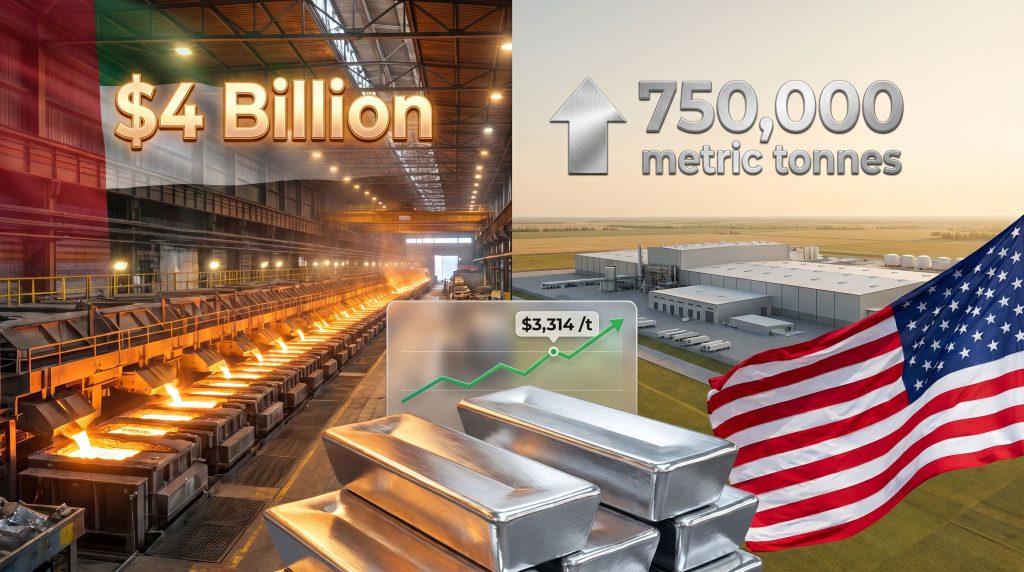
| US project target capacity | 750,000 metric tonnes per year |
| US project cost estimate | $4 billion |
| EGA's US project ownership stake | 60% |
| US development partner | Century Aluminum |
Maintaining Investment Continuity: What EGA's Leadership Said and Why It Matters
At the CRU World Aluminium Conference on May 12, 2026, EGA Chief Marketing Officer Adel Abubakar delivered a clear and unambiguous statement about the company's capital priorities. Speaking during a panel discussion and separately to reporters at the conference, Abubakar confirmed that from an investment standpoint, nothing was changing. The company was working to restart UAE operations and restore customer supply commitments, but the growth agenda — covering the Oklahoma smelter development and expanding recycling capabilities — was advancing as planned.
Abubakar further specified that EGA intended to break ground on the Oklahoma project during 2026, a statement that places a concrete near-term milestone on what has otherwise been a longer-horizon development initiative.
"This kind of public investment continuity signal from senior leadership during active operational disruption is not a routine communications exercise. It serves a specific commercial function: reassuring existing customers of long-term supply reliability, maintaining credibility with financing counterparties, and signalling to downstream partners and joint venture associates that the company's strategic direction is stable."
The timing, at a major global industry conference with significant media coverage, amplifies that signal considerably. What makes this posture analytically interesting is that it runs counter to what finance theory might predict. When a company suffers a major operational disruption affecting close to half its Gulf capacity, conventional capital allocation logic would suggest pausing discretionary growth spending to preserve liquidity for recovery operations. EGA appears to be rejecting this framework entirely, pursuing what amounts to a dual-track strategy.
The two parallel imperatives EGA is managing simultaneously:
- Operational recovery track: Restarting Al Taweelah, managing the 12-month restoration timeline, maintaining Jebel Ali output, and fulfilling existing customer commitments through inventory and alumina management
- Growth expansion track: Advancing the Oklahoma smelter project toward groundbreaking, progressing recycling capacity investments, and maintaining the $4 billion US capital commitment alongside Century Aluminum
The Oklahoma Project: Redefining US Primary Aluminum Capacity
The planned Oklahoma smelter is not simply another line item in EGA's capital expenditure schedule. It represents a potential structural inflection point for US primary aluminum production, a sector that has contracted significantly over several decades due to energy costs, trade dynamics, and competition from lower-cost international producers.
The US aluminium tariffs environment has, in fact, made domestic primary production capacity more strategically valuable than it has been in decades. Consequently, EGA's timing in committing to the Oklahoma facility aligns with a broader policy shift favouring domestic industrial investment. The facility, being developed in partnership with Century Aluminum with EGA holding a 60% ownership stake, is expected to produce 750,000 metric tonnes of primary aluminum annually at a total project cost of $4 billion.
A note on capacity figures: The Reuters article reporting this project references 750,000 metric tons per year in its text, while a related image caption cited 600,000 tonnes. The verified figure confirmed in EGA's public statements and in the primary reporting is 750,000 metric tonnes annually.
Why the Oklahoma Project Is Historically Significant
- The facility would be the first new primary aluminum smelter built in the United States in nearly 50 years, representing a generational gap in domestic primary capacity development
- At 750,000 metric tonnes annually, it would more than double current US primary aluminum output, a structural shift in domestic supply that carries implications beyond EGA's balance sheet
- The project addresses a well-documented vulnerability in US industrial supply chains: heavy reliance on imported primary aluminum to meet demand from automotive, aerospace, construction, and packaging sectors
- For Century Aluminum, the development partner, the project represents a major expansion of its domestic production base at a time when US industrial policy is increasingly focused on supply chain onshoring
Oklahoma Project vs. Al Taweelah: A Comparative View
| Factor | Al Taweelah (UAE) | Oklahoma Smelter (US) |
|---|---|---|
| Current status | Impaired, recovery underway | Pre-construction, groundbreaking targeted 2026 |
| Annual capacity | ~1.5-1.6 million metric tonnes | 750,000 metric tonnes |
| Ownership | EGA (direct) | EGA 60%, Century Aluminum 40% |
| Strategic function | Gulf and international export hub | US domestic supply anchor |
| Geopolitical exposure | Elevated (active regional conflict) | Low (geographically insulated) |
| Recovery or development timeline | Up to 12 months for full output | Groundbreaking targeted 2026 |
The next major ASX story will hit our subscribers first
Geographic Diversification as the Real Strategic Hedge
One of the most instructive aspects of EGA's current situation is what it reveals about the value of geographic diversification in industrial asset portfolios. The company's dual-geography strategy — with operational assets in the UAE and growth capital deployed toward North America — is functioning as a natural hedge against the concentration risk that has now materialised in the Gulf.
Had EGA's entire production and capital base been UAE-centric, the Al Taweelah disruption would represent an existential operational crisis. Instead, the company can credibly discuss growth timelines and investment continuity while simultaneously managing a 12-month smelter recovery, because its expansion capital is geographically insulated from the conflict zone affecting its existing operations.
This is a lesson with broad applicability for investors assessing industrial producers with single-region concentration. The premium placed on geographic diversification by capital markets is not merely theoretical. Events like the Al Taweelah shutdown demonstrate in real time what happens when concentrated industrial capacity sits within a military conflict zone. Furthermore, the ongoing debate around steel and aluminium tariffs underscores how trade policy compounds geopolitical risk for producers without diversified geographic footprints.
Recycling Investment: The Third Dimension of EGA's Strategy
Alongside its primary smelting footprint, EGA is advancing recycling and secondary aluminum capabilities as a distinct investment stream. This element of the company's growth agenda reflects a deeper structural shift in how the global aluminum industry thinks about energy intensity and operational resilience.
Secondary aluminum production through recycling requires approximately 95% less energy than primary smelting from bauxite and alumina. For a company whose primary production assets sit in a geopolitically sensitive region with significant energy infrastructure exposure, the ability to generate aluminum revenue through lower-energy, more geographically distributable recycling operations carries obvious strategic appeal. In addition, the broader trend toward aluminium joint venture structures in the recycling space — an aluminium joint venture model increasingly favoured across the sector — provides a template for how major producers are building secondary capacity without bearing full capital risk alone.
Why recycling investment makes particular sense for EGA in the current environment:
- Recycling operations are more modular and can be situated closer to end-user markets in Europe, North America, and Asia
- Lower energy intensity reduces exposure to power infrastructure risk that has directly affected Al Taweelah
- Secondary aluminum capacity provides revenue continuity during periods when primary smelting is constrained
- Growing regulatory and customer preference for lower-carbon aluminum creates commercial incentives for recycling investment independent of geopolitical considerations
The combination of primary smelting expansion in Oklahoma, operational recovery at Al Taweelah, continued output at Jebel Ali, and growing recycling investment creates a deliberately diversified production portfolio that is more resilient across multiple risk dimensions than a single-strategy approach would allow.
Frequently Asked Questions
Has the Iran conflict caused EGA to cancel or delay its major investment projects?
EGA's senior leadership publicly confirmed at the CRU World Aluminium Conference on May 12, 2026, that no investment plans have been cancelled or delayed. The EGA aluminum investment plans despite the Iran war remain intact, with the Oklahoma smelter project advancing toward a 2026 groundbreaking alongside Century Aluminum.
How long is the Al Taweelah smelter recovery expected to take?
EGA has indicated that restoring full output at Al Taweelah could require up to 12 months following the uncontrolled shutdown caused by Iranian strikes in late March 2026.
What is the planned production capacity of EGA's US smelter?
The Oklahoma facility is designed to produce 750,000 metric tonnes of primary aluminum per year, which the Oklahoma Department of Commerce has associated with a total project cost of $4 billion.
Is EGA's Jebel Ali smelter still operational?
Yes. As of May 12, 2026, EGA's Jebel Ali facility in the UAE has continued operating normally throughout the Iran conflict period.
What share of EGA's production is exported internationally?
Approximately 90% of EGA's total aluminum output is directed to international customers, making the company's operations globally oriented rather than domestically focused.
Why is the Oklahoma smelter historically significant for the US aluminum industry?
It would be the first new primary aluminum smelter constructed in the United States in nearly 50 years, and its planned 750,000-tonne annual capacity would more than double current US primary aluminum production.
Key Takeaways for Investors and Industry Observers
- Long-cycle capital does not automatically retreat during short-cycle disruption. EGA's decision to hold its $4 billion US investment commitment intact while managing a 12-month smelter recovery illustrates that industrial producers with diversified asset bases can sustain growth trajectories even during serious operational events.
- Geographic diversification is not theoretical insurance — it is operational insurance. The Jebel Ali smelter's continued output and the Oklahoma project's geographic insulation from Gulf conflict demonstrate what meaningful asset diversification actually delivers when tested.
- Aluminum futures at $3,314.25 per tonne as of May 12, 2026 reflect markets absorbing a genuine supply shock, with close to half of Middle East smelting capacity offline and a 12-month recovery timeline signposted.
- The Oklahoma project carries implications well beyond EGA's corporate strategy, representing a potential structural change in US domestic primary aluminum supply that has not been seen since the 1970s.
- Recycling investment alongside primary expansion signals portfolio maturity, balancing energy intensity risk, geopolitical exposure, and evolving customer demand for lower-carbon aluminum supply chains.
Disclaimer: This article is intended for informational purposes only and does not constitute financial or investment advice. References to commodity prices, production timelines, and project costs reflect information available as of May 12, 2026, and are subject to change. Investors should conduct independent research before making any investment decisions related to companies or commodities discussed in this article.
Want to Track the Next Major Mineral Discovery Before the Market Does?
Discovery Alert's proprietary Discovery IQ model delivers real-time alerts on significant ASX mineral discoveries across aluminium and 30+ other commodities, turning complex data into actionable investment insights — explore historic examples of exceptional discovery returns to understand the opportunity, then begin your 14-day free trial at Discovery Alert to position yourself ahead of the broader market.