May 12, 2026
The Race to Build Battery Supply Chains Outside Asia Has Already Begun
The lithium-ion battery industry has a geography problem that most investors and energy transition commentators have been slow to fully appreciate. While headlines focus on lithium prices, cobalt geopolitics, and the speed of EV adoption, the most structurally vulnerable point in the entire battery supply chain sits one step removed from the mine: the conversion of raw graphite into anode active material ready for cell manufacturing. This midstream processing stage is almost entirely located within a single country, and the commercial implications of that concentration are now forcing a fundamental rethink of where and how battery materials get made.
Understanding why the NextSource Abu Dhabi anode facility represents a genuine structural response to this challenge, rather than simply a corporate growth story, requires examining the mechanics of anode manufacturing, the economics of vertical integration, and the strategic logic of Japanese capital flowing into African-sourced graphite processed in the Gulf.
When big ASX news breaks, our subscribers know first
Why Anode Manufacturing Geography Is a Critical Battery Industry Vulnerability
The Processing Bottleneck That Mining Headlines Miss
Most critical mineral supply chain discussions focus on mining output, ore grades, and resource nationalism at the point of extraction. Far less attention goes to what happens between mine and battery cell. For graphite, that intermediate stage is arguably more strategically sensitive than the mining itself, and the global graphite shortage has intensified scrutiny of this precise vulnerability.
Natural graphite concentrate extracted from the ground cannot be inserted directly into a lithium-ion battery. It must be transformed through a multi-stage processing sequence: micronisation to reduce particle size, spheronisation to reshape flake graphite into the rounded particle geometry required for efficient lithium-ion intercalation, high-temperature purification to remove impurities to levels exceeding 99.95% carbon content, and finally a carbon coating process that governs how the finished anode material performs under charge and discharge cycling.
Each of these stages requires specialised equipment, significant energy input, and precise process control. The result is a product known as spheronized purified graphite (SPG), or in its coated form, coated SPG (CSPG). This is the anode active material (AAM) that battery cell manufacturers actually purchase and incorporate into cells.
The challenge is that the overwhelming majority of global SPG and CSPG manufacturing capacity sits within China, creating a single-point-of-failure risk that has become increasingly difficult for Western battery manufacturers, EV producers, and their governments to ignore. The concentration of this processing capability, built over decades of industrial policy investment, means that even companies mining graphite outside China typically send their concentrate to Chinese processors before it re-enters global supply chains.
The core vulnerability in global battery supply chains is not graphite mining. It is graphite processing. Any vertically integrated producer capable of converting mined concentrate into finished AAM outside of Asia occupies a structurally scarce commercial position.
Why Battery Cell Manufacturers Are Actively Searching for Alternatives
The commercial incentive to diversify away from single-geography anode material sourcing has intensified considerably since 2022. Battery manufacturers supplying EV producers in North America and Europe face increasing pressure to demonstrate supply chain resilience, driven by evolving regulatory frameworks, customer procurement requirements, and the lived experience of supply disruptions during earlier pandemic-era bottlenecks.
The structural issue is not simply one of price or availability. It is one of qualification: battery-grade anode materials must meet precise specifications for particle size distribution, carbon purity, surface area, and electrochemical performance. Qualifying a new supplier is a lengthy, expensive process that typically takes 12 to 24 months for major cell manufacturers. This means the window to capture long-term offtake relationships is narrow, and the first scaled non-Asian AAM producers to achieve qualification will likely lock in partnerships that persist for a decade or more.
What the NextSource Abu Dhabi Anode Facility Is Actually Building
From Concept to Pre-EPC: The Development Pathway
The NextSource Abu Dhabi anode facility, formally known as the Battery Anode Facility (BAF), is designed to process raw graphite concentrate into finished AAM for lithium-ion battery manufacturers. Located within the Industrial City of Abu Dhabi (ICAD), the facility leverages a pre-existing warehouse structure, converting what would otherwise have been a greenfield construction program into a more capital-efficient equipment installation and fit-out project. For further context on how this fits into the broader battery raw materials market, the shift away from Asian processing dominance is arguably the defining theme of 2025 and beyond.
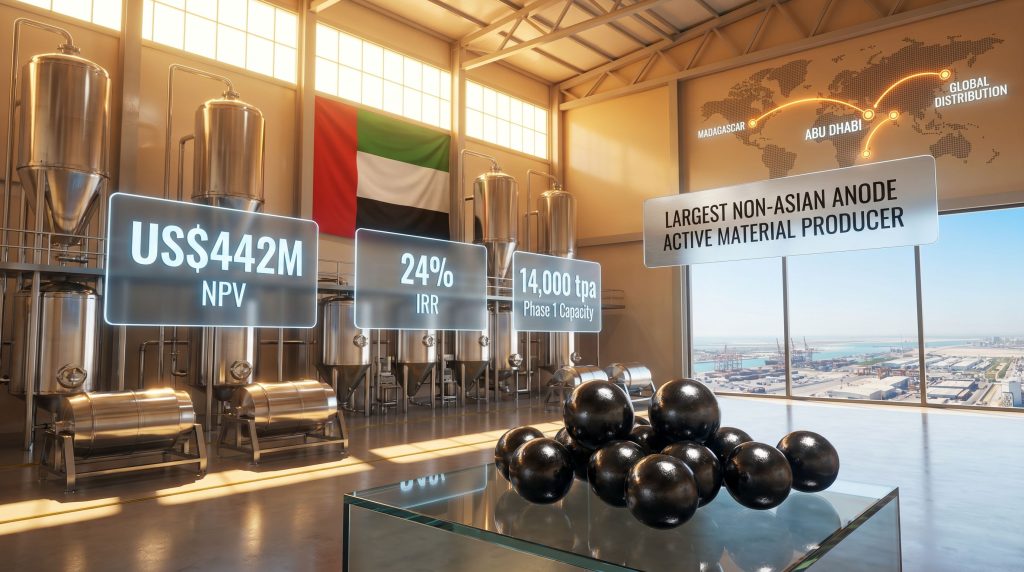
Phase 1 targets an annual production capacity of 14,000 tonnes of AAM, with a pathway to a full build-out of 30,000 tonnes per annum subject to demand confirmation and financing milestones. These are not aspirational figures appended to a speculative concept; they are the output of a detailed feasibility study completed in October 2025 and subsequently validated through a Front-End Engineering Design (FEED) study whose completion directly enabled the Final Investment Decision (FID) announced in May 2026.
| Project Phase | AAM Capacity Target | Development Status |
|---|---|---|
| Phase 1 | 14,000 tonnes per annum | FID approved May 2026 |
| Full Build-Out | 30,000 tonnes per annum | Subject to demand and financing milestones |
The feedstock for Abu Dhabi processing originates from the Molo Graphite Mine in Madagascar, which NextSource describes as one of the largest and highest-purity graphite resources globally. The company's SuperFlake® branded concentrate is the primary input material for the BAF. Importantly, existing concentrate stockpiles are reported to provide feedstock security through 2028, giving the facility a buffer against mine supply disruptions during its initial production ramp.
A supplementary supply agreement with Syrah Resources adds a second feedstock source, providing 34,000 to 68,000 tonnes of graphite fines over a seven-year term with quarterly index-linked pricing. This dual-source approach meaningfully reduces the BAF's dependency on any single mine, a structural resilience feature that also strengthens the facility's commercial credibility with offtake counterparties and project lenders.
Why Abu Dhabi Makes Strategic Sense as a Processing Location
The choice of the UAE as the facility's location reflects a set of considerations that extend well beyond real estate economics. Abu Dhabi sits at the intersection of major east-west and north-south shipping routes, placing it within efficient logistics distance of battery manufacturers in Asia, Europe, and North America. ICAD provides purpose-built industrial infrastructure, reducing the complexity and cost of establishing utilities and services compared to a greenfield site.
The warehouse conversion approach deserves particular attention from a project economics perspective. By securing an existing 60,000-square-metre structure within ICAD and configuring the BAF around it, NextSource converted what is typically the longest and most uncertain phase of industrial construction into a more predictable equipment procurement and installation program. Three-dimensional equipment modelling completed as part of the FEED process under Stantec further advanced construction readiness before the FID was pulled.
Understanding the Final Investment Decision: What It Does and Does Not Mean
The FID as a Structured Commitment, Not a Blank Cheque
A Final Investment Decision in project finance terminology represents the formal governance approval to commit capital beyond feasibility and engineering studies into the early stages of physical project execution. In the case of the NextSource Abu Dhabi anode facility, the FID specifically authorises entry into a pre-EPC mobilisation phase, which encompasses:
- Finalisation of property and site agreements within ICAD
- Execution of early works contracts and commencement of environmental and permitting activities
- Procurement of long-lead equipment, including initiation of shipments from China and Mauritius
- Recruitment of project personnel required for construction readiness
Critically, the FID is structured with conditions precedent and staged funding gates. This architecture means that financial exposure scales incrementally alongside the confirmation of external funding commitments, rather than requiring full capital deployment at a single point. This approach protects investor capital during the financing completion phase and reflects standard risk management practice for projects at this scale and development stage.
What the FID does not represent is a fully funded project. The capital stack remains in active assembly, and the conditions precedent embedded in the decision structure mean that certain activities are contingent on specific financing milestones being achieved. Prospective investors should note this distinction carefully.
The Role of FEED in De-Risking the Decision
The FEED process occupies a critical position between feasibility-level engineering and construction commitment. Where a feasibility study establishes that a project is technically viable and economically attractive at a conceptual design level, FEED takes the engineering to a level of resolution sufficient to confirm capital cost estimates, equipment specifications, and operational parameters with significantly reduced uncertainty.
The FEED work confirmed the capital profile and project configuration established in the October 2025 feasibility study. This alignment between pre-FEED and post-FEED economics is itself a meaningful data point, indicating that the initial study was not built on overly optimistic engineering assumptions. The FEED was completed to AACEi standards under the direction of Stantec, a globally recognised engineering consultancy, providing the institutional-grade technical validation that project financiers and strategic investors require before committing capital.
The Financial Architecture: What the Numbers Reveal
Project Economics at a Glance
The October 2025 feasibility study and subsequent FEED confirmation established a financial profile that positions the facility as commercially compelling relative to the capital required.
| Financial Metric | Value |
|---|---|
| Total Project Capex | US$291 million (inclusive of US$7M sunk costs and working capital) |
| Post-Tax NPV (8% discount rate) | US$442 million |
| Internal Rate of Return | 24% |
| Phase 1 AAM Production Capacity | 14,000 tonnes per annum |
| Mitsubishi Chemical Offtake Volume | 9,000 tpa (~64% of Phase 1 capacity) |
| Syrah Resources Feedstock Supply | 34,000 to 68,000 tonnes over 7 years |
A 24% IRR is considered strong for a critical minerals processing facility, particularly one operating on long-duration, contracted revenue rather than spot-market exposure. The post-tax NPV of US$442 million against a total capex of US$291 million implies a value creation ratio of approximately 1.5 times invested capital, which reflects the premium economics achievable when graphite is converted to qualified AAM rather than sold as raw concentrate.
This NPV premium is not simply a function of processing margin. It reflects the scarcity value of qualifying as a reliable, non-Asian AAM supplier to major battery cell manufacturers, a qualification that, once achieved, creates durable commercial relationships that are difficult for competitors to displace. However, the economics are nonetheless sensitive to graphite pricing dynamics, AAM contract terms, and production ramp timelines. Prospective investors should treat the feasibility economics as a baseline scenario rather than a guaranteed outcome, and conduct independent due diligence on the assumptions underlying the study.
This article does not constitute financial advice. All project economics referenced are drawn from company-disclosed feasibility and engineering study outputs and are subject to the risks, assumptions, and limitations inherent in such studies.
How the C$25 Million Financing Was Deployed
A recent C$25 million financing was allocated across three parallel workstreams simultaneously: completing the FEED study, advancing the feasibility study on the Molo mine expansion in Madagascar, and progressing project financing efforts for the BAF itself. The deliberate parallelism of this capital deployment, rather than sequential execution of each workstream, reflects a coordinated development strategy that compresses the overall timeline from FID to construction commencement.
The Japanese Capital Connection: Strategic Rather Than Simply Financial
Hanwa Co. and JOGMEC: Understanding the Consortium's Significance
The proposed strategic investment supporting the FID comes from a Japanese consortium comprising Hanwa Co., one of Japan's established commodity trading houses with extensive materials distribution networks, and JOGMEC, the Japan Organization for Metals and Energy Security. JOGMEC is a Japanese government agency with a specific mandate to secure critical mineral supply chains for Japanese industry.
The significance of JOGMEC's involvement extends beyond the financial contribution. As a government agency, JOGMEC participates in investments that it assesses to be strategically important for Japan's national energy and industrial security. Its presence in the NextSource capital structure signals that the Abu Dhabi BAF has been evaluated at a government-to-government strategic level, not merely as a commercial investment opportunity. Furthermore, this aligns with broader critical minerals energy security concerns that have elevated government-backed investment in battery supply chains globally.
Japan has particular cause to diversify its battery material supply chains. As a major centre of battery cell manufacturing and automotive production, with companies like Panasonic, Toyota, and AESC deeply embedded in global EV supply chains, Japan's industrial competitiveness is directly exposed to anode material availability. The country's energy security framework has increasingly incorporated critical minerals as a priority area, and JOGMEC's investment portfolio in graphite and other battery materials reflects this national strategic calculus.
The combination of a trading house with distribution reach and a government agency with strategic mandate represents a capital structure that carries commercial and geopolitical dimensions simultaneously.
Broader Financing Engagement: Equity, Debt, and Development Finance
Beyond the Japanese consortium, NextSource has confirmed active engagement with additional equity investors, commercial lenders, and development finance institutions (DFIs). DFIs occupy a particular role in critical minerals project financing: they provide capital to projects that serve broader development or energy transition objectives at terms that commercial lenders might not match on a pure risk-adjusted basis. Their involvement also typically brings enhanced due diligence credibility that can accelerate commercial debt appetite.
The parallel engagement across multiple financing categories reflects a sophisticated capital stack assembly strategy. No single financing source is likely to provide the full US$291 million required. Rather, the structure will involve layered capital from strategic investors, development finance, commercial debt, and potentially export credit support tied to equipment procurement from specific jurisdictions.
The next major ASX story will hit our subscribers first
The Offtake Foundation: Mitsubishi Chemical and the Revenue Certainty Question
What the Mitsubishi Chemical Agreement Represents
NextSource has confirmed a multi-year offtake agreement with Mitsubishi Chemical Corporation for the supply of AAM into North American battery supply chains. At 9,000 tonnes per annum, this agreement covers approximately 64% of Phase 1's 14,000 tpa nameplate capacity, providing a substantial contracted revenue base before a single tonne of AAM has been produced at the Abu Dhabi facility.
Mitsubishi Chemical's position as a major battery materials supplier into North American EV production makes this partnership commercially meaningful beyond the volume commitment. The relationship carries implicit endorsement of the Abu Dhabi facility's technical specifications and production approach, given that Mitsubishi Chemical's own customers will ultimately consume the AAM in battery cells subject to stringent performance requirements.
The remaining approximately 5,000 tonnes per annum of Phase 1 capacity is the subject of active offtake negotiations with additional counterparties. From a project financing perspective, achieving full offtake coverage before or concurrent with debt commitment would significantly de-risk the lender position and potentially improve debt pricing. The existing Molo concentrate stockpile provides commercial flexibility during this negotiation period, as it removes feedstock availability uncertainty from the conversation with prospective offtake partners.
Honest Risk Assessment: Where the Project Could Face Headwinds
Geopolitical and Regional Risk
NextSource has itself acknowledged that regional conflict in the Middle East has already caused delays to certain project workstreams. The UAE's position as a politically stable, internationally connected jurisdiction within a broader region that carries geopolitical volatility is a risk factor that requires ongoing monitoring rather than dismissal. The ICAD location and the UAE's established industrial and diplomatic relationships provide meaningful insulation from direct conflict risk, but investors should factor regional dynamics into their risk assessment frameworks.
Financing Completion Risk
The gap between an approved FID and a fully funded project is the most material near-term risk for the NextSource Abu Dhabi anode facility. The conditions precedent embedded in the FID structure mean that pre-EPC mobilisation activities can advance only to the extent that financing milestones are met. Any delay in finalising the capital stack creates timeline pressure against the targeted 2026 first product delivery date.
The staged funding gate architecture mitigates the risk of stranded capital but does not eliminate schedule sensitivity. Investors evaluating exposure to this project should closely monitor financing announcement cadence as the most forward-looking indicator of construction timeline confidence.
Feedstock, Competitive, and Market Risks
Several additional risk dimensions warrant consideration:
- Graphite price volatility affects both the cost of feedstock purchased from Syrah Resources and the economics of AAM contract pricing with offtake counterparties
- Molo mine operational risk remains a single-source concentration risk for primary feedstock, partially hedged by the Syrah agreement and existing concentrate stockpiles
- Competitive dynamics are evolving as other ex-China anode material projects advance in North America and Europe, meaning the first-mover advantage of reaching scaled production ahead of competitors is time-sensitive
- AAM qualification timelines with battery manufacturers are lengthy and technically demanding, creating execution risk around the ramp from first production to full commercial volume
In addition, ongoing developments in battery recycling expansion could introduce alternative anode material sources into supply chains over the medium term, adding a further competitive variable for primary producers to monitor.
The Bigger Picture: An Africa-Middle East Battery Materials Corridor
A New Industrial Model Taking Shape
The supply chain architecture underlying the NextSource Abu Dhabi anode facility represents something conceptually distinct from conventional mining and processing models. The Madagascar-to-Abu Dhabi-to-global-offtake structure demonstrates that value-adding processing for African critical minerals does not need to occur either in China or in the country of origin. The Gulf, with its infrastructure, capital access, logistics connectivity, and industrial zone capabilities, offers a third pathway.
If this model proves commercially successful at scale, it has potential replicability for other African critical mineral projects seeking to capture midstream processing value before export. The DRC cobalt corridor, East African rare earths, and Southern African manganese are among the resource categories where similar value-chain architectures could theoretically be developed. Consequently, governments seeking to replicate this model may find that lithium industry incentives and similar policy tools play an increasingly important role in attracting midstream investment.
Japan's Strategic Bet on What Comes Next
Japan's deployment of strategic capital into the NextSource Abu Dhabi anode facility through the JOGMEC-Hanwa consortium reflects a broader national industrial strategy that views critical mineral supply security as an economic sovereignty issue. JOGMEC's investment portfolio across graphite, lithium, cobalt, and rare earths has been expanding consistently as Japan's industrial base becomes more exposed to battery material availability.
The NextSource commitment is notable for its combination of upstream feedstock security (Molo graphite), midstream processing capability (Abu Dhabi BAF), and downstream offtake channel (Mitsubishi Chemical). For Japanese capital seeking full value-chain coverage in battery materials outside of Chinese control, this integrated structure addresses multiple strategic objectives simultaneously.
Whether the NextSource Abu Dhabi anode facility ultimately delivers on its promise of becoming the largest scaled non-Asian AAM producer will depend on financing completion, construction execution, and ramp performance against specification. But the strategic logic underpinning its development, the geographic diversification imperative, the vertical integration economics, the Japanese capital alignment, and the contracted offtake foundation, reflects a response to structural forces in battery supply chains that are not going away.
This article is intended for informational purposes only and does not constitute investment advice. All project economics, timelines, and development milestones referenced are based on company-disclosed materials and are subject to change. Readers should conduct independent due diligence before making investment decisions.
Frequently Asked Questions: NextSource Abu Dhabi Anode Facility
What is the NextSource Battery Anode Facility in Abu Dhabi?
A manufacturing facility within the Industrial City of Abu Dhabi designed to convert graphite concentrate sourced from the Molo Mine in Madagascar into finished anode active material for lithium-ion batteries. Phase 1 targets 14,000 tonnes per annum of AAM production, with a path to 30,000 tonnes per annum at full build-out.
What does the Final Investment Decision mean in practice?
The FID authorises NextSource to enter a pre-EPC mobilisation phase covering site and property agreements, early works, environmental permitting, long-lead equipment procurement, and project personnel hiring. It does not represent full project funding; conditions precedent and staged funding gates remain in place until external financing commitments are secured.
Who are the key financial backers involved?
A proposed strategic investment is being structured through a Japanese consortium comprising trading house Hanwa Co. and JOGMEC, a Japanese government agency focused on critical mineral supply security. NextSource is also in active discussions with additional equity investors, commercial lenders, and development finance institutions.
What is the total capital cost and what returns does the project target?
The October 2025 Technical and Economic Study confirmed total project capital costs of US$291 million, inclusive of sunk costs and working capital. The project carries a post-tax NPV of US$442 million at an 8% discount rate and a 24% IRR.
How is feedstock supply secured for the Abu Dhabi facility?
The Molo Graphite Mine in Madagascar serves as the primary feedstock source, with existing concentrate stockpiles providing supply security through 2028. A supplementary agreement with Syrah Resources covers 34,000 to 68,000 tonnes of graphite fines over seven years with quarterly index-linked pricing, providing dual-source feedstock resilience.
What is the Mitsubishi Chemical offtake agreement?
NextSource has confirmed a multi-year agreement with Mitsubishi Chemical Corporation covering 9,000 tonnes per annum of AAM, representing approximately 64% of Phase 1 production capacity, destined for North American battery supply chains. Negotiations for the remaining Phase 1 capacity are ongoing.
Want to Identify the Next Major Battery Materials Discovery Before the Market Does?
Discovery Alert's proprietary Discovery IQ model delivers real-time alerts the moment significant mineral discoveries — including graphite and other critical battery materials — are announced on the ASX, translating complex geological data into actionable investment insights for both traders and long-term investors. Explore Discovery Alert's discoveries page to understand how early positioning in major mineral discoveries has historically generated substantial returns, and begin your 14-day free trial today to stay ahead of the next structural shift in battery supply chains.