
May 12, 2026
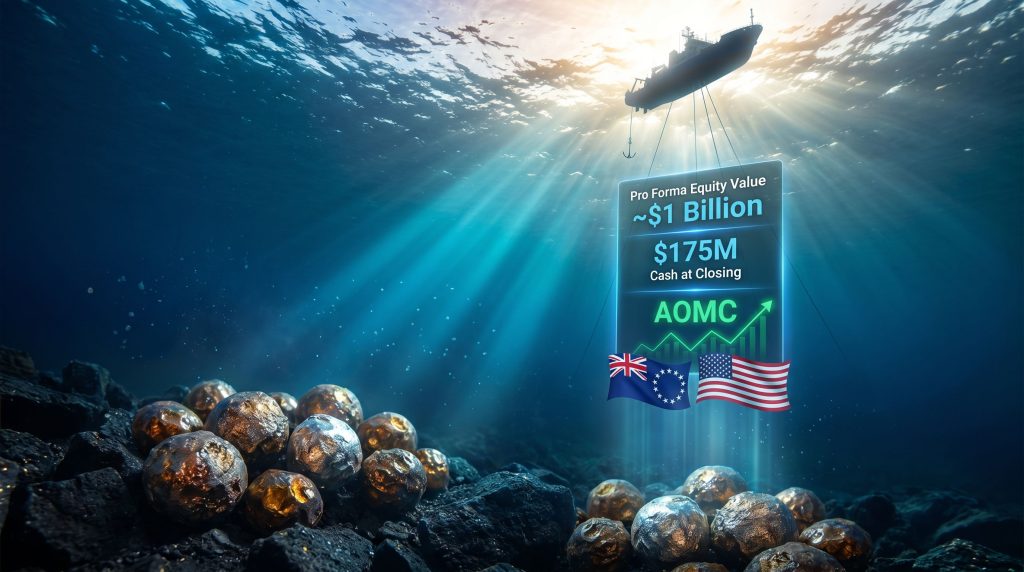
When the Ocean Floor Becomes the Next Frontier for Critical Minerals
The global mining industry has spent decades searching for the next great resource frontier. Terrestrial deposits of nickel, cobalt, manganese, and copper face mounting pressure from geopolitical instability, environmental opposition, and declining ore grades at established mines. Against this backdrop, an entirely different category of mineral resource has attracted growing institutional attention: the vast polymetallic nodule fields resting on the deep ocean floor, formed over millions of years through the slow accretion of metals around biological nuclei at depths exceeding 4,000 metres.
These nodule deposits are not a new discovery. Scientists have known about their existence since the Challenger expedition of the 1870s. What has changed is the convergence of technology, capital availability, and critical mineral supply urgency that is now making deep-sea exploration economically and strategically credible. The AOMC and Odyssey merger SEC filing, submitted on May 11, 2026, represents one of the most concrete expressions of this shift yet to emerge from institutional capital markets.
When big ASX news breaks, our subscribers know first
What the Form S-4 Filing Actually Means and Why It Matters
For investors unfamiliar with US securities law, a Form S-4 registration statement is the mandatory disclosure document required by the Securities and Exchange Commission whenever a company proposes an all-stock merger. It is not a simple notification. The document must contain comprehensive financial statements, merger agreement details, asset descriptions, risk disclosures, pro forma capital structures, and information sufficient for shareholders to cast an informed vote on the transaction.
The SEC does not passively receive S-4 filings. Its staff review the documents, may issue detailed comment letters requiring revisions or additional disclosures, and must formally declare the registration statement effective before any shareholder vote can proceed. This process typically spans several weeks and sometimes longer if the SEC's review identifies disclosure gaps requiring amendment cycles.
Filing this document on May 11, 2026 formally started the regulatory clock for the proposed combination of American Ocean Minerals Corporation and Odyssey Marine Exploration (Nasdaq: OMEX). Until the SEC declares the filing effective, neither shareholder base can vote, and the transaction cannot advance to closing.
The Form S-4 process functions as a structural safeguard in all-stock mergers, preventing shareholders from voting on transactions until regulators are satisfied that disclosures are materially complete and accurate.
Polymetallic Nodules: Understanding the Resource at the Heart of This Deal
Polymetallic nodules form on the abyssal plains of the world's oceans, most notably in the Clarion-Clipperton Zone of the Pacific Ocean, through an extraordinarily slow geological process. Metal ions dissolved in seawater gradually precipitate onto a nucleus, often a shark tooth or a fragment of basalt, building up layers of manganese dioxide and iron oxyhydroxides that incorporate economically significant concentrations of nickel, cobalt, and copper over timescales measured in millions of years.
A polymetallic nodules overview helps contextualise why these deposits have attracted such sustained institutional attention. The mineral characteristics that make these nodules strategically interesting include:
- Nickel: A primary battery material used in lithium-ion cathode chemistries, with nodule grades broadly comparable to laterite deposits
- Cobalt: A critical input for high-energy-density battery cathodes, with deep-sea nodules containing cobalt concentrations that have attracted sustained institutional interest
- Manganese: Used in steel production and emerging battery chemistries, present at exceptionally high concentrations in nodule deposits
- Copper: Essential for electrification infrastructure, present alongside the other three metals in commercially meaningful proportions
What distinguishes polymetallic nodules from most terrestrial mineral resources is that they deliver four critical metals simultaneously from a single extraction process. Land-based mining operations typically target one primary metal with by-products, while nodule processing could theoretically yield multiple co-primary revenue streams from a single tonne of extracted material.
How the AOMC and Odyssey Merger Is Structured
The All-Stock Exchange Mechanics
The transaction is structured as a fully scrip-based combination, meaning no cash changes hands between the two shareholder bases at closing. Odyssey Marine Exploration shareholders receive equity in the combined entity through a fixed exchange ratio of 4.5017 Odyssey shares for each share of AOMC common stock held. Existing AOMC common stock and warrants convert into Odyssey-issued equivalents under the terms of the merger agreement.
Upon completion, AOMC becomes a wholly owned subsidiary of Odyssey, but the combined entity then operates and trades under the American Ocean Minerals Corporation name and ticker symbol AOMC on the Nasdaq exchange. The practical effect is that Odyssey's public company infrastructure, including its regulatory reporting systems, investor relations capabilities, and SEC compliance frameworks, becomes the vessel for the combined enterprise, while the AOMC brand, assets, and financial resources drive the strategic direction.
This structure is deliberate. Odyssey brings years of experience as a publicly listed marine exploration company, along with the institutional familiarity and reporting discipline that comes from sustained Nasdaq listing. For a company attempting to build a credible deep-sea mineral platform, that operational scaffolding has genuine value that cannot be replicated quickly.
Capital Position at Closing: A Detailed Breakdown
The financial architecture assembled ahead of the merger closing reflects a sophisticated pre-positioning strategy across multiple capital-raising rounds:
| Capital Metric | Amount |
|---|---|
| Private Placement Proceeds | ~$156 million |
| Pre-Public Financing (Feb 2026) | $75.6 million |
| Total Pre-Merger Capital Raised | $230+ million |
| Pro Forma Equity Value | ~$1 billion |
| Estimated Cash at Closing | ~$175 million |
| PHOSAGMEX Liabilities Removed | ~$60 million |
The $175 million projected cash position deserves specific attention. Deep-sea mineral exploration does not follow the capital expenditure curves of conventional mining. Before any extraction occurs, operators must conduct extensive environmental baseline studies, deploy remotely operated vehicles for seafloor mapping and nodule sampling, undertake geotechnical assessments of sediment behaviour during collection, and navigate multi-jurisdictional permitting processes that unfold over years rather than months. A cash position of this magnitude provides meaningful operational runway without requiring immediate recourse to equity markets, which preserves shareholder value during the early exploration phase.
The PHOSAGMEX Divestiture: Clean Break Balance Sheet Strategy
One of the more technically interesting aspects of the pre-merger structure is Odyssey's plan to transfer its Mexican phosphate operations, referred to as PHOSAGMEX, into a liquidating trust for the benefit of existing Odyssey shareholders prior to closing. This removes approximately $60 million in associated liabilities from the post-merger balance sheet.
Balance sheet separation of this kind serves multiple strategic functions simultaneously:
- It eliminates legacy liability exposure that would otherwise burden the combined entity's credit profile
- It ensures that AOMC management attention is not divided between deep-sea mineral development and phosphate operations in a different jurisdiction
- It provides existing Odyssey shareholders with retained exposure to the Mexican phosphate asset without requiring them to remain invested in the combined entity
- It presents institutional investors evaluating the post-merger AOMC with a cleaner, more focused balance sheet that directly reflects the deep-sea critical minerals thesis
Regulatory Conditions Governing the Merger Timeline
The Five-Gate Closing Framework
The AOMC and Odyssey merger SEC filing process establishes a structured sequence of conditions that must each be satisfied before the transaction can close. These are not parallel optional conditions but an interdependent framework where earlier gates must open before later ones become relevant:
-
SEC Effectiveness of the S-4 Registration Statement: The foundational condition. No shareholder vote can occur until SEC staff declare the filing effective, which may require one or more amendment cycles if comment letters are issued.
-
Odyssey Stockholder Approval: A majority vote from OMEX shareholders is required. Critically, voting commitments have already been secured from holders representing approximately 30% of outstanding Odyssey shares, materially reducing approval execution risk before the formal vote is even scheduled.
-
AOMC Stockholder Approval: A parallel approval requirement from AOMC's shareholder base must be satisfied concurrently.
-
Regulatory Consents: Applicable permits and jurisdictional approvals across Cook Islands and US regulatory frameworks must be obtained or confirmed.
-
Nasdaq Listing Approval: The combined entity must satisfy Nasdaq's quantitative and qualitative listing standards for the AOMC ticker to become active and tradeable.
Board Unanimity as an Investor Signal
Both companies' boards of directors, along with Odyssey's dedicated special transaction committee, unanimously approved the merger agreement on April 8, 2026. In M&A analysis, unanimous board approval carries specific interpretive weight. It indicates the absence of internal dissent regarding deal terms, valuation, and strategic rationale at the board level. Contested or split-vote board approvals frequently signal underlying disputes over deal pricing or structural terms that can create deal risk.
The formation of a dedicated special transaction committee within Odyssey's governance structure is equally noteworthy. These committees are convened specifically to provide independent evaluation of transactions where potential conflicts of interest could exist, ensuring that minority shareholders receive the benefit of independent fiduciary review rather than being subject to decisions made by potentially conflicted directors.
The expected closing window of late Q2 or early Q3 2026 assumes a standard SEC review period without significant amendment cycles, combined with timely satisfaction of the remaining closing conditions.
Asset Portfolio: What the Combined Entity Controls
Cook Islands Exploration Licences
The Cook Islands Exclusive Economic Zone sits in the South Pacific and encompasses seafloor areas prospective for polymetallic nodule deposits. The AOMC platform holds interests managed through CIC and Ocean Minerals' subsidiary Moana Minerals, providing exposure to nodule resources within a national jurisdiction framework rather than the more complex regulatory environment of the international seabed.
This jurisdictional distinction is significant. Exploration within a national EEZ operates under the sovereign authority of the coastal state, in this case the Cook Islands government, rather than under the International Seabed Authority's framework that governs the global commons. This typically means more predictable regulatory timelines and clearer legal standing for exploration licence holders.
US Project Areas: AOM Area-1 and AOM Area-2
The US-based project areas, designated AOM Area-1 and AOM Area-2, operate under the Deep Seabed Hard Mineral Resources Act (DSHMRA), with regulatory oversight provided by the National Oceanic and Atmospheric Administration (NOAA). Enacted in 1980, the DSHMRA is one of the oldest national legislative frameworks governing commercial deep-sea mineral activity anywhere in the world, predating the modern International Seabed Authority regulatory regime by more than a decade.
The DSHMRA framework provides a legally established pathway for US-regulated deep-sea mineral exploration that has existed for over four decades, offering a level of regulatory predictability that more recently constructed international frameworks cannot yet match.
The designation of these areas as application-stage projects means that permitting processes are initiated but not yet complete. This is an important distinction for investors evaluating timeline risk: application-stage status indicates regulatory engagement has begun, but exploration activity cannot commence until NOAA determinations are finalised.
The Broader Critical Minerals Context
Fragmented International Regulation and Its Investment Implications
One of the least understood dimensions of deep-sea mineral investing is the regulatory fragmentation that characterises the sector globally. The International Seabed Authority governs mineral exploration and exploitation in the international seabed area, termed the Area, which lies beyond national jurisdiction. Separately, coastal nations exercise sovereign rights over their EEZs extending 200 nautical miles from their baselines, with their own domestic regulatory frameworks applying.
The AOMC-Odyssey platform's focus on both Cook Islands EEZ assets and US DSHMRA-governed areas represents a deliberate positioning within national jurisdiction frameworks rather than ISA Area licences. Furthermore, this distinction matters because:
- National jurisdiction assets benefit from the legal certainty of established domestic law and bilateral investment treaty protections
- ISA Area licences face continuing regulatory evolution as the ISA develops its exploitation regulations, which have been subject to extended negotiation and remain incompletely settled
- Regulatory risk divergence between these two frameworks is a material factor in institutional capital allocation decisions within the deep-sea minerals sector
The deep-sea mining concerns surrounding ecological impact and the deep-sea mining regulations governing these licence frameworks are both active areas of policy development that investors in this sector must monitor closely.
Why Four Metals From One Resource Class Changes the Investment Calculus
Conventional critical mineral investment analysis evaluates projects through a primary-metal lens, with by-product credits providing secondary revenue support. Polymetallic nodule deposits challenge this analytical framework because manganese, nickel, cobalt, and copper can each represent material revenue contributors depending on prevailing commodity prices at the time of production.
This multi-metal optionality creates an unusual dynamic: the relative attractiveness of a nodule project shifts with commodity price cycles in ways that conventional single-metal projects do not experience. When cobalt prices are elevated, the cobalt contribution dominates the economic case. When nickel markets tighten due to supply disruptions from major producing nations, the nickel grade becomes the primary value driver. In addition, this embedded optionality across four simultaneous commodity exposures is a structural characteristic of polymetallic nodule projects that distinguishes them from most terrestrial mining investments. The critical minerals and energy security dimension of these resources further elevates their strategic significance beyond conventional commodity analysis.
The next major ASX story will hit our subscribers first
Execution Strategy and the Phased Commercialisation Model
What the Four Work Streams Reveal About Near-Term Priorities
AOMC CEO Mark Justh identified four parallel work streams as the operational focus during the SEC review period: technical, environmental, permitting, and commercial. Taken together, these four categories reveal the full complexity of what responsible deep-sea mineral development actually requires before any extraction activity can begin.
- Technical work streams encompass seafloor mapping, nodule abundance surveys, geotechnical assessments of sediment plume behaviour during collection, and processing technology development for multi-metal recovery
- Environmental work streams involve baseline ecological assessments of benthic communities, sediment disturbance modelling, and development of monitoring protocols that will be required by regulators before exploration permits are granted
- Permitting work streams address the simultaneous regulatory processes across Cook Islands and US jurisdictions, each with its own procedural requirements and agency engagement protocols
- Commercial work streams involve offtake discussions, processing partnerships, and the longer-term infrastructure planning required to convert an exploration-stage asset into a producing platform
The explicit articulation of these four streams by the CEO, coinciding with the AOMC and Odyssey merger SEC filing, signals that the company is communicating a multi-track operational roadmap rather than a single-pathway development plan. For institutional investors evaluating execution risk, this framing suggests awareness that deep-sea mineral development cannot be accelerated by capital alone. The broader battery metals investment landscape provides useful context for understanding how marine-sourced critical minerals fit within global capital allocation trends.
Key Questions Answered: AOMC and Odyssey Merger SEC Filing
What Exactly Is the AOMC and Odyssey Merger SEC Filing?
It is a Form S-4 registration statement submitted to the US Securities and Exchange Commission on May 11, 2026, by Odyssey Marine Exploration in connection with its proposed all-stock merger with American Ocean Minerals Corporation. The document provides both shareholder bases with comprehensive disclosure on transaction terms, asset descriptions, capital structure, and the regulatory pathway to closing.
What Will the Combined Company Be Called?
The merged entity will operate as American Ocean Minerals Corporation, trading on Nasdaq under the ticker symbol AOMC.
How Much Capital Does the Combined Company Have Available?
More than $230 million was raised from institutional and strategic investors prior to the merger filing. The combined entity is projected to hold approximately $175 million in cash at closing.
What Minerals Does the Platform Target?
The platform focuses on deep-sea polymetallic nodule exploration, targeting manganese, nickel, cobalt, and copper concentrations across multi-jurisdictional marine mineral licences.
When Is the Merger Expected to Close?
Late Q2 or early Q3 2026, subject to SEC review completion, dual shareholder approvals, regulatory consents, and Nasdaq listing confirmation.
What Happens to Odyssey's Mexican Phosphate Business?
PHOSAGMEX will be transferred into a liquidating trust for existing Odyssey shareholders prior to closing, removing approximately $60 million in associated liabilities from the post-merger entity.
Has the Merger Been Approved Internally?
Yes. Both boards of directors and Odyssey's special transaction committee unanimously approved the merger agreement on April 8, 2026.
What This Filing Signals for the Deep-Sea Mining Sector
The AOMC and Odyssey merger SEC filing is not simply a procedural step in a corporate transaction. It represents the formalisation of a capital thesis that positions deep-sea polymetallic nodule development as a credible, institutionally supported component of the global critical mineral supply picture. Several dimensions of this transaction deserve attention from investors and industry observers:
- The ~$1 billion pro forma equity valuation marks one of the most substantial capital commitments to marine-sourced critical mineral development in recent years
- The $175 million cash position provides multi-year operational capacity without immediate dilution pressure on post-merger shareholders
- Dual-jurisdiction asset positioning across Cook Islands EEZ and US DSHMRA-governed areas provides regulatory diversification that is unusual among emerging marine mineral platforms
- The pre-committed 30% shareholder voting block materially reduces approval execution risk before the formal vote process begins
- The PHOSAGMEX divestiture demonstrates disciplined balance sheet management that removes legacy complexity and sharpens strategic focus
- The four-work-stream framework described by the CEO establishes a credible operational roadmap that acknowledges the full complexity of responsible deep-sea mineral development
This article is intended for informational purposes only and does not constitute financial advice. Forward-looking statements regarding timelines, capital positions, merger completion, and project development are subject to regulatory, operational, and market risks. Readers should conduct independent due diligence and consult a licensed financial adviser before making investment decisions. Regulatory frameworks and permitting timelines referenced herein reflect publicly available information as of the date of publication and may be subject to change.
Want to Stay Ahead of the Next Major Mineral Discovery?
Discovery Alert's proprietary Discovery IQ model delivers real-time alerts the moment significant ASX mineral discoveries are announced, turning complex commodity data across more than 30 resources into clear, actionable insights for both short-term traders and long-term investors. Explore historic discoveries and the returns they generated to understand the opportunity, then begin your 14-day free trial at Discovery Alert and position yourself ahead of the broader market.