
June 16, 2026
Argentina's RIGI Framework and What It Means for Large-Scale Mining Investment
Precious metals mining has always operated on a paradox: the deposits with the greatest geological promise frequently sit in the jurisdictions with the greatest political complexity. Argentina's northwestern provinces have long embodied this tension, holding world-class mineral endowments in silver, gold, lithium, and copper while simultaneously grappling with currency instability, shifting royalty regimes, and permitting unpredictability that deterred sustained capital commitment. Understanding what has changed structurally, and why it matters for projects like proyecto Diablillos RIGI Argentina, requires examining the mechanics of the investment framework itself before evaluating any single asset.
When big ASX news breaks, our subscribers know first
Understanding the RIGI: Architecture, Mechanics, and Investment Thresholds
Argentina's Régimen de Incentivos a las Grandes Inversiones, known by its acronym RIGI, is a purpose-built legal and fiscal structure designed to compete internationally for large-scale capital investment. The regime targets projects exceeding US$200 million in total investment, establishing a minimum scale requirement that immediately filters out smaller exploration plays and focuses benefits on development-stage or construction-ready assets capable of generating significant export revenue.
The RIGI delivers value to approved projects through several coordinated mechanisms:
- Fiscal stability guarantees that lock in the tax environment for the project's life, shielding operators from future legislative changes to corporate tax rates or royalty structures
- Reduced corporate income tax obligations that lower the effective tax burden compared to the standard Argentine corporate tax regime
- Tariff exemptions on imported capital goods, which is particularly material for mining operations requiring specialised equipment sourced internationally
- Foreign exchange benefits for export-oriented projects, addressing what has historically been one of the most significant deterrents to Argentine resource investment
The formal approval mechanism requires publication in Argentina's Boletín Oficial, providing legal certainty and public record of each project's approved status. Proyecto Diablillos received formal RIGI approval through Resolución 562/2026 from the Ministry of Economy, published on May 11, 2026, making it the fifteenth project to achieve this status since the regime's implementation under the Milei administration.
"The RIGI's design philosophy reflects a deliberate acknowledgment that Argentina was losing large-scale mining and energy investment to competing jurisdictions, and that structural fiscal certainty rather than incremental policy adjustments was required to shift capital allocation decisions at the project level."
RIGI by the Numbers: Pipeline Status as of May 2026
| Indicator | Figure |
|---|---|
| Total applications submitted | 36 projects |
| Total proposed investment in pipeline | US$97 billion |
| Projects formally approved | 15 projects |
| Investment committed across approved projects | US$28.5 billion |
| Diablillos' position in approval sequence | Project No. 15 |
| Mining sector commitments under RIGI | Over US$46 billion |
The ratio of approved projects to total applications (15 from 36) suggests a selective approval process rather than blanket acceptance, which itself communicates regulatory seriousness to international investors evaluating Argentine project risk. Mining's position as the leading sector by committed investment, surpassing petroleum and natural gas, reflects both the scale of individual mining projects and Argentina's comparative resource endowment.
Proyecto Diablillos: Geological Setting, Scale, and Resource Quality
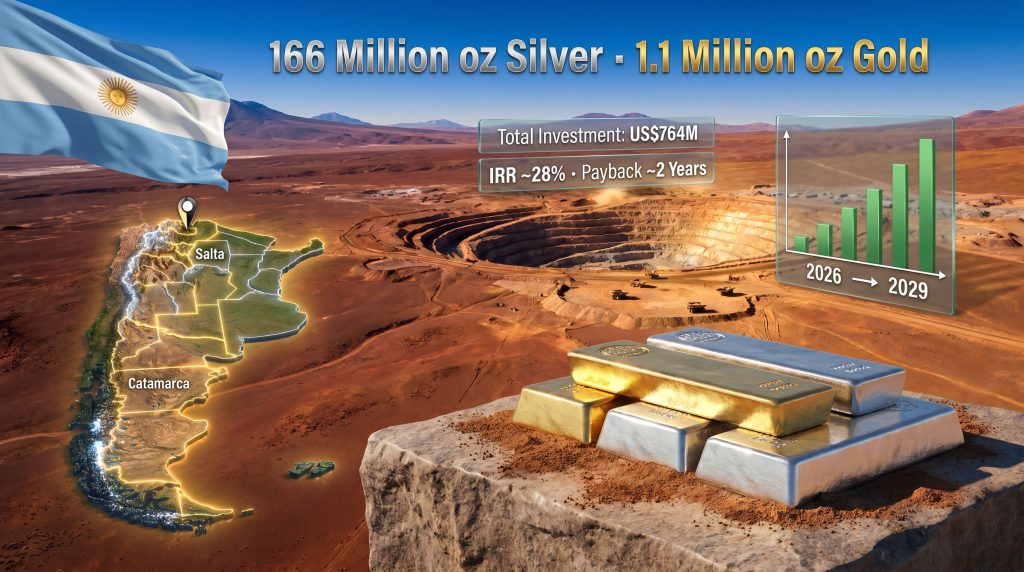
The Diablillos project occupies 15 contiguous mining concessions straddling the provincial boundary between Salta's Los Andes department and Catamarca's Antofagasta de la Sierra municipality, deep within the Puna plateau. This high-altitude plateau environment, characterised by extreme daily temperature variation, thin atmosphere, and remote logistics, is geologically significant precisely because the same tectonic and hydrothermal conditions that make operations challenging also created the mineralisation systems hosting Diablillos' resource base.
The Puna region sits within the broader Central Andes metallogenic belt, a geological province known globally for its concentration of porphyry copper, epithermal gold-silver, and polymetallic deposits. Furthermore, epithermal silver-gold deposits, which Diablillos represents, typically form at shallow depths from hydrothermal fluids cooling as they rise through fault systems, depositing precious metals in characteristic vein and breccia structures. The high silver-to-gold ratio at Diablillos, with estimated resources of 166 million ounces of silver and 1.1 million ounces of gold, is consistent with low-sulphidation epithermal systems common across the Puna and Altiplano.
Key operational parameters for the project include:
- Mining method: Open-pit extraction, enabling high-volume, lower-cost ore recovery compared to underground methods
- Processing capacity: 3.15 million tonnes per year through the planned processing facility
- Primary output: Doré bars containing gold and silver, suitable for direct sale to refineries and commodity markets
- Associated infrastructure: Purpose-built camp facilities, laboratory and assay capabilities, workshop infrastructure, and dedicated access roads
- Projected annual export value: Approximately US$417 million at full production
Doré production deserves specific attention from an investment perspective. Unlike base metal concentrates, which require smelting to separate payable metals from penalty elements, doré is a semi-pure alloy typically containing 80–95% combined gold and silver. It commands pricing close to spot metal values and can be sold directly to refiners without complex offtake arrangements, simplifying revenue realisation and reducing counterparty risk.
"The combination of a high silver resource base, doré output capability, and open-pit geometry positions Diablillos as a straightforward production profile operationally, though the Puna environment introduces genuine logistical and energy procurement challenges that will influence per-tonne operating costs at scale."
Financial Architecture: Investment Structure, Returns, and RIGI Benefits
The financial structure of proyecto Diablillos RIGI Argentina under the RIGI framework illustrates how the regime translates regulatory approval into tangible investment incentives.
| Financial Component | Amount (USD) |
|---|---|
| Total estimated project investment | US$764 million |
| Computable assets recognised under RIGI | US$481.7 million |
| Projected investment during 2026 | US$98.5 million |
| Projected investment during 2027 | US$253+ million |
| Combined 2026-2027 capital deployment | Over US$351.5 million |
The distinction between total project investment (US$764 million) and recognised computable assets (US$481.7 million) is technically important. The computable asset figure determines the extent to which fiscal and exchange rate benefits apply, meaning that approximately US$282 million of the total investment in operational costs, working capital, and potentially certain infrastructure phases falls outside the regime's direct benefit scope. This is standard within investment incentive frameworks globally and does not diminish the operational value of the approved benefits.
The project's economic metrics, as presented in AbraSilver's corporate materials, are notably strong for a primary precious metals development:
- Internal Rate of Return (IRR): Approximately 28%, indicating robust project economics under the assumed commodity price and cost scenarios
- Payback period: Approximately two years from the commencement of commercial production
- Construction start date: July 2026
- Commercial production target: July 2029
A 28% IRR places Diablillos in a performance category that typically attracts institutional mining capital without requiring heroic commodity price assumptions. For context, many major mining companies use hurdle rates of 15–20% for project approval at internal review stages, suggesting the Diablillos economics provide meaningful margin above typical institutional thresholds. The two-year payback period, if realised at scale, indicates the project generates sufficient operating cash flow to recover its capital investment rapidly following production ramp-up. Understanding cut-off grade economics is essential context for appreciating how these returns are structured at the mine planning level.
Important disclaimer: All financial projections, including IRR figures and payback periods, are forward-looking estimates based on assumptions embedded in AbraSilver's corporate materials. Actual outcomes will depend on realised commodity prices, operational costs, capital expenditure execution, and numerous other variables. This content does not constitute financial advice, and investors should conduct independent due diligence before making investment decisions.
The Computable Asset Differential: What It Means Operationally
Mining analysts familiar with incentive regime structures will recognise that the gap between gross capital investment and regime-eligible assets frequently reflects the treatment of sustaining capital, pre-production operating expenses, and infrastructure shared between multiple project phases. The recognition of US$481.7 million in computable assets against a US$764 million total represents a 63% recognition rate, which is broadly consistent with how similar frameworks define eligible capital in other jurisdictions. Projects in earlier exploration stages or those with significant operational expenditure heavy profiles typically see lower recognition ratios.
Stakeholder Landscape: Who Is Behind Proyecto Diablillos?
The capital structure supporting AbraSilver's development of Diablillos reflects a deliberately constructed investor base that provides both financial credibility and sector-specific expertise — a combination that sophisticated project financiers specifically seek when evaluating development-stage mining assets.
AbraSilver Resource Corp. serves as the project operator and developer. The Canadian company's focus on northwestern Argentina spans both the Diablillos silver-gold project in Salta and the La Coipita copper project in San Juan Province, indicating a deliberate geographic and commodity concentration strategy rather than a diversified portfolio approach. This focused positioning allows the company to develop regional expertise and stakeholder relationships while managing a concentrated asset base.
Central Puerto, Argentina's established energy generation company, became AbraSilver's largest institutional shareholder in February 2025 after acquiring a 9.9% stake through its Pacific Rim subsidiary. The 9.9% threshold is strategically significant: it sits just below the 10% threshold that typically triggers enhanced disclosure requirements and potential board representation obligations in many corporate governance frameworks, suggesting a deliberate positioning that maintains strategic flexibility.
The remaining institutional shareholder base includes two figures whose participation carries specific signalling value within the precious metals investment community:
- Eric Sprott: A Canadian resource investor with a long track record of identifying and financing junior precious metals projects before they reach institutional scale. His participation in early-stage precious metals ventures is widely followed within the sector as an indicator of geological and commercial conviction.
- Kinross Gold: A globally operating gold mining company with operational presence across the Americas, Africa, and Russia. Kinross's participation introduces a strategic investor dimension: major mining companies rarely take meaningful positions in junior developers without conducting thorough technical due diligence, effectively providing third-party geological validation through capital commitment.
"The convergence of a domestic Argentine energy operator, a specialist precious metals financier, and a multinational gold producer within a single junior mining company's shareholder register represents a multi-layer validation that project finance specialists refer to as a 'diverse smart money' signal, suggesting independent technical review processes have arrived at broadly compatible conclusions about asset quality."
Why Mining Leads RIGI: Structural Dynamics Over Policy Preference
The fact that mining commitments under the RIGI exceed US$46 billion, surpassing even Argentina's hydrocarbon sector, is not primarily a policy outcome. It reflects structural characteristics of the resource endowment and the stage of development across different commodity sectors.
| Sector | Estimated RIGI Commitments |
|---|---|
| Mining | Over US$46 billion |
| Petroleum and Gas | Second position (not separately quantified in official data) |
| Renewable Energy and Other | Under incorporation |
Several structural factors explain mining's leadership position:
- Deposit concentration: The Puna and Andean regions of northwestern Argentina host world-class Argentina lithium brines, Argentina copper systems, and epithermal precious metal deposits that rank among the largest known accumulations of their respective commodity types globally.
- Critical mineral demand alignment: The growing critical minerals demand for silver, copper, and lithium as essential inputs to electrification and energy transition technologies creates long-duration demand signals that support multi-decade project economics at current and projected price levels.
- Development stage readiness: Several Argentine mining projects entered the RIGI window having already completed significant exploration and pre-feasibility work, meaning capital deployment timelines are compressed relative to early-stage exploration programmes.
- Relative jurisdiction cost advantage: Argentina's exploration and development costs compare favourably to some competing Latin American jurisdictions, particularly for projects accessing existing regional infrastructure.
For proyecto Diablillos, mining's sectoral leadership within the RIGI pipeline provides a relevant precedent base. With 14 previously approved projects across the mining sector, regulatory teams have processed similar applications before, reducing administrative uncertainty for incoming applicants and establishing interpretive precedent on computable asset recognition.
The next major ASX story will hit our subscribers first
Development Timeline: Construction Through to Commercial Production
The pathway from RIGI approval to first doré bar production follows a structured construction and commissioning sequence:
2026 (First Half): RIGI formal approval via Resolución 562/2026 in May, followed by construction commencement in July. Capital deployment of approximately US$98.5 million during the year covers initial civil works and early infrastructure installation.
2027: The largest single-year capital deployment phase, with over US$253 million committed primarily to mining development works and processing plant construction. This represents the most capital-intensive construction period and carries the highest execution risk in terms of cost and schedule.
2028: Final construction completion, plant commissioning, and systems integration testing. This phase typically involves trial processing runs to validate throughput capacity and recovery rates before declaring commercial production.
2029 (Second Half): Commercial production commencement, with doré output beginning to generate export revenue. The government's approval of the RIGI application positions Diablillos to contribute approximately US$417 million annually in export value at full production, making it a meaningful contributor to provincial and national export totals.
Regional Transformation: Salta, Catamarca, and the Puna Economy
The Puna plateau that hosts Diablillos has historically been one of Argentina's most economically marginal regions, characterised by sparse population, subsistence economies, and limited formal employment opportunities. The project's projection of more than 2,000 direct and indirect jobs represents a substantial economic intervention in a region where formal employment at this scale has rarely existed.
Beyond direct employment, the supply chain effects of a US$764 million mining project extending across multiple years of construction and then decades of operation typically generate procurement demand for local services, transport logistics, equipment maintenance, fuel supply, catering, and technical services. In remote mining regions globally, this supply chain development often represents the most durable economic legacy of large mining projects, persisting beyond individual mine life cycles as local businesses develop capabilities that can serve subsequent projects.
The operational challenges of the Puna environment — including high altitude typically exceeding 3,500 metres above sea level, extreme temperature swings, limited surface water availability, and absence of established grid power infrastructure — will require AbraSilver to develop purpose-built solutions for energy, water, and logistics. Access roads built for mining purposes, for example, frequently remain in use as regional transport links after mining operations conclude. Furthermore, the broader Argentina copper exploration activity across the region demonstrates that Diablillos is part of a broader wave of Andean investment with lasting regional implications.
Historically, the regulatory unpredictability that characterised Argentine mining policy for extended periods created a pattern of project development that stalled at advanced exploration or pre-feasibility stages as capital sources waited for clearer signals on royalty treatment, profit repatriation, and currency access. The RIGI framework addresses each of these historically problematic dimensions through legally codified guarantees rather than discretionary administrative assurances.
Frequently Asked Questions: Proyecto Diablillos and the RIGI Framework
What is the RIGI and what specific benefits apply to Diablillos?
The RIGI is Argentina's large investment incentive regime targeting projects above US$200 million. For Diablillos, the regime recognises US$481.7 million in computable assets, providing fiscal stability guarantees, import tariff exemptions on capital equipment, reduced corporate tax obligations, and preferential foreign exchange treatment on export revenues.
When is commercial production expected to begin?
AbraSilver's project schedule targets commercial production commencement in July 2029, following construction start in July 2026 and an approximately three-year build and commissioning period.
What minerals will Diablillos produce?
The project will produce doré bars containing gold and silver. The estimated resource base includes 1.1 million ounces of gold and 166 million ounces of silver, making silver the dominant metal by volume.
How does Central Puerto fit into the ownership structure?
Central Puerto is AbraSilver's largest institutional shareholder, holding a 9.9% equity stake acquired in February 2025 through its Pacific Rim subsidiary. The investment represents Central Puerto's strategic diversification from conventional power generation toward mining and critical minerals.
Is Diablillos the only RIGI-approved mining project?
No. Diablillos is the fifteenth project to receive approval, with mining representing the leading sector across the 15 approved projects by total committed investment volume, exceeding US$46 billion across all mining-related commitments.
What is the projected employment impact?
AbraSilver projects that the project will generate more than 2,000 direct and indirect jobs across construction and operational phases, which represents a significant employment multiplier for the Puna region's current economic base.
Diablillos as a Structural Indicator of Argentina's Mining Repositioning
Evaluating proyecto Diablillos RIGI Argentina solely as a single mining approval misses the more significant analytical point. What the project represents, alongside the 14 approvals that preceded it, is evidence that Argentina's investment climate for large-scale extractive projects has undergone a measurable structural shift rather than a temporary political accommodation.
The combination of attributes present at Diablillos — a technically validated resource base, a multi-party shareholder structure bringing diverse institutional credibility, a clearly defined construction and production timeline, and formal legal protection through a published government resolution — represents the full checklist that development capital requires before committing to multi-year project execution in a historically complex jurisdiction.
The deeper question for investors, policymakers, and regional stakeholders is whether the commitments represented by the US$97 billion pipeline of RIGI applications translate into the production capacity, regional economic transformation, and export earnings that the framework's designers projected. That translation depends on factors extending well beyond regulatory approval: commodity price trajectories, construction cost inflation management, community and environmental licence maintenance, and the operational execution capability of individual development teams.
What RIGI provides is the enabling condition. What projects like proyecto Diablillos RIGI Argentina must demonstrate through the period from 2026 to 2029 is that the enabling condition is sufficient to convert geological potential into productive capacity at the scale that Argentina's northwestern provinces have long been capable of delivering.
Disclaimer: This article is intended for informational purposes only and does not constitute investment advice. Forward-looking statements, projections, and timelines are based on publicly available corporate materials and reporting from Reporte Minero (May 12, 2026). Actual project outcomes may differ materially from those described. Readers should consult qualified financial advisors before making investment decisions.
Want to Identify the Next Major ASX Mineral Discovery Before the Broader Market?
Discovery Alert's proprietary Discovery IQ model delivers real-time alerts on significant ASX mineral discoveries — instantly translating complex resource data into actionable investment insights for both short-term traders and long-term investors. Explore historic examples of major discoveries and the returns they generated, then begin your 14-day free trial at Discovery Alert to position yourself ahead of the market.