June 20, 2026
Africa's Industrial Transformation Through Strategic Resource Integration
Resource-rich nations across Africa have traditionally operated under extraction-focused economic models, shipping raw materials to international markets while importing finished goods at significantly higher costs. This dependency structure has limited value capture and industrial development across the continent for decades. However, a fundamental shift is emerging as countries recognise the transformative potential of vertical integration strategies that process natural resources domestically before export.
West Africa's mineral wealth presents unprecedented opportunities for industrial clustering, particularly in the aluminium sector where bauxite reserves can support integrated value chains from mining through finished product manufacturing. The region's strategic positioning between major consumer markets in Europe and emerging demand centres in Asia creates compelling logistics advantages for processed aluminium exports.
When big ASX news breaks, our subscribers know first
Ghana's Departure from Traditional Resource Export Models
Ghana's approach to aluminium sector development represents a methodological departure from conventional African mining strategies. Rather than exporting unprocessed bauxite, the country is implementing a comprehensive vertical integration framework that captures value across three distinct production stages: extraction, processing, and manufacturing. This Ghana aluminium industry expansion demonstrates how resource-rich nations can maximise economic returns through domestic processing capabilities.
Resource Endowment and Quality Metrics
Ghana possesses the world's third-largest bauxite reserves, with approximately 900 million tonnes of proven deposits according to the U.S. Geological Survey. This positions the country behind Guinea's 7.4 billion tonnes and Australia's 5.8 billion tonnes but ahead of Vietnam's 3.5 billion tonnes.
The quality of Ghanaian bauxite typically grades between 45-50% Al₂O₃ content, representing high-grade ore that reduces processing costs compared to lower-quality deposits found elsewhere. Furthermore, this quality advantage provides significant competitive benefits for downstream processing operations.
Current production capacity through Ashanti Bauxite Limited operates at approximately 1 million tonnes per annum, primarily serving export markets. However, the strategic vision involves scaling this capacity to 5 million tonnes annually while simultaneously developing downstream processing capabilities.
Economic Value Capture Analysis
Traditional African mining models typically monetise only the extraction phase, capturing $15-20 per tonne revenue for raw bauxite exports. In contrast, integrated production models that include alumina refining and aluminium smelting can generate $200-250 per tonne revenue for producing countries.
This ten-fold increase in value capture represents the economic rationale driving Ghana's industrial transformation strategy. Additionally, the bauxite project benefits extend beyond direct revenue generation to include employment creation and technology transfer.
The three-stage value chain operates as follows:
• Stage 1: Bauxite extraction and beneficiation
• Stage 2: Alumina refining through Bayer process technology
• Stage 3: Aluminium smelting using Hall-Héroult electrolytic reduction
Each successive stage requires higher technological capabilities, energy infrastructure, and skilled workforce development, but generates progressively greater economic returns per tonne of output.
VALCO's Role as Industrial Anchor Infrastructure
The Volta Aluminium Company Limited serves as the cornerstone of Ghana's aluminium industry expansion, providing existing operational infrastructure that significantly reduces development timelines and capital requirements compared to greenfield projects.
Current Operational Baseline
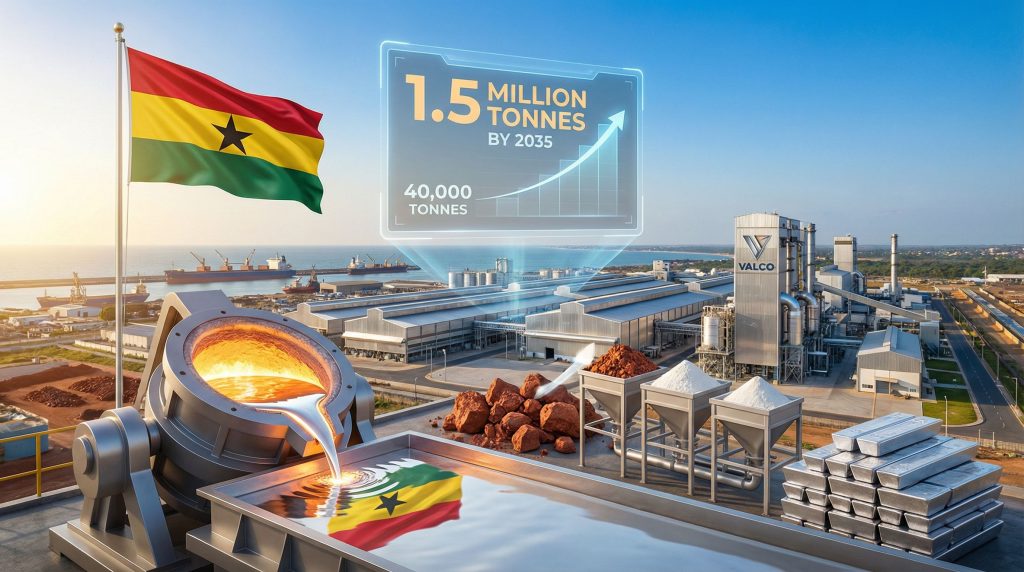
VALCO operates with an installed capacity of 205,000 tonnes per annum, though current utilisation rates hover around 19.5%, producing approximately 40,000 tonnes annually. This underutilisation stems from power supply constraints and economic factors that have affected operations since the facility's peak production years in the 1980s when capacity reached 280,000 tonnes per annum.
The facility's existing infrastructure includes:
• Hall-Héroult electrolytic cells for aluminium production
• Power distribution systems and electrical infrastructure
• Skilled workforce with decades of smelting experience
• Established supply chain relationships and logistics networks
• Port access through Ghana's coastal shipping facilities
Expansion Framework and Investment Requirements
The proposed modernisation involves a $800 million investment in smelter retrofitting and equipment upgrades. Phase 1 targets production expansion to 300,000 tonnes annually, representing a 650% increase from current output levels.
Long-term objectives envision reaching 1.5 million tonnes per annum by 2035, which would establish Ghana as Africa's largest single-site aluminium producer. This expansion requires comprehensive infrastructure development:
| Infrastructure Component | Investment Required | Timeline |
|---|---|---|
| Smelter Modernisation | $800 million | 2025-2030 |
| Power Generation Capacity | $1.2 billion | 2025-2028 |
| Port and Rail Infrastructure | $300 million | 2025-2027 |
| Total Phase 1 Investment | $2.3 billion | 2025-2030 |
Energy Infrastructure Challenges
Modern aluminium smelting requires stable baseload power with frequency deviations below 2% tolerance levels. VALCO's full capacity expansion would demand approximately 2,000-2,200 megawatts, representing 15-18% of Ghana's total installed electricity generation capacity of 15,680 megawatts.
Current power supply experiences seasonal constraints during dry periods when hydroelectric generation decreases. The expansion necessitates dedicated power supply agreements with guaranteed minimum availability, potentially requiring new generation capacity development or power import arrangements with neighbouring countries. Consequently, renewable energy transformations become critical for supporting sustainable industrial growth.
Building Supply Chain Resilience Through Vertical Integration
Ghana's integrated aluminium strategy addresses multiple supply chain vulnerabilities that affect traditional smelting operations dependent on imported feedstock materials.
Alumina Import Dependency Elimination
VALCO currently imports all required alumina from international suppliers, primarily Australian, Brazilian, and Caribbean refineries. This dependency exposes operations to price volatility, logistics disruptions, and foreign exchange rate fluctuations. Global alumina markets experience 18-24% annual price fluctuation ranges, directly impacting production cost structures.
The proposed domestic alumina refinery would process 5 million tonnes of locally-mined bauxite to produce 1.6 million tonnes of alumina annually, utilising standard Bayer process technology. This conversion ratio of 1.8:1 bauxite-to-alumina aligns with industry benchmarks for high-grade ore processing.
Economic Impact of Supply Chain Integration
Domestic alumina production creates substantial cost advantages:
• Import Cost Elimination: $350-400 per tonne delivered cost for imported alumina
• Domestic Production Cost: Estimated $280-320 per tonne including energy and transportation
• Annual Savings Potential: $48-192 million based on 1.6 million tonne output
These savings derive from reduced transportation costs, elimination of international trade margins, and local currency transactions avoiding foreign exchange exposure. Moreover, Ghana's integrated aluminium project demonstrates significant potential for job creation across the value chain.
Mining Sector Expansion Strategy
Awaso mine scaling from 1 million to 5 million tonnes annually represents the foundation of supply chain integration. Additional development projects at Nyinahin and Nyaso sites remain under parliamentary review, with potential for further capacity expansion based on refinery demand requirements.
The integrated mining-to-smelting model provides supply security advantages:
• Price Stability: Internal transfer pricing replaces volatile spot market exposure
• Supply Security: Elimination of import logistics risks affecting 1.6+ million tonnes annually
• Quality Control: Direct oversight of ore grade and processing specifications
• Foreign Exchange Conservation: Reduced import spending of $150-180 million annually
Employment Generation and Industrial Clustering Effects
The Ghana aluminium industry expansion creates significant employment opportunities across multiple skill levels and industrial sectors, with particular emphasis on technical roles supporting 24-hour operations.
Direct Employment Projections
| Sector | Employment Target | Operational Model |
|---|---|---|
| VALCO Smelter Operations | 6,000 positions | Three-shift continuous operations |
| Mining and Alumina Processing | 2,000+ positions | Extraction and refining activities |
| Logistics and Port Services | 1,500+ positions | Transportation and export operations |
| Total Direct Employment | 9,500+ positions | Integrated value chain |
These employment figures represent substantial economic impact for Ghana's industrial sector, particularly in regions surrounding mining operations and smelting facilities. Furthermore, the project's emphasis on local workforce development aligns with broader industry evolution trends focusing on skills transfer and capacity building.
Skills Development Requirements
Modern aluminium production requires specialised technical competencies:
• Metallurgical Engineering: Process optimisation and quality control
• Electrical Systems Management: High-voltage power distribution and cell operations
• Process Control Technology: Automated monitoring and adjustment systems
• Heavy Equipment Operations: Mining and materials handling machinery
• Environmental Management: Emissions control and waste processing
Training programmes must develop local expertise in these areas to support long-term operational sustainability and reduce dependence on expatriate technical personnel.
Downstream Manufacturing Opportunities
Integrated aluminium production enables industrial clustering effects:
• Automotive Components: Manufacturing for West African vehicle assembly operations
• Construction Materials: Architectural aluminium for regional infrastructure projects
• Packaging Industries: Food and beverage container production for domestic and export markets
• Transportation Equipment: Rail and marine component manufacturing
These downstream opportunities multiply employment effects beyond direct smelting operations, creating industrial ecosystems that support broader economic development objectives.
Regional Competitive Positioning and Market Dynamics
Ghana's aluminium strategy positions the country within a competitive continental landscape where several nations pursue aluminium sector development with varying approaches and resource endowments.
Continental Production Landscape Analysis
South Africa maintains established smelting capacity through Hillside and Richards Bay facilities but lacks significant bauxite resources, requiring imported feedstock from Guinea and other suppliers. This dependency on external alumina creates cost disadvantages and supply chain vulnerabilities.
Mozambique operates the Mozal smelter with 506,000 tonnes annual capacity, achieving 85-92% utilisation rates through dedicated power supply from Cahora Bassa hydroelectric facility. However, Mozal imports all alumina requirements, limiting value chain integration benefits.
Guinea possesses the world's largest bauxite reserves but has historically focused on raw material exports rather than downstream processing. Recent investments in alumina refineries represent movement toward value-added production, creating competitive pressure for Ghana's integrated strategy.
Ghana's Competitive Advantages
Several factors differentiate Ghana's approach:
• Resource-to-Product Integration: Complete value chain development reduces external dependencies
• Established Industrial Base: VALCO's existing operations provide technical foundation and experienced workforce
• Strategic Geographic Location: Atlantic coast positioning offers efficient access to European and American markets
• Government Policy Alignment: Long-term industrial development commitments support investor confidence
Market Access and Export Opportunities
Ghana's coastal location provides logistical advantages for aluminium exports:
• European Markets: Direct shipping access to major consuming regions
• North American Access: Trans-Atlantic routes avoiding Asian supply chain congestion
• Regional West African Demand: Growing construction and manufacturing sectors requiring aluminium products
• Reduced Transportation Costs: Shorter supply chains compared to Asian producers serving Atlantic markets
The next major ASX story will hit our subscribers first
Financial Requirements and Investment Timeline Challenges
The comprehensive nature of Ghana's aluminium industry expansion requires substantial capital deployment across multiple project phases, creating financing complexities that could impact implementation timelines.
Total Capital Requirements Breakdown
| Project Component | Investment Required | Timeline |
|---|---|---|
| Bauxite Mining Expansion | $250 million | 2026-2028 |
| Alumina Refinery Development | $1.5 billion | 2027-2030 |
| VALCO Smelter Modernisation | $800 million | 2025-2035 |
| Infrastructure Development | $1.5 billion | 2025-2030 |
| Total Integrated Investment | $4.05 billion | 2025-2035 |
Financing Structure Challenges
The $4 billion capital requirement necessitates diverse funding sources through various capital raising methods:
• Government Equity Participation: Direct state investment through Ghana Industrial Development Authority
• Private Sector Partnerships: Joint ventures with international aluminium companies
• Development Finance Institutions: World Bank, African Development Bank, and regional funding agencies
• Export Credit Agencies: Government-backed financing from equipment supplier countries
• Commercial Debt Markets: International lending for creditworthy project components
Currency and Economic Risk Factors
Large-scale industrial projects face several financial vulnerabilities:
• Foreign Exchange Exposure: Equipment imports and international contractor payments in hard currencies
• Commodity Price Volatility: Aluminium price fluctuations affecting project return calculations
• Interest Rate Risk: Multi-year construction periods during potential rate cycle changes
• Political Risk: Regulatory or policy changes affecting long-term project viability
Technical Implementation and Operational Complexities
Successfully executing Ghana's integrated aluminium strategy requires addressing sophisticated technical challenges across mining, processing, and manufacturing operations.
Alumina Refinery Technology Selection
The proposed 1.6 million tonne alumina refinery must utilise appropriate processing technology for Ghanaian bauxite characteristics:
Bayer Process Implementation:
• Standard technology for high-grade bauxite processing
• Operating temperature requirements: 150°C with caustic soda solution
• Energy consumption: 1.5-2.0 MWh thermal energy per tonne alumina
• Conversion efficiency: 1.8-1.9 tonnes bauxite per tonne alumina output
Red Mud Management Considerations:
• Byproduct generation: 1.5-2.0 tonnes red mud per tonne alumina produced
• Annual red mud volume: 2.4-3.2 million tonnes requiring disposal or utilisation
• Environmental compliance requirements: International standards for alkaline waste management
• Storage and treatment infrastructure: Additional capital and operational costs
Smelter Modernisation Technical Specifications
VALCO's expansion requires advanced Hall-Héroult cell technology:
• Cell Efficiency Improvements: Modern systems achieve 85-90% electrical efficiency versus 75-80% for legacy infrastructure
• Power Consumption Optimisation: Target 12.5-13.5 kWh per kilogram aluminium production
• Potline Upgrade Requirements: New cell technology supporting continuous 24-hour operations
• Automation Integration: Process control systems for consistent quality and efficiency
Environmental and Sustainability Framework
Modern aluminium production faces increasing scrutiny regarding environmental impact and sustainability practices, requiring comprehensive management strategies for long-term operational viability. This aligns with Ghana's broader critical minerals strategy for sustainable resource development.
Environmental Impact Management
Large-scale aluminium production generates several environmental considerations:
• Energy Consumption: High electricity requirements necessitating renewable energy integration
• Greenhouse Gas Emissions: Direct emissions from smelting processes and indirect emissions from power generation
• Water Usage: Significant freshwater requirements for cooling and processing operations
• Waste Management: Red mud disposal and other industrial byproduct handling
Sustainability Compliance Requirements
International market access requires adherence to evolving sustainability standards:
• ISO 14001 Environmental Management: Systematic environmental impact reduction programmes
• Equator Principles Compliance: Environmental and social risk management for project financing
• Carbon Footprint Reporting: Emissions tracking and reduction target establishment
• Community Engagement Protocols: Local stakeholder consultation and benefit-sharing agreements
Ghana's commitment to sustainable production practices positions the country favourably within global supply chains increasingly focused on environmental, social, and governance (ESG) compliance. Additionally, Ghana's Industrial Development Authority continues to develop frameworks ensuring responsible resource extraction and processing.
Strategic Timeline and Implementation Phases
Ghana's aluminium industry transformation follows a structured implementation approach designed to manage capital deployment, risk mitigation, and operational scaling across multiple decades.
Phase 1: Foundation Building (2025-2027)
Initial development focuses on critical infrastructure and capacity building:
• VALCO Modernisation Commencement: Equipment procurement and installation beginning
• Bauxite Mining Capacity Expansion: Awaso mine scaling from 1 million to 5 million tonnes annually
• Power Infrastructure Development: Generation capacity expansion and grid stability improvements
• Workforce Development Programmes: Technical training initiatives for specialised aluminium production skills
Phase 2: Integration Implementation (2027-2030)
Core integration components become operational:
• Alumina Refinery Construction: 1.6 million tonne capacity facility development and commissioning
• Supply Chain Integration Testing: Domestic bauxite-to-alumina-to-aluminium process optimisation
• Export Market Development: International customer relationship building and product certification
• Environmental Management Systems: Comprehensive sustainability programme implementation
Phase 3: Scale and Optimisation (2030-2035)
Full capacity achievement and market leadership establishment:
• Maximum Production Capacity: 1.5 million tonnes annual aluminium output achievement
• Regional Market Leadership: Continental aluminium production leadership establishment
• Downstream Industry Development: Manufacturing cluster creation and value-added product development
• Technology Transfer Programmes: Knowledge sharing and technical capability advancement
Performance Monitoring and Success Metrics
Tracking Ghana's aluminium industry expansion requires comprehensive metrics across production, economic, and strategic positioning dimensions.
Production and Operational Indicators
Key performance benchmarks include:
• Annual Bauxite Extraction Volumes: Mining output tracking against 5 million tonne targets
• Alumina Refinery Utilisation Rates: Processing efficiency and output consistency measurement
• VALCO Smelter Capacity Achievement: Production scaling progress toward 1.5 million tonne objectives
• Energy Efficiency Metrics: Power consumption per tonne aluminium produced
• Quality Standards Compliance: Product specifications meeting international market requirements
Economic Impact Assessment
Financial performance measurement focuses on:
• Direct Employment Generation: Job creation across mining, processing, and manufacturing sectors
• Export Revenue Achievement: Foreign currency earnings from aluminium product sales
• Import Substitution Savings: Reduced expenditure on imported alumina and aluminium products
• Foreign Investment Attraction: International capital deployment in related industrial sectors
• Government Revenue Generation: Tax and royalty income from expanded industrial activities
Strategic Competitiveness Benchmarking
Regional and global positioning metrics include:
• Continental Market Share: Ghana's proportion of African aluminium production capacity
• Supply Chain Integration Efficiency: Domestic value capture versus import dependency models
• International Cost Competitiveness: Production cost positioning relative to global suppliers
• Technology Transfer Success: Local technical capability development and knowledge retention
The success of Ghana's aluminium industry expansion ultimately depends on coordinated execution across multiple complex project components, sustained political commitment, and effective management of technical, financial, and environmental challenges. However, the potential for transforming Ghana into Africa's leading integrated aluminium producer represents a significant opportunity for industrial development and economic diversification that could serve as a model for resource-rich nations across the continent.
Disclaimer: This analysis involves forecasts and projections based on current plans and market conditions. Actual results may differ significantly due to changes in commodity prices, regulatory environments, financing availability, technological developments, or other factors beyond current projections. Investment decisions should consider comprehensive due diligence and professional financial advice.
Ready to Discover the Next Major Resource Development Breakthrough?
Discovery Alert's proprietary Discovery IQ model delivers instant notifications on significant ASX mineral discoveries, empowering subscribers to identify actionable opportunities in resource development and industrial expansion projects ahead of the broader market. Begin your 14-day free trial today and explore how major mineral discoveries have generated substantial returns through Discovery Alert's dedicated discoveries page.