May 18, 2026
The Engineering Reality of Going Deeper: Why Heat Is Mining's Most Persistent Problem
Few forces in the physical world are as relentless as the Earth's internal heat. Long before modern mining operations began pushing toward depths of several kilometres, geologists understood that the planet's interior temperature climbs steadily with every metre of descent. What was once an abstract scientific curiosity has become one of the most pressing operational challenges in extractive industry today. As shallow ore bodies are progressively exhausted and the global appetite for critical minerals intensifies, mining companies are being forced deeper into the crust, directly into conditions that standard engineering frameworks were never designed to address.
Thermal management in deep mining is no longer a secondary safety consideration tucked into operational footnotes. It has become a primary determinant of whether a deep ore body can be economically extracted at all. The physics are unforgiving, the human costs are measurable, and the engineering trade-offs are complex. Understanding why heat behaves so differently underground, and what that means for the future of the industry, is essential for anyone seeking to grasp where global mining is heading in the decades ahead.
When big ASX news breaks, our subscribers know first
The Geothermal Gradient: Why Every Metre Downward Changes the Equation
The temperature of the Earth's crust increases with depth at an average rate of roughly 25°C to 30°C per kilometre, a phenomenon driven by radioactive decay within the Earth's mantle and residual heat from the planet's formation. This rate, known as the geothermal gradient, is not uniform. Tectonic activity, local geology, and hydrothermal fluid movement can significantly steepen or flatten this gradient in specific regions, creating situations where mining operators encounter far more intense thermal conditions than baseline models would suggest.
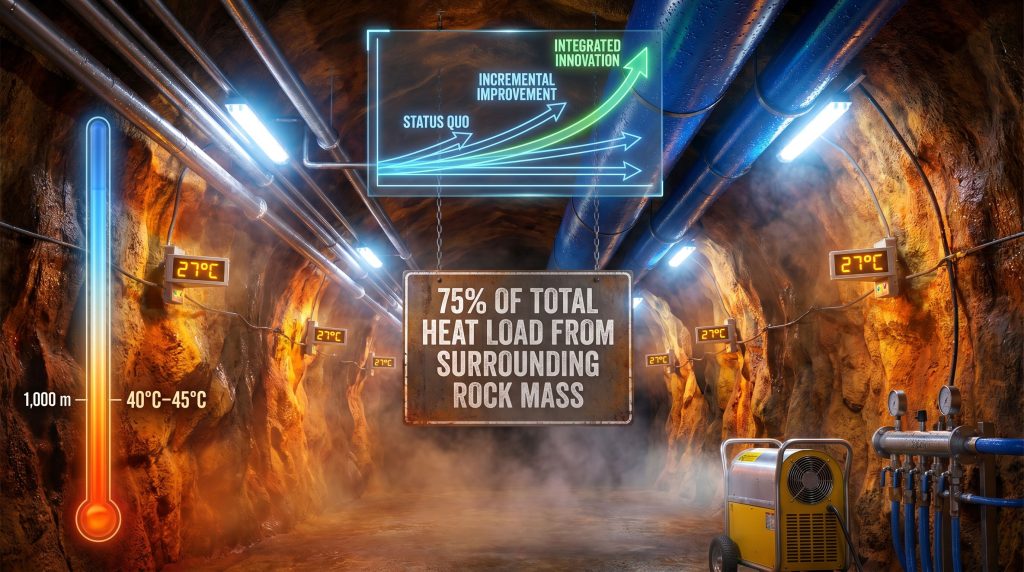
What makes underground heat particularly challenging is not merely its magnitude but its persistence. Unlike surface heat, which dissipates naturally into the atmosphere, underground heat accumulates within confined geometries. The rock mass surrounding any excavation continuously radiates thermal energy into the open airspace, a process that does not pause regardless of ventilation rates, shift schedules, or time of day. Research confirms that geothermal heat from the surrounding rock mass can account for more than 75% of the total heat load in deep-level mining operations, making depth itself the defining thermal risk factor rather than equipment heat output or human metabolic activity.
By the time operations reach depths approaching 1,000 metres, rock temperatures of 40°C to 45°C become essentially unavoidable without active intervention. These are not marginal exceedances of comfort thresholds. They represent conditions that compromise both human physiology and equipment reliability in ways that cascade through every dimension of mine operations.
"The deeper the mine, the hotter the ventilation air becomes before it even reaches the working face. At extreme depths, this effect fundamentally undermines any ventilation-only thermal strategy, regardless of airflow volume."
A critical and underappreciated dynamic is how underground geometries amplify heat accumulation. Dead-end development headings, narrow ore drives, and stope voids create thermal traps where hot air cannot circulate freely. This is qualitatively different from surface operations, where radiant heat dissipates across open environments. Underground, the confined space acts as a thermal reservoir, and without engineered cooling inputs, temperatures in poorly ventilated workings can climb far beyond the ambient rock temperature due to the additional heat contributions of diesel equipment, blasting activity, and compressed air use.
How Heat Stress Translates Into Human and Financial Cost
The Physiological Threshold: Where Conditions Become Dangerous
The human body's thermoregulatory system is sophisticated, but it operates within narrow tolerances under conditions of sustained physical exertion. In deep mining environments, workers performing moderate to heavy tasks generate between 300 and 500 watts of metabolic heat that must be dissipated. When ambient temperatures are low, evaporative sweating manages this load effectively. When ambient temperatures approach or exceed skin temperature, however, the physics of heat dissipation shift against the worker, and the body begins accumulating heat rather than shedding it.
This physiological threshold is well-documented. Research consistently shows that accident rates remain lowest when underground temperatures stay below approximately 21°C (70°F) but begin climbing sharply once conditions exceed 27°C (80°F). The reason is not simply physical discomfort. Cognitive function degrades measurably under heat stress, with studies showing impairments in decision-making accuracy, reaction time, spatial awareness, and hazard recognition — all capabilities that are critical in an environment where poor judgement can have fatal consequences.
The progression from heat exhaustion to heat stroke can occur within minutes under strenuous conditions, and the confined nature of underground environments limits the options available for rapid cooling once a worker's condition deteriorates. This makes prevention through engineering controls far more important than response protocols, since by the time symptoms become obvious, the situation may already be critical.
Quantifying the Damage: What Longitudinal Data Reveals
An 11-year longitudinal study tracking heat-related illness cases across mining operations recorded 151 incidents directly attributable to occupational heat exposure. This figure illustrates not an isolated cluster of events but a sustained, systemic pattern of harm that repeats across operations, seasons, and geographies wherever thermal management is inadequate.
The financial consequences extend well beyond direct medical costs:
| Impact Category | Consequence |
|---|---|
| Cognitive impairment | Elevated error rates, compromised hazard recognition |
| Physical illness | Heat exhaustion, heat stroke, hospitalisation |
| Operational disruption | Unplanned stoppages, multi-day incident investigations |
| Financial exposure | Workers' compensation claims, regulatory penalties |
| Workforce stability | Skilled labour attrition, retention difficulties |
A single heat-related medical emergency rarely costs only what the ambulance call-out implies. The incident triggers an investigation that halts production across the affected zone. Safety officers reassess thermal conditions across adjacent areas. Regulatory notifications may be required. Reputational exposure with both regulators and prospective employees follows. The cascading nature of these consequences means that operations that fail to invest in proactive thermal management often pay far more in reactive costs than any preventive infrastructure would have required.
Engineering Trade-Offs: Why There Is No Perfect Cooling Solution
The Portability Versus Performance Dilemma
Every thermal management system deployed underground involves compromises. Maximum cooling capacity typically requires fixed infrastructure with large refrigerant circuits, heat exchangers, and chilled water distribution networks. These systems deliver substantial cooling output but are expensive, difficult to relocate as mining fronts advance, and vulnerable to the pressure fluctuations and water quality variations that characterise deep underground environments.
Mobile cooling units offer operational flexibility, following the active mining face as development progresses, but their performance is constrained by the physics of compact refrigeration cycles. They cannot deliver the sustained cooling capacity of fixed systems, and their energy consumption per kilowatt of cooling is typically higher.
The purity-flow rate trade-off in fluid cooling circuits illustrates how optimising one performance parameter routinely compromises another. Fluid systems operating at approximately 98% purity deliver superior heat exchange efficiency and protect equipment from scaling and corrosion, but achieving this purity often requires flow restrictions that reduce overall cooling output. Furthermore, operators must decide which trade-off is acceptable for their specific depth, geology, and production profile, and there is no universal answer.
When Ventilation Alone Reaches Its Limits
For much of mining history, ventilation was the primary thermal management tool. High-volume air circuits moving millions of cubic metres of air per day through underground workings diluted heat, dispersed contaminants, and provided the oxygen that sustained human activity and diesel combustion. This approach worked well at moderate depths.
The fundamental problem at extreme depths is thermodynamic. As ventilation air travels down intake shafts, it gains heat from the surrounding rock walls before it even arrives at the working level. By the time this air reaches a development heading at 2,000 metres depth, it may already be substantially warmer than when it entered the system at surface. Adding more airflow volume helps, but the air being added is itself increasingly warm. The law of diminishing returns applies harshly, and at some depth threshold, the energy cost of running larger ventilation fans exceeds the thermal benefit they deliver.
This is the point at which the industry must transition from ventilation-centric strategies to integrated cooling architectures that address heat at its source rather than attempting to dilute it with ever-larger air volumes.
The Primary Thermal Management Strategies in Deep Mining Today
Mechanical Refrigeration Systems
Bulk air cooling and spot cooling units represent the conventional engineering response to deep mine heat. Surface-based refrigeration plants, where heat rejection is easier and infrastructure costs are lower, can supply chilled water to underground heat exchangers that cool incoming ventilation air before it reaches active workings. Underground refrigeration plants avoid the efficiency losses of distributing chilled water over long vertical distances but require robust heat rejection infrastructure, often using service water as the rejection medium and creating additional complexity in water management systems.
Large-scale operations such as South Africa's ultra-deep gold mines have deployed refrigeration systems with capacities exceeding 30,000 kilowatts to maintain workable conditions at depths where rock temperatures would otherwise approach or exceed 60°C. These systems represent massive capital investments and ongoing operational costs that directly affect the economic viability of the ore body being extracted. Consequently, decisions about refrigeration capacity must be integrated into the definitive feasibility study long before construction begins.
Ventilation Network Optimisation
Computational fluid dynamics modelling has transformed ventilation design from an empirical art into a predictive engineering discipline. CFD simulations allow engineers to model entire ventilation networks in three dimensions before a single metre of tunnel is excavated, identifying thermal hotspots, predicting airflow behaviour around complex underground geometries, and testing the impact of proposed changes to shaft configurations or fan arrays.
This capability shifts thermal management from reactive problem-solving to proactive design, enabling operators to anticipate conditions at depth rather than discovering them after costly infrastructure is already in place. In addition, 3D geological modelling has become an essential companion tool, enabling engineers to incorporate structural and lithological data into thermal planning with far greater precision than was previously achievable.
Water-Based and Geothermal Cooling Approaches
Water-based cooling strategies are gaining significant traction as lower-carbon, lower-operating-cost alternatives to conventional refrigeration. Key approaches include:
- Lake water cooling utilising thermally stable deep water in cold-climate regions, particularly relevant to Canadian mining operations where winter lake temperatures can provide free or near-free cooling during colder months
- Low-temperature geological water injection as a passive cooling mechanism that leverages naturally cold groundwater intersected during development
- Absorption chiller systems that use waste heat from hot fissure groundwater to drive cooling cycles, converting a thermal liability into a cooling asset
- Seasonal thermal energy storage that banks cold from winter conditions for use during warmer operational periods
Localised and Personal Cooling Technologies
When engineering controls cannot fully maintain safe ambient temperatures across all working areas, personal protective approaches provide a supplementary layer of protection. Ice vests and phase-change cooling garments directly manage the worker's personal heat load rather than attempting to cool the entire surrounding volume of air. Face-level cooling systems direct conditioned air to the immediate breathing zone, providing thermal relief with far less energy expenditure than whole-heading ventilation strategies.
Wearable physiological monitoring technology represents a significant emerging capability. Devices that track core body temperature proxies, heart rate, and heat strain indicators in real time allow supervisors to identify at-risk workers before clinical symptoms emerge, enabling targeted intervention before conditions deteriorate to dangerous levels.
Real-Time Monitoring and Adaptive Control
Continuous temperature logging across active mining zones serves dual purposes: regulatory compliance and operational intelligence. Sensor networks that trigger automated cooling responses when temperatures approach threshold limits remove the lag between condition deterioration and human response. Furthermore, data-driven mining operations are increasingly incorporating digital twin systems that update live thermal models with real-time sensor data, allowing operators to see how the mine's thermal state is evolving and to intervene proactively rather than reactively.
The Regulatory Landscape: Enforceable Standards and Compliance Obligations
Regulatory frameworks governing underground heat exposure reflect an evolving understanding of thermal risk in mining. Federal standards in the United States mandate a maximum apparent temperature of 35°C (95°F) in underground refuge alternatives, a benchmark that reflects the physiological limits of human heat tolerance under emergency sheltering conditions. Occupational health and safety agencies across major mining jurisdictions have established enforceable exposure limits, with compliance requiring continuous monitoring and documented temperature records across active working areas.
The regulatory challenge is consistency. Standards vary meaningfully across Australia, South Africa, Canada, and the United States, creating situations where the same mine design might be compliant in one jurisdiction and in violation in another. This inconsistency complicates multi-national operator planning and creates incentive structures that may not uniformly prioritise worker protection across all operating environments.
An emerging trend is the requirement for documented thermal management plans as a condition of mine operating licences. Understanding mining permit requirements is therefore increasingly important, as regulators shift from prescriptive temperature limits to a more comprehensive expectation that operators demonstrate systematic approaches to identifying, monitoring, and controlling heat risk throughout the mine lifecycle.
The next major ASX story will hit our subscribers first
Emerging Technologies and the Pathway to Integrated Cooling
The most significant recent development in thermal management in deep mining is the move away from siloed solutions toward fully integrated architectures that combine multiple cooling mechanisms under unified control systems. Rather than choosing between ventilation or refrigeration, leading operations are designing systems where CFD-modelled ventilation networks, targeted refrigeration at the working face, water-based bulk cooling, and real-time sensor networks all operate as components of a single adaptive system.
AI mining efficiency tools and machine learning are beginning to optimise energy consumption across these complex systems in ways that human operators cannot manage manually. By continuously analysing temperature data from hundreds of sensors against production schedules, equipment locations, and external weather conditions, automated systems can modulate cooling outputs dynamically, directing cooling capacity to where it is most needed while reducing energy waste across the network.
The sustainability dimension of this shift is significant. Conventional refrigeration-heavy systems carry a substantial energy and emissions burden, often representing 20–30% of a deep mine's total electricity consumption. Integration of water-based cooling, geothermal heat exchange, and smarter ventilation design can meaningfully reduce this burden while maintaining or improving thermal conditions for workers.
What the Future Holds for Ultra-Deep Mining Operations
As shallow ore bodies are progressively depleted globally, the industry's centre of gravity is shifting toward greater depths. This is not a distant possibility but a near-term operational reality for copper, gold, nickel, and battery minerals that are becoming critical to energy transition supply chains. The ore bodies that will sustain global mining output in the 2030s and 2040s are, in many cases, already identified. Their extraction viability depends heavily on whether thermal management technologies can keep pace with the depth at which they are found.
Three strategic pathways define the range of possible industry responses:
| Scenario | Approach | Outcome |
|---|---|---|
| Status Quo | Ventilation-heavy, reactive cooling | Rising costs, safety violations, declining productivity at depth |
| Incremental Improvement | Upgraded refrigeration with better monitoring | Moderate risk reduction, persistently high energy costs |
| Integrated Innovation | CFD ventilation design, water cooling, AI monitoring | Optimised safety, lower energy burden, viable ultra-deep economics |
The workforce dimension of this challenge deserves specific attention. Persistent heat stress is a documented contributor to skilled labour attrition in mining, with experienced workers increasingly choosing better-conditioned operations over those that rely on personal tolerance to manage thermal risk. Operations that invest in demonstrably superior thermal environments gain a competitive advantage in recruiting and retaining the experienced workforce that deep mining disproportionately requires.
Frequently Asked Questions: Thermal Management in Deep Mining
What causes underground mines to become so hot at depth?
The primary driver is the geothermal gradient — the natural increase in rock temperature with depth driven by the Earth's internal heat. At depths approaching 1,000 metres, surrounding rock temperatures of 40°C to 45°C radiate continuously into mine airways, creating conditions that ventilation alone cannot adequately manage.
At what depth does ventilation alone become insufficient?
There is no universal threshold because local geology, rock type, and geothermal gradient all influence this point. However, operations beyond approximately 1,500 metres commonly reach depths where incoming ventilation air gains sufficient heat during its descent to render high-volume ventilation thermodynamically insufficient as a standalone cooling strategy.
What is the maximum safe temperature for underground mining workers?
US federal standards mandate a maximum apparent temperature of 95°F (35°C) in underground refuge alternatives. Broader occupational exposure guidelines from health and safety agencies generally target ambient conditions below 27°C for sustained physical work, recognising that accident rates increase sharply above this threshold.
How does heat stress affect mining productivity?
Research shows that cognitive function and physical work capacity both decline measurably with rising temperatures. Accident rates remain lowest below approximately 21°C and escalate significantly above 27°C. The indirect productivity costs of unplanned stoppages following heat incidents often exceed the direct medical costs by a substantial margin.
What are the most cost-effective thermal management strategies?
This depends on depth, geology, and climate. Water-based cooling approaches offer lower operating costs in cold-climate jurisdictions. CFD-optimised ventilation networks reduce fan energy consumption. Integrated systems combining multiple mechanisms generally deliver the best cost-performance ratio at extreme depths, though they require higher upfront capital investment.
How is computational fluid dynamics used in mine ventilation design?
CFD modelling creates three-dimensional simulations of airflow behaviour, heat transfer, and pressure distribution throughout an entire underground ventilation network. Engineers can test proposed designs before construction, identifying thermal problem areas and optimising shaft configurations, fan placements, and airflow paths to minimise heat accumulation at working levels.
Key Takeaways: The Economics of Getting Thermal Management Right
The evidence across engineering research, regulatory frameworks, and operational data points consistently toward one conclusion: thermal management in deep mining has moved from a secondary safety concern to a primary economic determinant.
- Geothermal heat load intensifies with depth in ways that standard ventilation strategies cannot offset beyond certain thresholds, making early-stage thermal planning essential during feasibility assessment rather than an afterthought during construction
- The human cost of inadequate thermal management includes not only direct medical incidents but sustained cognitive impairment that elevates accident risk and reduces decision quality across the entire underground workforce
- Engineering trade-offs between cooling capacity, energy consumption, portability, and fluid system performance require operators to make informed design choices during planning rather than improvising solutions under operational pressure
- Integrated strategies combining CFD-designed ventilation, targeted refrigeration, water-based bulk cooling, and real-time adaptive monitoring represent the industry's most effective response to the physics of deep mine heat
- Regulatory compliance requirements are tightening globally, with documented thermal management plans increasingly required as operating licence conditions rather than as voluntary best practice
- The operations that invest in sophisticated, energy-aware thermal management today are positioning themselves to access the ultra-deep ore bodies that will define global critical minerals supply in the decades ahead, while those that defer this investment face rising safety, regulatory, and competitive exposure
Readers seeking additional technical depth on thermal management in deep mining may find value in AZoMining's analysis Enhancing Thermal Management in Deep Mining and Stantec's engineering brief 3 Ways to Use Water to Cool Your Underground Mine*, both of which offer complementary perspectives on cooling system design and sustainable approaches to underground heat management.*
Want To Know Which ASX Mining Discoveries Are Worth Watching Right Now?
Discovery Alert's proprietary Discovery IQ model scans ASX announcements in real time, instantly identifying significant mineral discoveries — including those in the deep-mining sector where thermal management and capital requirements make early positioning critical — and delivers actionable alerts directly to subscribers. Explore historic discoveries and their extraordinary returns to understand the scale of opportunity, then begin your 14-day free trial at Discovery Alert to gain a market-leading edge before the broader market catches on.