May 18, 2026
The Refinery Deficit That Defines a Continent's Energy Problem
Across sub-Saharan Africa, the gap between crude oil production and domestic refining capacity has persisted for decades, forcing nations sitting atop substantial hydrocarbon reserves to export raw crude and reimport finished petroleum products at a significant markup. This structural inefficiency is not a new observation, but the scale of its economic consequence is often underappreciated. For East Africa specifically, the reliance on refined fuel imports from the Middle East and Asia creates a compound vulnerability: price exposure tied to global crude benchmarks, supply chain fragility rooted in long shipping distances, and a persistent foreign exchange drain that quietly erodes national balance sheets.
It is against this backdrop that the proposed Dangote East Africa refinery location decision carries consequences well beyond a single infrastructure project. The question of where this facility gets built is, in practical terms, a question about which nation anchors the region's energy future for the next several decades.
When big ASX news breaks, our subscribers know first
East Africa's Structural Fuel Import Dependency
The economics of East Africa's energy supply chain are worth examining carefully before assessing any proposed solution. The region currently sources the majority of its refined petroleum products from refineries in the Persian Gulf and South and Southeast Asia. These products travel thousands of nautical miles before arriving at Indian Ocean ports, with each link in the chain adding cost, lead time, and risk.
For landlocked economies such as Uganda, Rwanda, and Ethiopia, the situation is compounded further. Fuel that arrives at a coastal port still faces overland transit of hundreds or thousands of kilometres, with road haulage and border crossing fees adding additional layers of cost. The result is retail fuel prices in landlocked East African capitals that consistently rank among the highest on the continent relative to local purchasing power.
The absence of large-scale domestic refining infrastructure is the root cause. Kenya's ageing Mombasa refinery, which operated for decades before being decommissioned, demonstrated both the demand case and the operational challenges of running a coastal processing facility in the region. The lesson was not that refining was unviable in East Africa, but that scale and modern technology matter enormously to commercial success.
What the Dangote East Africa Refinery Project Involves
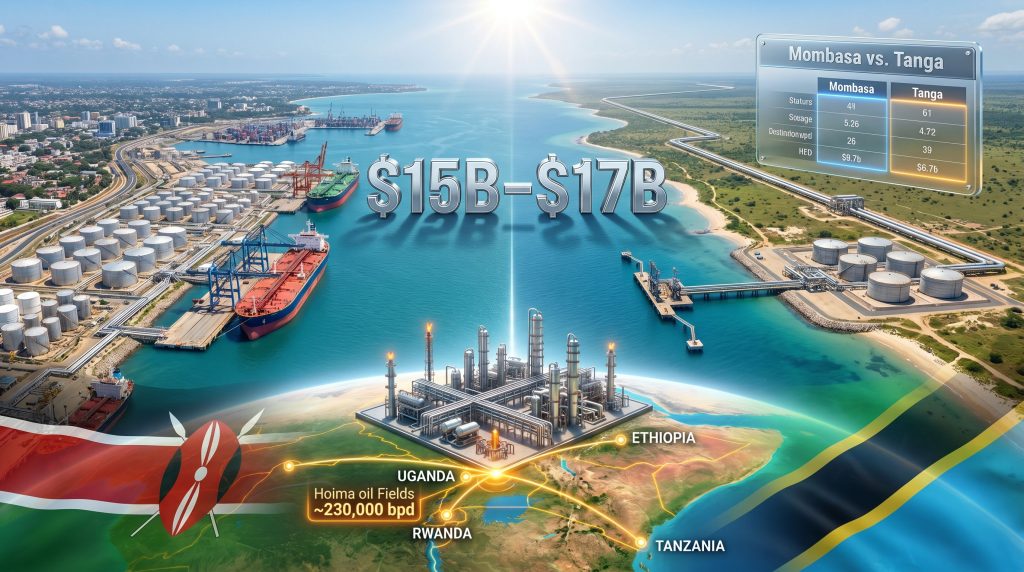
The proposed facility being championed by Aliko Dangote is designed to address exactly this structural gap. Reported estimates from Business Insider Africa place the project value at approximately $15 billion to $17 billion, which would position it as one of the largest single private sector industrial investments in East African history. To contextualise that figure: Dangote's separate commitment to an Ethiopian fertiliser facility has reached $4 billion, and that project alone has drawn continental attention. A refinery investment multiple times that size would represent a generational capital commitment to the region.
The facility is designed to process a diversified crude feedstock mix, including:
- Crude from Uganda's Hoima oil fields, which are projected to produce approximately 230,000 barrels per day once commercial production commences
- Output from Kenyan onshore oil reserves
- Supplementary imported crude to fill any feedstock gaps or optimise refinery throughput
The distribution scope envisioned extends across Kenya, Uganda, Tanzania, Rwanda, and potentially beyond, reflecting an ambition to serve as a regional processing hub rather than a single-nation supplier. This regional distribution logic is central to the investment case and directly influences which site makes most commercial sense. Furthermore, understanding the broader LNG supply outlook for the continent helps contextualise why downstream processing capacity of this magnitude is increasingly viewed as strategically critical.
This project also fits within a broader Dangote Group continental strategy that prioritises industrial anchoring through large-scale manufacturing. The Group's experience building and operating the Dangote Refinery in Lagos, Africa's largest oil refinery with a nameplate capacity of 650,000 barrels per day, provides a technical and operational template for replicating that model across the continent.
Mombasa vs. Tanga: The Two Sites in Contention
The site selection debate has crystallised around two coastal locations, each with a compelling but distinct investment rationale.
Why Mombasa Holds the Commercial Edge
Kenya's principal port city offers a combination of infrastructure maturity and market access that is difficult to replicate elsewhere in the region. Mombasa's deep-water port is capable of handling very large crude carriers (VLCCs), the class of tanker used for long-haul crude oil shipments from the Middle East and West Africa. This is a non-trivial technical requirement: not all East African ports can accommodate VLCC drafts without significant dredging investment.
Beyond port capacity, Mombasa sits at the centre of East Africa's most developed logistics network. The Standard Gauge Railway connecting Mombasa to Nairobi and onward, the Northern Corridor road network serving Uganda, Rwanda, and the Democratic Republic of Congo, and existing petroleum pipeline infrastructure linking the port to Nairobi's fuel storage facilities all provide a ready-made distribution backbone.
Kenya also represents East Africa's single largest refined fuel consumption market, meaning a Mombasa-based refinery would have immediate access to high-volume domestic demand before exporting a single litre across a border. According to reporting by the Financial Times on 10 May 2026, Dangote's own assessment leaned toward Mombasa based on its deep-water port capability, logistics network strength, and rising regional fuel demand.
Why Tanga Remains a Serious Contender
Tanzania's case rests primarily on one powerful structural argument: the East African Crude Oil Pipeline (EACOP). This pipeline, developed jointly by Uganda and Tanzania, stretches from Uganda's Hoima oil fields to the Chongoleani peninsula terminal at Tanga, on Tanzania's northern coast. When fully operational, EACOP creates a direct crude supply corridor from the region's primary upstream production hub to the coast.
For a refinery that intends to process Ugandan crude as a primary feedstock, co-locating at the pipeline terminus is logistically elegant. Crude arriving by pipeline eliminates the cost and complexity of loading crude onto tankers at a Ugandan or Kenyan inland terminal and then shipping it to a coastal refinery. The pipeline connectivity argument becomes more compelling as EACOP approaches operational status.
Tanzania's government has pursued this advantage at the highest diplomatic level. President Samia Suluhu Hassan held direct investment discussions with Dangote at Tanzania's State House in Dar es Salaam, signalling Dar es Salaam's serious institutional commitment to securing the project (Business Insider Africa, 17 May 2026).
Reinforcing the competitive dynamic, Kenyan President William Ruto, while addressing Tanzania's Parliament in Dodoma, acknowledged that Tanga held genuine competitive merit for the refinery project due to its strategic positioning and regional trade connections, even as his own administration was simultaneously lobbying for Mombasa.
Comparative Site Analysis
| Evaluation Criterion | Mombasa, Kenya | Tanga, Tanzania |
|---|---|---|
| Port Depth and VLCC Capacity | Deep-water; VLCC-capable | Moderate; EACOP terminal present |
| Pipeline Feedstock Connectivity | Developing (LAPSSET corridor) | Direct EACOP link to Uganda's Hoima |
| Regional Fuel Market Scale | Largest in East Africa | Smaller domestic market |
| Crude Supply Diversification | Kenyan reserves and imports | Ugandan crude via EACOP |
| Government Diplomatic Engagement | Active at presidential level | Active at presidential level |
| Reported Investor Preference | Favoured by Dangote (FT, May 2026) | Favoured by pipeline logic |
| Logistics Network Maturity | High | Moderate |
| Rail and Road Connectivity | Extensive regional network | More limited regional reach |
How the East African Crude Oil Pipeline Reshapes the Equation
Understanding the EACOP's significance requires a brief technical explanation. The pipeline spans approximately 1,443 kilometres, making it one of the longest heated crude oil pipelines in the world. The heating requirement exists because Uganda's Hoima crude is a waxy, low-sulphur oil with a high pour point, meaning it solidifies at moderate temperatures and must be kept heated throughout transit to flow efficiently. This technical characteristic has been a source of both engineering complexity and international environmental debate during the pipeline's development.
The EACOP's terminus at Tanga's Chongoleani terminal creates a natural crude supply corridor that could materially reduce feedstock transport costs for a Tanzania-based refinery, a factor that will carry growing weight as pipeline operations mature and Uganda's production ramps toward its projected plateau of 230,000 barrels per day.
For the Dangote East Africa refinery location decision, the EACOP timeline matters as much as its existence. If commercial crude production from Hoima begins in the near term as projected, and pipeline operations follow within a manageable timeframe, the economics of Tanga as a refinery site improve considerably. Conversely, delays in either upstream production or pipeline commissioning weaken Tanga's feedstock security argument relative to Mombasa's ability to receive imported crude by VLCC in the near term.
The next major ASX story will hit our subscribers first
Energy Security Implications for the Wider Region
The economic case for domestic refining capacity in East Africa extends well beyond any single investor's return calculation. Analysts have noted that a large-scale regional refinery could structurally reduce East Africa's dependence on Middle Eastern and Asian refined product imports, with downstream effects including:
- Lower landed fuel costs for regional economies, particularly for landlocked nations currently absorbing multi-stage transport premiums
- Reduced foreign exchange outflows on petroleum product imports, strengthening current account positions across multiple countries simultaneously
- Greater supply resilience by diversifying away from supply chains exposed to geopolitical disruption in the Strait of Hormuz or Indian Ocean shipping lanes
- Price stabilisation for retail fuel consumers, reducing the frequency and severity of fuel price spikes driven by global crude market volatility
In addition, the broader oil market dynamics shaping global energy investment in 2025 and beyond make the case for African domestic processing capacity increasingly compelling from both a commercial and geopolitical standpoint.
Industrial Spillover Effects at the Host Site
The economic benefits of hosting the refinery extend beyond the facility itself. Refinery construction and operation generates significant downstream industrial clustering effects. The host nation could realistically expect:
- Tens of thousands of construction jobs during the build phase
- Permanent operational and technical employment, including specialised petrochemical engineering roles
- Downstream petrochemical manufacturing opportunities, including fertiliser production using refinery by-products
- Port infrastructure upgrades with spillover benefits for all cargo categories
- A substantially expanded national tax base and export revenue stream
For context, Dangote's Lagos refinery project generated significant employment during construction and is expected to save Nigeria billions of dollars annually in refined product import costs once fully operational. The East African equivalent, at a comparable or potentially larger scale, could replicate this multiplier effect for whichever nation secures the investment.
The Geopolitics of Industrial Mega-Projects
The spectacle of multiple heads of state personally lobbying a private investor over a refinery site is not unique to East Africa, but it illustrates a dynamic that is particularly pronounced in developing economies with significant industrial infrastructure deficits. When a single project can redefine a nation's industrial trajectory and reshape regional trade flows, presidential engagement becomes rational rather than exceptional.
Tanzania's State House engagement with Dangote signals that Dar es Salaam views the refinery not merely as a commercial opportunity but as a cornerstone of its long-term industrial development strategy. Tanzania has invested heavily in the EACOP corridor and clearly intends to leverage that infrastructure investment to attract downstream processing capacity.
Kenya's dual-positioning is more nuanced. By publicly acknowledging Tanga's competitive merits while simultaneously pursuing Mombasa, President Ruto signalled openness to a regional cooperation framework, potentially within the East African Community (EAC) or under AfCFTA's industrial development provisions. This positioning may reflect a strategic calculation that a joint framework is preferable to losing the project entirely to Tanzania.
However, OPEC's market influence on global crude pricing also plays a quiet but meaningful role here. Refinery project economics are sensitive to long-term crude cost assumptions, and East African planners must factor global supply decisions into their financial modelling.
What Will Actually Determine the Final Location
Stripping away the diplomatic noise, the Dangote East Africa refinery location will ultimately be determined by a weighted assessment of the following factors:
- Technical feasibility: Can the site handle VLCC crude deliveries or receive pipeline crude at sufficient volume and reliability?
- Commercial viability: What are the all-in delivered costs of crude to the refinery gate, and what are the distribution costs to the key end markets?
- Feedstock security: Which location offers the most reliable crude supply across multiple production scenarios and geopolitical environments?
- Political risk and regulatory stability: Which jurisdiction offers greater confidence in land tenure, permitting timelines, and fiscal terms for a multi-decade investment?
- Environmental and social licensing: Both sites will require rigorous environmental impact assessments and community engagement, particularly given international lender requirements for infrastructure of this scale
- Financing structure: The participation of multilateral development banks or sovereign wealth funds could introduce site preferences of their own, particularly regarding environmental governance standards
Furthermore, the prevailing crude oil price trends will shape refinery margin projections and, consequently, the commercial thresholds that determine whether this project proceeds at all. The impact of sanctions on oil trade globally has also reconfigured crude supply routes in ways that may affect feedstock sourcing options for a large East African processing facility.
Large-scale energy infrastructure investments of this magnitude are almost never decided by a single variable. The final decision will reflect a complex weighting of logistics economics, feedstock availability, market access, and regulatory confidence, with Mombasa currently holding an apparent advantage on the commercial and logistics dimensions based on available reporting.
Three Scenarios for How This Resolves
Scenario A: Mombasa Confirmed
Dangote proceeds with Kenya, establishing Mombasa as East Africa's refining hub. The decision leverages Kenya's superior logistics infrastructure, VLCC port capability, and dominant regional fuel market. Tanga continues its role as the primary crude export terminal for Ugandan production via EACOP, while Kenya controls the regional refined product distribution network.
Scenario B: Tanga Secures the Project
Tanzania achieves a diplomatic and commercial breakthrough, combining EACOP crude supply synergies with an incentive package compelling enough to offset Mombasa's logistics advantages. Tanga evolves into a dual-function energy hub managing both crude export and refined product distribution across the region. According to East African reporting, this outcome would also place significant competitive pressure on the proposed Uganda refinery facility.
Scenario C: A Cross-Border Framework Emerges
Both nations and Dangote agree to a phased or split-site model, potentially structured as a joint Kenya-Tanzania energy corridor under EAC auspices. Initial refinery infrastructure is established at the primary site, with satellite distribution investment at the secondary location. This outcome is the most complex to execute but may represent the politically sustainable path if neither country accepts being the loser in a binary decision.
Frequently Asked Questions: Dangote East Africa Refinery Location
Where is the Dangote East Africa refinery most likely to be built?
Based on current reporting, including the Financial Times coverage from 10 May 2026, Mombasa, Kenya appears to be Dangote's preferred location, primarily due to its deep-water port infrastructure, mature logistics network, and access to the region's largest fuel consumption market. No final decision has been publicly confirmed as of mid-2026.
How much will the Dangote East Africa refinery cost?
The project has been reported at an estimated scale of $15 billion to $17 billion, which would make it one of the most significant private sector industrial investments in East African history.
Why is Tanzania competing for the refinery?
Tanzania's Tanga port is positioned at the terminus of the East African Crude Oil Pipeline (EACOP), which connects directly to Uganda's Hoima oil fields. This creates a structural argument for Tanga as the natural refinery site for processing Ugandan crude. Tanzania's government has also engaged Dangote at the presidential level to strengthen its bid.
What crude oil will the refinery process?
The proposed refinery is designed to handle a diversified feedstock mix including crude from Uganda's Hoima fields (projected at around 230,000 barrels per day), Kenyan onshore reserves, and supplementary imported crude.
What is the current project status?
As of mid-2026, the project is in an advanced discussion and site evaluation phase. Senior-level diplomatic engagements between Dangote Group and multiple East African heads of state are ongoing. No binding site agreements or groundbreaking announcements have been made publicly.
How could the refinery affect fuel prices across East Africa?
By replacing imported refined products with domestically processed output, a regional refinery of this scale could reduce landed fuel costs, lower foreign exchange outflows, and improve supply chain resilience, particularly for landlocked economies that currently absorb multiple layers of transport cost in their retail fuel pricing.
Key Takeaways
- The proposed $15B to $17B Dangote East Africa refinery represents a generational energy infrastructure opportunity for the region
- Mombasa, Kenya currently holds the commercial and logistics advantage based on reported investor assessments
- Tanga, Tanzania retains a structurally compelling case through EACOP pipeline connectivity and active high-level diplomatic engagement
- Uganda's projected crude production of ~230,000 barrels per day from the Hoima fields underpins the entire feedstock business case
- The final decision will be driven by investor-led technical and commercial analysis, with political incentives playing a supporting rather than determinative role
- Whichever nation secures the project will gain a transformational industrial anchor with economic multiplier effects extending across the broader East African region
This article is based on publicly available reporting and does not constitute financial or investment advice. Project details, cost estimates, and timelines remain subject to change pending official announcements from the parties involved. Readers should conduct independent research before forming conclusions about any commercial or investment implications.
Want To Track The Next Major Resource Discovery Before The Market Does?
Discovery Alert's proprietary Discovery IQ model delivers real-time alerts on significant ASX mineral discoveries — transforming complex resource data into actionable opportunities the moment they hit the exchange. Explore how major discoveries have historically generated substantial returns on Discovery Alert's dedicated discoveries page, and begin a 14-day free trial to position yourself ahead of the broader market.