May 18, 2026
How Blasting Technology Became a Strategic Priority in Russian Mining
The economics of hard rock mining rest on a deceptively simple premise: the quality of a blast determines the cost of everything that follows. Fragmentation size governs crusher throughput, haul cycle efficiency, and ultimately the energy consumed per tonne of mineral recovered. For decades, Russian mine operators sourced the precision technologies enabling this control from a small group of international specialists. That supply relationship has fundamentally changed, creating both urgency and opportunity for domestically developed solutions to fill a technically demanding gap.
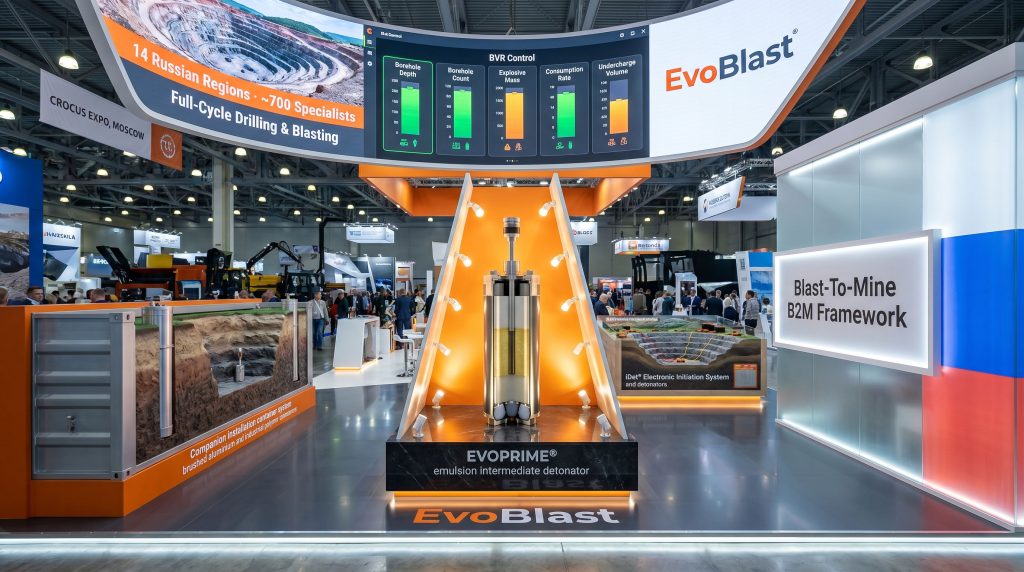
Against this backdrop, EvoBlast innovations at MiningWorld Russia 2026 represented far more than a routine trade exhibition appearance. The April showcase at Crocus Expo in Moscow offered a detailed view of how one Russian blasting technology group has responded to shifting market conditions with a portfolio of integrated engineering solutions, digital tools, and safety-focused product design.
When big ASX news breaks, our subscribers know first
MiningWorld Russia 2026: Context Beyond the Exhibition Floor
Why This Event Carries Strategic Weight
Mining technology exhibitions function as pressure tests for the companies that participate in them. Unlike controlled sales environments, a trade floor places products and claims in front of engineers, mine managers, and procurement specialists who can probe technical details and compare alternatives in real time. MiningWorld Russia, held annually at Crocus Expo in Moscow, has grown into Russia's most significant platform for this kind of direct technical evaluation.
The 2026 edition, which ran from 22 to 24 April, attracted participants spanning the full extraction value chain, from drill and blast contractors through to mineral processing equipment providers. For exhibitors like EvoBlast, the event provided simultaneous access to decision makers from operations scattered across Russia's extraordinary geographic range, a reach that would otherwise require months of individual site visits.
The mining geography of Russia stretches from the Kola Peninsula in the northwest to operations in the Far East, encompassing Arctic permafrost, high-altitude hard rock formations, and deep underground environments. Solutions that succeed across this range must be engineered for adaptability, not simply technical performance under ideal conditions.
Russia's mining industry generates approximately 10% of national GDP and accounts for a substantial share of the country's export earnings across gold, copper, coal, iron ore, and platinum group metals. The sector's strategic importance amplifies the significance of technology choices made at every stage of the extraction process, including blasting. Furthermore, mining innovation trends continue to reshape how operators evaluate supplier partnerships at events like these.
EvoBlast Group: Building a Full-Cycle Blasting Capability
From Explosives Manufacturer to Integrated Service Provider
EvoBlast Group is a Russian developer, manufacturer, and service provider operating across the commercial explosives and initiation systems segments of the mining and construction industries. The company's operational model is built around what it describes as full-cycle blasting engineering, encompassing explosives formulation, blast design, initiation system deployment, and post-blast analysis.
The company's field presence spans 14 Russian regions, with active experience in geologically complex and remote operating environments that place particular demands on the adaptability of blasting solutions. A workforce of approximately 700 specialists supports this footprint, including certified blasting engineers, field operations technicians, and geotechnical personnel who provide direct support to mining customers.
| Company Attribute | Detail |
|---|---|
| Operational Footprint | 14 Russian regions |
| Workforce | ~700 specialists |
| Primary Sectors | Mining, Construction |
| Service Model | Full-cycle drilling and blasting |
| Geographic Range | Kola Peninsula to Far East |
| Key 2026 Exhibition Products | EVOPRIME®, iDet® EIS, B2M Framework, BVR Control |
The Capability Gap EvoBlast Has Moved to Fill
The reduced presence of major Western blasting technology suppliers in Russia created a technically demanding void that generic domestic alternatives have struggled to address. Precision electronic initiation, emulsion explosive engineering, and blast-to-process integration represent capabilities that require sustained investment in both product development and specialist knowledge.
EvoBlast's strategic positioning targets exactly this gap. Rather than competing purely on price, the company has built its market identity around premium engineering quality, regional logistics capability, and deep familiarity with the geological conditions specific to Russian mining environments, including the thermal and mechanical challenges of permafrost zones and the stress characteristics of deep Siberian hard rock formations.
The company's participation in EvoBlast innovations at MiningWorld Russia 2026 with a technically sophisticated product range signals a deliberate strategy of increased market visibility at a moment when Russian mine operators are actively re-evaluating their blasting technology supply chains.
The Blast-To-Mine Framework: Rethinking What a Blast Actually Does
B2M as an Integrated Production Philosophy
The centrepiece of EvoBlast's 2026 exhibition was the Blast-To-Mine (B2M) framework, a comprehensive engineering approach that reframes blasting as a production optimisation activity rather than a standalone safety-compliance function.
The core proposition of B2M is straightforward but operationally significant: every blast design decision has measurable consequences for downstream processing performance. The particle size distribution created by a blast directly influences crusher energy consumption, mill throughput, conveyor loading patterns, and ultimately the cost per tonne of mineral processed. Treating these as separate domains, managed by different teams with different objectives, creates inefficiencies that accumulate across the production cycle.
B2M addresses this by connecting blast design explicitly to fragmentation outcomes and mineral processing requirements. The framework encompasses:
- Blast design engineering calibrated to ore body characteristics and processing requirements
- Fragmentation modelling predicting particle size distribution before detonation
- Ore displacement interpretation capturing how blasted material actually moves
- Post-blast analysis feeding forward into subsequent blast cycle planning
Industry research consistently demonstrates that improvements in fragmentation quality from blasting can reduce crushing and grinding energy consumption by 10 to 30 percent, representing one of the highest-return optimisation opportunities available to mine operators without significant capital expenditure on processing infrastructure.
Modular Adoption: Meeting Operators Where They Are
A critical commercial feature of the B2M framework is its modular architecture. Mine operators can adopt the complete integrated suite, which is suited to greenfield operations or major brownfield projects seeking comprehensive process integration, or they can deploy individual service modules targeting specific production bottlenecks.
This flexibility is strategically important. Many established Russian mining operations have existing blast management workflows and cannot immediately absorb a full system replacement. The modular approach allows EvoBlast to enter at a specific pain point, whether inconsistent fragmentation, poor blast data visibility, or safety compliance gaps, and demonstrate measurable value before broader adoption is considered.
Scenario example: A mid-sized open-pit gold operation experiencing high crusher maintenance costs attributable to oversized blast fragments could deploy the B2M fragmentation control module alongside BVR Control data capture. Within several blast cycles, the resulting data would identify the specific charge configurations and timing sequences generating problematic fragmentation, enabling targeted design adjustments without requiring a full workflow overhaul.
EVOPRIME® and the Safety-By-Design Approach to Explosives
What the Intermediate Detonator Represents
Among the new products introduced at MiningWorld Russia 2026, the EVOPRIME® emulsion-based intermediate detonator attracted significant attention for its design philosophy as much as its technical specifications. Intermediate detonators serve a critical function in blast columns, providing the initiating energy needed to reliably detonate bulk explosives in boreholes. The reliability and ease of use of these components directly affects both blast outcomes and crew safety.
EVOPRIME® uses an emulsion explosive compound as its core energetic component. Emulsion explosives are characterised by their inherent insensitivity to accidental initiation under normal handling conditions, a property that derives from the fine dispersion of oxidiser droplets within a continuous fuel phase. This chemical architecture provides a meaningful safety advantage over more sensitive explosive formulations in field handling scenarios.
The design objectives for EVOPRIME® focused on three parallel priorities:
- Reduced labour intensity for blasting crews through simplified charge preparation procedures
- Enhanced field safety through lower sensitivity to accidental initiation during handling and placement
- Consistent performance across the diverse temperature and geological conditions encountered across Russia's mining regions
The Companion Container System
Alongside EVOPRIME®, EvoBlast introduced a dedicated installation container system engineered specifically for intermediate detonator placement within boreholes. This companion product addresses a frequently overlooked aspect of blasting safety and efficiency: the manual handling steps involved in positioning and securing detonators within charged blast holes.
The container system reduces direct physical contact between blasting crew members and the energetic components during placement, simultaneously improving charge positioning consistency and reducing the variability that can arise from manual placement in challenging field conditions. Combined with the EVOPRIME® detonator's inherent handling safety, the two-product system represents a coherent safety-by-design approach to what has historically been one of the higher-risk phases of the blast preparation process.
Digital Integration: BVR Control and the Automated Data Layer
Why Blast Data Collection Has Been a Persistent Gap
One of the most consequential limitations in conventional Russian blasting operations has been the reliance on manual data collection during blast preparation and execution. Manual recording of borehole depths, explosive masses, and charge configurations is time-consuming, prone to transcription error, and difficult to audit in real time. When deviations from approved blast designs occur, they may not be identified until post-blast analysis, by which point the operational consequences have already materialised.
BVR Control is EvoBlast's software solution to this structural problem. The system automates the capture and real-time analysis of the key operational parameters that define whether a blast is being executed in accordance with its approved design. In addition, data-driven mining operations are increasingly reliant on precisely this kind of automated, auditable data infrastructure.
The variables tracked by BVR Control per blast event include:
- Borehole depth (actual versus planned)
- Total borehole count
- Explosive mass loaded per hole
- Explosive consumption rate across the blast pattern
- Undercharge magnitude where loading falls short of design specification
Real-Time Deviation Detection as a Safety and Quality Tool
The real-time deviation detection capability within BVR Control transforms blast data from a post-event record into an active quality management tool. When the system identifies a variance between planned and actual charge configuration during loading, the blasting crew and site supervisor can address the discrepancy before detonation rather than investigating its consequences afterwards.
This capability has direct implications for both safety compliance and fragmentation quality. Undercharged holes, where insufficient explosive has been loaded, produce local fragmentation failures that generate oversized boulders requiring secondary breaking. Overcharged holes create excessive energy release that can damage haul roads, disturb slope stability, or generate unacceptable ground vibration and air overpressure.
BVR Control completed final testing ahead of the MiningWorld Russia 2026 exhibition, positioning the software for broader commercial deployment across EvoBlast's operational footprint following the event. The system's ability to track a minimum of five critical parameters per blast event enables pattern recognition across multiple blast cycles, supporting continuous improvement in blast design calibration.
The longer-term potential of BVR Control lies in its capacity to generate structured datasets that can be analysed for systematic patterns across blast cycles, seasons, ore zones, and geological conditions. This accumulated operational intelligence, which manual recording systems rarely produce consistently, forms the foundation for the kind of data-driven blast optimisation that B2M conceptually targets.
The next major ASX story will hit our subscribers first
iDet® Electronic Initiation: Precision Timing as a Production Variable
How Electronic Detonators Differ From Conventional Systems
The functional difference between electronic initiation systems and conventional pyrotechnic or shock tube detonators is fundamentally a question of timing precision and programmability. Conventional detonators rely on pyrotechnic delay elements whose burn times are subject to manufacturing tolerances, temperature variation, and handling effects, creating timing scatter that limits how precisely blast sequences can be controlled.
Electronic detonators replace the pyrotechnic delay with a digital timing circuit that can be programmed to fire with millisecond-level precision. This capability enables blast designers to choreograph detonation sequences across large blast patterns with a level of control that was previously unavailable, with significant consequences for fragmentation quality, ground vibration management, and air overpressure control. Furthermore, drilling and blasting automation is rapidly advancing to support exactly this kind of precision sequencing at scale.
| EIS Benefit Category | Operational Impact |
|---|---|
| Timing Precision | Reduced ground vibration through sequential energy release |
| Fragmentation Control | More consistent particle size distribution across blast |
| Safety | Elimination of accidental initiation risk from stray current |
| Productivity | Faster post-blast re-entry through reduced fume generation |
| Compliance | Auditable firing records for regulatory reporting |
| Data Integration | Compatible with digital blast management platforms |
The iDet® System at MiningWorld Russia 2026
EvoBlast structured the iDet® demonstration at MiningWorld Russia 2026 around two purpose-built zones simulating open-pit and underground working environments. This exhibition design choice reflects a sophisticated understanding of how technology adoption decisions are made by conservative mining operators who need to observe system reliability and operational simplicity before committing to implementation.
Live demonstration environments, where attendees can observe actual system operation rather than relying on specifications and video content, play a disproportionately important role in accelerating adoption of precision initiation technology. The operational simplicity of electronic detonator systems, particularly the elimination of complex pyrotechnic connection sequences, is often more persuasive when observed directly than when described in technical documentation.
The two-zone format also allowed EvoBlast to demonstrate how iDet® system configurations differ between surface and underground environments, where regulatory requirements, blast geometry constraints, and safety protocols create distinct operational contexts requiring adapted initiation approaches.
Displacement Modelling: The Post-Blast Data Advantage
What Conventional Blast Modelling Misses
Standard blast modelling approaches predict fragmentation outcomes based on explosive energy distribution calculations and rock mass properties. These predictions are valuable planning tools, but they share a common limitation: they model what the blast is expected to do rather than capturing what it actually did. The physical movement of detonated rock mass after an explosion, called ore displacement, frequently deviates from theoretical predictions due to local geological variations, explosive loading inconsistencies, and blast geometry factors that pre-blast models cannot fully account for.
This displacement gap has practical consequences for ore recovery and dilution management. When blasted material moves differently from the predicted pattern, ore boundaries shift relative to mining equipment positions. Material intended for processing may move into waste zones, while diluting material may move into the ore stream. Over many blast cycles, these systematic errors accumulate into meaningful ore recovery losses.
How the Updated Hardware-Software Complex Addresses Displacement
EvoBlast's updated hardware-software complex, showcased at MiningWorld Russia 2026, incorporates a dedicated module for ore body displacement interpretation. The system uses post-blast data to model how the actual rock mass moved during detonation, generating a corrected picture of ore body geometry that accounts for displacement effects rather than relying on pre-blast theoretical positions.
This displacement-informed model serves two immediate functions:
- It provides more accurate guidance for mining equipment operators on where ore and waste boundaries are located after the blast
- It feeds into the planning of subsequent blast designs, enabling refinement of charge configurations and timing sequences to reduce displacement deviations in future production cycles
The combination of displacement modelling with BVR Control's operational data capture creates a feedback loop where each blast cycle generates structured information that can improve the next, progressively reducing fragmentation variability and ore recovery losses across a production sequence.
Benchmarking EvoBlast Against Global Blasting Technology Standards
Where the 2026 Portfolio Stands Internationally
A realistic assessment of EvoBlast's technology position requires comparing its capabilities against the global benchmark rather than simply within the Russian market context.
| Capability | EvoBlast 2026 Offering | Global Industry Benchmark |
|---|---|---|
| Electronic Initiation | iDet® EIS | Widely adopted across major mining markets |
| Blast-to-Process Integration | B2M Framework | Emerging best practice, limited full adoption |
| Automated Data Capture | BVR Control Software | Selectively deployed by advanced operators |
| Displacement Modelling | Integrated module | Advanced capability, limited commercial deployment |
| Emulsion Intermediate Detonators | EVOPRIME® | Standard in mature markets |
| Regional Service Coverage | 14 Russian regions | Varies significantly by provider |
The displacement modelling integration within the hardware-software complex represents a genuinely advanced capability that remains limited in commercial deployment globally. Most blasting technology providers offer either blast design optimisation or post-blast analysis as separate service offerings. However, integrating displacement interpretation directly into the operational workflow as a data source for subsequent blast planning is a more sophisticated approach that few providers have fully commercialised.
The Localisation Advantage Beyond Political Considerations
Technology sovereignty arguments are sometimes dismissed as politically motivated preferences that sacrifice technical quality for supply chain independence. The case for localised blasting solutions in Russia has a more substantive technical foundation than this framing suggests.
Russia's geological diversity is exceptional. Mining operations span permafrost zones where ice-bearing ground requires precise control of explosive energy to prevent post-blast ground destabilisation, through to deep Siberian hard rock formations where in-situ stress conditions create rock mass behaviour that differs fundamentally from softer or shallower ore bodies. The geological characteristics of the Kola Peninsula's nickel and copper ore bodies differ substantially from the gold deposits of the Russian Far East.
International blasting solutions are often calibrated for geological conditions prevalent in their primary markets. Adapting them to Russia's specific conditions requires either extensive field modification, which is expensive and technically risky, or acceptance of suboptimal performance. EvoBlast's deep experience with Russia's specific geological range represents a genuine technical asset that extends beyond the commercial appeal of supply chain independence.
Industry Forces Driving Demand for Advanced Blasting Solutions
The Digitalisation of Mining Operations
The integration of real-time data platforms, IoT sensors, and automated reporting systems across global mining operations has progressed rapidly across most operational domains. Equipment health monitoring, haul fleet management, ventilation control, and mineral processing have all seen substantial digital transformation investment over the past decade.
Drilling and blasting has lagged behind this trend, remaining one of the last major mining sub-processes where manual data collection and experience-based decision making still dominate. The reasons for this lag are partly regulatory, since explosive handling environments impose strict constraints on electronic equipment deployment, and partly cultural, since blasting engineering has traditionally been treated as a skilled craft domain. Consequently, mining automation trends are now creating renewed pressure to close this gap systematically.
Both of these barriers are now eroding. Advances in intrinsically safe electronics have expanded the range of digital tools that can be deployed in blast environments, while the competitive pressure to demonstrate measurable, auditable performance improvements has created demand for objective blast performance data that manual methods cannot consistently provide.
Safety Regulation and the Pressure to Reduce Manual Exposure
Russian industrial safety regulation in mining has progressively tightened requirements around explosive handling, with particular emphasis on reducing the number of manual steps that place blasting crew members in proximity to energetic materials during charge preparation and detonator placement. This regulatory direction creates direct demand for products like EVOPRIME® and its installation container system, which are explicitly designed to reduce manual handling requirements without sacrificing blast performance.
The economic pressure complements the regulatory one. Labour costs in Russia's remote mining regions are substantial, and the efficiency of blasting crews directly affects the overall production cycle. Simplifying charge preparation procedures, reducing the time required to set up each borehole, and enabling faster post-blast re-entry all translate into tangible cost reductions that mine operators can model against technology investment decisions.
Fragmentation Science as a Financial Variable
The growing body of research connecting blast fragmentation quality to total mine operating costs has created a more receptive audience for the kind of integrated blast-to-process value proposition that B2M represents. When blasting was viewed purely as a safety and productivity sub-process, investment justification focused on cost-per-tonne of material moved. When it is viewed as a production optimisation lever affecting downstream processing costs, the investment case changes substantially.
Industry research indicates that a 10% improvement in fragmentation quality from blasting can reduce grinding energy consumption by 15 to 25%, representing operating cost reductions that typically dwarf the cost of the blasting technology improvement itself. This economic logic, increasingly well understood among mine operators and their processing engineers, is what gives integrated frameworks like B2M their strategic appeal. In addition, mining technology advances in sorting and sensing are further elevating the importance of consistent feed quality from the blast stage onwards.
What EvoBlast's MiningWorld Russia 2026 Showcase Signals
Reading the Strategic Direction
The coherence of EvoBlast's 2026 exhibition portfolio suggests a company with a clearly defined technology roadmap rather than a collection of independent product initiatives. The B2M framework provides the conceptual architecture into which EVOPRIME®, iDet®, BVR Control, and the displacement modelling capability all fit as components of a connected engineering system.
Key strategic themes visible across the 2026 showcase include:
- Integration over isolation: Every product EvoBlast exhibited connects to at least one other element of the B2M framework, reflecting a systems engineering philosophy
- Safety as a design input, not an afterthought: EVOPRIME® and its container system demonstrate that safety improvements and operational efficiency improvements can be pursued simultaneously
- Data as a production asset: BVR Control and the displacement modelling module reflect recognition that structured operational data is itself a valuable output of the blasting process
- Localisation as a technical capability: The breadth of EvoBlast's operational experience across Russia's geological diversity is positioned as a substantive engineering advantage
What Mine Operators Should Monitor
For Russian mining operations evaluating blasting technology options, several specific developments from the EvoBlast innovations at MiningWorld Russia 2026 showcase merit continued attention. Furthermore, as sovereign technologies for drilling and blasting operations continue to evolve, operators should track the following closely:
- The commercial deployment trajectory of BVR Control following completion of its final testing phase
- Integration capability between EvoBlast's digital platform and third-party mine management and ERP systems
- The geographic expansion of iDet® electronic initiation system availability across additional Russian regions
- Further development of the B2M displacement modelling module and its integration with ore grade control systems
This article is intended for informational purposes only and does not constitute financial, investment, or technical advice. Forward-looking statements regarding technology performance, market adoption, or operational outcomes involve inherent uncertainty and should not be relied upon as guarantees of future results.
Further Reading: Ongoing coverage of drilling and blasting technology developments, exhibition reporting, and mining industry analysis relevant to the Russian sector is published by Gornaya Promyshlennost (Mining Industry Journal) at mining-media.ru, which provides editorial content across open-pit mining, underground operations, industrial safety, and mineral processing topics.
Want to Stay Ahead of the Next Major Mineral Discovery on the ASX?
Discovery Alert's proprietary Discovery IQ model delivers real-time alerts the moment significant mineral discoveries are announced on the ASX, transforming complex data across more than 30 commodities into clear, actionable insights for both short-term traders and long-term investors. Explore how historic discoveries have generated substantial returns and begin a 14-day free trial to position yourself ahead of the broader market.