
May 16, 2026
The Hidden Economics of Bringing Offshore Gas Back From the Dead
Most discussions about the UK's energy security focus on what gets built next. Offshore wind capacity additions, new hydrogen corridors, LNG import terminals, floating storage units. The conversation almost always runs in one direction: forward. Yet one of the most underappreciated dynamics shaping near-term domestic gas supply sits in the opposite direction, in the accumulated inventory of shut-in, mothballed, and near-decommissioned assets scattered across the Southern North Sea (SNS). These fields were not abandoned because their reservoirs ran dry. Many were sidelined because the economics of continued production, relative to the capital required to sustain aging 1970s-era infrastructure, crossed into negative territory during a period of depressed gas prices and tightening operational cost structures.
The Perenco Davy gas field restart changes the framing of that calculation entirely.
When big ASX news breaks, our subscribers know first
The Southern North Sea: A Mature Basin With Residual Value
The SNS is one of the oldest offshore gas-producing provinces in the world. First commercial gas production from the basin dates to the late 1960s, and peak output was achieved decades ago. Today, the basin is characterised by a large number of small-to-medium-sized fields, many of which share export infrastructure, pipeline tie-backs, and onshore processing facilities. Decline rates are elevated, and the cost per unit of gas produced tends to be higher than in newer, deeper-water developments elsewhere on the UK Continental Shelf (UKCS).
Despite this, the SNS retains meaningful reserves. The critical variable is not whether gas remains in the ground but whether a viable commercial pathway exists to recover it without triggering full decommissioning liability ahead of schedule. Monitoring natural gas price trends is, consequently, central to understanding when these marginal assets cross back into economic viability.
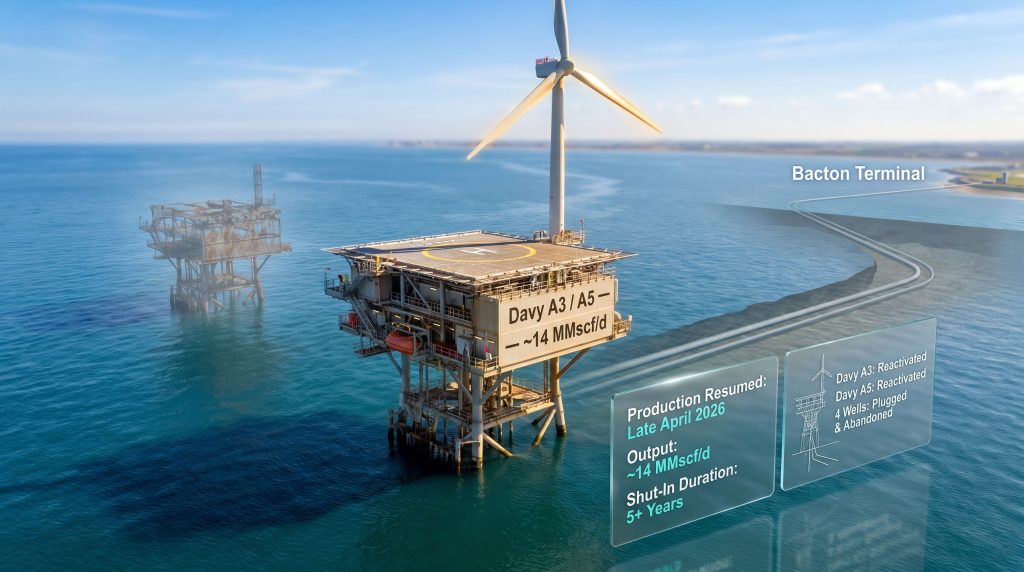
The Davy field sits within this broader SNS asset cluster. It produces gas that flows to the Bacton terminal on the Norfolk coast, one of the most strategically important gas processing and distribution hubs in the UK. Bacton functions as a receiving node for multiple SNS fields simultaneously, and its role in aggregating incremental production volumes from smaller assets makes it central to understanding how individual field restarts translate into meaningful supply contributions at a national level.
From Shut-In to Restart: Understanding the Five-Year Gap
When a platform goes offline in the SNS, the operational clock does not simply pause. Unmaintained offshore infrastructure deteriorates. Structural components are exposed to corrosive marine environments without active preservation programs. Well integrity, which is the mechanical condition of the steel casing and cement barriers that isolate reservoir fluids from the surrounding formation, degrades over time if monitoring and intervention are suspended.
A shut-in period of more than five years, which is the duration the Davy field sat offline before the Perenco revives North Sea production event in late April 2026, creates a meaningful technical challenge. Before any production wells can be returned to service, operators must conduct a full well integrity assessment. This involves pressure testing, logging runs, and in some cases remedial cementing or casing patches to confirm that the well barriers meet regulatory standards set by the North Sea Transition Authority (NSTA).
The fact that only two of the platform's wells, specifically the A3 and A5 wells, were returned to production reflects this screening process. The remaining four wells, two platform wells and two subsea completions, were not commercially viable or could not be certified for safe reactivation. They were plugged and abandoned as part of the same work program.
| Well Category | Action Taken | Rationale |
|---|---|---|
| Davy A3 | Reactivated for production | Viable reservoir connectivity confirmed |
| Davy A5 | Reactivated for production | Sufficient remaining reserves |
| 2 x Platform Wells | Plugged and abandoned | Uneconomic or integrity concerns |
| 2 x Subsea Wells | Plugged and abandoned | Partial decommissioning scope |
This well-by-well decision framework is more sophisticated than it might appear from the outside. Selectively retiring non-commercial wells during a restart program serves a dual function: it concentrates future production on the highest-quality reservoir targets while simultaneously reducing the operator's long-term decommissioning liability balance sheet exposure.
Platform Simplification: The Cost Lever Most Analysts Overlook
One of the least-discussed but most consequential aspects of the Davy redevelopment is platform simplification. In an offshore context, simplification refers to the deliberate removal or consolidation of non-essential platform systems, including redundant process trains, auxiliary utilities, and accommodation or support modules that are no longer required given the field's production rate and remaining well count.
The economic logic is straightforward. A platform originally designed in the 1970s to handle peak production rates from a larger well inventory carries a maintenance burden that is disproportionate to what a late-life field actually requires. Every additional system on a platform generates inspection obligations, spare parts inventory requirements, and potential failure modes that demand staffing and intervention. Stripping the platform back to the minimum configuration necessary to safely process and export current production rates reduces both capital expenditure and ongoing operating costs.
For late-life SNS assets, platform simplification is often the difference between a project that pencils out and one that does not. Reducing the operating cost base per MMscf produced can shift a marginal asset firmly into positive cash flow territory even at modest gas prices.
Perenco's redevelopment of Davy involved major upgrades to infrastructure originally engineered to 1970s standards, combined with this system rationalisation approach. The result is a platform that is technically simpler, less expensive to run, and more operationally reliable than the legacy configuration it replaced.
14 MMscf/d: Contextualising the Field's Contribution
The current combined output from wells A3 and A5 sits at approximately 14 million standard cubic feet per day (MMscf/d). To place this in context, UK daily gas demand fluctuates seasonally but averages in the range of 250 to 350 million cubic metres per day across the full consumption base. At the unit conversion of roughly 35.3 MMscf per million cubic metres, Davy's output represents a modest but not insignificant contribution, particularly when considered alongside the aggregated output of dozens of comparable SNS fields flowing through shared infrastructure.
The more meaningful framing is marginal supply contribution. Each additional MMscf/d of domestic production displaces an equivalent volume that would otherwise need to be sourced from the spot LNG market, Norwegian pipeline imports, or continental interconnectors. Furthermore, understanding the broader LNG supply outlook helps contextualise just how valuable incremental domestic production can be when import costs are elevated.
Key operational data snapshot:
- Current production rate: approximately 14 MMscf/d (combined A3 and A5)
- Production resumption date: late April 2026
- Shut-in duration: more than five years
- Export route: Perenco's Bacton terminal, Southern North Sea
- Wells reactivated: 2 (A3 and A5)
- Wells plugged and abandoned: 4 (2 platform, 2 subsea)
Wind Power on an Aging Offshore Platform: The Technical Achievement
Perhaps the most technically striking element of the Perenco Davy gas field restart is the installation of an offshore wind turbine as the platform's primary power source, replacing diesel-powered generation.
This matters for several reasons beyond the obvious emissions narrative. Diesel generation on an SNS platform requires regular fuel deliveries by supply vessel, which carries its own logistical complexity, weather dependency, and cost. Fuel delivery frequency scales with power demand, and a platform running diesel generators continuously can consume substantial quantities of marine gasoil over the course of a year.
Replacing this with a dedicated wind turbine eliminates fuel logistics almost entirely, though backup generation capacity is typically retained for periods of low wind availability. The net effect is a material reduction in both the platform's operational carbon intensity and its ongoing energy cost base. In addition, renewable energy solutions of this kind are increasingly demonstrating their viability across multiple extractive industries.
| Power Source | Carbon Intensity | Operational Cost | Reliability | Applicability |
|---|---|---|---|---|
| Diesel Generation | High | High (fuel logistics) | High | Legacy standard |
| Gas Turbine (self-powered) | Medium | Medium | High | Common on larger platforms |
| Offshore Wind Turbine | Very Low | Low (post-installation) | Variable | Emerging for smaller platforms |
| Shore Power (electrification) | Low to Zero | Low | High | Requires cable infrastructure |
The broader significance here is the proof-of-concept dimension. Smaller SNS platforms, which typically lack the economic scale to justify large capital investments in electrification via subsea power cables, now have a demonstrated alternative pathway to decarbonise their power supply. The Davy model suggests that wind-powered offshore operations are technically achievable even on legacy structures, a finding with meaningful implications for the 30-plus shut-in or late-life platforms currently being evaluated across the UKCS.
The UK's North Sea Transition Deal, agreed between the oil and gas industry and the UK government in 2021, established targets for reducing offshore production emissions intensity. The NSTA's stewardship framework increasingly evaluates late-life asset management decisions against these decarbonisation benchmarks. The decarbonisation benefits of integrating low-carbon power sources are, consequently, highly relevant to operators seeking field life extensions. A platform restart that simultaneously reduces emissions intensity relative to the legacy operational configuration aligns well with the regulatory expectations operators face when seeking production consents.
The next major ASX story will hit our subscribers first
The Operator-Decommissioning Specialist Model: Why It Works
Perenco UK executed the Davy restart in collaboration with Petrodec, a contractor specialising in offshore decommissioning. The choice of a decommissioning specialist for a project that involves both restarting production and plugging four wells reflects a logic that is not always obvious from the outside.
Decommissioning contractors possess a specific combination of capabilities: expertise in working on aging infrastructure that may be in degraded condition, experience with well abandonment operations, and the heavy-lift and intervention vessel access needed for complex offshore work programmes. These capabilities transfer directly to the mixed scope of a project like Davy, where the operator simultaneously needs to upgrade legacy systems, retire non-commercial wells, and bring surviving wells back into service.
This overlap between decommissioning execution capability and asset life extension project delivery is an emerging dynamic in the UK North Sea contractor market. As the SNS asset base ages and more fields approach or pass through the shut-in threshold, the demand for contractors who can handle this blended scope is likely to grow.
Is the Davy Model Replicable Across the Southern North Sea?
The SNS contains numerous fields that share the fundamental characteristics of Davy: infrastructure originally engineered in the 1970s or early 1980s, declining production rates that pushed economics into marginal territory, proximity to existing export route infrastructure, and residual reservoir volumes that have not been fully recovered.
A replicable redevelopment framework based on the Davy experience would involve the following assessment criteria:
- Well integrity screening to identify which wells in the existing inventory can be safely reactivated within acceptable cost parameters
- Platform simplification scoping to quantify the reduction in operating cost achievable through system rationalisation
- Export infrastructure proximity to confirm that existing pipeline or tie-back connections to onshore terminals remain serviceable
- Renewable power integration assessment to evaluate whether a wind turbine or other low-carbon energy design is technically viable given the platform's structural load capacity
- Partial decommissioning economics to determine whether retiring non-commercial wells improves the overall project return profile
- Residual reserve estimation to confirm that remaining recoverable volumes justify the redevelopment capital
Hypothetical scenario: An operator holds a small SNS gas field shut in for three years, with two remaining wells in acceptable mechanical condition and access to a shared pipeline export route. Residual reserves are estimated at 15 to 20 billion cubic feet. Applying a Davy-style framework, including platform simplification, selective plug-and-abandon of non-commercial wells, and wind turbine installation, the operator could potentially restore production at a fraction of the cost of a new development while extending field life by five to eight years and meeting current NSTA emissions benchmarks.
Regulatory Context: MER UK and Late-Life Asset Stewardship
The NSTA's Maximising Economic Recovery (MER UK) strategy creates a regulatory expectation that operators will actively evaluate all technically and commercially viable options before committing to full decommissioning. This framework does not mandate production continuation, but it does require operators to demonstrate that they have rigorously assessed redevelopment and life extension alternatives.
The Perenco Davy gas field restart is a concrete example of MER UK objectives being met through operational action rather than regulatory compliance paperwork. By investing in platform upgrades, executing partial decommissioning of non-commercial wells, and integrating renewable power generation, Perenco has extended the field's productive life while simultaneously reducing its long-term liability exposure.
Partial decommissioning within a restart programme also has nuanced financial provisioning implications. When wells are permanently plugged and abandoned, the associated decommissioning provisions held on the operator's balance sheet can be released, improving the financial profile of the remaining asset. This accounting dynamic is often underappreciated as a factor in the economics of mixed redevelopment and decommissioning programmes.
What This Means for UK Energy Security Beyond One Field
The Perenco Davy gas field restart is best understood not as an isolated operational event but as a data point in a larger argument about the residual value embedded in the SNS's mature asset base. According to reporting from Rigzone, the restart confirms that technically and commercially sound pathways exist for reviving Southern North Sea assets previously considered beyond economic recovery.
Several macro-level conclusions follow from careful analysis of this project:
- Domestic gas production from revived SNS assets carries a lower supply chain carbon intensity than imported LNG, which must be liquefied, shipped, and regasified before reaching UK consumers
- Platform simplification combined with renewable power integration can make late-life assets commercially viable at production rates that would have been uneconomic under legacy operating cost structures
- The decommissioning contractor community holds skills and equipment that are directly applicable to asset life extension projects, creating a growing market segment that sits between pure production operations and full asset retirement
- Regulatory frameworks designed to maximise economic recovery create an enabling environment for operators willing to invest in technically rigorous redevelopment programmes
- Incremental SNS production, aggregated across multiple Davy-scale field revivals, could represent a meaningful buffer against import dependency in the medium term
Disclaimer: This article contains forward-looking statements and scenario analysis based on publicly available information and established industry frameworks. Production forecasts, economic projections, and hypothetical redevelopment scenarios are illustrative in nature and should not be interpreted as investment advice or representations of guaranteed future outcomes. Readers should conduct independent research before making any investment or commercial decisions related to UK North Sea assets or operators.
Want to Stay Ahead of the Next Major Resource Discovery?
Discovery Alert's proprietary Discovery IQ model delivers real-time alerts on significant ASX mineral discoveries, turning complex data into actionable investment insights for both short-term traders and long-term investors — explore the historic returns major discoveries have generated and begin your 14-day free trial to position yourself ahead of the broader market.