May 16, 2026
India's Geological Intelligence Gap: Why the CMPDIL and MECL MoU for Mineral Exploration Changes the Equation
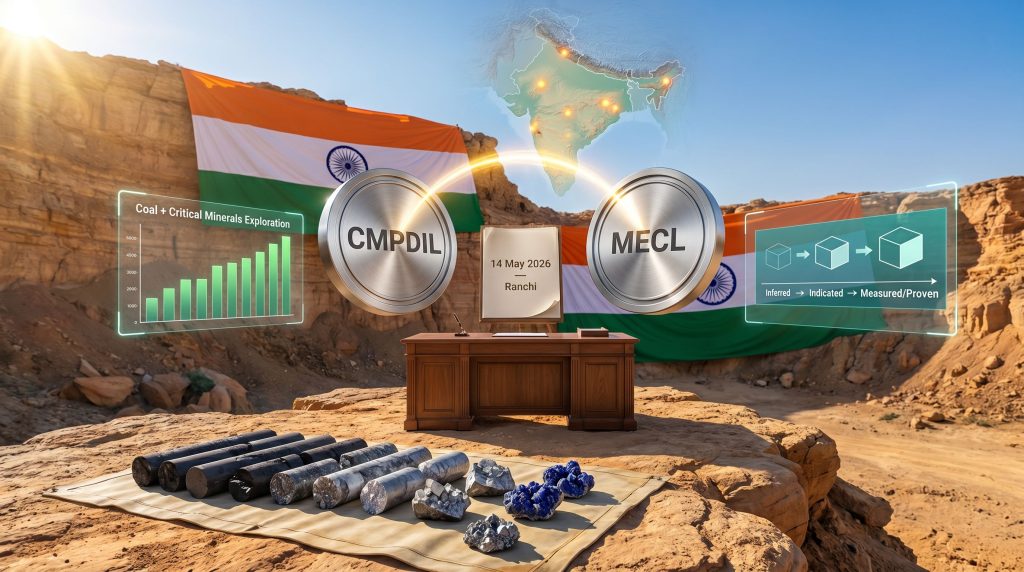
Across the global mining sector, one truth has become increasingly difficult to ignore: the countries that will dominate future mineral supply chains are not necessarily those with the largest deposits, but those with the most complete and bankable knowledge of what lies beneath their soil. Resource sovereignty begins in the data room, not at the mine gate. India, despite sitting atop one of the world's most geologically diverse landmasses, has long struggled to translate geological potential into proven, investment-ready reserve inventories. The CMPDIL and MECL MoU for mineral exploration, formalised on 14 May 2026 in Ranchi, represents a deliberate institutional response to this structural deficit.
Understanding why this agreement matters requires stepping back from the headline and examining the deeper mechanics of how mineral resource classification actually works, and why agency coordination is so critical to accelerating it.
When big ASX news breaks, our subscribers know first
The Resource Classification Problem India Has Been Quietly Managing
In geological terms, mineral resources move through a hierarchy of confidence levels before they become commercially viable. The internationally recognised framework, broadly aligned with the JORC Code and the UN Framework Classification for Resources, distinguishes between inferred, indicated, and measured categories for mineral resources, and further between probable and proven for ore reserves.
India's mineral resource database has historically carried a disproportionate weight of inferred and indicated inventory, particularly for critical and non-coal minerals. This matters enormously because:
- Inferred resources cannot support bankable feasibility studies or attract institutional debt financing
- Indicated resources require further drilling to reach the confidence thresholds demanded by project lenders
- Measured resources, converted through detailed drilling and sampling programmes, form the foundation of mine planning and capital investment decisions
The bottleneck has not primarily been a lack of geological prospectivity. India's Precambrian shield geology, Gondwana sedimentary sequences, and Deccan trap formations host significant endowments across coal, iron ore, bauxite, rare earth elements, lithium-bearing pegmatites, and cobalt-associated deposits. The bottleneck has been the pace at which promotional-stage surveys are followed by the detailed drilling campaigns needed to upgrade resource confidence categories.
This is precisely where the structural gap between CMPDIL and MECL has historically created friction. Furthermore, understanding the broader context of mineral exploration importance helps clarify why resolving this friction carries such significant consequences for India's resource development trajectory.
Two Agencies, Two Ministries, One Persistent Coordination Problem
CMPDIL, operating as a technical subsidiary of Coal India Limited under the Ministry of Coal, has built deep institutional expertise in coal block delineation, mine design, and feasibility assessment. Its core competency sits firmly within the coal value chain. MECL, operating under the Ministry of Mines, brings a broader geological mandate covering detailed exploration drilling programs and resource estimation across the full spectrum of mineral categories.
The ministerial separation between these two bodies created a structural incongruity that is rarely discussed in public commentary but has had measurable operational consequences:
- Promotional surveys conducted by CMPDIL over coal-adjacent zones containing polymetallic or critical mineral occurrences were rarely followed up by MECL's detailed investigation work
- Data standards and geological reporting formats differed between the two agencies, complicating any attempt at integrated resource assessment
- Capital expenditure planning cycles operated on separate ministerial timelines, making joint field operations logistically difficult to coordinate
- Human resource deployment, particularly for specialised drilling crews, remained siloed within each agency's own workforce
The CMPDIL and MECL MoU for mineral exploration is therefore not a routine inter-agency courtesy agreement. It is a structural correction to a coordination failure that has quietly constrained India's exploration velocity for years.
What the 14 May 2026 Ranchi Meeting Actually Covered
The high-level performance review convened in Ranchi under Union Minister of State for Coal and Mines Satish Chandra Dubey had a scope that extended well beyond the MoU signing itself. CMPDIL presented a comprehensive performance account covering FY 2025-26 and its forward targets for FY 2026-27 across the following domains:
| Performance Domain | FY 2025-26 Scope |
|---|---|
| Exploration Activities | Coal block surveys across multiple coalfields |
| Report Preparation | Geological, feasibility, and technical documentation |
| Capital Expenditure | Equipment procurement and infrastructure deployment |
| R&D Projects | Clean coal and emerging technology initiatives |
| CSR Initiatives | Community engagement and development programmes |
| Solar Energy Projects | On-site renewable energy integration |
Senior attendance at the review included Chaudhari Shivraj Singh as CMD of CMPDIL, Nilendu Kumar Singh as CMD of Central Coalfields Limited, and I.D. Narayan as CMD of MECL, alongside technical directors and senior officers from all three organisations. The calibre of representation signals that the MoU was not a peripheral agenda item but a centrepiece of the review's strategic outcomes. Indeed, the CMPDIL-MECL MoU signing has since drawn considerable attention from industry observers tracking India's evolving exploration architecture.
The Dual Mandate: Coal and Critical Minerals Together
One of the most technically significant aspects of the CMPDIL and MECL MoU for mineral exploration is its explicit coverage of both energy and non-energy mineral categories. This dual mandate reflects a sophisticated understanding of how India's mineral demand profile is evolving.
India's thermal coal requirements remain substantial in the near-to-medium term, with the country's installed coal-fired power capacity still forming the backbone of its electricity generation mix. However, the parallel acceleration of renewable energy deployment, electric vehicle adoption, and battery storage manufacturing creates a rapidly growing demand curve for minerals. In this context, critical minerals and energy security have become inseparable policy considerations, with the following materials at the forefront:
- Lithium for battery cathodes and electrolytes
- Cobalt as a cathode stabiliser in NMC and NCA battery chemistries
- Nickel for high-energy-density battery formulations
- Rare earth elements for permanent magnets in EV motors and wind turbines
- Graphite for battery anodes
- Manganese for battery cathode materials and steel alloying
India currently imports a significant portion of its critical mineral requirements, creating supply chain vulnerabilities that mirror those experienced by other industrialising economies. The domestic exploration acceleration enabled by CMPDIL-MECL coordination directly addresses this exposure by systematically upgrading the confidence and bankability of India's own mineral inventory.
The geological reality that is not widely appreciated outside specialist circles is that several of India's established coalfield regions contain associated mineralisation in overlying and underlying strata that has never been subject to systematic detailed investigation. MECL's involvement through the MoU framework could unlock resource potential in areas previously written off as purely coal-bearing.
Clean Coal Technologies: The Parallel Technical Mandate
Minister Dubey's emphasis on clean coal technologies during the Ranchi review deserves attention as a distinct strategic thread. Within the context of CMPDIL's mandate, clean coal is not a vague aspiration but a specific set of technical domains with real commercial and environmental implications:
- Coal gasification and liquefaction convert coal into syngas or liquid hydrocarbons, reducing direct combustion emissions and producing feedstocks for chemical industries
- Underground coal gasification (UCG) enables the extraction of energy value from coal seams that are too deep or thin to mine conventionally, with India's Coal India Limited having conducted UCG feasibility trials at specific sites
- Washery efficiency improvements reduce ash content in thermal coal, improving combustion efficiency and reducing particulate emissions per unit of energy generated
- Carbon capture, utilisation, and storage (CCUS) research positions coal-dependent operations for potential future emissions compliance frameworks
CMPDIL's R&D mandate in these areas positions it not merely as a survey organisation but as a technical development institution with relevance to India's long-term energy transition trajectory. The MoU's coverage of non-coal minerals sits alongside this clean coal mandate rather than displacing it.
The next major ASX story will hit our subscribers first
Procurement Reform: The Operational Enabler Nobody Discusses
Among the directives issued during the Ranchi review, the instruction to simplify procurement processes, enhance transparency, and improve market outreach may appear administrative in nature. In practice, procurement reform is often the single most consequential variable in determining whether exploration programmes actually deliver field metres drilled on schedule.
The mineral exploration industry operates on relatively specialised equipment and contractor pools. When procurement processes are complex, slow, or opaque, several damaging outcomes follow:
- Qualified international and domestic drilling contractors decline to participate in tendering, reducing competitive pressure on pricing
- Administrative delays between budget approval and contractor mobilisation erode the drilling season window, particularly in regions with monsoon-constrained fieldwork calendars
- Concentrated contractor awards create single points of failure in field operations
- Reporting and data deliverable timelines slip, delaying the resource classification upgrades that the entire exercise is designed to achieve
The Minister's directive to widen bidder participation and prevent project delays through better pre-award planning addresses all four of these failure modes simultaneously. Consequently, improvements in this area will directly determine how quickly survey outputs translate into upgraded mineral deposit tiers that attract private capital.
Mine Closure as Economic Asset: An Underappreciated Policy Dimension
The proposal to convert mine closure areas into productive economic zones through fox nut cultivation, fisheries development, and alignment with the One District, One Product initiative introduces a dimension to the Ranchi review that sits well outside conventional mining sector coverage.
From an environmental and social governance perspective, this approach represents a meaningful reframing of mine closure from a compliance liability into a community development asset. The practical implications are notable:
- Subsidence depressions and void-fill water bodies in post-mining landscapes create naturally formed pond systems with genuine aquaculture potential
- Reclaimed overburden areas with stabilised vegetation cover can support horticultural crops where soil amendment programmes have been implemented
- The One District, One Product framework provides a ready-made marketing and branding infrastructure for products from these reclaimed areas
For coal-dependent regions facing long-term structural employment transition as mine lifecycles conclude, this approach generates livelihood pathways without requiring greenfield economic development infrastructure.
Comparative State Exploration Architecture: Where India Sits Globally
India's dual-agency coordination model, while novel in its formal MoU structure, is consistent with approaches adopted by other resource-significant economies that have recognised the gap between geological survey capability and detailed exploration execution:
| Country | Primary State Exploration Agencies | Coordination Mechanism | Strategic Mineral Focus |
|---|---|---|---|
| India | CMPDIL + MECL | Inter-agency MoU (2026) | Coal + critical minerals |
| China | China Geological Survey + provincial bureaux | Centralised ministerial direction | Rare earths + base metals |
| Australia | Geoscience Australia + state geological surveys | Pre-competitive data sharing programmes | Battery minerals + iron ore |
| Brazil | CPRM (Geological Survey of Brazil) | Single-agency federal model | Lithium + niobium + iron ore |
| South Africa | Council for Geoscience | National geoscience mandate | PGMs + manganese + coal |
India's model is distinctive in that it bridges two separate ministerial jurisdictions through a formal cooperation instrument rather than through structural consolidation. Whether this proves sufficient as a coordination mechanism, or whether deeper institutional integration will eventually be required, remains an open and genuinely speculative question. In addition, discussions between MECL and CMPDIL on possible collaboration had been ongoing well before the formal MoU, suggesting the institutional groundwork for this partnership was carefully prepared.
Strategic Outlook: What the MoU Trajectory Implies
Near-Term Operational Expectations (FY 2026-27)
- Increased detailed drilling meterage targets in priority coal and critical mineral blocks, building on MECL's operational capacity
- Formation of joint technical working groups to align geological reporting formats between the two agencies
- Potential identification of polymetallic occurrences in coal-adjacent strata that have not previously received focused investigation
Medium-Term Implications (2027-2030)
- A materially more complete national mineral resource database enabling higher-quality block auction processes for private sector investors
- Reduced geological risk premiums in project financing for blocks covered by joint CMPDIL-MECL surveys
- Stronger domestic data foundations for India's participation in international critical mineral supply chain partnerships
Long-Term Mineral Security Architecture
The CMPDIL and MECL MoU for mineral exploration does not operate in isolation. It sits within a layered national strategy that also includes the National Critical Mineral Mission, the Khanij Bidesh India Limited overseas acquisition programme, and progressive amendments to the Mines and Minerals (Development and Regulation) Act. Each layer addresses a different segment of the mineral security problem, and definitive feasibility studies will ultimately determine how many of these identified resources translate into commercially viable projects:
| Strategic Layer | Mechanism | Gap Addressed |
|---|---|---|
| CMPDIL-MECL MoU | Domestic exploration coordination | Geological data quality and coverage |
| National Critical Mineral Mission | Policy prioritisation and funding | Sector-wide exploration acceleration |
| KABIL overseas programme | Equity stakes in foreign mineral assets | Supply diversification for import-dependent minerals |
| MMDR Act amendments | Regulatory framework reform | Private sector investment and auction efficiency |
The fundamental insight is this: India's mineral security challenge is not primarily one of resource scarcity. It is one of knowledge scarcity. The CMPDIL and MECL MoU for mineral exploration is, at its core, an investment in closing that knowledge gap before the demand curve for critical minerals accelerates further. Whether it delivers on that potential will depend on the quality of its implementation, not merely the intent of its signing.
Disclaimer: This article contains forward-looking assessments and projections based on publicly available information. Mineral exploration outcomes, policy implementation timelines, and resource classification upgrades are inherently uncertain and subject to geological, regulatory, and operational variables. Nothing in this article constitutes financial or investment advice.
Want to Capitalise on the Next Major Mineral Discovery Before the Broader Market?
Discovery Alert's proprietary Discovery IQ model delivers real-time alerts on significant ASX mineral discoveries, instantly transforming complex geological data into actionable investment insights for both short-term traders and long-term investors — explore historic discoveries and their remarkable returns to understand what early positioning can mean, then begin your 14-day free trial at Discovery Alert to secure your market-leading advantage.