May 18, 2026
Australia's Industrial Reckoning: Two Cities, Two Sites, One Defining Moment
Heavy industry rarely dies quietly. When steel mills and smelters close, they take with them not just jobs but the economic scaffolding of entire communities. The towns built around blast furnaces and processing plants experience a kind of structural grief that persists for generations. Port Talbot in Wales, Gary in Indiana, Wollongong in an earlier era — each carries the imprint of what happens when industrial anchors are removed without an adequate replacement. Australia is now confronting its own version of this risk, concentrated in two South Australian cities and crystallised into a narrow six-month window that will help determine whether the country retains genuine sovereign industrial capacity.
The Whyalla steelworks and Port Pirie smelter future is no longer just a matter of regional economics. It has become a test case for how democracies manage the intersection of private capital, public interest, geopolitical risk, and industrial transformation. The answers will have consequences well beyond Spencer Gulf.
When big ASX news breaks, our subscribers know first
Why These Two Industrial Sites Define Australia's Sovereign Capability Debate
The Strategic Weight of Aging Infrastructure in a Changing World
There is something striking about the fact that two of Australia's most politically consequential industrial facilities were built more than a century apart. The Port Pirie smelter dates to the 1880s. The Whyalla steelworks was established in the 1960s. Both were designed to serve economies that no longer exist in their original form. Both are now at the centre of a 21st-century debate about what it means for a nation to retain industrial self-sufficiency.
The concept of sovereign industrial capability has shifted significantly in recent years. Once treated primarily as an economic development question, heavy industry is increasingly framed as a national security asset. Supply chain disruptions during the COVID-19 pandemic, followed by geopolitical tensions reshaping global trade flows, have forced policymakers to ask a harder question: what happens to a country that outsources all of its industrial processing capacity?
For South Australia, the answer is not abstract. Whyalla and Port Pirie together represent a direct and indirect workforce estimated at approximately 5,500 people, with deep multiplier effects flowing through retail, transport, and services across the broader Spencer Gulf region. The loss of either site would not simply reduce employment numbers. It would alter the economic character of two cities that have no obvious industrial replacement waiting in the wings.
What Is at Stake: A Snapshot of the Numbers
| Metric | Whyalla Steelworks | Port Pirie Smelter |
|---|---|---|
| Year Established | 1960s | 1880s |
| Direct Employment | ~1,100 workers | ~900–1,400 workers |
| Indirect Employment | ~2,000 workers | Broader Spencer Gulf region |
| Government Funding Committed | ~$2.4–2.6 billion (state + federal) | $135 million (initial rescue package) |
| Ownership Status (2026) | Under administration; sale process underway | Operated by Nyrstar (Trafigura subsidiary) |
| Strategic Designation | Green steel transformation hub | Critical minerals processing (antimony, lead) |
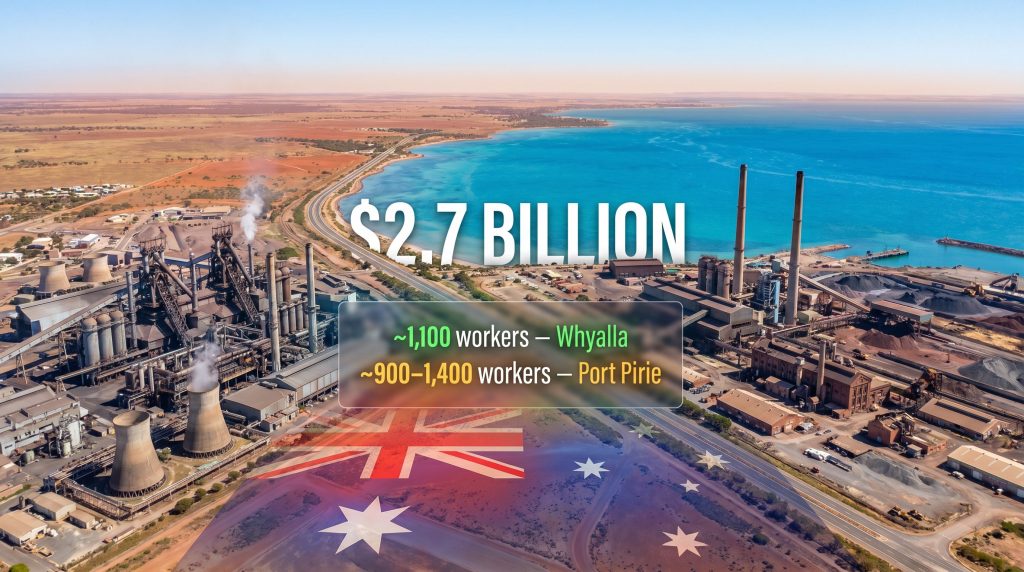
Combined, these two facilities have attracted well over $2.7 billion in committed public funding, making them among the most significant industrial policy interventions in modern Australian history.
How Did Australia Get Here? The Policy and Ownership Timeline
From Private Failure to Public Intervention: The Whyalla Story
The Whyalla steelworks' path to its current situation is a story of compounding governance failures. The facility was operated under the stewardship of GFG Alliance, led by British industrialist Sanjeev Gupta, whose empire relied heavily on complex and opaque financing structures. When those structures unravelled, the steelworks became financially unsustainable, leading the South Australian government to intervene in early 2025 and place the facility into administration.
What followed was one of the most ambitious industrial rescue operations in Australian history. The federal government's Future Made in Australia policy framework positioned Whyalla as a potential centrepiece of a broader green industrial transformation. Furthermore, the combined state and federal commitment has grown to approximately $2.4–2.6 billion, structured partly as stabilisation funding to keep the facility operational during administration and partly as transformation capital intended to fund an upgrade toward lower-emissions steelmaking.
The challenge is that stabilisation spending consumes public money without necessarily creating long-term industrial value. Every week the blast furnace sits idle or the sale process stalls, the gap between money spent and outcome secured widens. South Australia's green iron push illustrates just how much wider this strategic ambition extends across the state's industrial landscape.
The Port Pirie Equation: When a Corporate Owner Isn't Enough
Port Pirie presents a structurally different problem. The smelter has a corporate owner, Nyrstar, which is a subsidiary of Swiss-Dutch commodity trader Trafigura. However, corporate ownership does not automatically translate into commercial viability when the underlying market conditions have been distorted by deliberate state-level intervention from a competing power.
Nyrstar flagged that its Australian smelting operations were losing tens of millions of dollars per month before government support was negotiated. The initial $135 million rescue package, shared across South Australia, Tasmania, and the federal government, was designed to provide breathing room while a longer-term solution was developed. That package expired at the end of April 2026, and as of mid-2026, a replacement agreement has not yet been publicly announced despite ongoing negotiations.
Adding a layer of political complexity: Trafigura, Nyrstar's parent company, recorded a $US2.7 billion profit in 2025. This juxtaposition — a highly profitable multinational parent company alongside a subsidiary requiring government rescue — has sharpened public and political scrutiny of what constitutes a fair negotiating outcome for Australian taxpayers.
A separate $112.5 million transformation package was also flagged, including funding for a feasibility study examining whether Port Pirie could pivot toward producing antimony metal and other critical minerals at commercial scale. The Whyalla steelworks and Port Pirie smelter future, consequently, hinges not just on steel but on Australia's ability to secure its position in the critical minerals supply chain.
A Comparative Timeline of Government Interventions
| Date | Event |
|---|---|
| 1880s | Port Pirie smelter originally constructed |
| 1960s | Whyalla steelworks established |
| Early 2025 | Whyalla placed into administration; SA government intervenes |
| Mid-2025 | $135 million rescue package announced for Nyrstar smelters |
| Late 2025 | Feasibility study on Port Pirie critical minerals expansion funded |
| April 2026 | Nyrstar assistance package expires; new deal under negotiation |
| May 2026 | Blast furnace offline since early April; sale process narrows to five bidders |
| H2 2026 | Expected window for Whyalla sale completion (government target) |
What Is the Real Commercial Viability of the Whyalla Steelworks?
Understanding the Blast Furnace Problem
A blast furnace is the thermal heart of integrated steelmaking. Iron ore is fed in from the top alongside coke and limestone. Superheated air is blasted through tuyeres near the base, driving a chemical reduction reaction that separates iron from oxygen and produces molten pig iron. This liquid iron then moves to the basic oxygen furnace for conversion into steel. Without a functioning blast furnace, an integrated steelworks cannot produce steel through its primary production route.
The Whyalla blast furnace has been offline since early April 2026. The extended outage is not merely an operational inconvenience. It raises the deeper question of whether a furnace that dates to the 1960s can be economically restored, or whether its failure effectively signals the end of integrated steelmaking at the site in its current form. South Australia's Energy and Mining Minister Tom Koutsantonis acknowledged publicly in May 2026 that if the blast furnace cannot be saved, the government would need to consider what that means for employees, pending the outcome of the recapitalisation and sale process.
The technical stakes here are high. A permanent blast furnace shutdown would force any incoming owner to either invest heavily in alternative ironmaking technology, such as hydrogen-based direct reduced iron (DRI), or pivot to electric arc furnace (EAF) steelmaking using scrap feedstock. Both pathways require significant capital and represent fundamentally different business models.
The Sale Process: Where Things Stand
The narrowing of the bidder pool tells an interesting story on its own. The progression from 70 expressions of interest down to 12 shortlisted parties and most recently to five remaining finalists reflects both genuine buyer attrition and the commercial reality of what is being offered: a loss-making steelworks with aging infrastructure, a troubled blast furnace, and a complex set of government expectations around emissions, operations, and employment.
The only publicly identified consortium features ASX-listed BlueScope Steel alongside Nippon Steel (Japan), JSW Steel (India), and POSCO (South Korea). This grouping of major Asian steelmakers around an Australian incumbent is notable. It suggests that the commercial incentive for any buyer lies not primarily in the steelworks itself, but in adjacent assets — most importantly the Middleback Ranges iron ore deposits and the Whyalla port facility. Indeed, backing Whyalla's future will require bridging the gap between buyer incentives and government ambitions.
BlueScope's chief executive Tania Archibald has been measured in her public commentary, noting that any acquisition would need to demonstrate clear commercial sense for shareholders. The consortium has reportedly indicated a preference for gas-powered operations, a position that creates direct tension with the government's aspirations to position Whyalla as a renewable-powered green steel hub.
The structural tension at the heart of the sale process is this: potential buyers are motivated by the iron ore and port assets, while the government's policy objectives centre on steel production and green transformation. Bridging that gap is the central negotiating challenge of the next six months.
Dr Daniel Rossetto of the University of Adelaide's Centre for Energy Technology, who previously served as an executive director of environmental markets at JPMorgan Chase, has noted that multiple complications make it genuinely difficult to attract a buyer who can both take ownership and operate the plant in a manner satisfactory to both state and federal government. His assessment reflects a broader structural misalignment between profit-motivated multinational buyers and sovereign-interest-motivated governments that is not easily resolved through goodwill alone.
What Does a Viable Buyer Actually Need?
For any acquisition to be commercially rational, a prospective buyer would likely need to secure:
- Access to the Middleback Ranges iron ore deposits, which represent the primary underlying commercial incentive
- Control of the Whyalla port facility, a strategically valuable logistics asset independent of steelmaking activity
- Access to up to $1.9 billion in available upgrade capital as part of the sale structure
- A credible pathway to either affordable natural gas supply or hydrogen-based DRI technology
- Regulatory alignment with both state and federal governments on emissions benchmarks and employment obligations
- Confidence that policy settings supporting green steel development will remain stable over a long investment horizon
The iron ore angle deserves more attention than it typically receives in public commentary. The Middleback Ranges deposits are not incidental to the Whyalla story. They are arguably the most commercially durable asset in the package. The state government has effectively acknowledged this dynamic, noting that potential buyers are attracted by the iron ore resource and that the compulsion being applied is a requirement to also make steel. This is an unusual industrial policy lever, but it reflects a pragmatic reading of where the commercial value actually sits.
Is Green Steel a Realistic Destination for Whyalla?
The Case for a Renewable-Powered Industrial Transformation
Green steel, in operational terms, refers to steel produced through processes that eliminate or radically reduce carbon dioxide emissions. The dominant pathway involves replacing the coal-fired blast furnace with hydrogen-based direct reduced iron production. Hydrogen reacts with iron ore to produce DRI and water vapour rather than carbon dioxide. The DRI is then fed into an electric arc furnace powered by renewable electricity to produce steel.
South Australia has characteristics that make it a theoretically credible location for this transition. The state has among the highest penetration of renewable energy in its grid in the developed world. Its geographic position provides access to both wind and solar resources. The Whyalla port facility creates export optionality for green iron products, which are attracting growing interest from steel producers in Europe and Asia seeking to decarbonise their supply chains.
The Future Made in Australia policy framework has specifically flagged green steel as a priority sector. The alignment between federal industrial policy and South Australia's renewable energy position creates a policy environment that is, in principle, supportive of the transformation agenda. In addition, the broader context of critical minerals and energy security underscores why getting this right matters far beyond the steelworks fence line.
The Risk of Locking In the Wrong Technology
The counterargument is that a gas-heavy solution, which the BlueScope consortium appears to prefer as a near-term bridge, risks entrenching a cost structure and emissions profile that will be increasingly uncompetitive as global steel markets impose tighter carbon pricing and green procurement requirements. European steelmakers including SSAB and ArcelorMittal have already committed billions of dollars to hydrogen-DRI pathways. Australian steel that cannot demonstrate credible decarbonisation trajectories may find itself excluded from premium markets within a decade.
The administration period, uncomfortable as it is, represents a rare structural opportunity. Unlike an operating business constrained by sunk costs and legacy contracts, an asset in administration can theoretically be reconfigured around a new technology pathway without the institutional friction that typically slows industrial transformation.
Green Steel Feasibility: Key Variables
| Variable | Current Status | Risk Level |
|---|---|---|
| Renewable energy supply | Abundant in SA; grid integration ongoing | Medium |
| Hydrogen production at scale | Pre-commercial in Australia | High |
| Gas bridge dependency | Likely required short-term | Medium-High |
| Buyer appetite for green transition | Uncertain; BlueScope consortium gas-focused | High |
| Federal policy support | Strong (Future Made in Australia) | Low |
| Export market demand for green steel | Growing but not yet price-premium mainstream | Medium |
What Does Port Pirie's Future Actually Depend On?
Beyond Lead: The Critical Minerals Pivot
Port Pirie's historical identity as a lead smelter reflects an era when lead-acid batteries, pipes, and fuel additives created reliable industrial demand. That demand profile has shifted dramatically. Lead remains a significant market, but it is not sufficient on its own to justify ongoing public subsidy of a facility that is losing money in a structurally distorted market.
The antimony opportunity changes the calculus considerably. Antimony's strategic uses span several high-priority sectors, and Port Pirie's existing infrastructure provides a credible platform for entering this market. Those applications include:
- Energy storage: Antimony is used in sodium-ion battery technologies, which are gaining traction as a lower-cost alternative to lithium-ion batteries in stationary storage applications
- Semiconductors: Antimony compounds are used in certain semiconductor manufacturing processes
- Defence applications: Antimony is used in the hardening of lead alloys for ammunition and in flame-retardant materials with military applications
- Flame retardants: Antimony trioxide is a widely used industrial flame retardant in plastics, textiles, and electronics
Australia currently has no domestic antimony production capacity whatsoever. Port Pirie's existing smelting infrastructure, its technical workforce, and its processing capabilities create a plausible foundation for establishing that capacity. The feasibility study funded under the initial rescue package is designed to assess whether this pivot is commercially viable at scale. A positive outcome from that study, expected to inform a final investment decision in 2027, would fundamentally transform Port Pirie's long-term investment case.
China's Shadow Over Port Pirie's Viability
The structural problem facing Port Pirie is not primarily one of management failure or outdated technology. It is the deliberate and systematic consolidation of critical minerals processing capacity within China's borders, which has suppressed the economics of Western smelting operations by flooding markets and undercutting prices when needed.
China currently controls an estimated 80% or more of global antimony production. For lead processing more broadly, Chinese state-linked entities have invested heavily in smelting capacity that benefits from lower environmental compliance costs and direct policy support. This creates a structurally unfair competitive environment that no privately owned Western smelter can navigate through operational efficiency alone.
This is the policy logic underpinning government support: it is not simply a matter of keeping a struggling business alive. It is an attempt to preserve processing sovereignty in supply chains that have become dangerously concentrated in a single geopolitical actor. The antimony supply risks for defence and industry are particularly acute given that this material appears on critical minerals lists maintained by Australia, the United States, the European Union, and the United Kingdom simultaneously. Furthermore, Port Pirie has already demonstrated export capability in this space, with Nyrstar shipping its first batch of strategically vital antimony — a signal that the transition pathway is not purely theoretical.
The Nyrstar-Trafigura Dynamic: Corporate Interests vs. National Priorities
Ed Cavanough, chief executive of the McKell Institute, has articulated the broader strategic argument for maintaining government support. His position is that when governments face deliberate market interference from foreign industrial actors and withdraw support after only a few years, they send a signal that such disruption tactics are effective. The implication is that continued support is not just about Port Pirie specifically; it is about the credibility of sovereign industrial policy more generally.
This argument has merit but also carries risk. The Trafigura profitability question creates a legitimacy problem that governments cannot simply ignore. A framework that commits Australian public funds to a subsidiary of a company generating $US2.7 billion in annual profit requires robust conditionality and clear performance benchmarks to be politically sustainable.
The next major ASX story will hit our subscribers first
How Should Governments Decide When to Keep Subsidising Industrial Assets?
The Sovereign Capability Framework: When Is Public Funding Justified?
Industrial subsidy decisions are rarely straightforward. The criteria that typically justify ongoing public support include:
- Employment multiplier effects that make the social cost of closure greater than the cost of support
- Supply chain criticality where the loss of domestic capacity creates systemic vulnerability
- National security relevance for materials with direct defence or strategic applications
- Transition potential where the asset can be repositioned toward higher-value or lower-emissions production
- Market failure caused by external distortion rather than genuine commercial unviability
Applied to both Whyalla and Port Pirie, the case for continued support is defensible on at least three of these five criteria. The employment multiplier effects are substantial. The supply chain criticality argument is strengthened by China's consolidation of processing capacity. The transition potential exists, particularly at Port Pirie through the antimony pivot and at Whyalla through green steel aspirations. The China steel and iron ore market dynamics, moreover, reinforce why Australia cannot afford to be complacent about retaining its own processing capacity.
The Moral Hazard Problem: How Much Help Is Too Much?
The risk of open-ended government support is that it reduces the urgency for both corporate owners and potential buyers to commit to genuine commercial transformation. If Nyrstar's Trafigura parent knows that Australian governments will continue providing support to avoid the political cost of closure, its negotiating incentive is to extract maximum value from that dynamic rather than to invest in structural improvement.
The appropriate policy response to this risk is conditionality. Rather than providing operational continuity funding without strings attached, governments can structure support around measurable transformation milestones. Conditional tranches, performance reporting requirements, equity positions, and clawback provisions are tools that have been used in comparable international contexts to align corporate behaviour with public interest objectives.
Comparing the Two Sites: A Policy Risk Matrix
| Dimension | Whyalla Steelworks | Port Pirie Smelter |
|---|---|---|
| Ownership clarity | Unresolved (sale in progress) | Resolved (Nyrstar/Trafigura) |
| Government funding exposure | Very high ($2.4–2.6B) | Moderate ($135M+, growing) |
| Transformation pathway | Green steel (aspirational) | Antimony/critical minerals (feasibility stage) |
| Commercial buyer alignment | Uncertain | Structurally complex |
| Geopolitical relevance | Moderate | High (China supply chain risk) |
| Timeline pressure | Immediate (blast furnace crisis) | Near-term (deal expiry) |
| Downside scenario | Permanent furnace shutdown; no buyer | Smelter closure; 900–1,400 job losses |
What Happens to Workers and Communities If These Sites Close?
The Regional Economic Multiplier Effect
Industrial facilities of this scale function as anchor employers in regional economies. Their closure does not simply remove jobs from a spreadsheet. It triggers cascading economic contraction across every sector that depends on the spending power and supply chain activity those workers generate. Local retailers, service businesses, construction firms, transport operators, and education providers all absorb the secondary shock.
In Whyalla's case, the direct workforce of approximately 1,100 steelworks employees supports an estimated 2,000 indirect jobs. In Port Pirie, local residents have described a potential smelter closure as an existential threat to the city's economic future, with the loss of between 900 and 1,400 direct jobs sending ripple effects across the wider Spencer Gulf region.
Hypothetical Scenario: Pathways Forward
-
Scenario A: Managed transition. A credible buyer is secured for Whyalla with a phased green steel transition plan. Port Pirie secures a renewed support agreement and advances toward antimony production following a positive feasibility outcome. Employment stabilises at somewhat reduced but commercially sustainable levels across both sites.
-
Scenario B: Partial operational restructure. The Whyalla blast furnace is permanently decommissioned, and the site transitions to electric arc furnace steelmaking using scrap feedstock. This model requires less capital, produces lower emissions, but supports a reduced workforce and abandons integrated steelmaking.
-
Scenario C: No deal. Both sites close within 18 to 24 months. Combined direct job losses exceed 2,000 workers. Indirect losses could double that figure. Whyalla and Port Pirie face structural economic decline comparable to deindustrialisation events seen in regional British and American cities during the 1980s and 1990s.
The Six-Month Window: What Needs to Happen and When
The decisions concentrated in the second half of 2026 represent a genuinely pivotal cluster of industrial policy choices. Consequently, the Whyalla steelworks and Port Pirie smelter future depends heavily on whether key milestones can be met within this compressed timeframe. Those milestones include:
- Blast furnace determination at Whyalla: Whether the furnace can be restored or must be permanently decommissioned will reshape the entire sale process, workforce planning, and the nature of any future owner's business model
- Whyalla sale completion: The government's target of finalising a sale in the second half of 2026 is under pressure from blast furnace uncertainty and commercial negotiation complexity; any slippage extends both public funding exposure and workforce anxiety
- Port Pirie new assistance deal: With the April 2026 package expired and negotiations ongoing, every month without a renewed agreement creates operational and workforce planning uncertainty at the smelter
- Critical minerals feasibility outcome: The antimony production feasibility study will determine whether Port Pirie has a commercially viable long-term future beyond lead smelting, setting the stage for a final investment decision expected in 2027
Both Whyalla and Port Pirie are at genuine inflection points. The decisions made in the coming months will determine whether Australia retains sovereign steel and critical minerals processing capacity, or begins an irreversible process of industrial contraction in two of its most economically vulnerable regional cities.
Frequently Asked Questions
What is the current status of the Whyalla steelworks sale process?
As of mid-2026, the sale process has narrowed from 70 initial expressions of interest down to five remaining finalists. The only publicly identified group is a consortium led by BlueScope Steel, which includes Nippon Steel, JSW Steel, and POSCO. The government's stated target is to finalise a transaction in the second half of 2026, though experts have acknowledged the possibility of timeline slippage given the blast furnace complications and the complexity of aligning buyer commercial interests with government policy objectives.
Why does the blast furnace matter so much?
The blast furnace is the core ironmaking unit of an integrated steelworks. Without it, the facility cannot produce steel through its conventional production process. Its extended outage since early April 2026 raises genuine questions about whether the plant can continue in its current form, what technology pathway any future owner would adopt, and what that means for the existing workforce.
What is Port Pirie's role in Australia's critical minerals strategy?
Port Pirie is being explored as a potential location for Australia's first domestic antimony metal production capacity. Antimony is a strategically significant material used in energy storage, semiconductors, defence applications, and industrial flame retardants. China controls approximately 80% of global antimony production, creating a supply chain vulnerability that domestic processing capacity at Port Pirie could partially address.
How much public funding has been committed across both sites?
Combined state and federal commitments exceed $2.7 billion, with approximately $2.4 to $2.6 billion directed toward the Whyalla steelworks and at least $135 million committed to the Nyrstar smelting operations at Port Pirie and Hobart. Further negotiations for additional Port Pirie funding are ongoing.
Is Trafigura's profitability relevant to the public debate?
It is politically significant. Trafigura posted a $US2.7 billion profit in 2025 while its Nyrstar subsidiary required Australian government rescue funding. Analysts and policy observers note that Nyrstar's losses stem substantially from structural market distortion driven by Chinese industrial policy rather than from corporate mismanagement, which complicates the moral framing. Nevertheless, the profitability contrast has intensified scrutiny of negotiating terms and the appropriate level of conditionality attached to any renewed public support.
This article is intended for informational purposes only and does not constitute financial or investment advice. Forward-looking statements, scenario projections, and assessments of commercial outcomes involve inherent uncertainty. Readers should conduct their own research before making decisions based on the information presented.
Want to Stay Ahead of Australia's Critical Minerals and Resources Sector?
Discovery Alert's proprietary Discovery IQ model scans ASX announcements in real time, delivering instant alerts on significant mineral discoveries — including the antimony, iron ore, and critical minerals plays reshaping Australia's industrial future — so investors can act before the broader market catches on. Explore historic discoveries and their returns to see what early positioning can mean, and begin your 14-day free trial at Discovery Alert to secure your edge today.