May 20, 2026
The Mineral Chessboard: How Africa Became the World's Most Contested Strategic Arena
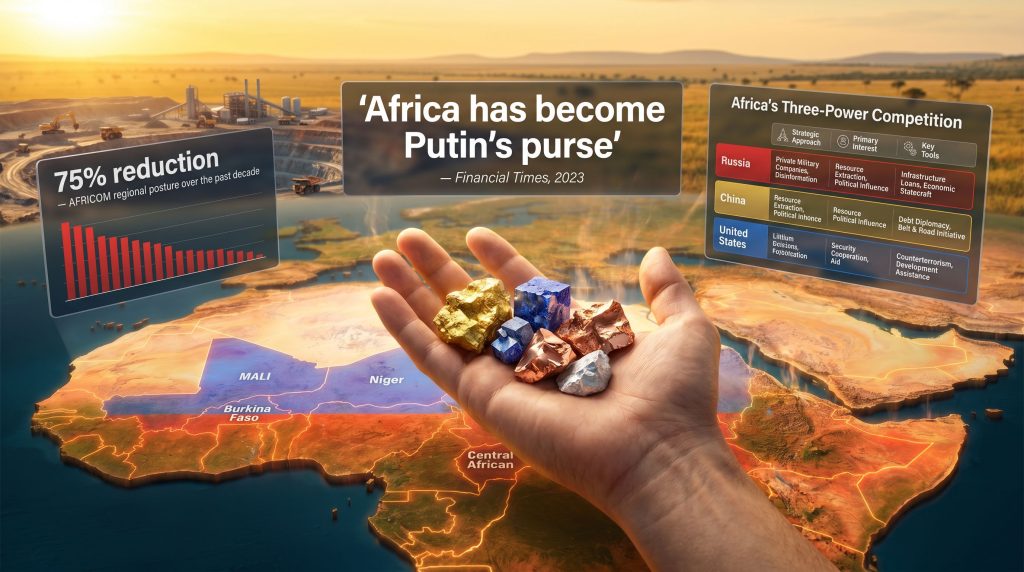
Rare earth elements rarely make headlines. Cobalt, lithium, and manganese are not the stuff of political speeches or prime-time news cycles. Yet beneath the surface of Africa's most volatile regions lies a subsoil reality that is quietly reshaping the trajectory of global power. The competition unfolding across the Sahel, Central Africa, and the Great Lakes region is not simply about ideology or military dominance. It is fundamentally a contest over raw materials that will determine who controls the next generation of electric vehicles, artificial intelligence hardware, semiconductor manufacturing, and advanced defence systems. Understanding this competition requires stepping back from daily news cycles and examining the structural forces that have made Africa has become Putin's purse — a phrase that captures something far more systematic than opportunistic meddling.
When big ASX news breaks, our subscribers know first
Russia's Security-for-Resources Framework: A New Kind of Colonialism
How Instability Became a Revenue Stream
The conventional model of foreign investment involves capital flowing into a country in exchange for economic returns, subject to legal frameworks and mutual accountability. Russia's approach in Africa operates on an entirely different logic. Rather than investing in productive capacity, Moscow deploys security assets into fragile states and extracts resource access in return. The arrangement is transactional, immediate, and deliberately structured to create dependency rather than development.
This framework exploits a specific vulnerability common to states experiencing insurgencies, coup threats, or severe governance breakdown. When a government faces an existential security threat, the immediate calculus shifts dramatically. Long-term questions about sovereignty, transparency, and economic development become secondary to survival. Russia's security partners understand this dynamic and deliberately position their offers at precisely the moment when conventional Western conditionality feels like an obstacle rather than a benefit.
AFRICOM Commander Gen. Dagvin Anderson made this dynamic explicit in testimony before the U.S. House Armed Services Committee in May 2026, stating that Africa serves as Putin's purse, where Russia exploits instability to extract resources, including human lives, to fuel its war machine. The inclusion of "human lives" in that formulation is not rhetorical. It reflects a documented recruitment pipeline through which African nationals are reportedly channelled into combat roles in Ukraine, adding a deeply troubling human dimension to what might otherwise appear as a straightforward geopolitical competition over minerals.
The Three Pillars of Moscow's African Strategy
Russia's African engagement rests on three mutually reinforcing pillars that together create a self-sustaining system of influence and extraction:
-
Military access and regime protection — Russian security personnel, initially through the Wagner Group and subsequently through its successor entity the Africa Corps, provide direct military support to governments facing insurgencies or coup threats, embedding operatives within host nation security structures.
-
Mineral and energy extraction rights — Bilateral agreements negotiated at moments of government vulnerability grant Russian-linked commercial entities preferential access to mining concessions, energy contracts, and logistics infrastructure that generate ongoing revenue streams.
-
Human capital recruitment — African nationals are reportedly recruited through Russian-linked networks under the pretence of employment opportunities, with some allegedly transported to conflict zones in Ukraine, according to congressional testimony citing reports of up to 1,000 Kenyan nationals potentially recruited through such channels.
The economic logic connecting these pillars is direct. Western sanctions have placed enormous pressure on Russia's ability to finance its Ukrainian military operations. African resource revenues, flowing through opaque commercial structures that are difficult to trace and sanction, provide a mechanism for circumventing financial restrictions while simultaneously expanding Moscow's geopolitical footprint.
From Wagner Group to Africa Corps: Russia's Institutional Evolution
The Transition After Prigozhin's Death
The Wagner Group's role in Africa was never simply about military operations. It was a sophisticated hybrid of combat capability, regime protection, intelligence gathering, and commercial extraction wrapped inside a structure that maintained plausible deniability from the Kremlin. Wagner personnel operated in the Central African Republic, Mali, Libya, Mozambique, and Sudan, securing mining concessions and energy access arrangements in exchange for security guarantees that Western partners were either unable or unwilling to provide.
The death of Wagner founder Yevgeny Prigozhin in August 2023 following his short-lived mutiny against Russian military leadership created an institutional vacuum that the Kremlin moved quickly to fill. The reorganised entity, known as the Africa Corps, operates under considerably more direct Kremlin oversight, transforming what had been a semi-autonomous private military enterprise into a more institutionalised instrument of Russian state power.
| Feature | Wagner Group | Africa Corps |
|---|---|---|
| Oversight Structure | Semi-private, Prigozhin-directed | Direct Kremlin coordination |
| Primary Function | Combat operations and regime protection | Security provision and resource extraction |
| Geographic Reach | Sahel, CAR, Libya, Mozambique | Expanded sub-Saharan Africa coverage |
| Accountability Mechanism | Deliberately opaque | More institutionalised state control |
| Commercial Integration | Informal resource deals | Structured extraction arrangements |
This institutional evolution is significant beyond organisational structure. The Africa Corps represents the formalisation of what had previously been deniable operations, signalling that Moscow views its African resource extraction model as a long-term strategic priority. Furthermore, Russia's re-engagement with Africa under Putin's direct oversight marks Africa's elevation within Russia's global strategic calculus in a way that has no recent historical precedent.
Why Fragile States Are the Preferred Operating Environment
Russia's security framework functions most effectively in states where governance institutions are weak, where insurgencies create acute government vulnerability, and where Western partners have either disengaged or attached conditions that governments in crisis find unworkable. This is not accidental. The deliberate targeting of fragile states reflects a sophisticated understanding of where Russian security assets offer maximum leverage at minimum cost.
Mali illustrates this dynamic with particular clarity. Following a military coup in 2021 and the subsequent collapse of the French-led counterterrorism partnership, Mali's transitional government faced both a worsening jihadist insurgency and growing international isolation. Russian security personnel stepped into the resulting vacuum, providing immediate military support without demanding governance reforms, democratic transitions, or human rights accountability. The resource agreements that followed granted Russian-linked entities access to Mali's lithium deposits and other strategic minerals, establishing the pattern that has since been replicated across multiple Sahelian states.
The Western Withdrawal That Created a Strategic Opening
Quantifying America's Shrinking African Footprint
The strategic opportunity Russia has exploited was not created overnight. It is the product of a decade-long pattern of Western military disengagement from Africa that Anderson quantified with striking precision in his congressional testimony. A 75% reduction in AFRICOM's regional posture over ten years represents a dramatic contraction in the intelligence-gathering networks, partner force training relationships, and rapid response capabilities that had provided a structural counterweight to destabilising forces across the continent.
The implications of this reduction extend far beyond troop numbers. Military presence in fragile regions serves functions that purely diplomatic or economic engagement cannot replicate. Embedded training teams build personal relationships with host nation officers that generate intelligence flows and early warning capabilities. The gradual withdrawal of these relationships created what Anderson described as an "intelligence black hole" — a region where the United States simultaneously lost visibility into emerging threats and the trust networks needed to act on warning signals.
Anderson's testimony made the structural nature of this problem explicit. His observation that "trust cannot be surged" captures a fundamental constraint on Western re-engagement strategies. The institutional memory, personal connections, and operational familiarity that effective intelligence partnerships require are products of time and consistency, not resources alone. Consequently, the geopolitics in mining and security competition across Africa have shifted significantly in Russia's favour during this period of reduced Western engagement.
The Compounding Effect of Allied Drawdowns
France's departure from the Sahel compounded America's reduced presence with particular severity. French military operations in Mali, Burkina Faso, and Niger had provided a sustained counterterrorism capability that both contained jihadist expansion and maintained Western intelligence coverage of one of the world's most strategically significant regions. The sequential expulsion of French forces from all three countries between 2022 and 2023 removed this framework entirely, leaving a security vacuum that Russia rapidly filled.
The timing of these withdrawals intersected catastrophically with a period of intensifying jihadist activity across the Sahel, creating conditions where the absence of Western military presence coincided with the greatest need for effective counterterrorism capability. The beneficiaries of this intersection were both Russia, which secured new security partnerships, and extremist groups, which expanded their territorial control during the transition period.
Africa's Mineral Wealth: The Resource Prize Driving Great-Power Competition
Strategic Minerals and Their Global Significance
The competition for African resources cannot be understood solely through the lens of traditional commodity markets. The minerals concentrated across Central, Southern, and West Africa are not merely economically valuable — they are structurally essential to the technologies that will define military capability, economic productivity, and geopolitical power through the twenty-first century. Indeed, critical minerals demand continues to accelerate as the global energy transition intensifies pressure on existing supply chains.
The minerals beneath Africa's most contested territories are not peripheral commodities. They are the physical foundation of electric vehicle batteries, semiconductor fabrication, artificial intelligence hardware, and next-generation defence systems. Control over these supply chains increasingly equates to strategic leverage in the global technology competition.
The geographic distribution of these resources across politically fragile territories creates precisely the conditions where Russia's security-for-resources model generates maximum returns:
- Cobalt and copper concentrated in the Democratic Republic of Congo and Zambia, essential for electric vehicle battery cathodes and electrical infrastructure
- Lithium deposits emerging in Zimbabwe and across southern Africa, critical for energy storage systems powering the clean energy transition
- Gold and diamonds in the Central African Republic and Republic of Congo, providing immediate liquidity for Russian-linked commercial operations
- Rare earth elements distributed across multiple African nations, essential for permanent magnets used in electric motors, wind turbines, and precision guidance systems
- Oil and gas assets along West African coastal states and in the Republic of Congo, providing energy revenue streams for Russian-linked partners
How the Security-for-Resources Deal Actually Works
The strategic significance of cobalt deserves particular attention. The natural resources in the DRC include an estimated 70% of global cobalt reserves, making the country indispensable to electric vehicle battery manufacturing. Chinese companies have secured dominant positions in Congolese cobalt mining over the past decade, establishing a supply chain dependency that Western technology manufacturers are only beginning to understand in its full strategic implications.
The mechanics of Russia's resource extraction model follow a consistent sequence that reveals its sophisticated design:
- A fragile government confronts an insurgency, coup attempt, or severe security deterioration that threatens its survival
- Russian security actors present an offer of immediate military assistance without political conditionality or governance requirements
- A bilateral security agreement is concluded, embedding Russian personnel within host nation military and intelligence structures
- As the security relationship deepens, commercial agreements grant Russian-linked entities preferential access to mining concessions, energy contracts, and logistics networks
- Resource revenues flow back through layered commercial structures that obscure the ultimate destination of funds, partially financing Russia's broader military operations
- The host government's political and operational dependency on Russian security support deepens, making exit from the arrangement increasingly costly
The self-reinforcing nature of this cycle is its most dangerous characteristic. Each stage of the arrangement creates conditions that make subsequent stages more likely, while simultaneously reducing the government's capacity and incentive to seek alternative security arrangements.
Africa as the Global Epicentre of Terrorism
The Sahel's Catastrophic Security Deterioration
The worsening security crisis across the Sahel represents one of the most significant shifts in global terrorism geography of the past decade. The region spanning Mali, Burkina Faso, and Niger has experienced a catastrophic deterioration in security conditions that has displaced millions of people, collapsed governance in large portions of these countries' territories, and produced terrorism-related casualty figures that now exceed those of any other region in the world.
Anderson's congressional testimony placed this crisis in stark terms, describing Africa as "the current epicentre of global terrorism" and noting that ISIS leadership has become African while Al-Qaeda's economic engine operates on the continent. These observations reflect a fundamental geographic shift in global terrorism's centre of gravity that has important implications for international security frameworks still oriented primarily toward Middle Eastern and South Asian threat environments.
The Paradox of Russian Security Partnerships in Terrorism-Affected States
There is a profound strategic paradox embedded within Russia's security model in the Sahel. Governments in Mali, Burkina Faso, and Niger originally justified their partnerships with Russian security forces on counter-terrorism grounds, arguing that Western partners had failed to contain jihadist expansion. Yet the security situation across all three countries has deteriorated significantly since Russian security forces assumed advisory and combat roles.
This paradox reveals a structural feature of Russia's approach that is rarely acknowledged in Western analysis. Sustained stability in Russian-partnered states would reduce those governments' dependency on Russian security support, potentially opening space for alternative partnerships. The persistence of insecurity, by contrast, perpetuates the conditions that make Russian security arrangements indispensable. Russia therefore has limited structural incentive to achieve the decisive counterterrorism outcomes that would render its presence unnecessary.
The next major ASX story will hit our subscribers first
China's Parallel Strategy: Infrastructure, Trade, and Mineral Dominance
Beijing's Long-Term Positioning Across the Continent
China's African strategy operates through fundamentally different mechanisms than Russia's security-centred approach, but both converge on the same structural outcome: reduced Western influence and preferential access to strategic resources. Where Russia deploys paramilitary forces and security agreements, China deploys infrastructure financing, trade relationships, and long-term economic integration that creates dependencies through debt and supply chain entanglement rather than military necessity.
Over two decades of sustained engagement, China has established itself as Africa's largest bilateral trading partner, with annual trade volumes reaching into hundreds of billions of dollars. The Belt and Road Initiative has financed roads, railways, ports, and energy infrastructure across the continent, creating physical connectivity that simultaneously serves commercial, logistical, and strategic military purposes. Anderson's congressional testimony framed China's ambitions in explicitly territorial terms, describing Beijing's perspective of Africa as "a second continent."
Where China's Mineral Interests Are Most Deeply Embedded
| Country | Key Mineral | Strategic Application | Chinese Involvement |
|---|---|---|---|
| Democratic Republic of Congo | Cobalt | EV battery cathodes | Major mining stakes via state-linked companies |
| Zambia | Copper | Electrical infrastructure | Infrastructure financing plus mining equity |
| Zimbabwe | Lithium | Energy storage systems | Emerging extraction partnerships |
| Multiple nations | Rare earth elements | Electronics, defence systems | Exploration and offtake agreements |
| Republic of Congo | Oil and gas | Energy supply chains | Refinery and pipeline investment |
The concentration of Chinese mining investment in cobalt is particularly significant from a supply chain security perspective. Furthermore, the Congolese cobalt rivalry between China and Western nations has intensified considerably, as Chinese companies control substantial portions of cobalt production at the mine level in the DRC, dominate cobalt refining and processing capacity, and supply the majority of battery-grade cobalt to global electric vehicle manufacturers.
Russia vs. China: Competing Strategies, Complementary Outcomes
While Russian and Chinese strategies in Africa differ substantially in their methods, they produce outcomes that are broadly complementary from a geopolitical perspective. Both approaches benefit from reduced Western military presence, weakened governance institutions, and African governments that are increasingly dependent on external actors for either security or economic survival.
The key distinction lies in time horizons and mechanisms. Russia's approach generates relatively quick returns through resource extraction and immediate security presence, but creates brittle relationships that depend on continued instability. China's approach involves longer time horizons and larger capital commitments, but builds structural dependencies that persist regardless of security conditions. Together, they create a layered challenge to Western influence that is more difficult to address than either would be in isolation.
What the United States Is Losing and What Recovery Would Require
The Limits of Re-engagement Without Trust
The challenge facing American policymakers attempting to reverse the strategic losses documented in Anderson's testimony is not primarily one of resources or political will. It is fundamentally a problem of institutional relationships that deteriorate gradually and cannot be rapidly reconstructed. The 75% reduction in AFRICOM's regional posture over the past decade eliminated the sustained human engagement through which trust, intelligence relationships, and operational partnerships are built and maintained.
Re-engagement efforts face a structural time constraint. Rebuilding the intelligence networks, personal relationships, and operational familiarity needed for effective partnership requires years of consistent presence. The $413 million U.S. approval for Nigeria's anti-insurgency operations in West Africa represents one approach to re-engagement through targeted security assistance rather than direct military presence. However, this model cannot replicate the trust-building functions of sustained in-country engagement.
The Recruitment Pipeline: A Dimension Often Overlooked
Congressional concern over the recruitment of African nationals for potential deployment to Ukraine adds a dimension to Russia's African strategy that receives insufficient analytical attention. Congressman Mike Turner's citation of reports suggesting up to 1,000 Kenyan nationals may have been recruited through Russian-linked networks operating under the guise of employment and economic opportunity reveals how Russia's African influence operations extend beyond resource extraction into the mobilisation of human capital for its military operations.
Anderson's response to congressional questioning described the recruitment of Africans across the continent by Russia for deployment to Ukraine as "deeply disturbing." The geopolitical implications for African governments are significant. Countries whose citizens are being recruited into a foreign military conflict without their knowledge or consent face both humanitarian obligations and diplomatic complications that could reshape bilateral relationships with both Russia and Western partners.
Africa's Agency: The Perspective That Changes Everything
African Governments Are Not Passive Actors
Western strategic analysis of great-power competition in Africa frequently treats African governments as passive environments within which external powers compete. This framing fundamentally misrepresents the dynamics at play. African leaders are making calculated decisions about which partners best serve their immediate survival and longer-term interests, weighing unconditional security support against conditional development assistance.
The preference many governments have demonstrated for Russian security partnerships reflects a rational response to their specific circumstances rather than ideological alignment with Moscow. When survival is uncertain, unconditional military support is more immediately valuable than conditional development financing. Understanding this agency is essential for designing effective Western re-engagement strategies. Policy approaches that treat African governments as objects of competition rather than active decision-makers will consistently misread the dynamics they are attempting to influence.
Emerging Voices for African-Led Security Frameworks
Across the continent, a growing body of political and civil society voices is articulating an alternative to great-power dependency. The argument that African security challenges require African-led solutions — backed by genuine continental institutions rather than foreign security providers — represents a long-term structural alternative to the cycle of external dependency that currently characterises security provision in fragile states.
The African Union's capacity to implement this vision remains genuinely limited by funding constraints, political divisions among member states, and technical gaps in military capability and intelligence capacity. However, the aspiration toward sovereign security arrangements represents a meaningful counternarrative to the great-power competition framing that dominates external analysis of Africa's security environment.
The Three-Power Competition: A Strategic Summary
| Actor | Primary Objective | Key Tool | Core Vulnerability |
|---|---|---|---|
| Russia | Resource extraction and war financing | Security partnerships and mercenary forces | Reputational damage and strategic overextension |
| China | Economic integration and mineral access | Infrastructure investment and trade relationships | Debt diplomacy backlash and political resentment |
| United States | Strategic denial and counterterrorism | Military partnerships and intelligence networks | Reduced footprint and eroded trust relationships |
The convergence of these three actors across the same geographic space, competing for influence over the same resource-rich fragile states, while simultaneously confronting a jihadist terrorism challenge that threatens to overwhelm what remains of regional governance structures, defines Africa's strategic environment in terms that have no modern precedent. Anderson's framing of Africa's "vast resources, strategic geography, and growing population" as critical to U.S. national security reflects a belated recognition in Washington of what Moscow and Beijing have understood for considerably longer. Moreover, China's rare earth strategy across the continent increasingly mirrors Russia's security-for-resources logic in its long-term implications for Western supply chain resilience.
Africa has become Putin's purse not through a single dramatic intervention, but through a patient, systematic exploitation of instability, governance failure, and Western disengagement that has unfolded across years and across dozens of bilateral relationships simultaneously.
Disclaimer: This article is based on publicly reported information including congressional testimony and reporting by Business Insider Africa. Claims regarding troop figures, recruitment numbers, and resource valuations reflect information as reported by cited sources and should be understood in that context. Readers are encouraged to consult primary source materials and independent assessments when forming analytical conclusions.
Frequently Asked Questions
What does it mean that Africa has become Putin's purse?
The phrase, drawn from the congressional testimony of AFRICOM Commander Gen. Dagvin Anderson, describes Russia's systematic exploitation of African instability as a mechanism for extracting resources, revenue, and manpower that directly support its war economy and broader global influence operations. It represents a doctrine, not merely a description.
Which African countries are most affected by Russian security influence?
Russian security and resource operations are most deeply embedded in Mali, Burkina Faso, Niger, the Central African Republic, and the Republic of Congo. In each case, Russian-linked entities secured mining and energy access in exchange for military support during periods of acute government vulnerability.
How does Russia's African strategy differ from China's approach?
Russia primarily operates through paramilitary security partnerships, mercenary forces, and resource extraction deals in fragile states experiencing acute security crises. China's strategy centres on infrastructure financing, trade integration, and long-term economic relationships that create structural dependency through commercial rather than military mechanisms.
Why is the Sahel region so strategically significant?
The Sahel sits at the intersection of terrorism, governance collapse, and resource competition. It now records more terrorism-related deaths than any other region globally and has become a primary theatre for Russian security influence following the withdrawal of French and Western forces.
What is the Africa Corps and how does it relate to the Wagner Group?
The Africa Corps is a Kremlin-backed successor to the Wagner Group's African operations, reorganised following the death of Wagner founder Yevgeny Prigozhin in 2023. It maintains and expands Russia's security presence across the continent under more direct state oversight than its predecessor.
What strategic minerals does Russia access through African partnerships?
Russian-linked entities have secured access to gold, diamonds, oil, and energy assets primarily across Central Africa. Broader competition for cobalt, lithium, copper, and rare earth elements — critical for defence systems, electric vehicles, and semiconductor manufacturing — intensifies the strategic stakes of great-power competition across the continent.
Want to Track ASX Discoveries Linked to the Minerals Driving Great-Power Competition?
The strategic minerals at the centre of this global contest — cobalt, lithium, rare earths, and copper — are precisely the commodities fuelling significant ASX exploration activity, and Discovery Alert's proprietary Discovery IQ model delivers real-time alerts the moment a significant mineral discovery is announced on the ASX, turning complex geological data into actionable investment insights. Explore why major mineral discoveries have historically generated substantial returns on Discovery Alert's dedicated discoveries page, and begin a 14-day free trial today to position yourself ahead of the broader market.