May 20, 2026
The Geography of Global Energy Vulnerability
Every few decades, the global economy rediscovers the same uncomfortable truth: the modern industrial system rests on an extraordinarily fragile physical foundation. Oil, the lifeblood of manufacturing, agriculture, transport, and electricity generation across dozens of developing nations, does not flow through a distributed network of resilient pathways. It flows, in disproportionate volume, through a single narrow corridor — one that can be threatened by a handful of naval vessels, a diplomatic breakdown, or a missile strike on a tanker. The South Africa Strait of Hormuz oil risk sits at the heart of this vulnerability.
The Strait of Hormuz is that corridor. And in 2025 and 2026, its vulnerability has moved from theoretical risk to active geopolitical reality, with consequences that reach far beyond the Persian Gulf — including deep into the South African economy.
When big ASX news breaks, our subscribers know first
Why 33 Kilometres Can Paralyse Global Oil Markets
The Physical Architecture of the World's Most Consequential Chokepoint
The Strait of Hormuz sits between the Persian Gulf and the Gulf of Oman, connecting the oil-producing heartland of the Middle East to global export markets. At its narrowest navigable point, the strait measures approximately 33 kilometres across. Within that width, commercial shipping is confined to two designated lanes, each roughly 3 kilometres wide, separated by a 3-kilometre buffer zone.
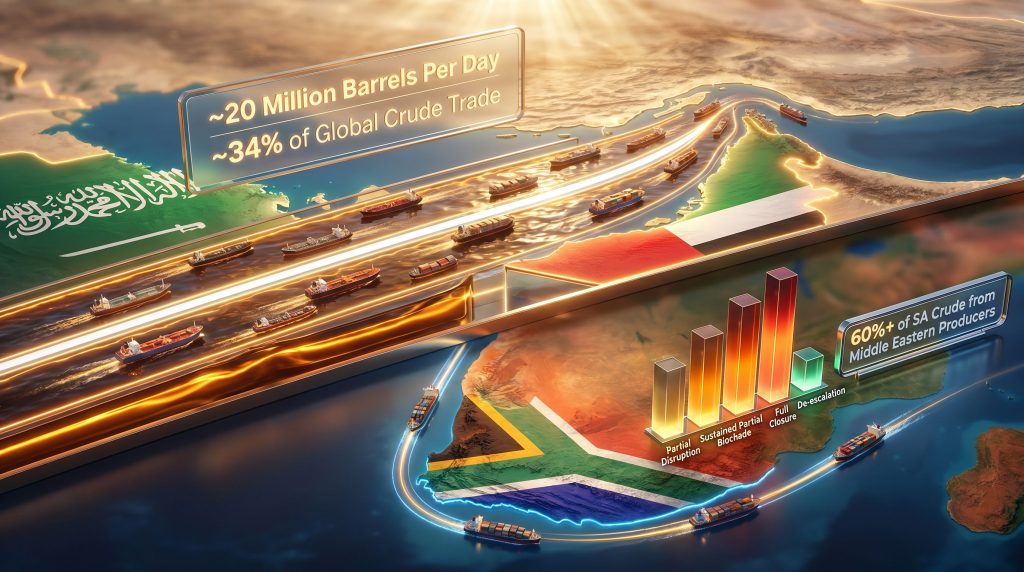
The mathematics of that constraint are extraordinary: the majority of the world's traded crude oil moves through approximately 6 kilometres of active shipping lane. According to the U.S. Energy Information Administration (EIA), approximately 20 million barrels of petroleum liquids transited the Strait of Hormuz daily in 2024, representing roughly 20% of global petroleum consumption. The International Energy Agency (IEA) separately estimated that crude oil specifically accounted for approximately 15 million barrels per day passing through the route in 2025, representing around 34% of global crude trade.
What makes Hormuz structurally irreplaceable is the absence of credible alternatives at scale. Partial bypass infrastructure exists, most notably Saudi Arabia's East-West Pipeline and the UAE's Abu Dhabi Crude Oil Pipeline, but neither facility comes close to absorbing full Hormuz transit volumes. The EIA confirms that the vast majority of Hormuz-bound petroleum has no practical alternative export route, which is precisely why the strait functions as a systemic pressure point rather than merely a regional concern.
A Historical Pattern of Disruption
The strait's role as a geopolitical flashpoint is not new. Its strategic significance became viscerally apparent during the 1973 Arab oil embargo and again during the 1979 Iranian Revolution — two events that reshaped global energy policy, triggered inflation cycles across industrialised economies, and accelerated investment in alternative energy sources. The Brookings Institution has characterised the current disruption environment as potentially exceeding the scale of both those historical shocks — a sobering benchmark for policymakers in import-dependent economies.
What differs today is the complexity of the stakeholder landscape. In the 1970s, the primary actors were Arab oil-producing states and Western importers. In 2025 and 2026, however, the constellation includes the United States, Israel, Iran, Gulf Cooperation Council members, and a range of Asian importers whose collective demand now dominates global crude flows. This complexity also contributes to wider oil price volatility across international markets.
The Current Crisis: Escalation, Vessel Harassment, and Market Volatility
How the US-Iran-Israel Conflict Spilled Into Maritime Trade
The current phase of Hormuz instability escalated sharply in late 2025 and into early 2026, as hostilities involving the United States, Israel, and Iran extended beyond land and air domains into the maritime environment. Iran has reportedly targeted or harassed at least 22 commercial vessels transiting the strait since the conflict intensified, according to reporting cited by South African government officials.
These incidents have produced cascading effects across global shipping and insurance markets. War-risk insurance premiums on Hormuz-bound voyages have surged, raising the landed cost of every barrel transiting the corridor. Brent crude prices have demonstrated sharp sensitivity to escalation events — reacting not to actual supply interruptions but to the credible threat of future ones. This dynamic illustrates how deeply the market has priced Hormuz risk into its forward expectations, contributing to the broader oil price shock felt by energy executives worldwide.
The Global Shipping Rerouting Effect
Major international container carriers have begun avoiding the Strait of Hormuz altogether, opting instead for the significantly longer Cape of Good Hope route around southern Africa's coastline. This rerouting adds approximately 10 to 14 days to voyage times and substantially increases fuel consumption and insurance costs per voyage.
The world's second-largest container carrier has reportedly avoided the Strait of Hormuz on multiple occasions as US-Iran tensions have persisted. The cumulative effect of these decisions is a meaningful redistribution of global trade flows, with the Cape route emerging as the primary alternative corridor for vessels unwilling to absorb Hormuz risk premiums.
Who Bears the Heaviest Burden?
The distribution of Hormuz oil flows is heavily skewed toward Asia, which creates a complex transmission mechanism for global price benchmarks.
| Country/Region | 2024 Share of Hormuz Oil Flows | Primary Exposure Type |
|---|---|---|
| China | Largest single recipient | Crude oil imports for industrial demand |
| India | Second largest recipient | Refinery feedstock dependency |
| Japan | Major recipient | Near-total import dependency |
| South Korea | Major recipient | Refinery and petrochemical feedstock |
| Combined Asia-Pacific (Top 4) | ~69% of total Hormuz flows | Benchmark price transmission to all importers |
| South Africa | Indirect exposure | Global price benchmarks, shipping costs, fertiliser inputs |
Source: U.S. Energy Information Administration, 2024 data
Because Asian demand dominates Hormuz flows and Asian buyers set the marginal price for Gulf crude, any disruption-driven price increase transmits immediately into global Brent benchmarks — and from there into the import costs of every oil-dependent economy, including South Africa.
How the South Africa Strait of Hormuz Oil Risk Translates Domestically
A Structural Import Dependency
South Africa does not produce meaningful volumes of crude oil domestically. The country imports the majority of its crude and refined petroleum products, making it structurally exposed to both price movements and physical supply disruptions in global oil markets. Data from the South African Petroleum Industry Association (SAPIA) indicates that more than 60% of South Africa's crude oil imports originate from Middle Eastern producers, including Saudi Arabia and the United Arab Emirates — nations whose entire export infrastructure funnels through the Strait of Hormuz.
This dependency is not incidental. It reflects decades of procurement relationships, refinery feedstock specifications calibrated to Gulf crude grades, and pricing arrangements anchored to benchmarks priced off Hormuz-transiting volumes. Rewiring that supply chain is neither quick nor cost-free.
The Four Transmission Channels From Hormuz to South African Households
The South Africa Strait of Hormuz oil risk does not arrive in a single, easily identifiable form. It transmits through at least four distinct channels, each with its own lag time and amplification mechanism.
1. Imported Fuel Price Inflation
South Africa's domestic fuel pricing operates through a regulated mechanism that directly incorporates the rand price of imported crude. When Brent crude rises in response to Hormuz tension, that increase flows through into petrol and diesel prices at South African forecourts. PwC South Africa has framed Hormuz disruption scenarios as capable of delivering material upward pressure on local fuel prices and, by extension, on broader consumer price inflation.
2. Logistics Cost Escalation
The rerouting of vessels via the Cape of Good Hope does not just affect petroleum tankers — it affects container ships carrying manufactured goods, agricultural inputs, and consumer products. Every vessel diverted to the Cape route incurs 10 to 14 additional days of fuel, crew, and insurance costs, which are embedded in the landed prices of imported goods. South Africa's port infrastructure, already operating under capacity pressure, faces additional throughput demands from this rerouting trend.
3. Fertiliser and Agricultural Input Pressure
This channel is perhaps the least appreciated transmission mechanism of Hormuz disruption for South African observers. The Middle East is a critical production base for ammonia and urea, two nitrogen-based fertilisers synthesised from natural gas produced across the Gulf region. Furthermore, any disruption to Hormuz transit tightens global fertiliser supply chains, raising input costs for South Africa's agricultural sector and, downstream, food prices for consumers. Shifts in natural gas price trends compound this pressure further. Commentary in South African media, including eNCA, has highlighted fertiliser supply risk as an underappreciated secondary consequence of Hormuz instability.
4. Rand Depreciation Amplification
South Africa's currency has a well-documented sensitivity to global risk-off sentiment. Geopolitical crises, particularly those involving energy supply disruptions, typically trigger emerging market currency sell-offs as investors move toward dollar-denominated safe havens. A weaker rand amplifies the domestic cost of oil imports priced in US dollars, creating a compounding dynamic where even a stabilisation in global crude prices fails to translate into domestic fuel price relief.
"Risk Compounding Warning: South Africa faces a double-exposure scenario where rising global oil prices and a weakening rand can reinforce each other simultaneously. This currency-commodity feedback loop can amplify domestic fuel inflation substantially beyond what raw Brent price movements alone would indicate. Investors and policymakers should model for this compounding effect rather than treating the two variables as independent."
South Africa's Strategic Response: Diplomacy, Diversification, and On-the-Ground Assessment
The Government Delegation to the Strait
South Africa's Mineral and Petroleum Resources Minister Gwede Mantashe announced during his department's parliamentary budget vote that a government delegation would travel directly to the Strait of Hormuz. The stated purpose of the mission is to build first-hand analytical understanding of the geopolitical dynamics surrounding the corridor and their implications for South African energy security planning.
The decision to dispatch officials physically to the strait represents a significant acknowledgement: that energy security policy for a country as structurally exposed as South Africa cannot be formulated adequately from a distance when its primary import corridor is under active geopolitical stress. The delegation signals an intent to move beyond reactive price monitoring toward proactive strategic engagement.
Diplomatic Engagement Without Formal Mediation
South Africa has engaged diplomatically with both Gulf Cooperation Council member states and Iran, consistently advocating for restraint and dialogue to preserve the continuity of global oil flows. Pretoria has not assumed a formal mediation role comparable to that played by Oman or Qatar, but has maintained active consultations with relevant parties on multiple sides of the dispute.
In a notable diplomatic development, Minister Mantashe confirmed before the National Assembly in March 2026 that Iran had communicated its intention to allow uninterrupted passage through the strait for cargo destined for South Africa. This was a meaningful signal that Pretoria's engagement was generating tangible assurances, even if not formal agreements, at the bilateral level. South Africa's non-aligned foreign policy tradition — maintaining relationships with parties across geopolitical divides — has historically provided the country with access that more aligned states lack. In the context of Hormuz diplomacy, that posture may represent a genuine strategic asset.
Supply Chain Diversification in Practice
Beyond diplomacy, South Africa has moved concretely to reduce its exposure to Gulf supply concentration:
- West African petroleum suppliers, including volumes potentially routed through the Dangote Refinery in Nigeria, have been increasingly integrated into South Africa's import mix
- Strategic crude reserves have been reinforced as a buffer against acute supply disruptions
- Key domestic refining assets, including Sasol and SAPREF, have received official support as critical national infrastructure
- Monitoring of fuel stock levels, shipping routes, and supply chain integrity has been operationally strengthened as a precautionary measure
- Contingency planning frameworks for supply disruption scenarios have been formalised within government energy security structures
The Cape Route Paradox: Opportunity and Structural Limitation
South Africa's Geographic Windfall
The rerouting of global shipping away from both the Strait of Hormuz and the Red Sea onto the Cape of Good Hope route creates an incidental geographic advantage for South Africa. Vessels transiting the Cape route pass through South African waters and, ideally, call at South African ports for bunkering, provisioning, and maintenance. Durban and Cape Town are consequently positioned to benefit from increased traffic volumes if they can offer competitive port services. Some uplift in bunker fuel demand has already been observed at South African ports as a consequence of the rerouting trend, suggesting the commercial opportunity is real rather than theoretical.
Why South Africa Is Not Capturing Its Full Share
"Structural Gap: Despite the geographic advantage created by Hormuz and Red Sea disruptions, South Africa is reportedly forfeiting billions of rands in potential shipping revenue due to port inefficiency, regulatory constraints, and infrastructure limitations that reduce the attractiveness of its ports for time-pressured vessels on extended Cape-route voyages."
The core constraints include:
- Port throughput capacity at Durban and Cape Town constrained by operational backlogs and equipment reliability issues
- Bunkering infrastructure and service depth not fully competitive with established Cape-route hubs such as Las Palmas in the Canary Islands
- Regulatory and administrative processes that increase dwell time for vessels seeking rapid turnaround
- Labour disruptions that create unpredictability for shipping operators managing tight voyage schedules
Addressing these bottlenecks would require sustained investment and regulatory reform — neither of which can be delivered within the timeframe of the current Hormuz crisis.
Scenario Analysis: Hormuz Disruption Impact on South Africa
| Scenario | Probability Assessment | Impact on SA Fuel Prices | Impact on SA Inflation | Cape Route Opportunity |
|---|---|---|---|---|
| Partial disruption (vessel harassment, insurance spikes) | High (current state) | Moderate increase | 0.5-1.5% CPI uplift | Moderate: some rerouting already occurring |
| Sustained partial blockade | Medium | Significant increase | 1.5-3% CPI uplift | High: major rerouting but port capacity limits gains |
| Full Hormuz closure | Low | Severe spike | 3%+ CPI uplift | Very high demand but infrastructure constraints bind |
| De-escalation and normalisation | Medium-High | Price relief | Inflationary pressure eases | Cape-route uplift reverses |
The next major ASX story will hit our subscribers first
Long-Term Lessons: Building Energy Security Beyond the Current Crisis
The Structural Argument for Energy Diversification
The Hormuz crisis has laid bare a vulnerability that South Africa's energy planners have understood intellectually but addressed insufficiently in practice: excessive concentration of import sourcing in a single corridor creates systemic risk that no amount of diplomatic engagement can fully neutralise. Genuine energy security requires geographic diversification of supply, maintained strategic reserves, and investment in domestic processing capacity.
South Africa's longer-term green hydrogen programme, valued at approximately $5.8 billion, has been framed in some quarters as a structural hedge against fossil fuel import dependency. The economic and energy security logic is sound: pursuing renewable energy solutions that displace imported petroleum directly reduces Hormuz exposure. However, the commercialisation timeline for green hydrogen extends well beyond the window of the current crisis, meaning it offers no near-term relief.
Regional Cooperation as a Risk Diversification Tool
An underappreciated dimension of South Africa's energy security challenge is its regional context within SADC. Coordinated energy procurement, shared strategic reserves, and collaborative infrastructure investment across southern African nations could reduce individual country exposure to single-corridor dependencies. The current crisis provides a compelling political moment to advance that conversation, even if institutional and financial barriers to regional energy cooperation remain substantial.
Furthermore, the economic argument for accelerating South Africa's energy security transition has rarely been more straightforwardly quantifiable: every percentage point of domestic renewable generation that displaces imported oil represents a direct reduction in Hormuz-linked price volatility exposure. On those grounds alone, the current crisis strengthens the investment case for South Africa's renewable energy build-out, independent of climate policy considerations.
Key Facts: South Africa's Hormuz Risk at a Glance
- ~20 million barrels per day transited the Strait of Hormuz in 2024, representing approximately 20% of global petroleum consumption (EIA)
- ~34% of global crude trade passed through the strait in 2025 (IEA)
- 60%+ of South Africa's crude imports originate from Middle Eastern producers whose exports transit the strait (SAPIA)
- At least 22 vessels targeted or harassed in the strait since the US-Iran-Israel conflict escalated in early 2026
- 10-14 additional days added to voyage times for vessels rerouting via the Cape of Good Hope
- ~69% of Hormuz flows in 2024 were absorbed by China, India, Japan, and South Korea, whose demand dynamics transmit into global benchmark prices that South Africa pays
- The Brookings Institution has assessed the current disruption environment as potentially more severe than either the 1973 oil embargo or the 1979 Iranian Revolution
Disclaimer: This article contains forward-looking statements, scenario projections, and assessments sourced from third-party institutions. These do not constitute financial or investment advice. Readers should conduct independent analysis before making decisions based on geopolitical risk assessments or commodity price forecasts. Scenario probabilities and CPI impact estimates are indicative and subject to significant uncertainty.
For additional data on the Strait of Hormuz's role in global energy markets, the U.S. Energy Information Administration's analysis titled "Amid regional conflict, the Strait of Hormuz remains critical oil chokepoint" provides detailed statistical context on transit volumes and bypass capacity constraints.
Want to Stay Ahead of the Commodity Shifts Driving the Next Major ASX Discovery?
Geopolitical shocks like the Hormuz crisis reshape commodity markets rapidly, creating windows of opportunity for investors positioned early — Discovery Alert's proprietary Discovery IQ model scans ASX announcements in real time, translating complex mineral and energy market signals into actionable alerts the moment significant discoveries are announced. Start your 14-day free trial and explore how historic discoveries have generated exceptional returns for investors who acted decisively.