August 8, 2026
The Geopolitics of Mineral Dependency: Why the Indo-Pacific's Next Frontier Is Underground
The most consequential battlegrounds of the 21st century are not always visible on satellite imagery. Some of the most strategically significant contests are playing out in supply chains, trade frameworks, and resource corridors that rarely make front-page headlines. The competition for control over critical minerals, the raw materials underpinning electric vehicles, semiconductors, and advanced weapons systems, has quietly become one of the defining strategic fault lines of our era. It is within this context that the Marco Rubio India visit and the accompanying Quad meeting scheduled for late May 2026 carry weight far exceeding a standard diplomatic exchange.
When big ASX news breaks, our subscribers know first
A Four-City Visit With a Singular Strategic Purpose
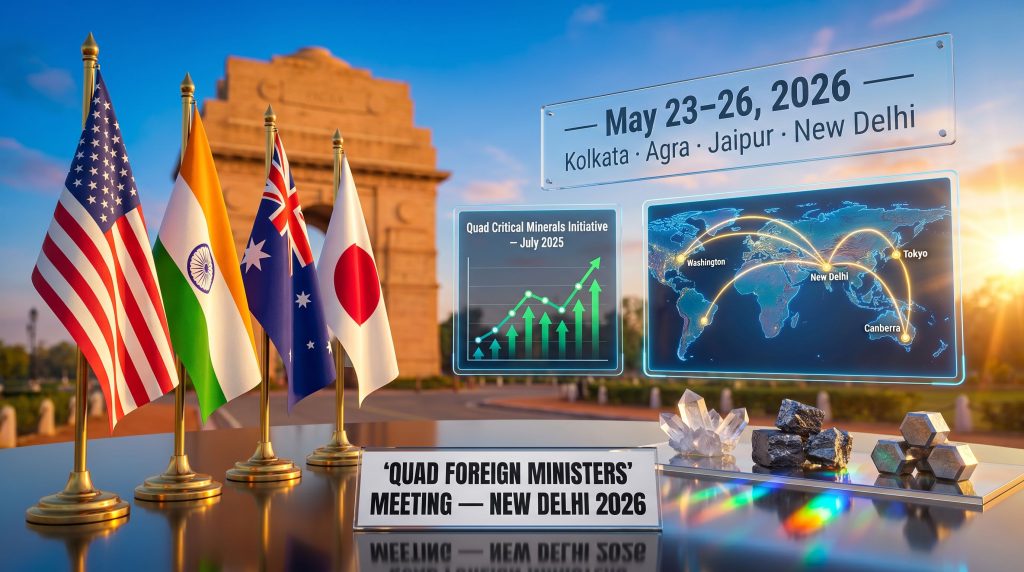
U.S. Secretary of State Marco Rubio's four-day India itinerary, running from May 23 to 26, 2026, is deliberately structured to signal both cultural engagement and hard-nosed strategic intent. The decision to visit Kolkata, Agra, Jaipur, and New Delhi in sequence is not incidental.
| City | Strategic Dimension |
|---|---|
| Kolkata | Eastern gateway; trade connectivity and Bay of Bengal access |
| Agra | Cultural diplomacy and bilateral goodwill signalling |
| Jaipur | Emerging industrial and technology engagement |
| New Delhi | Formal bilateral talks; Quad Foreign Ministers' summit |
Each stop reinforces a layered message: that Washington's engagement with India is broad, sustained, and not purely transactional. However, it is the New Delhi leg, where Rubio is expected to meet External Affairs Minister S. Jaishankar, National Security Advisor Ajit Doval, and potentially Prime Minister Narendra Modi, that carries the most consequential policy freight.
The formal Quad Foreign Ministers' Meeting will draw counterparts from Australia and Japan into the same room, transforming what might otherwise be a bilateral visit into a multilateral strategic session with regional implications stretching from the Indian Ocean to the South China Sea. According to reporting on the visit's agenda, trade, defence, and Indo-Pacific security cooperation are all expected to feature prominently in the discussions.
Understanding the Quad's Evolution From Dialogue to Architecture
The Quadrilateral Security Dialogue has undergone a profound transformation since its original conception by the late Japanese Prime Minister Shinzo Abe. What began as an informal democratic counterbalance to rising authoritarian influence across the Asia-Pacific has matured into a structured platform with expanding policy mandates covering security, technology, supply chains, and energy.
The Quad's evolution can be tracked across three distinct phases:
- Conceptual phase (2007 onwards): Abe's original vision of a democratic alliance framework surrounding China's sphere of regional influence
- Formalisation phase (2017–2021): Revival and institutionalisation of the dialogue at foreign minister and then leader level
- Economic security phase (2022–present): Expansion into critical minerals, clean energy, infrastructure investment, and technology governance
The July 2025 Quad Foreign Ministers' Meeting in Washington represented the clearest expression of this third phase, producing the Quad Critical Minerals Initiative, a coordinated effort to map, develop, and diversify supply chains across member nations and partner countries. The May 2026 New Delhi meeting is best understood as the next chapter in that progression, building toward a planned Quad Leaders' Summit on Indian soil later in 2026.
The Critical Minerals Dimension: Why Graphite Is the New Oil
To understand why critical minerals and energy security have become the Quad's most urgent economic deliverable, it is necessary to appreciate the scale of existing dependency on Chinese-controlled supply chains.
China controls an estimated 65 to 70 percent of global natural graphite production, a mineral that serves as the primary anode material in lithium-ion batteries powering electric vehicles. This concentration of supply represents one of the most significant strategic vulnerabilities facing advanced economies planning the transition to clean energy technology.
The dependency extends well beyond graphite. Furthermore, the critical minerals demand surge driven by clean energy transitions has intensified the urgency of securing alternative sources:
- Rare earth elements: China's processing capacity for rare earths remains overwhelmingly dominant globally, despite reserves being more geographically distributed
- Lithium refining: While raw lithium reserves are found across South America, Australia, and parts of Africa, the refining and processing infrastructure skews heavily toward Chinese facilities
- Graphite: Unlike lithium, natural graphite reserves are genuinely concentrated, with China holding both the deposits and the processing infrastructure
What makes this strategically distinct from conventional commodity dependency is the dual-use nature of these materials. Critical minerals are not merely inputs for consumer electronics; they are foundational to next-generation defence systems, satellite communications, and the energy transition infrastructure that advanced economies are now racing to build.
How Are Quad Members Responding?
The Quad Critical Minerals Initiative responds to this challenge by attempting to build alternative supply pathways across member nations. Australia's role is particularly significant here, given its position as one of the world's largest producers of lithium, rare earths, and battery minerals. In addition, Australia's strategic reserve policy has further reinforced its role as a dependable partner in supply chain diversification efforts.
India contributes geological endowments including iron ore, bauxite, and emerging lithium exploration potential, alongside a strategic geographic position that makes it a natural node in any alternative supply architecture. Consequently, disruptions to rare earth supply chains — already a growing concern — have sharpened the Quad's collective focus on building resilience before dependencies deepen further.
India's Multi-Alignment Doctrine: The Complexity Washington Must Navigate
The Marco Rubio India visit does not land in a frictionless diplomatic environment. India's foreign policy is defined by strategic autonomy, a doctrine that allows New Delhi to engage simultaneously with Washington, Moscow, Tehran, and Beijing according to its own national interest calculus. This is not diplomatic inconsistency; it is a deliberate long-term posture refined over decades.
The week immediately preceding Rubio's arrival saw India hosting BRICS foreign ministers, with Russia's Sergei Lavrov and Iran's Abbas Araghchi both attending. The juxtaposition is not accidental on New Delhi's part. India has consistently used multilateral convening to signal its independence from any single great-power orbit.
| India's Engagement | Strategic Signal Sent |
|---|---|
| BRICS hosting (incl. Russia, Iran) | Commitment to non-alignment and strategic autonomy |
| Quad participation and defence cooperation with U.S. | Indo-Pacific alignment with democratic partners |
| Critical Minerals Initiative engagement | Supply chain diversification from Chinese dependency |
| Planned Quad Leaders' Summit hosting (2026) | Elevation of multilateral convening power |
| Continued Russian energy imports | Economic pragmatism over geopolitical solidarity |
Washington's challenge is not to resolve this complexity but to work productively within it. Rubio's visit is partly a recalibration exercise, acknowledging that U.S.-India relations have experienced friction over tariff disputes and differing positions on the Russia-Ukraine conflict, while simultaneously reinforcing the strategic logic that binds both nations together in an era of rising Chinese assertiveness.
Where Quad Members Genuinely Diverge
Despite strong convergence on Indo-Pacific security and supply chain concerns, treating the Quad as a monolithic bloc misreads its internal dynamics. Meaningful divergences persist across several policy dimensions:
| Issue | U.S. Position | India's Position | Australia and Japan |
|---|---|---|---|
| Russia-Ukraine War | Strong condemnation; sanctions regime | Strategic neutrality; continued energy imports | Broadly aligned with Western position |
| Iran engagement | Pressure and sanctions | Diplomatic engagement; BRICS participation | Aligned with Western position |
| China trade exposure | Active decoupling push | Managed competition; significant trade ties | Mixed; Australia has diversified, Japan remains cautious |
| Military posture in Indo-Pacific | Forward deployment orientation | Preference for diplomatic and economic primacy | Active cooperation with U.S. military frameworks |
These divergences do not undermine the Quad's foundational coherence but they do define the ceiling of what the alliance can achieve as a unified geopolitical actor. The partnership functions most effectively in the space where economic security, technology cooperation, and maritime rules intersect, and least effectively when asked to produce unified positions on conflicts where members' interests diverge sharply.
How Has China Responded to Quad Mineral Initiatives?
China's rare earth restrictions, which accelerated significantly in 2025, have paradoxically strengthened the case for Quad coordination. By weaponising its mineral processing dominance, Beijing has effectively provided the clearest possible justification for the supply chain diversification agenda that Washington, New Delhi, Canberra, and Tokyo are now pursuing in earnest. Furthermore, analysts at The Hindu note that this strategic backdrop is expected to loom large over the New Delhi ministerial discussions.
The next major ASX story will hit our subscribers first
Setting the Agenda for the 2026 Leaders' Summit
The Foreign Ministers' Meeting in New Delhi serves a dual function: producing near-term policy outcomes while simultaneously structuring the agenda for the Leaders' Summit India hopes to host later in 2026. The ministerial session is expected to work across four priority areas:
- Consolidating deliverables from the July 2025 Washington meeting, particularly on the Critical Minerals Initiative's implementation progress
- Defining summit-level commitments on clean energy transitions, maritime security, and technology governance including AI standards
- Coordinating Indo-Pacific infrastructure investment positioning to offer alternatives to existing multilateral financing models
- Establishing working group outputs on semiconductor supply chains, cyber resilience, and defence technology co-production
A productive Leaders' Summit hosted by India would carry significant symbolic weight, reinforcing New Delhi's position as a leading voice in the Global South while simultaneously demonstrating that its deepening alignment with democratic Indo-Pacific partners is not merely rhetorical. For Washington, a successful summit on Indian soil would represent a tangible return on the diplomatic investment the Marco Rubio India visit represents.
The Broader Investment and Strategic Implications
For analysts and investors tracking Indo-Pacific strategic dynamics, the Quad meeting and Rubio visit signal several durable trends worth monitoring:
- Critical mineral equities linked to non-Chinese supply chains, particularly Australian lithium and rare earth producers, stand to benefit from sustained Quad-level attention to supply diversification
- Defence technology co-production agreements between the U.S. and India, if advanced during Rubio's visit, could create significant new commercial opportunities in both markets
- Energy security frameworks being discussed at the ministerial level reflect a broader structural shift away from fossil fuel dependency toward strategic mineral and clean energy partnerships
- Indo-Pacific infrastructure investment coordination, if it produces concrete mechanisms, could reshape capital flows across Southeast Asia and the Indian Ocean rim
Disclaimer: The above observations represent strategic analysis based on publicly available information and should not be construed as financial advice. Investors should conduct independent due diligence before making decisions based on geopolitical analysis.
Frequently Asked Questions
When is the Marco Rubio India visit scheduled?
The visit runs from May 23 to 26, 2026, covering Kolkata, Agra, Jaipur, and New Delhi.
What is the Quad Critical Minerals Initiative?
Established at the July 2025 Quad Foreign Ministers' Meeting in Washington, the initiative coordinates efforts among the U.S., India, Australia, and Japan to map and diversify critical mineral supply chains, reducing collective vulnerability to Chinese-controlled resources essential for clean energy and advanced technology manufacturing.
Why does China view the Quad as a strategic threat?
Beijing has consistently characterised the Quad as a containment architecture designed to constrain its regional influence. Quad members reject this framing, positioning the alliance as a mechanism for preserving a rules-based international order and ensuring freedom of navigation across the Indo-Pacific.
What role does India play in critical mineral supply chains?
India holds geological endowments including bauxite, iron ore, and emerging lithium exploration potential. Its geographic position at the centre of Indian Ocean trade routes also makes it a pivotal node for any alternative supply chain architecture designed to reduce Chinese processing dominance.
Is India hosting the next Quad Leaders' Summit?
India is expected to host the next Quad Leaders' Summit in 2026, with the May Foreign Ministers' Meeting functioning as the key preparatory session for defining deliverables and summit-level commitments.
Want to Track the ASX Mineral Discoveries Driving the Critical Minerals Race?
As Quad nations accelerate supply chain diversification away from Chinese-controlled resources, Australian critical mineral explorers are attracting significant strategic and investor attention — Discovery Alert's proprietary Discovery IQ model delivers real-time ASX alerts the moment significant mineral discoveries are announced, ensuring subscribers can act on actionable opportunities ahead of the broader market. Explore historic discovery returns to understand the scale of what early identification can mean, and begin a 14-day free trial to position ahead of the next major find.