August 14, 2026
The Economics of Extraction: Why Africa's Mineral Wealth Remains Largely Untapped
For decades, economists have studied a paradox that defines much of Sub-Saharan Africa's development trajectory: the more mineral-rich a nation, the more likely it is to remain locked in low-income growth cycles. This is not a coincidence of geography or governance alone. It reflects a structural design embedded in the global mineral supply chain, one that concentrates value creation in processing and manufacturing economies while positioning Africa as the starting point, rather than the beneficiary, of industrial transformation. Africa mineral value addition and regional value chains sit at the heart of this unresolved challenge.
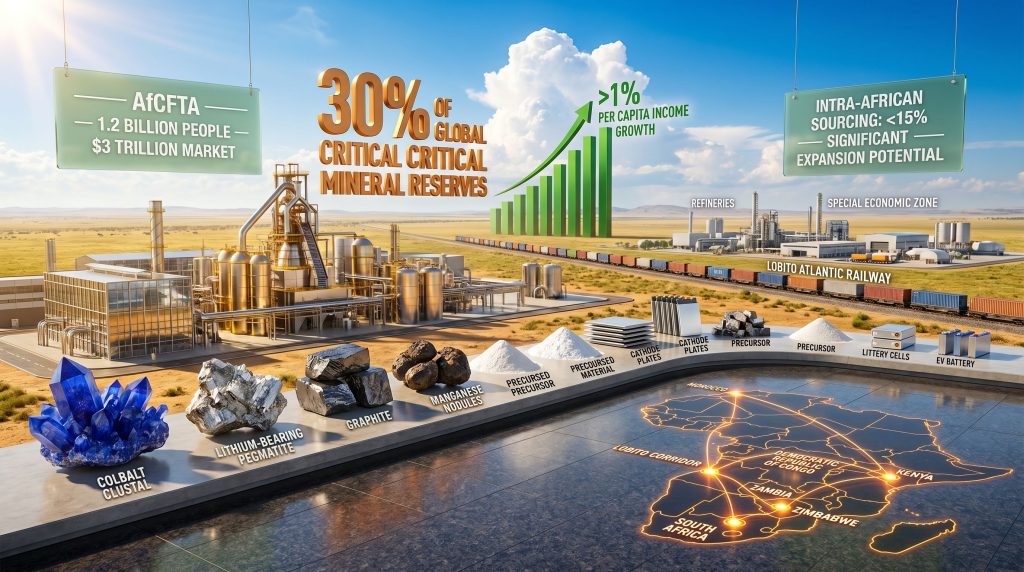
The urgency of solving this problem has intensified dramatically. As the global economy pivots toward electrification and decarbonisation, demand for cobalt, lithium, manganese, graphite, and rare earth elements has surged. Africa holds an estimated 30% of the world's critical mineral reserves, making the continent geopolitically indispensable to the energy transition. Yet its contribution to global value chain participation sits at approximately 2%, a figure that captures the scale of the disconnect between resource endowment and industrial participation.
According to analysis published by the United Nations Economic Commission for Africa (UNECA), Sub-Saharan Africa's exports are approximately 35.6% linked to global value chains, but that participation remains overwhelmingly concentrated at the raw extraction end of the production spectrum. The continent supplies the inputs. Others manufacture the outputs. The economic rewards follow accordingly.
The fundamental challenge is not a lack of mineral wealth. It is the persistent failure to convert that wealth into industrial capacity, skilled employment, and diversified revenue streams that benefit African citizens rather than foreign processing economies.
The green energy transition compounds this dynamic. Western-aligned nations and multilateral financing institutions are increasingly structuring off-take agreements and capital deployment to secure raw material access, often without embedding local processing requirements. Without deliberate policy intervention and collective bargaining, Africa risks repeating a centuries-old pattern: providing the raw inputs of a technological revolution while capturing none of the value that revolution generates.
When big ASX news breaks, our subscribers know first
Defining the Opportunity: What Mineral Value Addition and Regional Value Chains Actually Mean
Before the scale of the opportunity can be understood, the terminology requires precise definition. These concepts are frequently invoked in policy discussions but rarely explained with enough technical clarity to support investment decisions or institutional design.
The Processing Spectrum: From Ore to End Product
Mineral value addition refers to the transformation of raw extracted ores into progressively higher-value intermediate and finished products. This process spans a technically distinct spectrum:
| Processing Stage | Core Activity | Value Captured |
|---|---|---|
| Upstream | Raw ore extraction and primary sorting | Low |
| Midstream | Smelting, refining, hydrometallurgical processing | Medium |
| Downstream | Battery precursor chemicals, cathode active materials | High |
| End-product | EV battery cells, electronics, renewable components | Highest |
Each stage upward on this spectrum requires incrementally more sophisticated infrastructure, technical expertise, and capital investment. It also generates proportionally greater revenue, employment, and technology spillovers. Africa currently captures value predominantly at the upstream stage, with limited midstream capacity concentrated in South Africa, Zimbabwe, and Morocco.
Regional Value Chains vs. Global Value Chains
The distinction between global value chains (GVCs) and regional value chains (RVCs) is not merely geographic. It is structural and strategic.
In GVCs, African nations supply raw or minimally processed materials to external manufacturing hubs, primarily in East Asia and Europe. Value accumulates along the chain, but outside the continent. In RVCs, cross-border industrial ecosystems are built within Africa, integrating upstream extraction in one country with midstream processing in another, and progressively linking to downstream manufacturing across the region.
The economic evidence for this transition is compelling. A GMM-based econometric analysis covering the period from 1996 to 2018 demonstrates that a 1% increase in RVC participation correlates with more than a 1% increase in per capita income across participating economies, driven by human capital accumulation, R&D spillovers, and revenue diversification. This multiplier effect distinguishes RVC participation from raw export growth, which generates limited equivalent gains.
Furthermore, research on regionalising African mineral value chains confirms that current intra-African sourcing in mineral value chains remains below 15%, underscoring both the structural gap and the scale of the industrial opportunity available under improved regional coordination.
The AfCFTA as Enabling Architecture
The African Continental Free Trade Area (AfCFTA), operational since 2021, provides the legal and regulatory backbone for building coherent mineral processing corridors. Connecting 1.2 billion people across a combined GDP of approximately $3 trillion and encompassing all 55 African Union member states, AfCFTA creates the conditions for harmonised trade rules, cross-border manufacturing zones, and integrated supply chains that no individual African country could construct alone.
The Strategic Frameworks Guiding Africa's Value-Addition Agenda
Africa's value-addition ambitions are not new. What is new is the convergence of geopolitical urgency, institutional infrastructure, and continental consensus that has emerged over the past two years.
From the Africa Mining Vision to the African Green Minerals Strategy
The Africa Mining Vision, adopted in 2009 under the African Union, established the foundational policy argument for repositioning minerals as drivers of industrialisation rather than instruments of raw export. It articulated a long-term vision for transparent, equitable, and optimal exploitation of mineral resources to underpin broad-based sustainable growth.
The African Green Minerals Strategy (2025) updated this framework for the energy transition era. It explicitly targets critical minerals as levers for inclusive growth and continental industrialisation, reflecting the changed geopolitical context created by accelerating global decarbonisation. Both documents share a common thesis: the paradigm must shift from extraction-led development to value capture-led development.
The Magaliesberg Communiqué: A Collective Call to Action
In March 2026, a landmark declaration issued by a multi-stakeholder coalition of governments, civil society organisations, think tanks, academia, and private sector representatives reframed the value-addition debate in explicitly continental terms. The Magaliesberg Communiqué called for acceleration of continental value addition, construction of regional industrialisation corridors, and the establishment of collective bargaining power to prevent a race-to-the-bottom dynamic among African nations competing for the same pool of external investment capital.
Its central institutional insight is understated but significant: financing for value chains must be regional by design, not structured on a project-by-project or country-by-country basis. This reframing shifts the unit of analysis from individual mineral assets to integrated cross-border industrial ecosystems, which requires fundamentally different capital structures, governance frameworks, and institutional mandates.
The Africa Minerals Strategy Group Initiative
The Africa Minerals Strategy Group (AMSG) represents the operational arm of this agenda, established specifically to develop processing hubs targeting critical minerals and rare earth elements. Its objectives extend beyond individual project development to include skills development, domestic manufacturing capacity, and systemic supply chain risk reduction for global buyers. The AMSG marks a meaningful transition from policy declaration to institutional implementation.
Five Structural Barriers Preventing Africa From Capturing Mineral Value
Understanding why the value-addition agenda has remained aspirational for so long requires an honest assessment of the barriers that have frustrated previous attempts. These are not temporary obstacles. They are structural constraints that require coordinated, multi-level responses.
Barrier 1: The Financing Misalignment Problem
Capital for critical energy-transition minerals is available in principle but increasingly selective. It flows toward jurisdictions offering regulatory stability, policy clarity, and credible pathways to processing capacity rather than raw extraction. The structural mismatch is this: most available climate finance and energy transition investment is still oriented toward securing raw material access rather than funding African processing capacity.
As articulated by Dr. Marit Kitaw, Economic Affairs Officer at UNECA, aligning capital with Africa's value-addition ambitions has proven considerably more difficult than attracting investment for extraction alone. This distinction matters because it reveals that the financing challenge is not primarily about capital scarcity. It is about capital structure and intent. Mining Indaba, How Africa Can Unlock Capital for Mineral Value Addition and Regional Value Chains, May 2026.
Barrier 2: The Bankable Project Pipeline Gap
The Africa Finance Corporation has identified the absence of technically prepared, commercially viable investment pipelines as one of the primary constraints on industrial investment across the continent. Policy ambitions cannot be converted into financeable opportunities without structured feasibility studies, investment roadmaps, and transaction advisory services. This is not merely a capital market problem. It is an institutional capacity problem.
Barrier 3: Fragmented Regulatory Environments
Inconsistent national mining codes, tax regimes, and investment frameworks across African jurisdictions elevate perceived risk for cross-border industrial projects. More critically, regulatory fragmentation weakens collective bargaining power. When individual countries compete against each other to attract investment by offering progressively more favourable terms, they collectively undermine the continent's ability to negotiate processing requirements, technology transfer commitments, and skills development provisions into capital agreements.
Barrier 4: Infrastructure Deficits Across the Mineral-Energy-Transport Nexus
Value addition at scale demands integrated infrastructure: processing corridors, reliable industrial-grade energy supply, and efficient logistics networks. UNCTAD data indicates that approximately 95% of critical mineral infrastructure investment needed in developing economies remains underfunded relative to demand. Without this physical foundation, midstream and downstream processing remains economically unviable across large portions of the continent regardless of policy design.
Barrier 5: Human and Institutional Capital Shortfalls
Operating refineries, smelters, battery precursor plants, and battery manufacturing facilities requires highly specialised technical skills that most African nations currently lack at scale. This is compounded by institutional capacity gaps in project management, regulatory oversight, and financial structuring. A UNIDO report published in February 2026 on Regional Value Chains in Africa identifies skills and institutional capacity as foundational prerequisites for sustainable industrial transformation, not outcomes that follow from it.
Eight Strategies for Unlocking Capital Toward Africa Mineral Value Addition and Regional Value Chains
The barriers above are significant but not insurmountable. Dr. Kitaw's analysis, published through Mining Indaba in May 2026, outlines a structured set of actionable recommendations for unlocking appropriately structured capital, each addressing a distinct dimension of the challenge.
Strategy 1: Diversify and Domesticate Capital Sources
Given that African mining investment has historically been dominated by foreign capital, domestic capital mobilisation represents both a strategic necessity and an underutilised opportunity. Recommended channels include:
- Pension funds and sovereign wealth funds directed toward upstream and midstream processing investments
- Local institutional capital structured around manufacturing and industrialisation objectives
- Deployment of the AMREC (African Mineral and Energy Resources Classification) system and the Pan-African Reporting Code (PARC) as instruments for domestic resource mobilisation
The technical importance of AMREC and PARC is frequently underappreciated. By standardising geological data classification and improving the transparency and bankability of mineral assets, these frameworks enable African countries to raise capital on regional exchanges, attract institutional investors, and structure asset-backed financing. In effect, they shift the basis of capital formation from speculative extraction to value-based industrial development, reducing the information asymmetry that has historically disadvantaged African nations in capital negotiations.
Strategy 2: Mobilise African Development Finance Institutions
Several African development finance institutions are uniquely positioned to finance mineral corridors, energy infrastructure, and Special Economic Zones (SEZs):
| Institution | Primary Role in Value Chain Financing |
|---|---|
| Afreximbank | Trade finance and regional industrial project support |
| African Development Bank | Infrastructure corridors and concessional lending |
| Africa Finance Corporation | Project development equity and infrastructure co-investment |
| Industrial Development Corporation | Co-investment in processing and manufacturing facilities |
These institutions understand African risk contexts in ways that external capital providers frequently do not, enabling more appropriate structuring of long-horizon industrial investments.
Strategy 3: Use Public Capital to Crowd In Private Investment
The OECD's Africa Development Dynamics 2025 report supports a crowding-in approach as central to sustainable industrialisation. African governments should deploy guarantees, co-investments, and concessional funding to de-risk private sector participation in value-addition projects. Public finance is particularly critical for shared infrastructure, including energy corridors, transport networks, and industrial zones, which no single private investor can justify funding independently but which collectively enable commercial processing operations.
Strategy 4: Restructure Engagement With Global Climate Finance
Climate finance and energy transition capital increasingly target Africa's critical minerals. However, the problem is that most of this capital remains structured around securing raw material supply rather than funding African processing capacity. The solution is not to reject this capital but to renegotiate the terms on which it enters.
African governments are advised to pursue financial partnerships that embed local processing requirements, mandate technology transfer, and include skills development provisions as non-negotiable conditions of capital access. A continental coalition approach, as advocated in the Magaliesberg Communiqué, would substantially strengthen Africa's negotiating position in these discussions by preventing individual nations from undercutting each other.
Strategy 5: Scale Innovative Financial Instruments
Value-addition facilities are among the most capital-intensive and risk-exposed categories of industrial investment. Instruments designed to manage this risk profile include:
- Blended finance models that combine concessional public capital with commercial private finance to reduce the risk profile of high-capital, long-horizon processing projects
- Green bonds issued at sovereign and project level, linked to verified mineral processing and industrialisation outcomes
- Regional infrastructure funds pooling investment across borders to target mineral, energy, and transport corridors collectively
Multilateral development banks and climate finance institutions have a critical structural role in designing these instruments to match the specific risk and return characteristics of regional industrialisation projects. In addition, UNCTAD's support for Africa's value addition drive highlights the growing multilateral momentum behind these financing approaches.
Strategy 6: Build Bankable Project Pipelines Through Systematic Preparation
Converting policy ambition into investable reality requires a disciplined project preparation process:
- Conduct integrated feasibility studies covering technical, commercial, environmental, and social dimensions
- Develop clear investment roadmaps with defined milestones, risk frameworks, and return profiles
- Engage transaction advisory services to structure projects for institutional investment readiness
- Align project design with regional value chain objectives rather than standalone national development
- Apply AMREC classifications to standardise asset reporting and improve investor confidence
- Coordinate project preparation across neighbouring countries to identify complementary roles within regional processing networks
Strategy 7: Harmonise Policy Across National, Regional, and Continental Levels
Regulatory fragmentation is both a direct barrier to investment and an indirect barrier to bargaining power. Leveraging AfCFTA's architecture to create coherent cross-border frameworks for mineral processing and trade reduces risk premiums and improves the economics of regional industrial investment. Effective harmonisation also requires strengthening coordination across national ministries, regional economic communities including COMESA, ECOWAS, SADC, and EAC, and continental institutions to eliminate conflicting regulatory signals that undermine investor confidence.
Transparent, predictable, and well-coordinated governance systems at all levels are not merely good governance principles. They are prerequisites for attracting and sustaining the long-duration industrial investment that value addition requires.
Strategy 8: Invest in Human and Institutional Capital as a Prerequisite
Strategic investment in technical education, vocational training, and specialised skills development must precede or accompany major processing facility construction. A UNIDO publication from February 2026 explicitly frames skills and institutional capacity not as outputs of industrial development but as inputs that determine whether industrial development can succeed at all.
This reframing has practical implications for sequencing: governments and development finance institutions should invest in workforce and institutional capacity before or concurrent with committing capital to processing infrastructure, rather than treating skills development as a secondary consideration.
Regional Corridors With the Greatest Near-Term Promise
Several regional cooperation frameworks and infrastructure projects are emerging as leading candidates for Africa mineral value addition and regional value chain development.
The COMESA Model and Its Economic Evidence Base
The Common Market for Eastern and Southern Africa (COMESA), encompassing Kenya, Uganda, Zambia, Zimbabwe, and others, represents one of the most institutionally developed frameworks for RVC development on the continent. The econometric evidence cited above, drawn from a GMM analysis covering 1996 to 2018, demonstrates that RVC participation within this regional architecture drives measurable economic diversification through multiple transmission mechanisms.
The Lobito Corridor as Industrial Infrastructure
The Lobito Atlantic Railway, discussed at Mining Indaba 2026 by COO Nicolas Gregoir, is rapidly establishing itself as a strategic backbone for African mining logistics. By connecting copper and cobalt-rich regions of the DRC and Zambia to Atlantic export infrastructure, it creates the physical precondition for viable regional value chains, enabling the movement of partially processed materials between regional processing nodes rather than exporting unprocessed ore directly to port.
Infrastructure corridors of this nature are structural prerequisites rather than optional enhancements. Without them, the economics of midstream and downstream processing cannot be made viable regardless of policy design or capital availability.
AfCFTA-Enabled Processing Hubs
Countries with existing processing capacity, particularly South Africa, Morocco, and Zimbabwe, could function as anchor nodes in AfCFTA-enabled regional processing networks. Smaller producing nations would supply upstream materials, while anchor processors provide midstream refining and chemical processing services. This hub-and-spoke model reduces the capital threshold for individual countries while distributing industrial benefits more broadly across the continent.
The next major ASX story will hit our subscribers first
What the Evidence Says About the Scale of the Economic Opportunity
The quantitative case for pursuing Africa mineral value addition and regional value chains is substantial. The following table summarises where the continent stands and where the opportunity lies:
| Indicator | Current Position | Value-Addition Potential |
|---|---|---|
| Share of global critical mineral reserves | ~30% | Largely untransformed for processing |
| Intra-African sourcing rate | Below 15% | Meaningful expansion possible under AfCFTA |
| SSA GVC participation | 35.6% (extraction-concentrated) | Shift toward midstream and downstream processing |
| RVC income multiplier | Baseline | Over 1% per capita income growth per 1% RVC increase |
| Global value chain participation share | ~2% | Targeted increase through regional integration |
Beyond the mineral sector itself, RVC development generates spillover effects across adjacent industries. East African tea processing corridors, West African livestock value chains, and cassava processing networks in Central Africa demonstrate that organic regional integration is already occurring in non-mineral sectors. These examples provide institutional and logistical templates that mineral value chain developers can draw upon.
The Path From Policy Architecture to Industrial Reality
The gap between strategic ambition and investable reality remains the defining challenge. Africa has produced increasingly sophisticated policy frameworks over the past two decades. The Africa Mining Vision, the African Green Minerals Strategy, the AfCFTA architecture, and the Magaliesberg Communiqué collectively represent a coherent and well-reasoned industrialisation agenda. What has lagged is the translation of these frameworks into technically prepared, commercially bankable projects that institutional capital can act upon.
Closing this gap demands investment in the unglamorous infrastructure of industrial development: feasibility analysis, transaction structuring, workforce preparation, and regulatory harmonisation. High-level declarations are necessary but not sufficient. The continent needs project pipelines, not just policy pipelines.
A unified continental coalition of mineral-producing nations, coordinated through the African Union and regional economic communities, would fundamentally alter the terms on which international capital engages with Africa's mineral sector. Collective bargaining would enable African governments to mandate local processing, secure technology transfer commitments, and ensure that energy transition financing genuinely serves African industrialisation rather than simply extracting African resources for transformation elsewhere.
The institutional imperative is equally clear. Transparent, predictable, and well-coordinated governance systems across national, regional, and continental levels are not merely governance ideals. They are investment prerequisites. Building institutional capacity across regulatory agencies, development finance institutions, and project preparation bodies is as consequential as building the processing facilities themselves.
Disclaimer: This article is intended for informational purposes only and does not constitute financial advice or an investment recommendation. Projections, forecasts, and strategic analyses represent forward-looking scenarios subject to significant uncertainty. Readers should conduct their own due diligence before making investment decisions. Statistics and figures referenced are drawn from publicly available sources including UNECA, UNCTAD, OECD, UNIDO, the African Union, and Mining Indaba publications.
Want to Identify the Next Major Mineral Discovery Before the Broader Market?
Discovery Alert's proprietary Discovery IQ model delivers real-time alerts on significant ASX mineral discoveries — instantly converting complex geological and commodity data into actionable investment insights for both short-term traders and long-term investors. Explore how historic mineral discoveries have generated extraordinary returns and begin your 14-day free trial today to position yourself ahead of the market.