
May 14, 2026
Understanding the Structural Forces Behind Africa's Mining Investment Crisis
The African continent sits atop some of the world's most valuable mineral reserves, yet a profound shift in global capital allocation has fundamentally altered the mining investment landscape across the region. While traditional mining powerhouses once commanded significant shares of exploration budgets, complex regulatory environments and infrastructure challenges have created new dynamics that favour certain jurisdictions over others. This transformation reflects broader trends in industry evolution trends that emphasise risk assessment, technological advancement, and the evolving requirements of modern mining operations.
The relationship between exploration activity and future mining production operates on extended timelines, creating a delayed impact that masks the severity of current investment deficits. When exploration funding contracts, the effects ripple through the mining value chain over decades, ultimately threatening national economic strategies built around mineral wealth extraction and export revenues.
When big ASX news breaks, our subscribers know first
Regulatory Complexity and Its Investment Implications
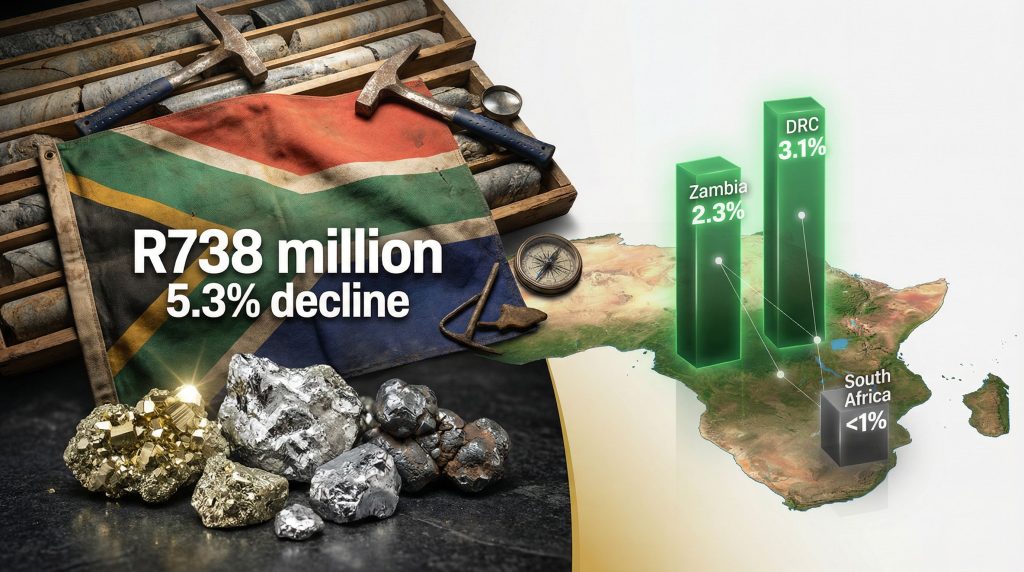
South Africa's mineral exploration decline represents a case study in how regulatory uncertainty can systematically deter capital investment. Over the past seven consecutive years, exploration spending has contracted, reaching R738 million ($43.9 million) in 2025, marking a 5.3% decline from the previous year. This sustained downturn extends a longer-term pattern, with exploration investment falling by more than 85% over three decades.
Key regulatory barriers creating investment friction include:
• Extended mining licence approval timelines averaging 18-24 months
• Overlapping jurisdictional requirements across multiple government departments
• Environmental compliance frameworks requiring specialised legal navigation
• Uncertain implementation of the Mineral Resources Development Amendment Bill
The Minerals Council South Africa, representing major operators including Valterra Platinum Ltd., Harmony Gold Mining Co., and Exxaro Resources Ltd., has characterised the continued decline in exploration spending as requiring urgent attention for the sector's long-term viability. Furthermore, comprehensive mining permitting insights reveal that industry representatives emphasise exploration as the foundation for future mining operations, making current investment deficits particularly concerning for sectoral sustainability.
Infrastructure deficits compound these regulatory challenges, creating compound barriers to exploration investment. However, power supply reliability issues, water resource management constraints, and transportation network limitations increase both operational costs and project risk assessments. These infrastructure challenges affect project economics from the earliest exploration phases through to potential production scenarios.
Comparative Regional Investment Patterns
South Africa's mineral exploration decline has seen the country's share of global mineral exploration spending plummet dramatically from 5% in 1995 to less than 1% currently. This contraction occurred despite generally favourable commodity price environments for the country's key mineral exports, including platinum group metals, gold, and manganese. The divergence between commodity prices and exploration investment suggests that fundamental structural factors, rather than market conditions, drive investment allocation decisions.
Neighbouring countries have capitalised on this capital reallocation, with Zambia and the Democratic Republic of the Congo capturing increasing shares of African exploration investment. These jurisdictions have implemented different approaches to regulatory frameworks, infrastructure development, and investor engagement that have proven more attractive to exploration companies.
Regional exploration investment trends demonstrate:
| Country | Policy Approach | Investment Trajectory | Key Advantages |
|---|---|---|---|
| South Africa | Complex regulatory framework | Declining 7 consecutive years | Geological diversity, established infrastructure |
| Zambia | Streamlined mining code | Increasing market share | Simplified licensing, government partnerships |
| DRC | Resource-focused approach | Stable despite challenges | Exceptional mineral endowments, lower costs |
| Ghana | Targeted marketing strategy | Growing exploration activity | Predictable regulations, mining-friendly policies |
The competitive dynamics reveal how regulatory efficiency and policy predictability influence capital allocation decisions. In addition, exploration companies typically operate with limited budgets and must allocate resources across multiple potential projects, making jurisdictional comparison a critical factor in investment decisions.
Economic Consequences of Exploration Deficits
Mining's contribution to South Africa's GDP has declined from 21% in 1980 to 8.2% in 2024, reflecting both reduced production from ageing mines and insufficient development of replacement capacity. While total mineral sales increased 7.3% in 2024 to R861 billion, this growth primarily reflects commodity price improvements rather than expanded production capacity.
South African mining exploration falls for seventh straight year, highlighting how the typical development timeline from exploration initiation to first production averages 17 years for major mining projects. Consequently, current exploration deficits will impact South Africa's mining output through the 2040s. This extended timeline creates a "lost generation" of potential mining projects that threatens the country's position in global mineral markets.
Economic impact analysis reveals:
• Regional unemployment increases in mining-dependent communities exceeding 15%
• Reduced foreign direct investment in extractive industries by approximately 40% since 2018
• Export revenue vulnerability in key mineral categories
• Skills migration as geological and mining professionals seek opportunities elsewhere
The downstream effects extend beyond direct mining employment to supporting industries, including equipment suppliers, logistics providers, and professional services firms. For instance, mining communities in provinces such as North West, Limpopo, and the Northern Cape face particular economic challenges as exploration activity contracts.
The exploration deficit creates compounding economic risks, as reduced current activity limits future production capacity while simultaneously diminishing the sector's ability to generate employment and export revenues.
Policy Reform Frameworks for Investment Revival
The Department of Mineral and Petroleum Resources has outlined strategic objectives to increase South Africa's share of global exploration spending to 5%, representing a five-fold increase from current levels. This ambitious target requires comprehensive policy reforms addressing regulatory efficiency, infrastructure development, and capital market access.
Cape Town-based Economic Research Southern Africa has recommended that government initiatives focus on tax incentive implementation, transparent mining rights databases, and increased geological mapping funding. These recommendations align with successful policy frameworks implemented in major mining jurisdictions including Australia and Canada, particularly in relation to critical minerals strategy development.
Recommended policy interventions include:
• Tax Incentive Structures: Flow-through share mechanisms enabling junior mining strategies to pass exploration expenses to investors
• Regulatory Streamlining: Centralised permitting processes reducing approval timelines by 40-60%
• Infrastructure Investment: Targeted programmes addressing power, water, and transportation constraints
• Data Transparency: Open-access geological databases improving exploration efficiency
International best practices demonstrate that successful mining jurisdictions combine regulatory predictability with targeted incentive programmes. Australia's flow-through share system, for example, has mobilised significant private capital for exploration activities while providing tax benefits that encourage risk-taking in early-stage projects.
Technology Integration and Modernisation Opportunities
Advanced exploration technologies offer pathways to improve project economics and reduce investment risk profiles. Digital geological mapping, artificial intelligence-driven data analysis, and remote sensing technologies can accelerate exploration timelines while reducing capital requirements.
Technological advancement opportunities include:
• Satellite-Based Detection Systems: Reducing ground-based exploration costs by 30-50%
• AI Geological Analysis: Improving target identification accuracy through machine learning
• Drone Surveying Platforms: Enabling cost-effective assessment of remote areas
• Blockchain Rights Management: Creating transparent, efficient mining rights administration
These technological solutions address traditional exploration challenges while creating opportunities for smaller companies to participate in exploration activities. Moreover, data-driven operations can particularly benefit junior exploration companies that typically operate with constrained capital budgets.
Data transparency initiatives could significantly improve exploration efficiency by consolidating historical exploration information, providing standardised geological surveys, and enabling predictive modelling for mineral deposit identification. Such databases have proven valuable in countries like Canada, where comprehensive geological information supports both government planning and private sector investment decisions.
The next major ASX story will hit our subscribers first
Global Supply Chain Implications and Strategic Considerations
South Africa's mineral exploration decline threatens its strategic position in critical mineral supply chains, particularly for platinum group metals essential to hydrogen economy development, manganese required for battery manufacturing, and chrome necessary for stainless steel production. These materials play crucial roles in energy transition technologies and global manufacturing processes.
The country's geological advantages include some of the world's largest platinum group metal deposits, significant manganese reserves, and substantial chrome resources. However, without adequate exploration investment, these comparative advantages may not translate into sustained market leadership as competing producers develop alternative supply sources.
Strategic mineral security considerations:
| Mineral Category | Global Market Share | Strategic Importance | Competition Risk |
|---|---|---|---|
| Platinum Group Metals | 75% of global reserves | Hydrogen economy, automotive | Recycling technologies, substitution |
| Manganese | 37% of global production | Battery manufacturing | Australian expansion, Brazilian projects |
| Chrome | 44% of global reserves | Stainless steel production | Turkish development, Indian expansion |
The intersection of exploration decline with global energy transition trends creates particular risks for South Africa's mineral sector. Furthermore, as countries implement policies supporting electric vehicle adoption and renewable energy development, demand for specific minerals is projected to increase substantially. Consequently, without adequate exploration investment, economic challenges facing South African mining may prevent the country from capitalising on these demand trends.
Investment Recovery Scenarios and Timeline Analysis
Recovery scenarios for South Africa's exploration sector depend heavily on the timing and comprehensiveness of policy reforms. Immediate implementation of regulatory streamlining and tax incentive programmes could begin reversing exploration decline within 24-36 months, while delayed action would extend recovery timelines significantly.
Recovery pathway analysis:
• Immediate Reform Implementation (2026): Exploration recovery beginning 2028-2030, production impact 2035-2040
• Delayed Reform Implementation (2028): Exploration recovery beginning 2030-2032, production impact 2040-2045
• Status Quo Continuation: Continued exploration decline, sector contraction accelerating
The window for effective intervention continues narrowing as competing jurisdictions strengthen their positions in global exploration markets. Each year of delayed reform extends the timeline for recovery and increases the capital investment required to regain market competitiveness.
Junior mining companies play particularly critical roles in exploration recovery, as these entities typically drive early-stage exploration activities that larger companies later acquire or joint venture. Supporting junior exploration requires access to risk capital, simplified regulatory requirements, and clear pathways for project advancement.
International experience demonstrates that successful exploration revival requires sustained policy commitment over multiple years. Countries that have successfully increased their shares of global exploration investment typically maintained consistent policy frameworks for 5-7 years while continuously improving regulatory efficiency and infrastructure support.
Strategic Imperatives for Long-Term Competitiveness
South Africa's mineral exploration decline reflects broader challenges in balancing regulatory oversight with investment attraction. The solution requires coordinated action across multiple government departments, industry stakeholders, and supporting institutions to create an environment that encourages exploration investment while maintaining appropriate environmental and social standards.
The competitive dynamics in global exploration markets continue evolving as countries implement new strategies to attract investment capital. South Africa's success in reversing its exploration decline will depend on the speed and effectiveness of policy implementation relative to competing jurisdictions' continued improvements in their investment climates.
Success metrics for exploration recovery should include increased exploration spending, growing numbers of active exploration projects, expanded junior mining sector participation, and eventual translation into new mining operations. These indicators will demonstrate whether policy reforms effectively address the structural challenges that have driven exploration decline.
The broader implications extend beyond mining sector performance to South Africa's economic diversification strategies, export revenue sustainability, and employment generation in mining-dependent regions. Reversing the exploration decline represents both an immediate policy priority and a fundamental requirement for long-term economic competitiveness in global mineral markets.
Investment decisions involve significant risks, and past performance does not guarantee future results. This analysis is for informational purposes only and should not be considered as investment advice. Readers should conduct their own research and consult with qualified professionals before making investment decisions.
Looking for the Next Major African Mining Discovery?
Discovery Alert's proprietary Discovery IQ model delivers real-time alerts on significant ASX mineral discoveries, instantly empowering subscribers to identify actionable opportunities ahead of the broader market. Begin your 14-day free trial today and secure your market-leading advantage whilst major mineral discoveries continue reshaping investment landscapes across global markets.