May 19, 2026
The Scale of Africa's Mining Renaissance: Strategic Scenarios for Continental Resource Security
Unprecedented geological abundance meets accelerating global demand across mineral markets worldwide. As battery technology reshapes energy infrastructure and industrial applications require increasingly sophisticated material inputs, established mining jurisdictions face capacity constraints while emerging regions unlock previously inaccessible deposits. Africa's greenfield exploration surge represents more than traditional resource development; it signals a fundamental restructuring of global supply chains where geological advantage, regulatory innovation, and strategic positioning converge to create new centres of mineral security.
This continental transformation unfolds through distinct regional approaches, each leveraging unique geological formations and policy frameworks to capture growing market opportunities. From Southern Africa's platinum group metal dominance to West African critical mineral diversification, exploration strategies reflect both historical mining expertise and forward-looking adaptation to evolving commodity demands.
When big ASX news breaks, our subscribers know first
Unprecedented Scale: Beyond Traditional Mining Frontiers
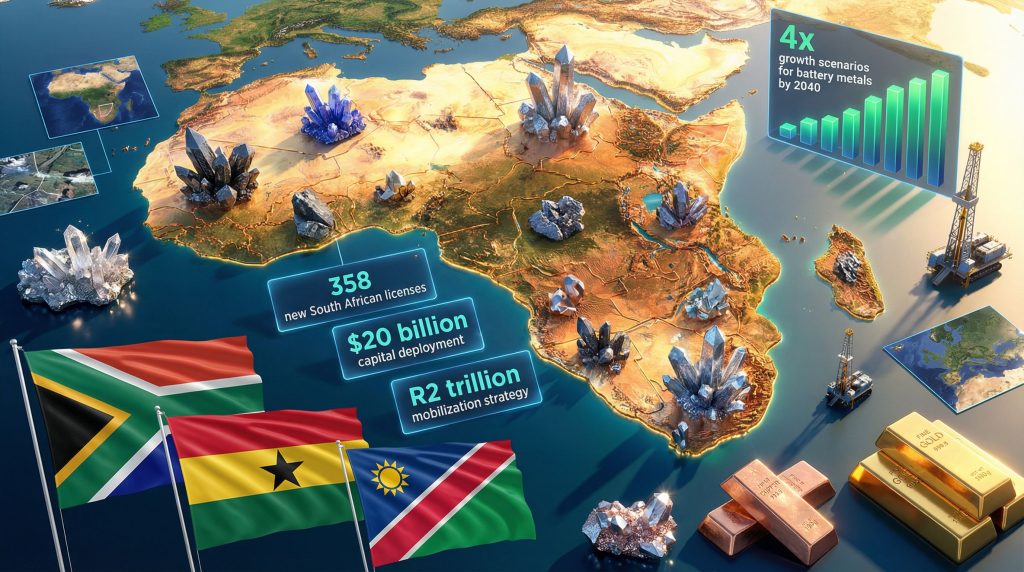
The current exploration cycle across Africa demonstrates statistical intensity that surpasses historical precedents. South Africa awarded 358 new prospecting rights alongside 32 mining rights in 2025, representing the most comprehensive licensing expansion in over two decades. This activity coincides with Namibia receiving over 800 new exploration applications whilst processing 600+ pending environmental approvals through newly deployed digital platforms.
Ghana's exploration portfolio has expanded to encompass more than 90 active projects, supported by $20 billion in mining and exploration investment over two years. These figures reflect not merely increased activity but systematic strategic positioning to capture projected commodity demand growth. Furthermore, this surge demonstrates how mineral exploration insights are driving investment decisions across the continent.
Critical Minerals Drive Strategic Repositioning
The transition from gold-focused exploration portfolios toward diversified critical mineral targeting represents a fundamental shift in African mining strategy. Global demand for critical minerals faces quadruple growth projections by 2040, according to industry analysis, creating supply gaps that traditional producing regions cannot adequately fill.
This demand acceleration creates unique opportunities for regions with untapped geological potential. In addition, understanding the critical minerals energy transition becomes crucial for strategic planning:
• Battery metal exploration priorities: Lithium pegmatite formations, cobalt extensions, and graphite deposits become primary targets
• Industrial transition metals: Copper belt expansions beyond traditional boundaries
• Rare earth element mapping: Unexplored geological provinces with strategic mineral concentrations
• Platinum group metal applications: Expanding beyond automotive catalysts to hydrogen economy infrastructure
African exploration companies increasingly structure portfolios around energy transition applications rather than traditional industrial uses, reflecting market positioning for long-term commodity cycles.
Regional Exploration Strategies: Geological Advantage Meets Policy Innovation
Southern Africa: PGM Leadership and Industrial Metal Expansion
South Africa's approach combines established geological expertise with targeted policy support for exploration acceleration. The R2 billion government allocation supporting junior mining companies represents direct financial intervention designed to unlock resource development in previously unexplored regions.
This strategy targets specific outcomes:
| Strategic Focus | Resource Potential | Investment Framework |
|---|---|---|
| Platinum Group Metals | Global leadership maintenance | Government co-investment |
| Critical Minerals | R2 trillion sector mobilisation | Junior mining support |
| Iron Ore | R40 trillion untapped reserves | Infrastructure development |
| Chrome & Manganese | Production expansion | Export facilitation |
The R40 trillion iron ore reserve estimate positions South Africa as potentially transformative for global steel supply chains, though development timelines depend on infrastructure investment and beneficiation technology deployment.
Digital transformation initiatives streamline regulatory processes, reducing licensing timeframes and improving investor confidence through predictable approval mechanisms. These improvements address historical concerns about regulatory efficiency whilst maintaining environmental and social compliance standards.
West Africa: Gold Expertise Enables Critical Mineral Diversification
Ghana's exploration strategy leverages established mining infrastructure and regulatory frameworks to expand beyond traditional gold production. Emmanuel Armah-Kofi Buah, Ghana's Minister for Lands and Natural Resources, has emphasised the country's transition toward supporting global energy transition requirements through diversified mineral portfolio development.
Ghana's geological potential extends across multiple strategic minerals. However, as Namibia leads Africa's critical minerals race, regional competition intensifies:
• Bauxite deposits: Supporting aluminium production for lightweight applications
• Manganese resources: Critical for steel production and battery manufacturing
• Iron ore formations: Complementing regional steel supply chains
• Cobalt and nickel potential: Supporting battery metal supply diversification
The $20 billion investment attraction over two years demonstrates international confidence in Ghana's regulatory stability and geological prospectivity. This capital deployment supports both expansion of existing operations and greenfield exploration in previously unexplored regions.
Investment confidence indicators reflect policy stability measures including transparent licensing processes, predictable taxation frameworks, and established infrastructure supporting mining operations. Ghana's approach emphasises continuity with existing mining expertise whilst systematically expanding into strategic minerals.
East and Central Africa: Copper Belt Extensions and Infrastructure Synergies
Zambia's 3 million ton annual copper production target by 2031 represents ambitious expansion from current production levels, requiring significant exploration success in regions adjacent to established copper belt operations. This production scaling methodology involves both brownfield expansion at existing mines and greenfield exploration in geological extensions.
Guinea's Simandou project, valued at $20 billion, exemplifies how large-scale infrastructure development enables exploration across previously inaccessible regions. As the world's largest untapped iron ore deposit, Simandou requires coordinated development of rail, port, and power infrastructure that benefits broader exploration activities across Guinea's mineral-rich regions.
Cross-border exploration synergies emerge through:
- Shared geological formations: Mineral belts extending across national boundaries
- Infrastructure coordination: Transportation corridors supporting multiple projects
- Regulatory harmonisation: Standardised environmental and social standards
- Technology transfer: Shared expertise in exploration and development methodologies
Regional mining corridor development creates economies of scale for exploration companies whilst reducing individual project risks through shared infrastructure and regulatory frameworks.
Technology Integration Transforms Exploration Economics
Digital Licensing Platforms Accelerate Regulatory Processing
Namibia's deployment of digital licensing systems addresses fundamental constraints on exploration expansion. Mining Commissioner Isabella Chirchir has confirmed that "automated processing systems reduce application backlogs whilst improving transparency and efficiency" for the 800+ pending exploration applications.
Digital transformation components include:
• Automated environmental screening: Preliminary assessment capabilities for low-risk exploration activities
• Blockchain-based title management: Transparent ownership records reducing disputes
• Real-time application tracking: Improved communication between regulators and applicants
• Data integration platforms: Geological survey information accessible to exploration companies
These technological improvements reduce both time and cost for exploration companies whilst maintaining regulatory standards. Processing time reductions of 30-50% create competitive advantages for jurisdictions implementing comprehensive digital systems. Moreover, AI drilling advancements are revolutionising how Africa's greenfield exploration projects approach resource identification.
Advanced Geological Survey Techniques Enable Remote Area Exploration
Modern exploration technologies make previously inaccessible regions economically viable for mineral discovery. Satellite-based mineral detection capabilities identify geological formations indicating potential mineralisation without requiring extensive ground-based surveys.
Technical deployment includes:
• Hyperspectral satellite imagery: Identifying mineral signatures across large geographic areas
• AI-powered geological modelling: Predictive analytics for deposit probability assessment
• Drone-assisted surveying: High-resolution mapping in challenging terrain
• Geophysical integration: Combining multiple data sources for comprehensive geological understanding
Cost reduction benefits range from 40-60% for preliminary exploration phases, enabling economic evaluation of prospects previously considered marginal. These efficiency improvements expand viable exploration targets whilst reducing capital requirements for early-stage activities.
Investment Architecture Supporting Greenfield Development
Government Co-Investment Strategies and Risk Sharing
Direct financial support mechanisms reduce exploration risks for private investors whilst maintaining government interests in successful discoveries. South Africa's R2 billion junior mining support allocation demonstrates systematic approach to exploration financing through public-private partnerships. Consequently, junior mining investments become more attractive for international capital allocation.
Risk-sharing frameworks typically include:
• Exploration cost sharing: Government contribution to initial geological surveys
• Infrastructure development: Public investment in shared transportation and power systems
• Regulatory efficiency improvements: Streamlined approval processes reducing time-based costs
• Technical expertise provision: Geological survey data and analytical capabilities
These mechanisms enable exploration companies to pursue higher-risk targets whilst providing governments with potential returns from successful discoveries through taxation, royalties, or equity participation arrangements.
International Development Finance and Strategic Partnerships
World Bank and African Development Bank exploration funding supports regional mineral security objectives whilst providing concessional financing for infrastructure development. These multilateral funding sources complement private investment by addressing infrastructure constraints that individual projects cannot economically resolve.
Private equity participation increasingly targets early-stage exploration through venture capital structures designed for high-risk, high-reward mining investments. Fund managers identify portfolios of exploration projects to diversify geological and political risks whilst maintaining exposure to potential major discoveries.
Supply Chain Diversification and Strategic Mineral Security
Western Supply Chain Resilience Initiatives
European Union Critical Raw Materials Act implementation creates demand for non-Chinese mineral sources, positioning African exploration as strategically important for Western supply chain diversification. This policy framework provides market certainty for African mineral development through long-term purchase agreements and infrastructure financing.
Strategic considerations include:
• Geographic diversification: Reducing dependence on single-source suppliers for critical applications
• Political stability assessment: Regulatory predictability supporting long-term investment decisions
• Infrastructure development: Transportation and processing capabilities enabling market access
• Environmental standards: Sustainable mining practices meeting international requirements
These factors create premium valuations for African mineral projects meeting Western supply chain requirements, supporting higher exploration investment levels and accelerated development timelines. Furthermore, exploration investment trends in Africa indicate sustained international commitment to diversification strategies.
Market Price Volatility and Long-Term Contract Structures
Commodity price cycle analysis demonstrates that exploration investment correlates with long-term price expectations rather than short-term volatility. Record gold prices and critical mineral demand projections create favourable investment conditions for African exploration companies.
Long-term contract structures mitigate price volatility through:
- Offtake agreements: Guaranteed sales volumes at predetermined pricing formulas
- Infrastructure cost sharing: Customer financing for transportation and processing facilities
- Technology partnerships: Equipment and expertise provision in exchange for mineral supply access
- Strategic equity investment: Customer ownership stakes in mining projects ensuring supply security
These contractual arrangements enable exploration financing whilst providing customers with supply certainty for critical mineral requirements.
The next major ASX story will hit our subscribers first
Challenges and Risk Mitigation Strategies
Regulatory Stability and Community Engagement
Mining code stability remains crucial for long-term exploration investment, requiring government commitments to predictable taxation and regulatory frameworks. Policy reversals create substantial losses for exploration companies, particularly during long development timelines between discovery and production.
Community engagement requirements increasingly influence exploration project success through social licence to operate considerations. Early stakeholder consultation and benefit-sharing agreements reduce development risks whilst ensuring local community support throughout project lifecycles.
Environmental compliance frameworks balance development opportunities with conservation priorities through systematic environmental impact assessment and mitigation planning. Modern exploration activities incorporate environmental monitoring from initial survey stages, reducing future compliance costs and development delays.
Technical Infrastructure and Skills Development
Skills shortage mitigation requires coordinated training programmes for geological, engineering, and technical mining professionals. African universities and technical institutions increasingly offer specialised mining programmes whilst international partnerships provide advanced training opportunities.
Equipment and technology access improvements through preferential financing and local assembly facilities reduce capital costs for exploration companies. Import duty relief and technology transfer agreements enable more competitive exploration economics across African jurisdictions.
Remote area exploration challenges include power supply, transportation access, and communication infrastructure limitations. Integrated development approaches combine mining project infrastructure with broader regional development priorities, creating shared benefits and reduced individual project costs.
Future Production Impact and Global Market Implications
Development Timeline Projections and Capacity Analysis
Typical development phases from exploration to production range from 8-15 years for major mining projects, depending on mineral type, infrastructure requirements, and regulatory complexity. African exploration success today translates to production capacity increases beginning in the mid-2030s.
Capacity ramp-up scenarios indicate that successful Africa's greenfield exploration could contribute:
• 15-20% of global copper supply growth through Zambian and DRC expansion
• 30-40% of platinum group metal production through South African development
• 25-35% of iron ore capacity additions through West and Central African projects
• 10-15% of critical mineral supply diversification through multi-commodity operations
Market share redistribution toward African producers creates strategic implications for established mining regions whilst providing supply security for consuming countries through geographic diversification. These trends align with broader mining industry evolution patterns observed globally.
Downstream Processing and Value Addition Opportunities
Value-added manufacturing development enables African countries to capture higher-value segments of mineral supply chains rather than limiting exports to raw materials. Beneficiation requirements and local processing incentives encourage downstream industry development linked to mining operations.
Regional industrial development synergies include:
• Smelting and refining facilities: Processing raw materials into industrial inputs
• Manufacturing integration: Using processed minerals for finished goods production
• Technology transfer programmes: Building local expertise in mineral processing technologies
• Export diversification: Reducing dependence on raw material exports through value addition
These opportunities create employment multiplier effects whilst increasing government revenues from mining sector development.
Emerging Exploration Frontiers and Strategic Positioning
Underexplored Geological Provinces and Discovery Potential
Satellite territory identification reveals regions with favourable geology but limited historical exploration due to infrastructure or political constraints. Advanced geological mapping identifies high-potential areas across Central African Republic, Chad, and Madagascar where previous exploration activity remained minimal.
Cross-border geological formations extending across national boundaries create opportunities for coordinated exploration strategies whilst requiring diplomatic cooperation and standardised regulatory approaches.
Deep deposit exploration utilises advanced drilling techniques accessing previously unreachable mineralisation. Technology improvements enable economic extraction from depths exceeding 2,000 metres, expanding resource potential in regions with established surface mining operations.
Strategic Minerals for Emerging Applications
Green hydrogen production requirements create new demand for platinum group metals in electrolysis applications, expanding market opportunities beyond traditional automotive and industrial uses. Hydrogen economy development could triple PGM demand by 2040, according to industry projections.
Alternative battery chemistry development requires diverse mineral inputs including vanadium, manganese, and specialised lithium compounds. African geological diversity positions the continent to supply multiple battery technology pathways rather than depending on single mineral applications.
Strategic metal reserves for defence and aerospace applications include rare earth elements, titanium, and specialised alloys requiring secure supply chains and strategic stockpiling capabilities. Government-to-government agreements increasingly supplement commercial mineral supply arrangements for strategic materials.
Consequently, Africa's greenfield exploration represents not just resource development but strategic repositioning for future mineral demand cycles. As exploration technologies advance and regulatory frameworks improve, the continent's geological advantages position it as a cornerstone of global mineral security.
Investment Disclaimer: This analysis contains forward-looking statements and projections based on current market conditions and exploration activities. Mineral exploration involves substantial risks including geological uncertainty, regulatory changes, and market volatility. Readers should conduct independent research and consult qualified professionals before making investment decisions related to mining or exploration companies.
For comprehensive coverage of African mining developments and exploration opportunities, readers can explore additional industry analysis and project updates through specialised mining publications and regulatory announcements from relevant government agencies across the continent.
Looking to Capitalise on Africa's Mining Renaissance?
Discovery Alert's proprietary Discovery IQ model delivers real-time alerts on significant ASX mineral discoveries, instantly empowering subscribers to identify actionable opportunities ahead of the broader market. Begin your 14-day free trial today and secure your market-leading advantage in this rapidly evolving sector.