June 4, 2026
When the Assay Method Becomes the Discovery: A New Framework for Evaluating Polymetallic Gold Projects
There is a class of mineral discovery that does not begin with a new drill hole. It begins with a question: what did the original assay program miss? In gold exploration, this question is asked infrequently because the industry has spent decades optimising its analytical workflows around a single metal. When a secondary commodity sits in a mineralogical form that resists standard digestion chemistry, it becomes invisible in the data, not because it is absent, but because the method was never designed to find it.
This is the technical lens through which the Benz Mining Glenburgh tungsten discovery deserves to be understood. What has emerged from a targeted re-assay program using lithium borate fusion is not a new geological system. It is an existing one, viewed through a more accurate instrument for the first time.
When big ASX news breaks, our subscribers know first
The Tungsten Supply Problem That Makes This Discovery Strategically Relevant
Before examining the project-level details, it is worth understanding why tungsten discovery in a stable Western jurisdiction commands attention in 2025 and 2026 in a way it simply did not a decade ago.
China controls approximately 80 to 85 percent of global tungsten mine production, according to data from the United States Geological Survey. That level of supply concentration exceeds even lithium and rare earths in terms of single-country dominance. Furthermore, a critical minerals demand surge across defence and industrial sectors has intensified focus on supply chain security. The downstream consequences are significant:
- Tungsten is a critical input for cemented carbide tooling, which underpins virtually all precision machining in defence and aerospace manufacturing
- Armour-piercing projectiles, radiation shielding, and high-performance electrical contacts all rely on tungsten's exceptional density and melting point — placing it firmly among critical military metals in strategic planning frameworks
- The semiconductor industry uses tungsten in contact plugs and interconnects within chip architectures
- Energy transition hardware, including wind turbine components and electric motor parts, contributes to growing industrial demand
The combination of supply concentration and demand diversification creates a structural vulnerability for Western manufacturers. Australia has identified tungsten on its national list of critical minerals, reflecting this supply risk at a policy level. However, it is important to note that policy classification does not translate automatically into project-specific support, and explorers should not assume regulatory tailwinds will accelerate individual project timelines.
Why Western Australia's Geology Is Relevant
The Glenburgh region sits within a Proterozoic metamorphic belt in Western Australia, a geological setting known to host structurally controlled mineralisation systems. The metamorphic and hydrothermal processes that concentrate gold in such terrains also create conditions favourable for tungsten mineralisation, particularly where calcium-rich host rocks interact with tungsten-bearing hydrothermal fluids to precipitate scheelite.
This is not a coincidence. Gold-scheelite associations in metamorphic terrains are well-documented globally, from the Otago Schist belt in New Zealand to the Meguma Terrane in Nova Scotia. The Glenburgh and Mt Egerton projects appear to fit within this broader geological family, which means the co-occurrence of gold and tungsten is structurally predictable rather than anomalous.
The Scale of the Glenburgh Corridor and What the Numbers Actually Mean
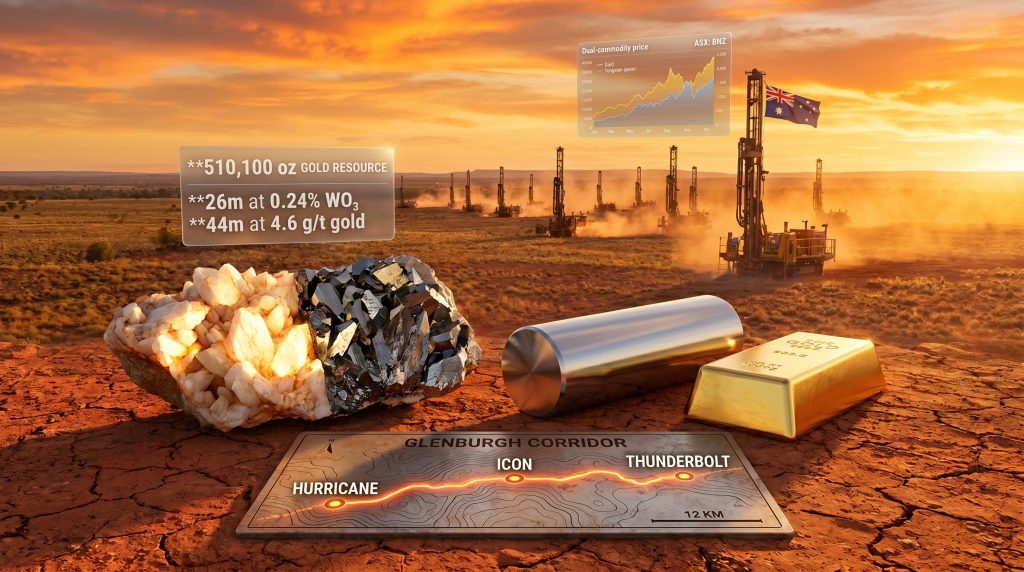
Benz Mining Corp (ASX: BNZ) holds a 12-kilometre mineralised corridor in Western Australia that already carries a JORC-compliant mineral resource of 16.3 million tonnes at 1.0 g/t gold for 510,100 ounces. Three distinct exploration camps sit within this corridor:
| Camp | Target Style | Key Intercepts Reported |
|---|---|---|
| Hurricane | Bulk tonnage / high-grade underground | Multiple RC intercepts pending |
| Icon | Structural corridor | Active drilling underway |
| Thunderbolt | District extension | Exploration-stage targets |
| Zone 126 | Underground lens | 44m @ 4.6 g/t within 103m @ 2.3 g/t |
| Mt Egerton/Kilkenny | High-grade structural | 7m @ 223 g/t gold |
The company has ramped to 12 RC drill shifts operating concurrently across these camps, with more than 250,000 metres planned across the 2026 program. To contextualise that scale, most junior gold explorers in Australia run programs measured in the low tens of thousands of metres. A 250,000-metre program places Benz among the more aggressively funded active exploration campaigns on the ASX.
The management target is a multi-million-ounce gold profile. The Zone 126 Third Lens discovery, which returned 44 metres at 4.6 g/t gold within a broader 103-metre interval at 2.3 g/t gold, and the separate high-grade intercept of 7 metres at 223 g/t gold at Mt Egerton/Kilkenny, both reinforce the structural complexity and high-grade potential of the system.
Why the Assay Method Gap Changed the Entire Picture
Understanding why tungsten was previously invisible at Glenburgh requires a basic knowledge of analytical chemistry applied to drill core. Consequently, interpreting drill results from historical programs demands careful attention to the analytical methodology employed at the time.
Standard four-acid digest assays work by dissolving a sample in a combination of hydrochloric, nitric, hydrofluoric, and perchloric acids. This method is highly effective for gold and most base metals. However, scheelite (calcium tungstate, CaWO₄) and ferberite (iron tungstate, FeWO₄) are resistant to standard acid attack. They do not fully dissolve, which means the tungsten they contain is systematically under-reported or entirely missed.
Technical Note: Lithium borate fusion operates by fusing the sample at high temperature with a lithium borate flux, creating a glass bead that is then dissolved in acid. This process fully digests refractory minerals including scheelite and ferberite, producing accurate WO₃ results. The absence of this technique from historical Australian gold programs is common because tungsten was not considered economically relevant when most projects were initially drilled.
Benz applied lithium borate fusion to selected intervals across Glenburgh, and three key drill holes, designated 25GLR023, 25GLR070, and 26HZ002, returned meaningful WO₃ intervals. The headline intercept of 26 metres at 0.24% WO₃, nested within a 79-metre interval at 4.4 g/t gold, illustrates the spatial relationship between the two commodities.
The implication for the broader project is significant. The entire historical drill dataset across the 12-kilometre corridor was assayed using conventional four-acid methods. A re-assay program covering more of that historical core represents a genuinely low-cost pathway to building a tungsten inventory, because the drilling costs have already been sunk.
What the Hand-Panning Result Tells Investors That Grade Alone Cannot
Buried within the Benz Mining announcement is a detail that carries more metallurgical significance than its understated presentation suggests. RC drill chips from Glenburgh were subjected to hand-panning, and the process produced visible tungsten-rich concentrates. One unconcentrated sample returned an assay of 0.94% WO₃, and individual scheelite grains were coarse enough to be visually identified and manually separated.
For investors unfamiliar with mineral processing, the distinction between coarse-grained and fine-grained tungsten mineralisation is economically critical:
- Coarse-grained scheelite that responds to gravity separation can be recovered using jigging, spirals, or shaking tables, all of which are standard components in conventional gold processing plants
- Fine-grained or disseminated tungsten typically requires froth flotation or, in refractory cases, hydrometallurgical processing, both of which add substantial capital and operating cost
- A tungsten gravity circuit that can be integrated into an existing gold plant is fundamentally different in capital intensity from a standalone tungsten processing facility
The hand-panning result suggests the Glenburgh tungsten is at least partially coarse-grained and amenable to gravity methods. This is a positive metallurgical indicator, though it is not a substitute for formal testwork. ALS Metallurgy has commenced formal testing on Glenburgh samples, running in parallel with the gold metallurgical program, and the results from that work will be the definitive test of whether tungsten recovery is technically viable at industrial scale.
How Tungsten By-Product Credits Could Reshape Project Economics
In polymetallic mining systems, by-product credits reduce the effective cash cost of the primary metal. For a gold project, a tungsten credit would lower the all-in sustaining cost (AISC) per ounce of gold, which has direct implications for project viability across a range of gold price scenarios. Understanding these dynamics is particularly relevant when assessing cut-off grade economics for polymetallic ore bodies.
The economic value of any such credit depends on three variables: the WO₃ grade in the ore feed, the metallurgical recovery rate achievable through the processing circuit, and the prevailing price for ammonium paratungstate (APT), which is the primary traded form of refined tungsten and serves as the global benchmark. APT prices are quoted in USD per metric tonne unit (MTU).
The table below illustrates how these variables interact under different assumptions. These figures are illustrative only, based on publicly available APT price ranges and typical gravity recovery benchmarks from comparable operations.
| Variable | Conservative Case | Base Case | Optimistic Case |
|---|---|---|---|
| WO₃ grade (ore feed) | 0.10% | 0.20% | 0.30% |
| Gravity recovery rate | 55% | 70% | 80% |
| APT price (USD/MTU) | $280 | $320 | $380 |
| Estimated credit (USD/t ore) | ~$3.50 | ~$10.00 | ~$20.00+ |
These figures are illustrative and do not constitute financial advice or a projection of actual project economics.
What the table demonstrates is that even at conservative assumptions, a tungsten by-product credit is not trivial. At the base case, a credit of approximately USD $10 per tonne of ore processed could meaningfully reduce AISC in a low-cost bulk mining scenario.
The next major ASX story will hit our subscribers first
The Valuation Gap: What the Market Has Not Yet Priced
The current equity valuation of Benz Mining has been anchored almost exclusively to the 510,100-ounce gold resource. No publicly available broker model or market consensus figure incorporates tungsten mineralisation, because no formal tungsten resource estimate exists and no metallurgical recovery data has been published.
This creates a structural information asymmetry. The tungsten system has been confirmed geologically across the full corridor length. The assay methodology has been validated. The mineralogy has been identified. What remains unconfirmed is whether the mineralisation can be economically recovered and whether it meets the grade and continuity thresholds required for a JORC 2012-compliant resource estimate.
The transition from geologically credible to economically validated is the single most value-accretive step in the lifecycle of any polymetallic by-product story. It is also the step most frequently discounted by junior explorer valuations until the data is in hand.
How Glenburgh Compares to Other Australian Tungsten Projects
| Project | Location | Primary Metal | Tungsten Status | Development Stage |
|---|---|---|---|---|
| Glenburgh (BNZ) | WA | Gold | By-product candidate, pre-resource | Active exploration |
| Watershed | QLD | Tungsten | Primary tungsten resource | Feasibility-stage |
| Dolphin | King Island, TAS | Tungsten | Historical producer | Care and maintenance |
| Molyhil | NT | Tungsten-Molybdenum | JORC resource | Pre-development |
What distinguishes the Benz Mining Glenburgh tungsten discovery from most Australian tungsten plays is the shared discovery cost structure. At Watershed, Dolphin, and Molyhil, tungsten is the primary commodity and all exploration capital is directed at proving up tungsten economics. At Glenburgh, however, every metre drilled to grow the gold resource simultaneously tests the tungsten system. The marginal cost of the tungsten discovery is effectively zero, because the drilling infrastructure and programs are already funded by the gold thesis.
Key Risks Investors Should Evaluate Carefully
Any investment thesis built around an unresourced by-product commodity carries specific risks that deserve direct treatment:
Metallurgical Risk
Geological presence does not guarantee recoverable grades. Fine-grained or interlocked tungsten mineralisation can render gravity circuits ineffective. If ALS Metallurgy finds that Glenburgh's tungsten is predominantly fine-grained, the economics of recovery change materially. The hand-panning result is encouraging but not conclusive.
Resource Conversion Risk
A re-assay program can demonstrate widespread mineralisation without producing a JORC-compliant resource. Grade continuity, spatial distribution, and minimum width criteria must all be satisfied before tungsten can be formally reported. The current re-assay program is best understood as a screening exercise rather than a resource definition exercise.
APT Price Volatility
Historical APT price cycles have experienced drawdowns of 40 to 60 percent over multi-year periods, driven primarily by Chinese export policy adjustments and changes in global industrial demand. A by-product credit is only economically meaningful if prices remain above the threshold that justifies processing costs.
Primary Asset Risk
Gold remains the dominant value driver. If the expanded drilling program at Hurricane, Icon, and Thunderbolt does not deliver the anticipated resource growth, the tungsten optionality is insufficient to compensate.
Catalyst Timeline: What to Watch Over the Next 12 Months
Near-Term Catalysts (0 to 6 Months)
- ALS Metallurgy testwork results confirming or denying gravity amenability of scheelite and ferberite at Glenburgh
- Progressive lithium borate fusion re-assay batches building the corridor-wide tungsten inventory picture
- Gold assay results from the 12-RC-shift drilling program across Hurricane, Icon, and Thunderbolt
Medium-Term Catalysts (6 to 12 Months)
- Gold resource update targeting material growth from the current 510,100-ounce base toward a multi-million-ounce profile
- Formal tungsten resource estimate, contingent on re-assay results demonstrating sufficient grade continuity
- A definitive feasibility study potentially incorporating tungsten by-product credits if metallurgical testwork is positive
| Catalyst | Probability Assessment | Potential Impact |
|---|---|---|
| Positive ALS metallurgy results | Moderate to High | High: validates by-product economics |
| Re-assay batches confirm corridor-wide WO₃ | High | Medium: builds inventory narrative |
| Gold resource upgrade toward 1M+ oz | Moderate | Very High: primary re-rating catalyst |
| Formal tungsten resource estimate | Low to Moderate | High if achieved |
Frequently Asked Questions: Benz Mining Glenburgh Tungsten
What exactly is the Glenburgh tungsten discovery?
Benz Mining Corp (ASX: BNZ) has confirmed tungsten mineralisation in the form of scheelite and ferberite across the full length of the Glenburgh mineralised corridor in Western Australia. The mineralisation occurs within the same zones as the primary gold system, with intercepts including 26 metres at 0.24% WO₃ spatially overlapping a 79-metre gold interval grading 4.4 g/t.
Why does the assay method matter so much for this discovery?
Standard four-acid digest assays, the default analytical method in most gold exploration programs, do not fully dissolve scheelite or ferberite. Tungsten grades are therefore systematically under-reported. Lithium borate fusion fully digests these minerals and produces accurate WO₃ readings. Because historical Glenburgh drilling used conventional methods, the project almost certainly contains more tungsten than the original assay database suggests.
What is scheelite and why does its grain size matter?
Scheelite is a calcium tungstate mineral (CaWO₄) and one of the two principal ore minerals of tungsten globally. Coarse-grained scheelite that responds to gravity separation is significantly cheaper to process than fine-grained material requiring flotation or hydrometallurgical treatment. The hand-panning result at Glenburgh, which produced visible scheelite concentrates from raw RC chips, is a preliminary indicator of favourable grain size.
Is Glenburgh a tungsten project or a gold project?
Glenburgh is a gold project with an emerging tungsten by-product dimension. Management has been clear that the drilling program and resource development strategy are focused on growing the gold inventory. The tungsten represents an unpriced embedded option on a critical mineral, not a strategic pivot away from gold.
What is APT and why does it matter for project economics?
Ammonium paratungstate is the primary globally traded intermediate product of tungsten refining and serves as the benchmark price reference for the metal. APT prices directly determine the economic value of any tungsten by-product credit and are heavily influenced by Chinese production and export decisions.
The Two-Asset Framework: One Priced, One Not
The analytical conclusion that emerges from the Benz Mining Glenburgh tungsten discovery is straightforward. The market is currently pricing a gold explorer with a 510,100-ounce resource and a substantial active drilling program. That is the primary value driver and will remain so regardless of what the tungsten program delivers.
The tungsten represents a second asset that is geologically credible, methodologically validated, and economically unquantified. It sits entirely outside the current consensus valuation. The pathway from unpriced option to valued by-product runs through two gateways: positive ALS metallurgy results and a JORC-compliant tungsten resource. Neither is guaranteed, and investors should not assign certainty to either outcome.
What the Benz Mining Glenburgh tungsten discovery does establish is a genuinely unusual structure for a junior ASX explorer: a district-scale gold system with a growing high-grade discovery pipeline, one of the more intensive active drilling programs in the country, and a secondary critical mineral dimension that could materially improve project economics if it clears the technical hurdles ahead.
This article is general in nature and does not constitute financial advice. Past performance and geological intercepts are not indicative of future results or economic outcomes. Investors should conduct their own due diligence and consult a licensed financial adviser before making investment decisions. Further coverage of ASX-listed mining and resources companies is available at Stocks Down Under.
Want to Be First When the Next Major ASX Mineral Discovery Hits the Market?
Discovery Alert uses its proprietary Discovery IQ model to deliver real-time alerts on significant ASX mineral discoveries — including polymetallic and critical mineral systems like the one emerging at Glenburgh — turning complex geological data into actionable investment insights the moment they're announced. Explore historic discoveries and their remarkable returns, then start your 14-day free trial at Discovery Alert to position yourself ahead of the broader market.