June 4, 2026
The Geology That Makes Sediment-Hosted Copper Systems Genuinely Rare
Among all copper deposit archetypes, manto-style sediment-hosted systems occupy a peculiar and commercially attractive position. They lack the sheer bulk tonnage of large porphyry systems, yet their near-surface geometry, high-grade mineral assemblages, and predictable horizontal continuity make them disproportionately valuable relative to their footprint. The world has produced only a handful of genuinely significant manto discoveries in the modern exploration era, and most of those were found decades ago. Understanding why these systems are so rare, and what it means when drilling data begins to confirm one at scale, is essential context for evaluating what is now emerging at the Marimaca Copper Pampa Medina discovery in northern Chile.
When big ASX news breaks, our subscribers know first
Why Pampa Medina Is Redefining Marimaca Copper's Investment Thesis
From Oxide Development Play to District-Scale Exploration Story
Marimaca Copper entered the market with a well-understood value proposition: a permitted, financeable copper oxide project in northern Chile's Atacama Region, backed by a robust definitive feasibility study and a management team with genuine development credentials. The Marimaca Oxide Project (MAD) remains central to the company's near-term production plans, but a second narrative has been gathering momentum in parallel, one that is now beginning to overshadow the development story in terms of speculative upside.
What began as a satellite exploration target adjacent to the oxide project has, through systematic drilling, revealed characteristics consistent with a district-scale copper system. The Marimaca Copper Pampa Medina discovery is no longer a footnote to the MAD story. For investors willing to look beyond near-term production metrics, it may represent the more consequential of the two assets.
The Strategic Shift That Caught the Market Off Guard
Part of the market's confusion stems from the pace at which Pampa Medina's geological profile has evolved. A project originally interpreted through the lens of incremental oxide production has, through a single transformative drill hole and subsequent confirmation drilling, revealed a stacked, multi-horizon mineralised system with both near-surface leachable oxides and a high-grade sulphide core beginning at depth.
The company's chief executive has been explicit that the geological team now views this as a district-scale sulphide system with the potential to qualify as a tier-one copper asset.
Investors who entered the stock based on the MAD development timeline alone are now holding exposure to a fundamentally different risk-reward profile than when they first invested.
What Is the Pampa Medina Copper Discovery?
Location, Geology, and Regional Context in Northern Chile
Pampa Medina sits within Chile's low coastal cordillera in the Atacama Region, an area that hosts some of the world's most productive copper operations but has historically been dominated by porphyry-style systems rather than the sediment-hosted manto style now emerging here. The distinction matters enormously from both a processing and capital cost perspective. Furthermore, understanding the Chile copper price outlook provides important context for evaluating the asset's long-term commercial potential.
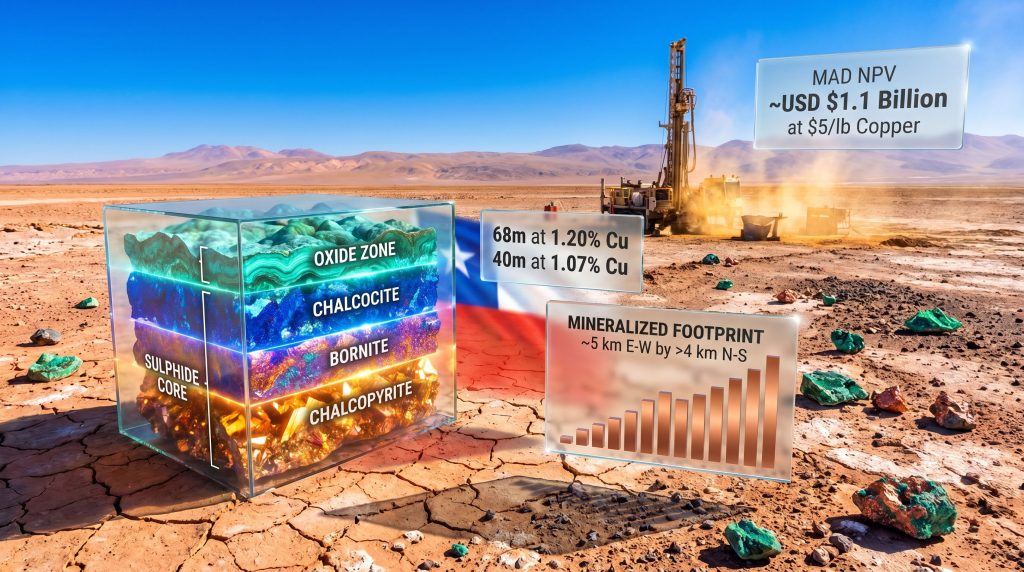
The known mineralised footprint currently extends approximately 5 kilometres east-west and more than 4 kilometres north-south, with a high-grade core zone measuring roughly 1.5 kilometres north-south and 600 to 800 metres east-west. That core zone is where drilling has consistently returned the thickest and highest-grade intercepts.
Understanding Manto-Style Copper Systems in the Atacama Region
Manto deposits form through the replacement or filling of sedimentary horizons by copper-bearing fluids, typically resulting in tabular, stratabound ore bodies that follow bedding planes rather than fracture systems. This geometry creates a critically important characteristic for mine planning: predictable continuity. When a manto is mineralised over hundreds of metres, the expectation is that the mineralisation extends laterally unless structural disruption has occurred.
Every drill hole that confirms a mineralised horizon adds confidence not just to that specific location but to the entire trend. The dominant copper minerals encountered at Pampa Medina include bornite, chalcocite, and chalcopyrite. The first two are commercially significant beyond their grade because they are amenable to leach processing, opening a pathway to cathode production without the capital intensity of a flotation concentrator.
Pampa Medina at a Glance
| Parameter | Current Status |
|---|---|
| Location | Northern Chile, Atacama Region |
| Deposit Style | Manto-type sediment-hosted copper system |
| Known Mineralisation Footprint | ~5 km east-west, >4 km north-south |
| High-Grade Core (Oxide) | 1.5 km north-south, 600-800 m east-west |
| Key Sulphide Intercept (SMR-01) | 462m-650m (chalcopyrite-bornite) |
| Dominant Copper Minerals | Bornite, chalcocite, chalcopyrite |
| Resource Stage | Pre-inferred (drilling in progress) |
What Do the Drill Results Actually Tell Us?
Breaking Down the Key Intercepts at Pampa Medina Norte
The most recent programme of drilling has delivered results across a range of hole types, from infill holes tightening the resource grid to substantial stepout holes testing the limits of the mineralised system. Interpreting drill results of this nature requires careful analysis of both grade and width continuity across the system. The headline intercepts include:
- 68 metres at 1.20% copper, confirming the northern extension of oxide mineralisation
- 40 metres at 1.07% copper, validating lateral continuity across the system
- Hole SMR-01: Oxide zone from 272 metres to 462 metres depth, transitioning into a chalcopyrite-bornite sulphide zone from 462 metres to 650 metres
The SMR-01 result is particularly instructive. A single hole that passes through nearly 200 metres of oxide mineralisation before entering a further 188 metres of sulphide mineralisation containing bornite and chalcopyrite suggests vertical stacking of multiple ore-forming events, not simply a single thin manto. For a detailed overview of recent drilling results, Marimaca's Pampa Medina Norte discovery release provides comprehensive technical disclosure.
The Significance of Five Stacked Mantos in a Single Drill Hole
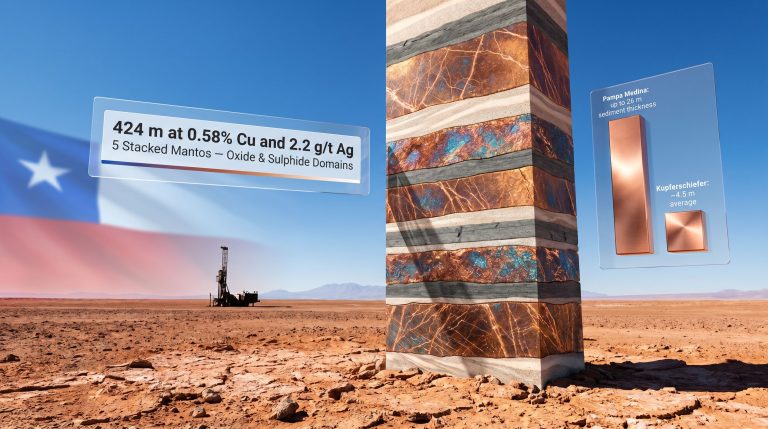
One of the more revealing aspects of the recent drilling programme has been the identification of five stacked manto horizons within a single drill hole. In a typical manto system, encountering two or three stacked horizons would already be considered geologically noteworthy. Five stacked mantos across a 400-metre mineralised package fundamentally changes the resource calculus.
This is because even moderate grades across the full package could deliver exceptional contained metal tonnage. The question this raises for mine planning is whether the system is better developed as a very large open pit targeting the entire 400-metre package at lower average grades, or as a selective underground operation targeting the highest-grade 20 to 50 metre horizons. Both scenarios are potentially economic given the grades and widths observed.
What Grade and Width Continuity Means for Resource Estimation
When an independent resource geologist determines that a 150 metre by 150 metre drill spacing is sufficient for JORC-compliant inferred resource classification, it signals exceptional geological coherence. For comparison, some comparable sediment-hosted systems have presented technical reports at IPO stage based on drill spacing of 1.6 kilometres. The contrast reflects a fundamentally more coherent and continuous mineralised system at Pampa Medina.
This matters for investors because inferred resource classifications carry inherent uncertainty. A system that achieves inferred status at 150 by 150 metre spacing has demonstrated far greater geological predictability than one requiring kilometre-scale spacing for the same classification.
Drill Performance Benchmarking
| Metric | Pampa Medina | Comparable Sediment-Hosted Systems |
|---|---|---|
| Grade consistency | High, nearly every hole mineralised | Variable across peer systems |
| Mineralised width | 20-400m depending on zone | Varies significantly |
| Sulphide mineral type | Bornite + chalcocite (leachable) | Often chalcopyrite-dominant |
| Continuity of horizon | Strong north-south and east-west | Typically patchy at early stage |
| Stepout success rate | Near 100% to date | Industry average significantly lower |
Is Pampa Medina a Tier-One Copper Asset in the Making?
Defining Tier-One: The 100,000-Tonne-Per-Year Threshold
The term tier-one is used loosely across the mining sector, but in copper it carries a reasonably consistent definition. A tier-one copper asset is one capable of sustaining production of at least 100,000 tonnes of copper metal per year for a minimum of 20 years. Achieving this requires not simply high grades but demonstrated scale across a large, geologically coherent mineralised footprint, combined with processing economics that allow cost-competitive production across commodity price cycles.
Very few new copper discoveries in the past two decades have achieved this designation. The most celebrated recent example, Kamoa-Kakula in the Democratic Republic of Congo, is a sediment-hosted system, and the comparison is instructive. Kamoa-Kakula's early drill results showed characteristics that are now being observed at Pampa Medina: consistent mineralisation across nearly every hole, grades and widths exceeding those of established peer deposits, and a mineralised footprint that grew with every stepout hole.
The 3 to 4 Kilometre Northern Trend Extension: What It Could Mean
The current interpretation of Pampa Medina's mineralised trend suggests a potential extension of 3 to 4 kilometres to the north of the current drilling area, plus at least 1 kilometre to the southwest. If stepout drilling confirms mineralisation of similar grade and width along this trend, the contained metal inventory implied would almost certainly support a tier-one production scenario.
The management team has been careful to frame this as conditional on drilling confirmation, which is appropriate scientific discipline. However, the near-100% drill hole success rate observed to date means that each stepout hole carries unusually high probability of adding to rather than subtracting from the resource picture. This dynamic is consistent with the broader copper supply crunch narrative reshaping global investment priorities in the sector.
Oxide vs. Sulphide: Two Separate Projects or One Integrated System?
The Case for a Phased, Integrated Development Approach
One of the more commercially interesting aspects of Pampa Medina's geology is that every single drill hole has returned both oxide and sulphide mineralisation. The oxide envelope has expanded in all directions with each new hole, meaning that the oxide resource is growing simultaneously with the sulphide story.
This creates a natural phasing logic. Near-surface oxides can be developed first under a heap leach and solvent extraction-electrowinning (SX-EW) model, consistent with the MAD project's established processing pathway. The sulphide zones below can then be evaluated and potentially incorporated into the operation as the oxide resource depletes, extending mine life significantly without requiring a complete restart of infrastructure investment.
Leachability of Bornite and Chalcocite: A Commercial Advantage
The mineral assemblage at depth is what makes Pampa Medina genuinely unusual among sulphide copper discoveries. Bornite and chalcocite are the dominant copper species encountered in the sulphide zone, and both are meaningfully amenable to leach processing under the right conditions. This is in contrast to chalcopyrite, which is refractory to heap leaching and typically requires flotation concentration followed by smelting.
The commercial implications are significant:
- Both bornite and chalcocite can potentially be incorporated into heap leach or SX-EW processing, extending cathode production without the capital cost of a concentrator
- A concentrator will almost certainly still be required for the deeper, chalcopyrite-dominant portions of the system
- A hybrid approach combining leach processing for the upper sulphide zone and conventional flotation for the deeper zone is the most likely long-term development scenario
The oxide and leachable sulphide zones together create the potential to expand cathode production from a baseline of approximately 50,000 tonnes per year to 75,000 tonnes per year or beyond, before any concentrator capacity is brought online.
Processing Pathway Options
| Processing Route | Applicable Minerals | Capital Intensity | Best Suited For |
|---|---|---|---|
| Heap Leach / SX-EW | Bornite, chalcocite (oxides + leachable sulphides) | Lower | Near-surface and shallow sulphide zones |
| Conventional Flotation + Concentrator | Chalcopyrite-dominant sulphides | Higher | Deeper, higher-grade sulphide core |
| Hybrid (Leach + Concentrator) | Mixed mineral assemblage | Moderate-High | District-scale integrated operation |
The next major ASX story will hit our subscribers first
How Does Pampa Medina Compare to Other Major Chilean Copper Discoveries?
The Rarity of New High-Grade Manto Discoveries in the Chilean Copper Belt
Sediment-hosted manto copper systems of the scale emerging at Pampa Medina are geologically unusual within the Chilean context. The overwhelming majority of major copper discoveries in Chile over the past three decades have been porphyry systems, typically located at significant depth and requiring multi-billion dollar capital programmes to develop. A near-surface, high-grade manto system of potentially tier-one scale would represent a genuinely differentiated addition to Chile's copper development pipeline.
The Chuquicamata district provides a long-run historical analogue for large-scale copper production from the Atacama Region, but it is a porphyry system and operationally incomparable to a manto deposit. The more relevant comparison is to the sediment-hosted systems of central Africa, where Kamoa-Kakula and deposits of the Central African Copperbelt have demonstrated that tabular, stratabound copper systems can achieve tier-one scale with relatively predictable geological behaviour.
Manto deposits of Pampa Medina's apparent scale are exceptionally uncommon in Chile's coastal cordillera. Most comparable systems globally are hosted in sedimentary basins with different tectonic histories. The Chilean coastal setting adds a layer of geological novelty that the exploration team itself acknowledges is still being understood.
What Is the Path to a Maiden Inferred Resource?
Current Drilling Campaign: Scale, Spacing, and Timeline
The current drilling campaign is targeting approximately 35,000 additional metres of drilling to achieve the 150 by 150 metre grid spacing recommended by the independent resource geologist for JORC-compliant inferred classification. The campaign is scheduled for completion by the end of September 2025, with resource estimation expected to take a further 6 to 7 months following completion of drilling.
This places the maiden inferred resource release on a timeline of approximately mid-2026, and it is important to understand what that resource will and will not represent. The initial resource will cover only a defined subset of the total interpreted mineralised system, specifically the areas with sufficient drill density to support inferred classification. Large portions of the interpreted trend will remain outside the resource boundary at first release, representing a reservoir of subsequent resource growth.
Step-by-Step: From Drill Results to Maiden Resource
-
Complete infill and stepout drilling on a 150 metre by 150 metre grid across the target area
-
Submit all assay results for independent analytical review and quality assurance
-
Engage independent resource geologist for JORC-compliant resource estimation
-
Define the resource boundary over the highest-confidence drill-tested portion of the system
-
Release maiden inferred resource, expected to represent only a portion of the total interpreted mineralised footprint
-
Use maiden resource as the platform for continued stepout drilling, scoping studies, and preliminary economic assessment
How Does Pampa Medina Fit Within Marimaca's Broader Capital Allocation Strategy?
Balancing Two Value Drivers: MAD and Pampa Medina
Managing capital allocation across a near-production development asset and an active exploration programme with tier-one potential is genuinely complex. The company has confirmed an exploration budget of approximately $30 million for the current Pampa Medina drilling programme, a figure that was reduced from earlier estimates because the geological efficiency of the system means fewer metres are required to achieve inferred resource status than originally projected.
The logic is sound: capital preserved at the exploration stage can be directed toward the MAD project's advancement toward a Final Investment Decision (FID), maintaining momentum on the near-term production story while the exploration programme delivers on its own timeline. In addition, thoughtful copper investment strategies suggest that dual-asset companies of this type can offer compelling risk-adjusted exposure compared to pure-play development plays.
The MAD Project as a Near-Term Production Anchor
The financial parameters of the MAD oxide project provide important grounding for any valuation analysis of Marimaca Copper overall:
- Post-tax NPV at an 8% discount rate and $5 per pound copper: approximately USD $1.1 billion
- Implied NAV multiple at current market capitalisation: approximately 0.75 times
- Cash position: approximately USD $160 million
- Interpretation at current pricing: Pampa Medina's oxide and sulphide upside is effectively unpriced by the market
At approximately 0.75 times NAV for the MAD project alone, the market appears to be ascribing minimal value to Pampa Medina's growing oxide resource, its leachable sulphide potential, and its speculative tier-one sulphide upside. For investors with a high tolerance for exploration-stage risk, this valuation structure is the central investment thesis.
Disclaimer: NPV figures, production targets, and resource estimates are forward-looking statements based on company-disclosed assumptions. Actual outcomes may differ materially. This article does not constitute financial advice.
The Sulfuric Acid Strategy: An Overlooked Margin Protection Mechanism
Why Acid Price Volatility Is the Single Biggest Operational Risk in Copper Leaching
Heap leach copper operations consume sulfuric acid in substantial quantities as the primary lixiviant for oxide mineralisation. Acid pricing is determined by a separate set of supply-demand dynamics to copper, most notably the output of smelters producing acid as a byproduct of sulphide concentrate processing. When smelter throughput falls, acid supply tightens and prices spike, compressing margins for oxide copper producers precisely when their revenue may already be under pressure.
The company's management team has identified acid price volatility as the single greatest operational risk to the MAD project's business case, ahead even of copper price risk itself. This framing reflects a sophisticated understanding of the specific economics of heap leach operations.
The Elemental Sulfur Burner Solution: Chemistry, Economics, and Logistics
The proposed mitigation strategy involves installing a dedicated elemental sulfur burner capable of producing sulfuric acid on-site at a cost substantially below prevailing spot prices. The chemistry is straightforward:
- Conversion ratio: 1 tonne of elemental sulfur produces 3 tonnes of sulfuric acid
- Self-produced acid cost: Below USD $250 per tonne under current conditions
- Prevailing spot price for acid (as elevated by recent supply disruptions): above USD $400 per tonne
- Payback period on sulfur burner capital investment: approximately 12 to 14 months at current price differentials
Beyond the unit economics, there is a storage advantage that is not immediately obvious. Sulfuric acid must be stored in sealed concrete tanks, creating substantial working capital requirements and logistical complexity. Elemental sulfur, by contrast, can be stockpiled on open ground without sealed containment. A company that entered a calendar year with 100,000 tonnes of elemental sulfur stockpiled at the prices prevailing at the start of 2025 would have secured its acid supply at an effective cost of approximately $75 per tonne, a fraction of spot acid pricing seen later in the year.
North American Sulfur Supply: A Structural Advantage From Canadian Oil Sands
A less widely appreciated dimension of the sulfur strategy involves North American supply dynamics. The oil sands operations of northern Alberta produce elemental sulfur as a mandatory byproduct of bitumen upgrading. This sulfur accumulates in large surface stockpiles and represents a genuine environmental management challenge for Canadian producers.
Marimaca's sulfur procurement strategy could potentially establish a long-term offtake relationship that provides cost-certain acid feedstock while simultaneously offering Canadian oil sands operators a commercial outlet for a material they currently treat as a liability. This structural dynamic helps explain why North American elemental sulfur prices have not escalated in line with the Chinese acid market, where sulfur supply constraints are considerably more acute.
Permitting, Infrastructure, and the Road to FID
Current Permitting Status and Development Timeline
The MAD project has already secured early works commencement permits, allowing initial site preparation activities to proceed ahead of full construction authorisation. The remaining construction permits, covering full site development, are expected to be received in October 2025, which the company has indicated is ahead of when they are operationally required.
| Milestone | Target Date |
|---|---|
| Early works commencement permits | Already secured |
| Remaining construction permits | October 2025 |
| Debt financing process completion | Late 2025 |
| Pre-FID early construction work commencement | End of 2025 / Early 2026 |
| Final Investment Decision (FID) | To be confirmed |
| Long-lead item procurement decisions | Next 6 months |
Long-Lead Items and Supply Chain Considerations
The company is actively reviewing long-lead procurement requirements, with electrical transformers identified as a potentially constrained item. In an irony that reflects broader macro dynamics, transformer lead times globally have extended substantially due in part to the surge in copper demand from energy transition infrastructure, the very trend that underpins the long-term copper price thesis. The company has indicated it holds sufficient cash to place deposits on critical long-lead items and will make procurement decisions over the next six months with the goal of compressing construction schedules once FID is declared.
What Would a Confirmed Tier-One Discovery Mean for Marimaca's Strategic Position?
M&A Attractiveness and the Mid-Tier Producer Pathway
A confirmed tier-one copper system in Chile's low coastal cordillera, situated adjacent to a permitted and financeable oxide development project, would represent one of the most strategically attractive copper assets available on the public markets. Major copper producers globally are facing a deepening pipeline problem: the discovery rate for large new copper deposits has fallen sharply over the past decade while existing mines age and grade decline.
A near-surface, high-grade manto system with demonstrated continuity and leachable mineralogy addresses several of the most acute constraints facing the sector simultaneously. The management team has been explicit that its ambition is to develop Marimaca into a mid-tier producer rather than to sell the asset to a major, viewing the value creation potential of self-development as superior to any current acquisition premium. However, a confirmed tier-one designation at the Marimaca Copper Pampa Medina discovery would materially increase the attractiveness of the company to every significant copper producer globally, creating a strategic tension that investors should monitor. For an independent assessment of the Pampa Medina growth path, third-party coverage offers useful perspective.
Frequently Asked Questions: Pampa Medina and Marimaca Copper
What type of copper deposit is Pampa Medina?
Pampa Medina is a manto-style sediment-hosted copper system, characterised by tabular, stratabound mineralisation following sedimentary horizons. The deposit contains both near-surface oxide mineralisation and deeper sulphide zones dominated by bornite and chalcocite, with chalcopyrite present at greater depth.
How does Pampa Medina compare to other Chilean copper discoveries?
Most recent significant Chilean copper discoveries have been porphyry systems located at depth. A large, near-surface, high-grade manto system is geologically unusual in the Chilean context and would represent a differentiated addition to the country's development pipeline.
What is the difference between the MAD project and Pampa Medina?
The Marimaca Oxide Project (MAD) is an advanced development asset with a completed DFS, secured permitting, and an active debt financing process. Pampa Medina is an exploration-stage discovery adjacent to MAD that is demonstrating characteristics consistent with a district-scale, potentially tier-one copper system.
When will Marimaca release a maiden resource estimate for Pampa Medina?
The current drilling campaign is targeted for completion by the end of September 2025, with resource estimation expected to take 6 to 7 months thereafter, placing the maiden inferred resource release at approximately mid-2026.
Can the sulphide mineralisation at Pampa Medina be processed by leaching?
The dominant sulphide minerals, bornite and chalcocite, are meaningfully amenable to leach processing, which is commercially significant. Deeper chalcopyrite-dominant zones are less amenable to leaching and would likely require conventional flotation concentration.
What is the significance of bornite and chalcocite at depth?
The presence of leachable sulphide minerals at depth expands the potential scope of cathode production beyond the oxide resource without requiring the capital investment of a concentrator, at least for the shallower portions of the sulphide system.
How is Marimaca funding its exploration and development programs?
Marimaca holds approximately USD $160 million in cash, providing substantial runway for both the $30 million Pampa Medina exploration programme and the MAD project's advancement toward FID. The company is also running a formal debt financing process to fund construction of the MAD project.
Key Takeaways: Why Pampa Medina Deserves Serious Analytical Attention
-
Drill results to date suggest a high-grade, laterally continuous manto-style copper system extending over several kilometres in multiple directions, with a near-100% drill hole success rate that is exceptional by any measure
-
The presence of leachable sulphide minerals at depth materially expands processing optionality, potentially supporting cathode production expansion to 75,000 tonnes per year or beyond without a concentrator
-
An independent resource geologist has confirmed that 150 metre by 150 metre drill spacing is sufficient for JORC inferred resource classification, signalling geological coherence far stronger than peer systems at comparable stages
-
The adjacent MAD oxide project provides a near-term production and valuation anchor at approximately 0.75 times post-tax NPV, while Pampa Medina represents optionality that appears largely unpriced at current market capitalisation levels
-
The sulfuric acid self-production strategy offers meaningful margin resilience against input cost volatility, with a payback period of approximately 12 to 14 months at current acid price differentials
-
A maiden inferred resource is targeted for mid-2026, covering only a fraction of the interpreted system, leaving substantial upside for subsequent resource growth as stepout drilling extends the known mineralised trend
This article is intended for informational purposes only and does not constitute financial or investment advice. All financial figures, resource estimates, production targets, and development timelines are based on company disclosures and forward-looking statements that are subject to material uncertainty. Investors should conduct their own due diligence and consult a qualified financial adviser before making investment decisions.
Want to Track the Next Major Copper Discovery the Moment It Hits the ASX?
Discovery Alert's proprietary Discovery IQ model delivers real-time alerts on significant ASX mineral discoveries — cutting through complex geological and commodity data to surface actionable opportunities before the broader market reacts. Explore why historic mineral discoveries have generated extraordinary returns and begin your 14-day free trial today to position yourself ahead of the next transformative find.