August 5, 2026
The Power Paradox Reshaping Global Digital Infrastructure
The global race to build artificial intelligence infrastructure has quietly become, at its core, an energy problem. Hyperscale computing facilities are extraordinarily power-hungry, and as AI workloads intensify, the question of where reliable electricity will come from is increasingly driving billion-dollar infrastructure decisions. This dynamic is creating a convergence that few anticipated: the world's most advanced technology sector is looking toward Africa natural gas for AI data centers as a foundational energy solution.
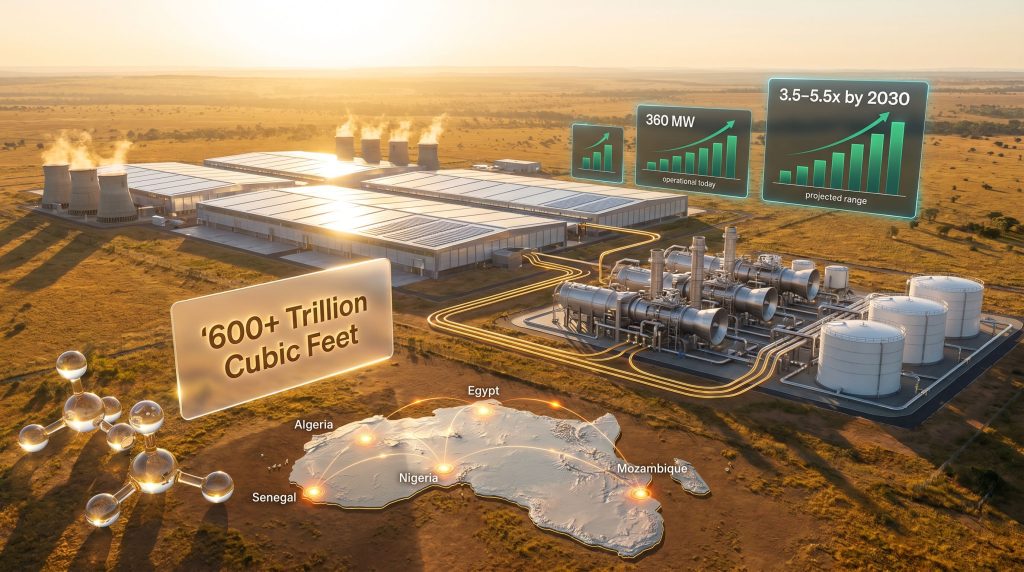
Africa holds over 600 trillion cubic feet of proven natural gas reserves, yet currently accounts for just 0.6% of global data center capacity despite representing nearly 20% of the world's population. That structural contradiction — resource abundance alongside digital scarcity — is no longer an academic footnote. It has become a strategic flashpoint as AI infrastructure investment accelerates globally and power reliability emerges as the decisive variable in where that investment lands.
When big ASX news breaks, our subscribers know first
Why AI's Power Demand Is Unlike Anything the Grid Has Faced Before
Global data centers already consume approximately 1.5% of total worldwide electricity, but the growth trajectory embedded in AI adoption transforms that figure from a manageable burden into an acute infrastructure challenge. AI-driven workloads are pushing electricity demand upward at roughly 12% annually, a pace that substantially outstrips broader grid expansion in virtually every market.
What makes AI infrastructure uniquely demanding is not just the volume of electricity it consumes, but the nature of how it must be delivered. Traditional industrial loads can tolerate fluctuations, scheduled downtime, and occasional supply interruptions. AI training and inference cycles cannot. These systems require:
- Continuous, uninterrupted power delivery at consistent voltage levels, 24 hours a day
- High power density concentrated at specific physical locations
- Instantaneous responsiveness to load changes without grid-level delays
- Long-term supply certainty to justify the capital intensity of facility construction
This technical profile creates what engineers and infrastructure planners refer to as a dispatchability requirement — the ability to call on generation capacity on demand rather than waiting for favourable weather or available storage capacity. Grid-connected solar and wind, for all their cost advantages, cannot yet satisfy this requirement at the scale AI infrastructure demands.
Natural gas-fired generation satisfies the dispatchability standard more effectively than any other currently scalable energy source. A gas turbine can be ramped up within minutes, sustain full output indefinitely, and respond to load fluctuations without degrading equipment or compromising power quality. For data center operators choosing between markets, this characteristic alone can determine site selection outcomes. Furthermore, the energy transition and security implications of this dynamic extend well beyond individual infrastructure decisions.
Africa's Reserve Endowment Meets Digital Infrastructure Demand
The scale of Africa's gas endowment relative to its current digital footprint is striking when examined in tabular form:
| Metric | Africa's Current Position |
|---|---|
| Proven natural gas reserves | 600+ trillion cubic feet |
| Share of global data center capacity | ~0.6% |
| Share of global population | ~20% |
| Currently operational data center capacity | ~360 MW |
| Total capacity (active + planned + pipeline) | ~1.2 GW |
| Annual digital power demand growth rate | 20–25% |
| Projected total power demand (near-term) | 8,000 GWh |
| Projected capacity expansion by 2030 | 3.5 to 5.5 times current levels |
| Estimated investment requirement by 2030 | $10–20 billion |
Source: World Oil / African Energy Chamber, May 2026
These figures reveal a market in the early stages of an exponential growth phase. With only 360 MW currently operational against a projected need that could reach five times that figure within five years, the gap between existing capacity and future demand represents both a significant infrastructure challenge and a substantial investment opportunity.
The investment gap between Africa's current data center capacity and its projected 2030 demand is not a sign of weakness. It is a signal of compressible growth, the kind of trajectory that characterises markets where latent demand is finally finding the infrastructure to express itself. (World Oil, May 2026)
The continent's data center market is growing at 20 to 25% annually, a rate that places it among the fastest-expanding digital infrastructure markets globally. Yet this growth is unfolding from a starting point so small that even sustained high rates of expansion will require coordinated capital deployment to translate into meaningful global market share. In addition, the critical minerals demand required to build supporting infrastructure further underscores the complexity of scaling these systems.
Country-Level Positioning: Who Holds the Strategic Advantage?
Africa's gas endowment is not uniformly distributed, and neither is the infrastructure readiness to convert that endowment into data center power supply. A tiered analysis reveals distinct categories of strategic positioning.
Established Producers with Scale Advantages
Nigeria commands more than 200 trillion cubic feet of proven reserves, making it the continent's most resource-rich gas nation by a substantial margin. The country has maintained an active gas monetisation strategy for years, creating institutional familiarity with gas-to-power development models. Its scale of reserves provides long runway for large domestic utilisation projects without compromising export commitments.
Algeria has operated as a major gas exporter for decades, with existing pipeline infrastructure reaching into Mediterranean markets. Its proximity to European digital corridors gives it a geographic advantage in serving cross-border data center demand, while its established production infrastructure reduces the capital intensity of domestic gas-to-power conversion.
Egypt occupies a strategically unique position at the convergence of African and Middle Eastern energy networks. With growing domestic consumption capacity and well-developed regulatory frameworks for energy investment, Egypt is well-placed to attract integrated gas-digital development projects that require both supply certainty and institutional stability.
Emerging Producers with First-Mover Potential
Mozambique represents perhaps the most compelling long-term opportunity on the continent. Its offshore LNG developments are projected to produce more than 13 million tonnes per year, positioning it among the world's significant LNG exporters. Critically, the country is still in early-stage development, meaning it retains the option to architect domestic supply frameworks that embed gas-to-power infrastructure within new industrial and digital zones from the outset.
Senegal and Mauritania are entering production phases with large-scale LNG projects at a moment when the global playbook for gas-powered digital infrastructure is being actively written. Nations that align domestic gas supply strategies with data center development at this early stage can avoid the structural inefficiencies that older producers must now work to correct.
The Global Template: How Developed Markets Are Already Running This Playbook
Africa's gas-to-data-center opportunity is not speculative. A directly transferable precedent is already being implemented at scale in the United States, where the economics and engineering of gas-powered AI infrastructure are being stress-tested and validated.
Key data points from the US market illustrate the scale of this shift:
- New gas-fired generation capacity in the global project pipeline surged by 31%, surpassing 1,000 GW in total planned development
- More than one-third of newly approved gas capacity in the United States is specifically targeting data center power supply
- A single gas generation project of 7.7 GW was approved in Texas in 2026 dedicated exclusively to private data center grid supply
- Natural gas currently represents approximately 43% of US nameplate electricity generation capacity, functioning as the reliability anchor for AI-driven demand
These figures describe a market that has already resolved the debate about whether natural gas belongs in an AI infrastructure strategy. The answer, in the world's largest AI market, is unambiguously yes. Gas is not being tolerated as a transitional compromise. It is being deployed at unprecedented scale as the foundational energy source for next-generation computing infrastructure. According to the IEA's analysis of energy supply for AI, this trajectory is expected to intensify significantly through the end of the decade.
Behind-the-Meter Deployment: The Model That Changes African Market Dynamics
A particularly relevant development for African markets is the growing adoption of behind-the-meter gas generation, where turbines are installed directly at data center sites rather than connecting to existing grid infrastructure. This model has several characteristics that make it especially applicable to African conditions:
- Grid independence: Eliminates reliance on transmission infrastructure that may be fragmented or unreliable
- Scalability: Generation capacity can be sized to match data center load profiles and expanded incrementally
- Speed to deployment: On-site generation can be operational faster than waiting for grid upgrades
- Power quality control: Operators maintain direct oversight of voltage stability and supply continuity
- Economic isolation: Project economics do not depend on broader grid pricing or availability dynamics
Engineering firms are developing flexible configurations combining gas turbines, reciprocating engines, and on-site storage systems to optimise load-following capability for data center demand profiles. Jet-engine-derived turbine architectures are gaining traction for their rapid-response generation characteristics and compact footprint — both valuable attributes in markets where land use and grid interconnection are constrained.
The infrastructure playbook being deployed in Texas and other high-demand US markets transfers directly to gas-rich African regions, with the additional advantage that African developers can integrate generation assets within greenfield data center campuses rather than adapting existing grid-connected systems. (World Oil, May 2026)
Natural Gas Versus Renewables: A Sequencing Problem, Not a Binary Choice
The energy source debate for African data centers is frequently framed as a choice between natural gas and renewables. This framing misrepresents the actual decision facing infrastructure planners. The realistic question is one of sequencing: which energy sources can reliably power data centers now, and which will be ready to do so at scale within a defined timeframe?
| Energy Source | Reliability for Data Centers | African Scalability | Deployment Timeline |
|---|---|---|---|
| Natural gas (gas-to-power) | High — fully dispatchable | High — abundant reserves | Near-term |
| Solar PV | Medium — intermittent | High — strong solar irradiance | Near-to-medium term |
| Wind | Medium — intermittent | Variable by region | Medium term |
| Geothermal | High — baseload | Limited to East Africa | Medium-to-long term |
| Hydropower | High — but drought-sensitive | Variable by geography | Long term |
East African nations, including Kenya, Ethiopia, and Uganda, operate electricity grids with renewable penetration in the 90 to 99% range, demonstrating that near-fully green baseload supply is achievable at a national scale on the continent. This precedent matters because it establishes that Africa's long-term renewable ambitions are technically credible, not aspirational fiction.
However, the reliability, regulatory frameworks, and transmission infrastructure required to power hyperscale data center loads from renewables alone remain underdeveloped across most African markets. Data center operators need power certainty now, and commitments to specific sites require supply guarantees that intermittent sources cannot currently provide. Consequently, renewable energy solutions are best positioned as a complementary layer rather than an immediate replacement.
Natural gas functions as the bridging mechanism, enabling immediate infrastructure deployment while parallel renewable buildout proceeds. This is not a philosophical concession to fossil fuels. It is a practical recognition of infrastructure timelines and the technical requirements of AI computing at scale.
The next major ASX story will hit our subscribers first
The Barriers That Stand Between Potential and Reality
The strategic case for Africa natural gas for AI data centers is compelling, but the obstacles to realising it are substantial and interconnected. Understanding these barriers is essential for evaluating where and how the opportunity materialises.
Infrastructure gaps beyond the wellhead represent the most fundamental constraint. Pipeline networks connecting gas production zones to population centres and industrial areas remain fragmented across most African markets. Power transmission infrastructure is insufficient to carry gas-generated electricity to the locations where digital infrastructure demand is concentrated. Without midstream and downstream investment running in parallel with upstream gas development, reserves remain commercially stranded relative to their domestic potential.
Regulatory and pricing constraints on domestic gas markets create a further layer of complexity. Domestic gas pricing frameworks in several African markets are structured to incentivise export rather than domestic consumption, reflecting decades of policy designed around revenue maximisation from international sales. Regulatory uncertainty around gas-to-power project approvals creates investment hesitancy among international data center operators evaluating African locations against markets with more predictable approval timelines.
Investment coordination failure is perhaps the most structurally challenging barrier. The $10 to $20 billion required to meet Africa's projected data center capacity needs by 2030 will not materialise through uncoordinated individual project financing. Multilateral development institutions, sovereign wealth funds, and private infrastructure investors must align around integrated gas-digital development corridors where shared infrastructure reduces per-project capital requirements and improves risk-adjusted returns for all participants.
A particularly insidious dynamic is what might be described as the chicken-and-egg dependency: data centers require power certainty before committing capital; power infrastructure requires anchor demand before attracting investment. Gas-to-power projects co-located with data center campuses break this circular dependency by providing both generation assets and a committed off-take arrangement simultaneously.
Beyond Energy: The Digital Industrialisation Argument
NJ Ayuk, Executive Chairman of the African Energy Chamber, has framed this convergence not merely as an energy infrastructure question but as an economic strategy, noting that aligning gas development with digital infrastructure creates a pathway to industrialisation, job creation, and positioning the continent as a meaningful participant in the global AI economy. (World Oil, May 2026)
This framing captures something important that pure energy analysis tends to miss. The economic multiplier effect of retaining gas value domestically — through power generation, employment in construction and operations, and the industrial anchoring effect of reliable electricity — substantially exceeds the marginal revenue from directing the same gas volumes toward export markets.
Data centers anchored by gas-to-power infrastructure create employment across construction, engineering, digital services, and operations sectors. Furthermore, the clean energy transition conversation must account for these economic realities when assessing the role of gas in African development strategies. Reliable generation assets built to serve computing campuses create positive spillover effects for surrounding communities and industries, stabilising local utility economics and improving electricity access in ways that export-oriented gas development simply does not.
The competitive window for establishing this position is defined by global AI infrastructure investment timelines. Investment decisions made in the next five to seven years will determine the geographic concentration of AI infrastructure for a generation. As Bloomberg's analysis of data center energy trends highlights, natural gas is increasingly central to these decisions globally. African nations that establish integrated gas-to-digital development frameworks in the near term will capture a disproportionate share of that investment wave.
The decarbonisation benefits of a phased transition approach — using gas now while scaling renewables in parallel — are considerable, provided that clear timelines and accountability mechanisms are embedded within development frameworks from the outset.
Frequently Asked Questions: Africa Natural Gas for AI Data Centers
Why is natural gas preferred over renewables for AI data centers in Africa?
Natural gas provides fully dispatchable, baseload electricity that can be generated on demand around the clock without dependence on weather or daylight. AI data centers require uninterrupted power at consistent voltage levels, a requirement that intermittent renewable sources cannot currently guarantee at scale across most African markets without substantial battery storage infrastructure that does not yet exist at the required scale.
Which African countries are best positioned to develop gas-powered AI data center hubs?
Nigeria, Egypt, and Algeria hold the most established reserve bases and gas infrastructure. Mozambique, Senegal, and Mauritania represent high-potential emerging producers with the opportunity to integrate domestic gas supply into new digital infrastructure development from the ground up rather than retrofitting export-oriented systems.
How large is Africa's current data center market?
Total installed data center capacity across Africa stands at approximately 1.2 GW across active, planned, and pipeline projects, with only around 360 MW currently operational. This represents roughly 0.6% of global capacity, a figure projected to grow 3.5 to 5.5 times by 2030.
What investment is required to meet Africa's projected data center demand?
Between $10 billion and $20 billion in capital investment is projected to be required to build the data center and supporting power infrastructure necessary to meet African digital demand by 2030, alongside parallel investment in gas-to-power generation assets and transmission networks.
Can Africa balance gas-powered data centers with its renewable energy commitments?
Yes. The most credible frameworks position natural gas as a transitional energy source that enables immediate data center deployment while renewable capacity scales in parallel. Several East African nations already operate near-fully renewable national grids, demonstrating that a long-term green energy transition is achievable on the continent.
Disclaimer: This article contains forward-looking projections and market forecasts sourced from industry publications. These projections involve assumptions and uncertainties and should not be interpreted as investment advice. Readers should conduct independent due diligence before making investment decisions based on information contained herein.
Want to Invest in the Commodities Driving Africa's Digital Infrastructure Revolution?
Discovery Alert's proprietary Discovery IQ model delivers real-time alerts on significant ASX mineral discoveries — including the critical minerals underpinning global AI infrastructure expansion — turning complex market data into actionable investment insights for both short-term traders and long-term investors. Explore Discovery Alert's dedicated discoveries page to understand how major mineral discoveries have historically generated substantial returns, and begin your 14-day free trial today to position yourself ahead of the market.