May 11, 2026
When Dormant Assets Wake Up: The Strategic Logic Behind European Re-Entry Into Post-Conflict Oil Markets
Post-conflict upstream re-entry is rarely a simple commercial decision. It sits at the intersection of geopolitical risk tolerance, technical rehabilitation economics, and the institutional memory of operators who walked away under duress rather than by choice. In Syria's case, the conditions that forced European energy companies out over a decade ago have shifted substantially, and the operators with pre-existing concession rights are now weighing a narrow but potentially significant re-entry window. INA restarting Syria oil and gas operations, through its parent MOL Group's broader strategic lens, represents one of the more consequential upstream re-engagement stories to emerge from the post-conflict Middle East in recent years.
Understanding what this re-entry actually involves, and what stands between ambition and production, requires looking well beyond the bilateral meetings and press statements. It demands a structured examination of technical, commercial, regulatory, and geopolitical variables that will ultimately determine whether dormant assets become productive again or remain frozen in assessment limbo.
When big ASX news breaks, our subscribers know first
The Geopolitical Unlock That Reshaped Syria's Investment Risk Profile
For much of the past decade, Syria represented one of the most uninvestable upstream environments on Earth. Sanctions regimes, active conflict, territorial fragmentation, and institutional collapse made any commercial calculation essentially meaningless. The variables that matter most to international upstream operators, including contract enforceability, workforce security, export route access, and cross-border capital movement, were either absent or severely compromised.
The political transition that followed the collapse of Bashar al-Assad's government created a fundamentally different risk calculus. Consequently, sanctions and oil policy shifts from both the United States and European Union opened pathways for foreign capital re-engagement. Syria's reintegration into global financial infrastructure, including the resumption of SWIFT connectivity in mid-2025, removed one of the most practical barriers to cross-border energy transactions. For operators with suspended but legally intact concession rights, this combination of changes transformed a theoretical opportunity into an operationally explorable one.
The 2025 to 2026 window is being watched closely by energy analysts precisely because pre-existing concession holders face a time-sensitive advantage. Their rights survived suspension, but the competitive landscape is evolving quickly, and new entrants are actively pursuing fresh awards that could erode first-mover positioning.
INA's Syrian Legacy: A $1.1 Billion Foundation for Re-Entry
To understand why INA restarting Syria oil and gas operations carries strategic weight inside MOL Group, it helps to appreciate the scale of what existed before 2012. INA's Syrian operations were not peripheral assets. They were a core component of MOL Group's international upstream portfolio, and the numbers reflect that.
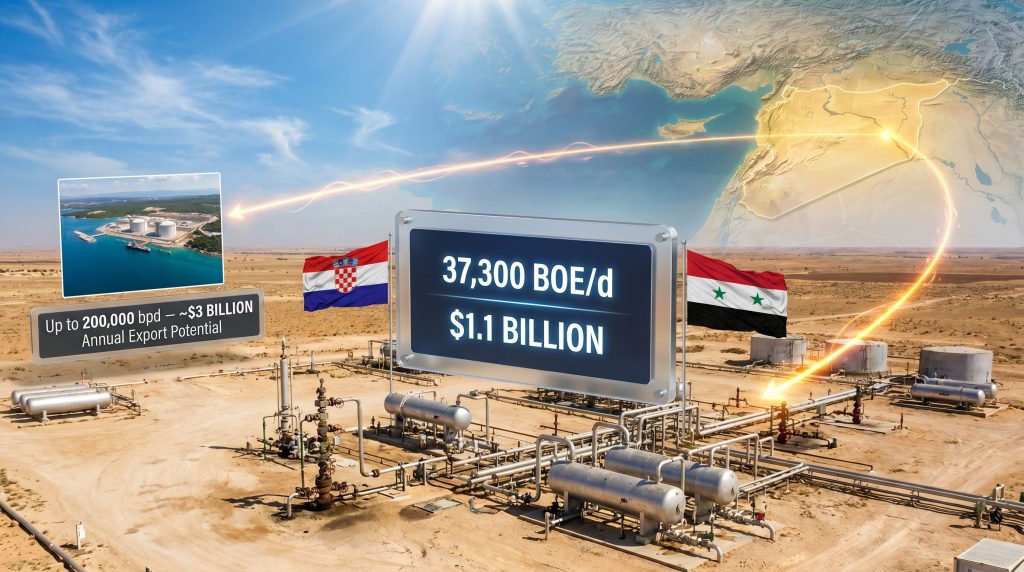
At peak output in 2011, INA's Syrian concessions delivered 37,300 barrels of oil equivalent per day through its 50:50 joint venture with Syria's General Petroleum Company on the Hayan block. According to MOL Group's press release, that production profile included:
- 125 million cubic feet per day of sales gas output
- 6,000 barrels per day of condensate production
- 2,100 barrels per day of LPG volumes
- A gas potential ceiling on the Hayan block estimated at 130 mmcfd
The total capital deployed across exploration, development, and production infrastructure prior to the 2012 suspension reached approximately $1.1 billion. This figure matters not just as a historical accounting entry, but as the economic anchor for any re-entry decision.
Sunk costs in upstream oil and gas are typically irrelevant to future investment decisions. But in the context of a concession re-entry, they define the negotiating dynamic. INA's $1.1 billion historical commitment provides leverage in discussions with Syria's counterpart organisations and frames the basis on which rehabilitation economics must be assessed.
When EU sanctions were imposed in 2012, INA's exit was regulatory rather than commercial in motivation. The concession rights were not formally terminated, which preserved INA's legal standing. That preservation of contractual position over a 14-year dormancy period is, in itself, a commercially significant achievement that distinguishes INA from operators who would need to pursue entirely new licensing processes.
The Four-Condition Framework Governing Any Restart Decision
INA Management Board President Zsuzsanna Ortutay has been direct in public statements about what stands between the current assessment phase and an actual production restart. Her position, confirmed through bilateral meetings held in both Budapest and Zagreb in May 2026, is that four distinct condition categories must be resolved simultaneously before any operational restart can proceed.
These conditions are not sequential checkboxes. They operate in parallel, and a failure to clear any single category is sufficient to block or indefinitely delay re-entry:
-
Operational conditions: Physical asset integrity verification, workforce mobilisation planning, and supply chain re-establishment for a concession inactive since 2012
-
Technical conditions: Wellbore integrity assessment after 14 years of inactivity, reservoir pressure evaluation, surface facility rehabilitation requirements, and pipeline condition surveys
-
Commercial conditions: Concession contract renegotiation under Syria's new governing framework, revenue-sharing structures with the Syrian Petroleum Company, and cost recovery mechanism design
-
Regulatory conditions: Alignment with Syria's post-transition domestic legal framework for foreign upstream operators, combined with ongoing EU and US sanctions compliance requirements that INA and MOL must maintain even as restrictions are progressively eased
The joint technical team formed between INA and the Syrian Petroleum Company in early 2025 is specifically focused on progressing the operational and technical dimensions of this framework. The team's mandate covers infrastructure condition surveys, field status reviews, and safety assessments, with the goal of developing a structured roadmap for potential future cooperation.
MOL Group Executive Vice President for Exploration and Production Zsombor Marton has emphasised Syria's historical significance within the group's international E&P portfolio, contextualising the re-entry effort as a return to a previously material asset base rather than a speculative new venture. This framing is important because it signals internal organisational commitment at the group level, not merely a subsidiary-level exploration of options.
The LNG Terminal Visit: Reading the Broader Energy Signal
One element of the bilateral engagement that deserves more analytical attention than it typically receives is the Syrian delegation's visit to Croatia's LNG terminal on Krk Island. The inclusion of this visit in the bilateral program is not incidental. It reflects something more strategically layered than a standard site tour.
The Krk Island LNG terminal represents Croatia's primary gateway for liquefied natural gas imports from global markets, and it sits within a broader energy geopolitics framework that has accelerated significantly since 2022. By including this infrastructure in the diplomatic agenda, the Syrian delegation and INA/MOL were implicitly exploring a dual-role positioning: INA and MOL as upstream production partners in Syria and as downstream energy infrastructure connectors into European supply chains.
The Krk Island LNG terminal visit signals that the conversations between INA, MOL, and Syrian counterparts extend beyond production restart logistics. They encompass Syria's potential role as a gas supply contributor to Eastern Mediterranean and European markets, with MOL's Croatian infrastructure serving as a potential downstream anchor.
This matters because it elevates the strategic value of INA's re-entry from a bilateral asset reactivation story into a regional energy supply narrative. For Syria's new governing authorities, attracting a partner with downstream European infrastructure connectivity is meaningfully more valuable than attracting an operator focused purely on upstream extraction.
Syria's Upstream Recovery: Scenario Pathways and Honest Uncertainties
Any credible assessment of INA restarting Syria oil and gas operations must be embedded within a broader understanding of Syria's upstream recovery trajectory. Three broad pathways are analytically plausible, though each carries material uncertainty:
| Scenario | Key Conditions | INA Restart Timeline | Primary Risk |
|---|---|---|---|
| Accelerated Recovery | Sustained political stability, rapid regulatory framework, broad FDI | 12 to 18 months | Political fragmentation reversal |
| Gradual Re-Entry | Partial regulatory clarity, selective operator engagement | 2026 to 2027 | Concession renegotiation delays |
| Prolonged Stagnation | Regulatory vacuum, territorial disputes, sanctions risk | Post-2027 | Geopolitical destabilisation |
The base case for most analysts familiar with post-conflict upstream markets leans toward the gradual re-entry scenario. Syria's eastern fields in Deir ez-Zor and Al-Hasakah hold the bulk of the country's remaining producible reserves, but those regions have been subject to territorial complexity involving Kurdish Syrian Democratic Forces and central government authority transitions. The fragility of ceasefire arrangements in those areas represents a persistent operational risk.
Infrastructure deterioration compounds the technical challenge. After 14 years of minimal maintenance, conflict damage, and natural reservoir pressure decline, the rehabilitation capital requirements for restarting dormant Syrian fields are likely to be substantial. Furthermore, the joint technical team's field status review will be the critical input for determining whether rehabilitation economics cross the commercial viability threshold at current crude pricing.
However, oil price volatility adds another layer of complexity to the investment calculus, as the commercial viability of any rehabilitation programme depends heavily on prevailing market conditions at the point of capital commitment. It is worth noting, as a matter of analytical discipline, that production potential figures cited in various industry discussions are forward-looking assumptions dependent on capital deployment, political stability, reservoir performance, and pricing conditions that cannot be reliably forecast at this stage.
The next major ASX story will hit our subscribers first
The Competitive Landscape: Who Else Is Pursuing Syrian Concessions?
INA's pre-existing concession rights create a structural advantage, but the broader competitive environment for Syrian upstream access is developing quickly. Several international operators have been exploring re-entry or new entry positions:
- Dana Gas has been engaged in discussions around gas sector re-entry opportunities
- ConocoPhillips has had exploratory engagement with Syrian authorities regarding upstream positioning
- Novaterra has pursued memoranda of understanding covering specific gas and oil concession areas
- Saudi technical service providers, including TAQA and ADES, have been positioning for service and technical support roles rather than direct equity upstream investment
- Russian and Chinese operators maintain legacy interest through prior contractual histories, though the geopolitical complexity of re-engagement in a post-transition Syria complicates their positioning
The distinction between operators pursuing pre-existing concession reactivation and those seeking new concession awards is commercially significant. New entrants face the full licensing process under an evolving and not yet fully established regulatory framework. Operators with preserved concession rights, like INA, have a contractual starting point that reduces licensing risk but introduces a different complexity: renegotiating the terms of those existing rights with a new governing authority that may have different commercial expectations than its predecessor.
Technical and Geological Considerations for the Hayan Block
The Hayan block's technical profile warrants specific attention for readers seeking to understand the production restart economics. The block's gas potential, estimated at 130 mmcfd ceiling capacity, positions it primarily as a gas and associated liquids asset rather than a crude oil-dominant concession. The sales gas production of 125 mmcfd achieved prior to the 2012 suspension suggests the field was operating at near-peak gas extraction rates at the time of suspension.
Fourteen years of inactivity creates specific geological and mechanical challenges that differ from those encountered in simply ramping down and restarting a well in normal operational circumstances:
- Reservoir pressure dynamics: Extended periods without production or injection activity alter reservoir pressure distribution. Understanding whether pressure has partially recovered or declined further requires new pressure transient analysis and reservoir modelling
- Wellbore integrity: Casings, cement bonds, and completion equipment deteriorate over extended dormancy periods, particularly in environments with temperature cycling and H2S exposure common in Middle Eastern gas fields
- Surface facility condition: Processing equipment, compression systems, and separation trains require systematic inspection and likely substantial rehabilitation or replacement after 14 years without operational maintenance
- Pipeline infrastructure: Export pipelines and gathering systems connecting wellheads to processing facilities are particularly vulnerable to corrosion and mechanical degradation during extended non-operational periods
The joint technical team's infrastructure and field status review is therefore not a formality. It is a substantive engineering exercise that will generate the data needed to construct a realistic rehabilitation capital estimate and, by extension, determine whether the asset economics justify the investment commitment.
Syria's Energy Recovery and Its Broader Regional Significance
Syria's geographic position gives its energy sector a strategic dimension that extends beyond domestic production economics. The country sits at the intersection of potential pipeline corridors connecting Middle Eastern gas producers to Eastern Mediterranean markets and, through those markets, to European supply infrastructure. In addition, geopolitical oil market risks specific to the region mean that for European operators with downstream assets, Syria's upstream recovery has a supply security dimension that augments the direct investment return calculation.
This dynamic is not unique to Syria. Post-conflict upstream recovery markets have historically attracted European operator interest disproportionate to what pure financial return modelling would justify, because they serve dual purposes: generating upstream production economics and securing long-term supply chain positioning. Libya post-2011 and Iraq post-2003 both attracted European operator re-entry that was partly driven by supply security motivations rather than purely financial ones.
The signal value of INA restarting Syria oil and gas operations extends to the broader investor community watching Syria's reconstruction trajectory. A credible European upstream operator conducting structured technical assessments with Syria's national oil company counterpart provides a reference point for other potential investors evaluating Syrian energy sector risk. It does not guarantee a positive investment environment, but it reduces the informational uncertainty that keeps capital on the sidelines of post-conflict markets. Moreover, trade war oil impacts on global energy pricing add further complexity to the broader investment environment within which these decisions are being made.
Key Risks That Investors and Analysts Must Weigh
No assessment of this re-entry process would be complete without an honest enumeration of the risks that could prevent or significantly delay a production restart:
- Regulatory vacuum risk: Syria's post-transition legal framework for foreign upstream operators is not yet fully established. The absence of clear, enforceable rules for concession rights, cost recovery, and revenue sharing creates material investment uncertainty
- Territorial control risk: Eastern field regions remain subject to governance complexity, and changes in territorial control arrangements could directly affect operational access to producing fields
- Sanctions compliance complexity: Even with progressive easing of EU and US sanctions, INA and MOL must maintain compliance frameworks that add transaction costs and operational constraints to any restart scenario
- Rehabilitation capital risk: If technical assessments reveal more extensive infrastructure damage than initially projected, the capital requirement for restart could exceed commercially justifiable thresholds at current pricing
- Political stability risk: Syria's transition government faces internal challenges that could affect the consistency and enforceability of energy sector policy over the multi-year horizon needed for investment recovery
Important Disclaimer: This article contains forward-looking analysis, scenario projections, and assessments of commercial potential that are inherently speculative. Readers should not interpret any production estimates, revenue projections, or timeline assessments as investment advice or as verified forecasts. All such projections are subject to material uncertainty and should be evaluated alongside independent financial and geopolitical analysis.
Frequently Asked Questions: INA Restarting Syria Oil and Gas Operations
What is INA's operational history in Syria?
INA operated the Hayan block concession in Syria through a 50:50 joint venture with Syria's General Petroleum Company. Peak output reached 37,300 BOE/d in 2011, including 125 mmcfd of sales gas, 6,000 barrels per day of condensate, and 2,100 barrels per day of LPG, before EU sanctions triggered a full operational suspension in 2012.
Why did INA suspend Syrian operations in 2012?
The suspension was driven entirely by the imposition of EU sanctions related to the Syrian civil war. The decision was regulatory in nature rather than commercially motivated, and critically, it preserved INA's concession rights without formal contract termination.
What triggered the re-entry assessment process?
Political transition in Syria following the collapse of the Assad government, combined with progressive US and EU sanctions relief and Syria's reintegration into global financial infrastructure including SWIFT resumption in mid-2025, created the conditions for INA and MOL Group to re-engage with the Syrian Petroleum Company.
What must happen before a production restart can proceed?
INA and MOL have identified four condition categories requiring simultaneous resolution: operational readiness, technical feasibility through infrastructure and reservoir assessment, commercial terms including concession renegotiation and revenue sharing, and full regulatory compliance under both Syrian domestic law and ongoing EU and US sanctions frameworks.
How much did INA invest in Syria prior to the suspension?
INA invested approximately $1.1 billion in its Syrian concessions before the 2012 suspension, representing a substantial sunk cost that underpins the commercial logic of pursuing reactivation rather than writing the asset off entirely.
What is the significance of the Krk Island LNG terminal visit?
The inclusion of Croatia's Krk Island LNG terminal in the bilateral engagement program signals that discussions encompass Syria's potential role as a gas supply contributor to Eastern Mediterranean and European markets, positioning INA and MOL as potential dual-role partners: upstream producers and downstream energy infrastructure connectors.
Who else is exploring Syrian upstream opportunities?
Several international operators including Dana Gas, ConocoPhillips, and Novaterra through MoUs, alongside Saudi technical service providers such as TAQA and ADES, are exploring various forms of engagement with Syria's energy sector. Russian and Chinese operators also maintain legacy interests, though their re-engagement is complicated by the new geopolitical configuration.
What the INA-Syria Engagement Actually Signals
Stepping back from the specific metrics and condition frameworks, the INA and MOL Group engagement with Syria's Petroleum Company represents something worth watching carefully: the methodical, structured re-approach of a European upstream operator to an asset base it has never legally relinquished.
The bilateral meetings in Budapest and Zagreb, the formation of a joint technical team, and the inclusion of LNG infrastructure in diplomatic discussions collectively indicate a level of institutional seriousness that goes beyond exploratory positioning. This is not a speculative land grab by a new entrant. It is a deliberate, conditions-based re-engagement process by an operator with $1.1 billion of historical investment, preserved legal rights, and a parent company with the financial capacity to fund rehabilitation if the technical and commercial conditions justify it.
Whether INA restarting Syria oil and gas operations ultimately succeeds within a near-term horizon or extends through a multi-year assessment process will depend on variables that no amount of bilateral goodwill can fully control. Syria's political stabilisation, regulatory framework development, and eastern field security situation will be the ultimate determinants. What INA and MOL are doing now is building the informational and relational foundation needed to act decisively when those external variables align.
For the broader energy sector, that approach represents a reasonable model for how experienced operators navigate post-conflict upstream re-entry: systematically, conditionally, and with clear-eyed acknowledgment that good intentions and historical rights are necessary but not sufficient conditions for a successful restart.
Want to Stay Ahead of the Next Major Resource Discovery Before the Broader Market Catches On?
Discovery Alert's proprietary Discovery IQ model delivers real-time alerts on significant ASX mineral discoveries, translating complex geological and commodity data into clear, actionable investment insights — the same analytical edge that has historically positioned subscribers ahead of transformative finds like those made by De Grey Mining and WA1 Resources. Start your 14-day free trial today, or explore Discovery Alert's dedicated discoveries page to understand why major mineral discoveries have the potential to generate substantial market returns.