June 11, 2026
The Hidden Data Problem That Has Kept Africa's Critical Metals Undiscovered
For decades, the fundamental challenge in mineral exploration has not been geological potential. It has been the inability to interrogate vast, fragmented, and siloed datasets fast enough to make meaningful decisions before capital moves elsewhere. Across Africa, the problem is especially acute. The Eramet Lithosquare BRGM AI African critical metals exploration initiative is designed precisely to address this structural inefficiency. Governments and colonial-era geological agencies produced enormous volumes of survey data during the 20th century, but much of this material remained buried in archives, incompatible across systems, and inaccessible to the private sector exploration companies that needed it most.
This is the structural inefficiency that the partnership between Eramet, Lithosquare, and BRGM is designed to dismantle. By combining one of the world's most significant producers of manganese ore with France's national geological survey authority and a specialist AI exploration technology firm, the three-way framework targets the very bottleneck that has prevented Africa from fully monetising its geological endowment. The implications reach far beyond any single deposit discovery.
When big ASX news breaks, our subscribers know first
Why Africa's Mineral Wealth Has Been Systematically Undervalued
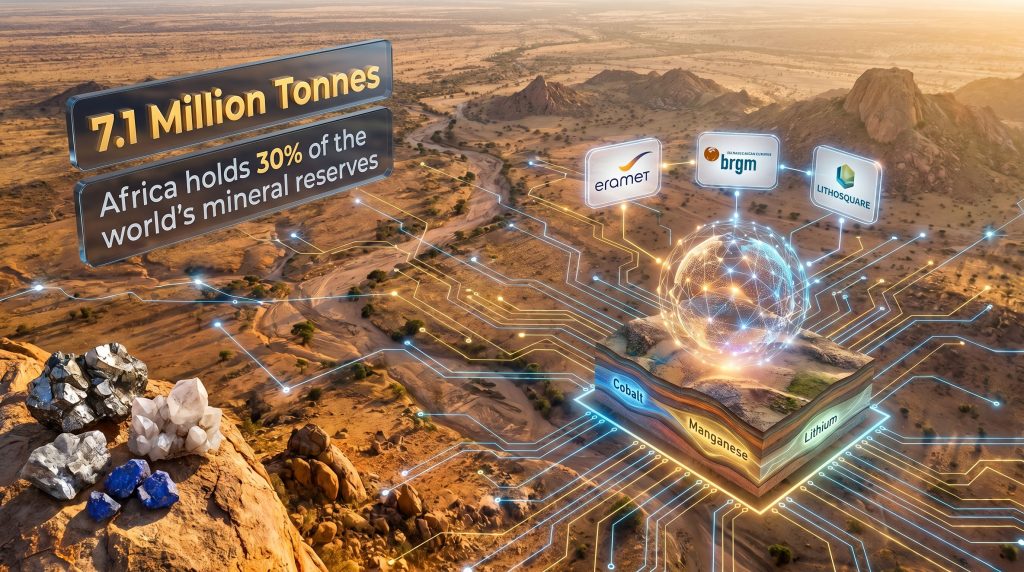
Africa is estimated to hold approximately 30% of the world's mineral reserves, a figure that consistently surprises investors who associate the continent with operational risk rather than geological opportunity. The Democratic Republic of Congo contains the majority of the world's known cobalt reserves. Gabon and South Africa together account for a dominant share of global manganese production. Emerging lithium provinces are being traced across Zimbabwe, Namibia, and Mali. And yet, relative to its geological endowment, Africa remains one of the most underexplored regions on earth.
The reasons are partly infrastructural, partly political, and partly methodological. Exploration in remote African terrain is expensive. Logistics are challenging. Historical survey data is inconsistent in quality, format, and accessibility. However, there is a deeper issue that is less frequently discussed: the exploration industry's traditional workflow was never designed to synthesise information at the scale that Africa's geological complexity demands.
Exploration geologists working in frontier African regions often describe the experience of knowing that mineralisation is statistically probable within a given geological domain, while lacking the computational tools to systematically narrow down where to look first. The result is an exploration process driven as much by heuristics and professional intuition as by data-driven probability.
This is where AI-assisted targeting changes the fundamental calculus of exploration investment. Furthermore, AI in mineral exploration is increasingly demonstrating its capacity to compress timelines and reduce capital waste across frontier geographies.
Breaking Down the Eramet, Lithosquare and BRGM AI Partnership
The framework announced between Eramet, Lithosquare, and BRGM for AI-driven African critical metals exploration is structured around complementary institutional capabilities that would be difficult for any single organisation to replicate independently.
| Partner | Institutional Type | Core Contribution to Partnership |
|---|---|---|
| Eramet | Multinational mining group | Operational infrastructure, African presence, commercial execution |
| BRGM | French national geological survey | Decades of archived African survey data, geoscientific credibility |
| Lithosquare | AI technology specialist | Proprietary machine learning platform for predictive mineral targeting |
Each partner addresses a gap that the others cannot fill. Eramet brings 7.1 million tonnes of manganese ore and agglomerates produced in 2025, along with established operational relationships across the African continent. BRGM contributes what may be the most strategically valuable asset in the entire partnership: an institutional archive of geological survey data accumulated through decades of publicly funded fieldwork across francophone Africa.
Lithosquare provides the computational engine that converts this raw data into actionable exploration targets. According to Lithosquare's seed funding announcement, the company raised $25 million to deploy its geology AI platform, reflecting strong investor confidence in the approach.
Critically, this was not a cold commercial agreement. Before formalising the three-way framework, Eramet and Lithosquare had already executed a joint exploration programme specifically designed to test whether AI-assisted targeting could produce operationally valid results. The outcomes of that prior programme provided sufficient confidence in the methodology to justify scaling up to a broader framework agreement. This validation step is significant for evaluating the technical credibility of the initiative.
How AI-Driven Mineral Targeting Works in Practice
Stage One: Data Aggregation and Harmonisation
The first and arguably most labour-intensive phase involves ingesting heterogeneous datasets into a unified analytical environment. This includes legacy drilling records, geochemical sample databases, historical geophysical surveys, satellite remote sensing data, and structural geological maps. BRGM's archives represent a particularly rich input layer, providing historical datasets from state-sponsored programmes that private exploration firms have never been able to access or afford to replicate.
Stage Two: Pattern Recognition Across Multiple Data Layers
Lithosquare's machine learning models are trained on known mineralisation signatures associated with target critical metal deposit types. The system identifies structural patterns, geochemical anomalies, and lithological associations across multiple data layers simultaneously. A task that might require a team of senior geologists twelve to eighteen months to complete manually can be compressed into weeks, without sacrificing analytical rigour.
Stage Three: Ranked Target Generation
The AI outputs a probability-weighted list of exploration targets, ranked by statistical likelihood of mineralisation within the relevant geological context. Importantly, these outputs are not treated as conclusive. They are reviewed and interrogated by experienced geoscientists who apply professional judgement to evaluate whether the AI's pattern recognition aligns with geological plausibility.
Stage Four: Field Validation and Model Refinement
Ground-truthing campaigns test the AI-generated targets against physical geology. Results from field programmes are fed back into the model, improving its predictive accuracy over successive iterations. This feedback loop is the mechanism through which the system becomes progressively more effective at distinguishing genuine mineralisation indicators from noise in the data.
The human-in-the-loop design is not a concession to technological limitation. It is a deliberate architectural choice that prevents the AI from generating confident-sounding but geologically implausible targets, which is a failure mode observed in early-generation automated exploration systems that lacked robust expert oversight.
The BRGM Data Advantage: Understanding Why Institutional Archives Matter
One aspect of this partnership that tends to be underappreciated by observers focused on the AI technology itself is the strategic value of BRGM's data contribution. The Bureau de Recherches Géologiques et Minières has been conducting geological surveys across francophone Africa since the mid-20th century. Many of these programmes were executed during periods when systematic geological mapping was a priority for French development policy, resulting in fieldwork that covered enormous areas in considerable scientific detail.
This data exists nowhere else in usable form. Private exploration companies cannot reconstruct it from satellite imagery or modern geophysical surveys without spending orders of magnitude more capital than the original surveys cost to produce. For Lithosquare's AI models, access to this archive substantially increases both the volume and the geographical coverage of the training dataset, which in turn improves the reliability of predictive outputs across African target regions.
The competitive moat created by this data access is worth examining carefully. In AI-assisted exploration, the quality and completeness of the historical dataset is the primary determinant of model performance. A technologically superior AI platform trained on inferior data will consistently underperform a less sophisticated model trained on rich, comprehensive historical inputs. BRGM's archive effectively gives the partnership a data advantage that purely commercial exploration programmes are structurally unable to replicate. Eramet's official press releases confirm that this data-sharing arrangement is central to the commercial rationale of the framework.
Eramet's Strategic Position and Why Exploration Expansion Is Essential
Understanding Eramet's motivation for entering this partnership requires an appreciation of the company's existing operational profile and its long-term resource planning challenges. As one of the world's leading manganese producers, with 7.1 million tonnes of manganese ore and agglomerates produced in 2025, Eramet occupies a position of significant market influence in a commodity that is essential for both steelmaking and, increasingly, battery chemistries being evaluated for energy storage applications.
Manganese's role in battery technology is one of the less widely understood dynamics in the critical metals space. High-manganese cathode chemistries, including lithium manganese iron phosphate (LMFP) formulations, are gaining traction as battery manufacturers seek to reduce dependence on cobalt and nickel. This shift could substantially expand the addressable market for high-purity manganese beyond its traditional steelmaking applications. Consequently, this creates a demand profile that makes long-term resource replenishment a strategic priority rather than merely a routine operational concern.
Against this backdrop, the Eramet Lithosquare BRGM AI African critical metals exploration partnership is not simply about finding new mines. It is about rebuilding the exploration pipeline at a pace that can keep up with demand trajectories that were not envisaged when existing reserves were first classified. In addition, the growing demand for critical minerals driven by the energy transition makes this pipeline acceleration a matter of genuine urgency.
The next major ASX story will hit our subscribers first
What Conventional Exploration Cannot Deliver at Scale
To appreciate the significance of the initiative for African critical metals, it is worth quantifying the limitations of the traditional exploration workflow it is designed to improve upon.
| Capability Dimension | Traditional Exploration | AI-Assisted Exploration |
|---|---|---|
| Target generation timeline | Months to years | Weeks to months |
| Data integration capacity | Constrained by human bandwidth | Near-unlimited via machine learning |
| Historical data utilisation | Selective, based on analyst familiarity | Systematic and comprehensive |
| Cost per validated target | High | Potentially significantly lower |
| Scalability across geographies | Limited by expert availability | High, given sufficient data |
| Field validation requirement | Essential | Essential (unchanged) |
A critical factor not visible in this comparison is the declining discovery grade problem. Across virtually every major critical metal category, the average grade of newly discovered deposits has been falling for decades as the most geologically accessible, highest-grade occurrences are progressively depleted. This means that each dollar spent on exploration is, on average, discovering less economic metal than the same dollar spent two or three decades ago.
AI-assisted targeting cannot reverse the geological reality of grade decline, but it can improve the probability that limited exploration capital is directed at the most prospective targets rather than wasted on low-probability terrain. Furthermore, drilling programmes that follow AI-generated targets are increasingly demonstrating superior hit rates compared with those derived from conventional targeting methods.
Geographic Priorities and the Geopolitics of African Critical Metals
The framework's initial deployments are focused on Africa, with provisions for expansion to other continents as the methodology is validated at scale. This geographic sequencing reflects both geological logic and commercial pragmatism.
Africa's endowment in the specific metals that matter most to the energy transition is without parallel. Beyond cobalt and manganese, the continent hosts significant rare earth element occurrences, graphite deposits being actively developed for anode applications, and emerging nickel sulphide discoveries in underexplored eastern African terranes. The breadth of potential target commodities means that an AI platform calibrated on African geology has access to a very large number of potential discovery opportunities.
The geopolitical dimension adds another layer of complexity and urgency. Several African governments have moved to reassert control over their mineral sectors in recent years, renegotiating legacy agreements and in some cases nationalising assets. For Western mining companies operating in this environment, the ability to identify and develop new deposits quickly through AI-accelerated exploration represents a meaningful competitive advantage.
Projects that move from target generation to resource definition faster present lower political risk exposure, simply because they spend less time in the vulnerable early-stage window where regulatory or political changes can derail years of investment.
Risk Factors That Investors and Industry Observers Should Not Overlook
No assessment of AI-assisted mineral exploration would be complete without an honest accounting of its limitations. Several risk factors deserve specific attention:
- Data quality dependency: AI models can only be as reliable as the historical datasets used to train them. Where BRGM's archives contain gaps, inconsistencies, or methodological biases from legacy survey techniques, the AI outputs in those areas will be correspondingly less reliable.
- Geological complexity: Some critical metal deposit types are hosted in structurally complex settings where remote-sensing and geochemical signatures are ambiguous. AI pattern recognition performs best in geological environments where mineralisation signatures are well-defined and consistent.
- The validation bottleneck: Even dramatically faster target generation does not eliminate the need for physical field validation. Drilling programmes, permitting, community engagement, and environmental assessment remain sequential constraints that no algorithm can compress beyond certain limits.
- Model overfitting risk: AI systems trained heavily on known deposit types may systematically underweight unconventional geological settings that could host novel deposit configurations not well-represented in historical training data.
- Speculative note: It is worth acknowledging that AI exploration methodology is still accumulating a public track record. The long-term hit rate of AI-generated targets relative to conventional exploration approaches remains an area of active industry evaluation. Early results from multiple programmes have been encouraging, but the full validation of this approach at commercial scale is ongoing.
Readers should note that forward-looking assessments of exploration technology performance involve inherent uncertainty. Past performance of AI-assisted targeting in specific programmes does not guarantee equivalent outcomes in new geological settings or jurisdictions.
A New Architecture for Critical Mineral Discovery
The Eramet Lithosquare BRGM AI African critical metals exploration framework represents something more significant than a single corporate announcement. It is an early institutional articulation of what the next generation of mineral exploration may look like: tripartite structures where state geological agencies contribute data depth, technology firms contribute analytical capability, and mining operators contribute commercial execution and risk capital.
This architecture is already beginning to emerge in other jurisdictions. National geological surveys in Canada, Australia, and Scandinavia have initiated dialogue with AI exploration technology providers about data-sharing frameworks. The structural logic is identical regardless of geography: publicly funded geological data, accumulated over generations of systematic survey work, represents a latent asset whose value can only be unlocked by the analytical capacity to interrogate it at scale.
For the critical metals sector specifically, the urgency of accelerating the exploration pipeline is not a matter of commercial preference. Structural supply shortfalls in several battery metals within the coming two decades, if exploration investment remains at current levels, are a widely discussed scenario in specialist commodity research. The global cobalt mining industry, for instance, faces precisely this kind of long-term supply pressure that AI-assisted frameworks are being designed to help address.
What is not in question is that the traditional exploration model, with its dependence on sequential, expensive, and data-limited fieldwork programmes, is no longer adequate for the pace of discovery that global energy transition demand requires. The question is not whether AI will reshape mineral exploration. It is which institutions and partnerships will execute it most effectively.
Want to Know Which ASX Mineral Discoveries Could Deliver Exceptional Returns?
As AI accelerates the identification of critical metal deposits across frontier geographies, Discovery Alert's proprietary Discovery IQ model ensures subscribers receive real-time alerts the moment significant ASX mineral discoveries are announced — turning complex geological data into actionable investment opportunities. Explore historic discovery returns on Discovery Alert's dedicated discoveries page and begin your 14-day free trial to position yourself ahead of the broader market.