June 11, 2026
Northern Ontario's Workforce Crossroads: Why Mining Education Has Never Mattered More
Across the global mining industry, a structural tension has been building for years. The accelerating demand for critical minerals needed in batteries, clean energy systems, and advanced electronics is colliding with a workforce pipeline that was never designed to handle this scale or pace of technological change. In Canada, this tension is most acutely felt in northern Ontario, a region that sits atop some of the continent's most significant mineral endowments yet faces compounding pressures from an aging workforce, evolving operational technologies, and educational programs that have struggled to keep pace with industry expectations.
It is within this context that the Haileybury School of Mines revitalization carries significance well beyond the borders of Temiskaming Shores. What is unfolding at this century-old institution represents a deliberate attempt to rebuild the foundational layer of Canada's mining talent pipeline at precisely the moment when that pipeline is under the greatest strain.
When big ASX news breaks, our subscribers know first
A Century of History, Then a Slow Decline
The Haileybury School of Mines was established in 1912 in direct response to the labour demands generated by the Cobalt silver boom in northern Ontario. That regional silver rush was itself remarkable in scale: the Cobalt district produced hundreds of millions of ounces of silver during its peak years, transforming a remote corner of Ontario into one of the most productive mining districts on earth. HSM was built to supply the skilled workers that this industry desperately needed, and it succeeded.
Over more than a century of operation, the institution trained in excess of 2,000 graduates, many of whom went on to careers not just in northern Ontario but across the global mining industry. When HSM merged with Northern College in 1970, becoming a mining-focused division rather than an independent school, it retained its identity and continued producing technically capable graduates.
The decline that followed was gradual rather than sudden. As cost pressures mounted, the program shifted increasingly toward online delivery. Physical mining laboratories were progressively decommissioned. Enrolment in the Mining Engineering Technology program fell sharply as the program's practical relevance weakened. The gap between what HSM was teaching and what modern mining operations actually required widened with each passing year, and the student numbers reflected that disconnect.
| Milestone | Year | Significance |
|---|---|---|
| Institution founded | 1912 | Direct response to Cobalt silver mining boom |
| Merger with Northern College | 1970 | Became a mining-focused division |
| Laboratory decommissioning | Post-1970s | Shift toward online learning; enrolment decline |
| Industry consultation workshop | October 2025 | Curriculum redesign process formally launched |
| Equipment donation (Endress+Hauser) | November 2025 | Over $91,000 in automation and control equipment |
| Revitalized program launch | September 2026 | New competency-based curriculum goes live |
What the Revitalization Actually Involves
The HSM revitalization is not a cosmetic rebranding. It is a ground-up reconstruction of what the institution teaches, how it teaches it, and what physical infrastructure supports that learning.
The October 2025 Curriculum Workshop: Industry Co-Designing the Program
In October 2025, approximately 25 participants gathered at Northern College's Timmins campus for a formal curriculum development workshop. The group included industry experts, external consultants, and HSM alumni, all brought together with the specific purpose of shaping a redesigned, competency-based curriculum for the Mining Engineering Technology program.
The session was facilitated by Jamie Johnston, Dean of Trades, Technology, Apprenticeship and Mining at Northern College. Johnston made clear that the objective was not simply to update existing content but to rebuild the program around the actual demands of modern mining operations. In Johnston's own words, as reported by CIM Magazine, the team aimed to modernise the curriculum and exceed industry standards with what the program would offer.
The single most consistent recommendation from industry participants was direct and unambiguous: dramatically increase the proportion of hands-on and experiential learning. This feedback shaped the structural decisions that followed. Furthermore, current mineral exploration trends indicate that the industry increasingly expects graduates to arrive site-ready rather than requiring extensive post-hire training.
New Curriculum Competencies for a Modern Mining Environment
The redesigned program incorporates a range of technical disciplines that were either absent from or inadequately covered by the previous curriculum. These additions reflect what today's mine sites actually require from incoming graduates:
- Geographic Information Systems (GIS) for spatial data analysis and mine planning
- Drone operation and long-range LiDAR monitoring for terrain mapping, slope stability monitoring, and remote inspection
- Automation and control engineering for process management in increasingly mechanised environments
- Geological mapping across both underground and surface environments
- Surface mine planning and development techniques aligned with current operational standards
- Ground control, ventilation, and safety systems that underpin safe mining practice
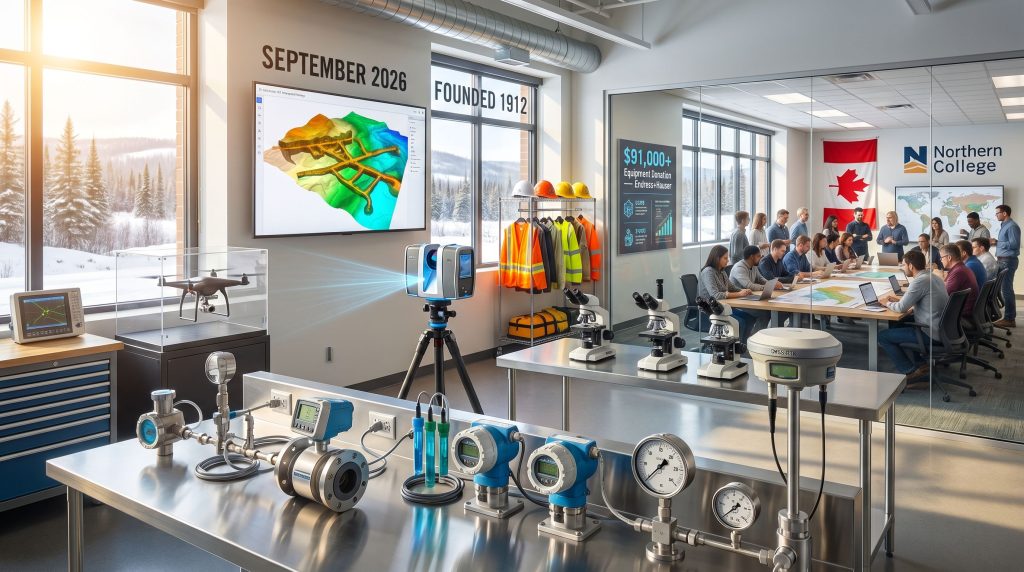
The addition of GIS and drone-based surveying technologies deserves particular attention. LiDAR (Light Detection and Ranging) has become an industry standard for monitoring pit wall stability, mapping subsurface features, and tracking volumetric changes over time. GNSS-RTK (Global Navigation Satellite System with Real-Time Kinematic positioning) provides centimetre-level precision for surveying applications. Exposing students to these technologies before they enter the workforce meaningfully reduces the time employers spend on post-hire technical training.
Mandatory Co-Op: Closing the Classroom-to-Worksite Gap
One of the most structurally significant changes in the revitalized program is the introduction of a mandatory co-operative education component. This replaces what was previously either optional or entirely absent, and it addresses the most fundamental criticism levelled at mining education programs generally: that graduates arrive at mine sites without the practical experience to be productive from day one.
Northern College is actively developing paid industry placements in partnership with regional mining companies. The program will also incorporate structured mine site tours and processing plant visits, ensuring that classroom instruction is grounded in the operational realities students will encounter after graduation.
Competency-based learning reorients educational outcomes around measurable, job-relevant skills rather than contact hours or subject areas alone. The distinction matters because it aligns what graduates can do with what employers need them to do from their first week on site.
Equipment Modernization: From Decommissioned Labs to Industry-Standard Facilities
Curriculum reform without corresponding infrastructure investment would be insufficient. The Haileybury School of Mines revitalization includes a parallel effort to modernise laboratory facilities with equipment that reflects current industry practice. In addition, the shift toward data-driven mining operations makes it essential that students gain familiarity with the instrumentation and data systems used in live operational environments.
Planned additions to HSM's laboratory infrastructure include:
- Petrographic microscopes for mineralogical and petrographic analysis of rock and ore samples
- LiDAR systems and GNSS-RTK equipment for hands-on surveying and remote sensing training
- Drone simulation software for operational planning and airspace management training
- Blast simulation platforms for mine planning and fragmentation optimisation exercises
The Endress+Hauser Donation: Industry Instrumentation in the Classroom
In November 2025, Swiss measurement and automation technology manufacturer Endress+Hauser donated equipment valued at over $91,000 to HSM's automation and control engineering department. The donated equipment included magnetic flowmeters, vortex flowmeters, analytical transmitters, and pressure transmitters.
This contribution is significant beyond its dollar value. Modern mines rely extensively on automated process control systems to manage fluid flows, chemical dosing, slurry transport, and a wide range of operational parameters. These are not theoretical concepts for students who will enter the workforce; they are the actual instruments they will be expected to read, calibrate, and troubleshoot from their first days on site.
Hands-on exposure to industry-grade instrumentation before graduation fundamentally changes the employer onboarding experience. Rather than spending weeks familiarising new hires with equipment they have never touched, employers receive graduates who already understand how these systems behave in practice.
How Industry Engagement Shifted from Doubt to Active Participation
The path to industry buy-in was not straightforward. When Johnston first approached mining executives at the 2024 PDAC convention with early revitalization plans, the response was sceptical. Executives noted that similar proposals had been made at various points over the years, raising legitimate questions about whether this initiative would produce lasting results where previous efforts had not.
By the 2025 PDAC convention, the narrative had changed materially. Broader PDAC conference insights from that year highlighted growing consensus around workforce readiness as a critical bottleneck for the sector. The HSM team was able to present concrete, documented progress rather than plans and intentions. This shift from proposal to demonstrated execution proved to be the credibility threshold that converted sceptical observers into active supporters.
Industry engagement now takes several forms:
- Equipment donations providing access to instrumentation used in active mining operations
- Provision of real mine lab reports and operational datasets for integration into the curriculum, giving students exposure to authentic industry data rather than textbook simulations
- Co-op hosting commitments from companies prepared to accept students in paid placements
- Mine tour and processing plant access that contextualises classroom learning within operational environments
Alumni networks have also played a meaningful validation role. HSM graduates working in the industry are well positioned to assess whether the curriculum updates reflect genuine operational realities, and their involvement lends credibility to the competency framework being developed.
Comparing Old and New: What the Revitalized Program Looks Like Against Prior Standards
The structural differences between the previous delivery model and the revitalized program are substantial enough to represent a fundamental reimagining of how mining technician education is delivered at HSM.
| Dimension | Previous Model | Revitalized HSM Program |
|---|---|---|
| Learning delivery | Primarily online | Blended: classroom, labs, co-op, fieldwork |
| Industry alignment | Infrequent curriculum review | Industry co-designed, competency-defined outcomes |
| Technology exposure | Limited or outdated equipment | LiDAR, drones, GNSS-RTK, automation systems |
| Work-integrated learning | Optional or absent | Mandatory co-op component |
| Graduate outcome focus | Entry-level placement | Career longevity and leadership readiness |
| Data access | Simulated or textbook | Real mine reports and operational datasets |
What distinguishes HSM's approach from generic curriculum updates is the combination of institutional heritage, geographic positioning, and the depth of industry co-design behind the new model. Northern Ontario is not a peripheral mining region; it is one of Canada's most active and historically significant mineral districts. An institution embedded in that geography, drawing on industry relationships built over more than a century, has structural advantages that newer programs cannot replicate quickly.
The next major ASX story will hit our subscribers first
What Students and Employers Can Expect from September 2026
For Prospective Students
The revitalized Mining Engineering Technology program launching in September 2026 offers a structured pathway that moves from foundational mining science through to applied, site-ready competencies. Students can expect:
- A mandatory co-op placement providing paid work experience before graduation
- Access to modernised laboratory infrastructure including industry-grade instrumentation
- Exposure to technologies actively deployed in modern mining operations
- A curriculum built around competencies that directly correspond to entry-level and mid-career mining roles
- Fieldwork opportunities including mine site visits and processing plant tours
For Employers
The practical value proposition for hiring organisations is equally concrete. Graduates of the revitalized program will have:
- Verified hands-on experience with automation, surveying, geological mapping, and mine planning technologies
- Prior exposure to the instrumentation used in live mining operations
- Work experience gained during co-op placements, reducing onboarding time and cost
- A demonstrated ability to apply competency-based skills in real operational contexts
The Bigger Picture: Education Infrastructure as a Critical Minerals Imperative
Canada's critical minerals strategy depends on a continuous pipeline of technically capable workers. The battery metals transition, the expansion of base metals extraction, and the growing global demand for mineral inputs to clean energy systems all require human capital at scale. Regional institutions like HSM serve as the foundational layer of that pipeline, and their deterioration has downstream consequences that extend well beyond individual enrolment figures.
Consequently, the Haileybury School of Mines revitalization provides a documented framework for how legacy mining schools can rebuild operational relevance through industry co-design, infrastructure investment, and work-integrated learning. The role of AI in mineral exploration and the broader uptake of mining automation trends further underline why modern graduates must enter the workforce already fluent in the technologies reshaping the industry. The model is potentially replicable in other resource-dependent regions across Canada where mining education programs have faced similar erosion pressures.
Johnston's emphasis on keeping skilled graduates in northern Ontario reflects a broader truth about resource-dependent regions: workforce retention and educational infrastructure are not separable issues. Building a program that produces graduates capable of succeeding in modern mining operations is a prerequisite for the regional economic development that depends on those operations continuing to function. As Northern College continues to invest in the program's physical infrastructure and industry partnerships, the institution's capacity to deliver on these ambitions becomes increasingly credible.
The Haileybury School of Mines revitalization is, at its core, a bet that institutional legacy combined with rigorous industry co-design and genuine infrastructure investment can reverse decades of decline. The September 2026 program launch will be the first real test of that thesis.
This article draws on reporting published by CIM Magazine, the publication of the Canadian Institute of Mining, Metallurgy and Petroleum. Readers seeking additional coverage of mining education and workforce trends in Canada can explore related content at magazine.cim.org. This article contains forward-looking statements regarding program launches, industry outcomes, and workforce trends. Such statements are subject to change and should not be interpreted as guarantees of specific educational, economic, or employment outcomes.
Want to Identify the Next Major Mineral Discovery Before the Broader Market Does?
As northern Ontario rebuilds its mining talent pipeline to meet surging critical minerals demand, Discovery Alert's proprietary Discovery IQ model delivers real-time alerts on significant ASX mineral discoveries — instantly transforming complex geological data into actionable investment insights for traders and long-term investors alike. Explore Discovery Alert's discoveries page to understand how historic mineral finds have generated substantial returns, and begin a 14-day free trial to position yourself ahead of the market.