June 11, 2026
The Institutional Energy Shift Reshaping How Heavy Industry Powers Itself
For decades, the economics of industrial electricity procurement in southern Africa operated within a narrow set of assumptions: one supplier, one grid, and a tariff structure that heavy industry had limited power to influence. That architecture is now fracturing. Across the global mining and metals sector, the convergence of Scope 2 emissions accountability, carbon border adjustment mechanisms, and investor-led ESG screening is fundamentally altering how energy-intensive operations think about their power supply. The question is no longer simply how much electricity costs, but where it comes from, how reliably it arrives, and what carbon signature it carries.
It is against this backdrop that the Eskom Green renewable energy unit enters the picture, not as a footnote to South Africa's energy policy debate, but as a structurally significant development in how the country's dominant grid operator intends to reposition itself within a rapidly changing energy economy.
When big ASX news breaks, our subscribers know first
Understanding the Problem Eskom Green Was Built to Solve
South Africa's electricity sector has spent years under structural strain. Load-shedding, which reached unprecedented frequency between 2022 and 2024, inflicted estimated losses of tens of billions of rands on the mining sector alone, with deep-level gold and platinum group metal operations among the most acutely affected. For mines running continuous extraction processes, even brief interruptions translate directly into lost ore throughput, equipment damage, and worker safety complications.
Beyond reliability, there is a cost trajectory problem. Eskom's tariff increases have consistently outpaced inflation over the past fifteen years, compressing margins for energy-intensive producers and accelerating the search for alternatives. Private embedded generation, rooftop solar, and wheeling arrangements have proliferated, but these solutions typically operate at scales unsuitable for the largest industrial consumers, those processing hundreds of thousands of tonnes of ore annually or running energy-hungry smelters around the clock.
The gap between what private independent power producers can supply and what the largest mines actually require is precisely the space that the Eskom Green renewable energy unit is designed to occupy. Furthermore, the broader shift toward renewable energy in mining is accelerating this structural realignment across the sector.
Defining the Eskom Green Renewable Energy Unit: Structure and Purpose
Eskom Green is a dedicated business unit within Eskom Holdings, established to develop, own, and operate utility-scale renewable energy and battery storage projects. Its commercial mandate is to supply clean electricity directly to large industrial customers, with an initial focus on the country's top 20 energy-consuming operations.
Rivoningo Mnisi, CEO of Eskom Renewables, has confirmed that the unit was created specifically to deliver utility-scale clean energy and storage at speed, targeting the segment of the market where volume requirements exceed what conventional independent power producer structures can practically serve.
Who Is Eskom Green Targeting?
The commercial logic of focusing on the top 20 industrial energy consumers is straightforward from a revenue concentration perspective. These are the operations consuming electricity at a scale where a single long-term power purchase agreement can anchor an entire project's financial viability. They include:
- Deep-level gold mining operations in Gauteng and the Free State
- Platinum group metal mines and associated processing facilities in the Bushveld Complex
- Ferrous and base metal smelters requiring uninterrupted high-load supply
- Energy-intensive manufacturing and chemical processing facilities
The plan is to expand the customer base progressively as project capacity grows, but anchoring initial development on the highest-volume consumers reduces early-stage commercial risk considerably.
The Projects: What Is Actually Being Built?
Komati Power Station: A Coal Asset Reborn
The most symbolically significant of Eskom Green's early projects is located at Komati Power Station in Mpumalanga. Komati was decommissioned as a coal-fired facility, and its repurposing as a hybrid clean energy site carries both practical and strategic weight.
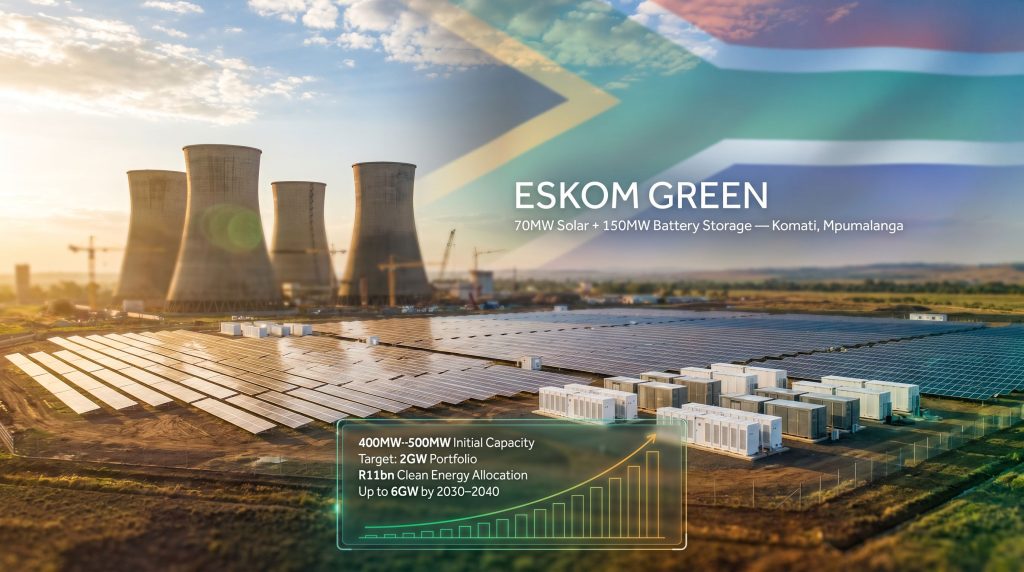
The project combines 150MW of battery energy storage with 70MW of solar photovoltaic generation. The co-location rationale is critically important: Komati sits on Eskom-owned land with existing high-voltage transmission infrastructure already in place. This eliminates two of the most time-consuming and capital-intensive hurdles facing private renewable developers, namely land acquisition and grid connection.
The repurposing of decommissioned coal stations as renewable development platforms represents an emerging template for just energy transition strategy globally, and Komati is one of the earliest large-scale examples in Africa of this approach being applied to an operational project pipeline.
Eastern Cape Hydroelectric Development
The second confirmed early-stage project is a proposed run-of-river or storage hydroelectric facility in the Eastern Cape, with a planned capacity range of 80MW to 100MW. Hydroelectric generation offers a fundamentally different risk profile to solar, providing more predictable baseload characteristics and less dependence on weather variability, making it a strategically complementary addition to a portfolio anchored by solar and battery assets.
Infrastructure Co-Location: The Structural Advantage Private Developers Cannot Replicate
The competitive moat that Eskom Green holds over private independent power producers is not financial, at least not initially. It is infrastructural. Consequently, this positional advantage has significant implications for how the broader mining energy transition unfolds across South Africa's resource sector.
| Advantage Factor | Eskom Green | Private IPP Developers |
|---|---|---|
| Land Access | Eskom-owned sites available immediately | Commercial acquisition required |
| Transmission Connection | Existing grid tie-ins on retired coal sites | Subject to lengthy Eskom interconnection queue |
| Regulatory Land Use | Streamlined via existing state land tenure | Full environmental and planning process |
| Development Timeline | Materially accelerated | Standard multi-year process |
| Site History | Known geotechnical and grid data | Requires full survey programme |
This advantage is more consequential than it may initially appear. South Africa's renewable energy interconnection queue has been a persistent bottleneck for private developers, with wait times of several years reported in some cases. Eskom Green bypasses this entirely on its own land.
Capital Structure: How the Numbers Stack Up
Phase One Funding
The initial capacity tranche of 400MW to 500MW will be funded from a ring-fenced clean energy allocation of R11 billion, embedded within Eskom's broader R343 billion five-year capital expenditure programme. Proportionally, this represents approximately 3.2% of total planned capex, a figure that reflects both the scale of Eskom's overall infrastructure obligations and the relatively early-stage nature of the clean energy commercial platform.
| Financial Metric | Figure |
|---|---|
| Clean energy capex allocation | R11 billion |
| Total Eskom 5-year capex | R343 billion |
| Clean energy share of total capex | ~3.2% |
| Initial funded capacity | 400MW to 500MW |
| Minimum project threshold | 500MW per project |
| Single site capacity potential | Up to 1GW |
| Portfolio growth target | Toward 2GW |
| Long-term national target | Up to 6GW (2030 to 2040) |
| Komati battery storage | 150MW |
| Komati solar | 70MW |
| Eastern Cape hydro | 80MW to 100MW |
Phase Two: Project-Level Private Finance
As the portfolio scales beyond initial tranches, Eskom Green will transition toward project-level financing structures designed to attract private capital and concessional development finance. Advanced discussions are reportedly underway with the World Bank around funding instruments structurally linked to the decommissioning of four specific coal-fired power stations: Camden, Grootvlei, Hendrina, and Kriel.
This financing architecture is worth examining carefully. By tying clean energy investment to coal asset retirement, the model creates a self-reinforcing incentive structure where accelerating the renewable pipeline simultaneously advances the coal phase-out timeline. It also makes the financing case more compelling to multilateral development institutions whose mandates are explicitly oriented toward just transition outcomes.
The linkage between World Bank-style concessional finance and coal retirement timelines is not incidental. It reflects an emerging global financing model where clean energy investment and fossil fuel decommissioning are packaged together to unlock funding that neither could access independently at the same cost of capital.
Regulatory Headwinds: The PFMA Constraint Problem
One of the most underappreciated challenges facing the Eskom Green renewable energy unit is not technical or financial, it is bureaucratic. As a state-owned entity, Eskom operates under the Public Finance Management Act, a legislative framework designed to ensure accountability in public spending. However, while this serves legitimate governance objectives, it creates procurement and contracting processes that are structurally slower and less flexible than those available to private sector developers.
Rivoningo Mnisi has acknowledged this constraint directly, indicating that Eskom Green will pursue regulatory exemptions to enable competitive parity with private independent power producers. This is a significant admission: it recognises that operating under PFMA obligations while competing in a commercial energy market creates an asymmetric disadvantage that cannot be resolved through operational efficiency alone.
Comparing the Competitive Landscape
| Dimension | Eskom Green | Private IPPs |
|---|---|---|
| Regulatory Framework | PFMA-constrained | Commercial law |
| Land and Transmission Access | Structural advantage | Market-dependent |
| Capital Access | State balance sheet plus concessional | Private markets |
| Procurement Speed | Constrained by public sector rules | Commercially agile |
| Scale per Project | 500MW to 1GW | Typically smaller tranches |
| Governance Structure | Transitioning to subsidiary model | Already commercially structured |
The transition of Eskom Green to a fully owned subsidiary with an independent board is pending regulatory approvals and is expected to complete within the broader 2030 unbundling timeline. This structural separation is designed to improve commercial agility and create clearer accountability, but the timeline means that for several years the unit will operate under constraints that its private competitors do not face.
The next major ASX story will hit our subscribers first
What This Means for South Africa's Mining Sector
For South African miners, the emergence of the Eskom Green renewable energy unit introduces a new category of counterparty into their energy procurement landscape. Historically, mines either bought from the national grid or developed their own embedded generation capacity. The prospect of direct, utility-scale power purchase agreements with a dedicated clean energy provider operating at 500MW to 1GW project scales changes the calculus significantly.
The Scope 2 Emissions Imperative
The pressure on South African mining companies to reduce their Scope 2 emissions, those generated by purchased electricity rather than direct combustion, has intensified considerably as global commodity buyers and institutional investors have sharpened their net-zero commitments. A verifiable, large-scale clean energy supply contract with an entity operating purpose-built renewable infrastructure offers a more credible emissions reduction pathway than grid-based claims, where the generation mix remains largely coal-dependent.
For platinum group metal producers facing European automotive supply chains with increasingly strict supplier emissions requirements, and for gold miners subject to investor coalitions pressing for science-based targets, access to dedicated renewable supply at scale is not a nicety. It is becoming a commercial prerequisite. In addition, the well-documented mining decarbonisation benefits extend well beyond regulatory compliance, offering measurable cost and reputational advantages.
Key Strategic Implications for Mine Energy Procurement
-
Long-term power purchase agreements structured directly with Eskom Green could provide cost certainty over extended horizons, reducing exposure to Eskom tariff escalation cycles.
-
Co-location opportunities where mine infrastructure and Eskom-owned land intersect may enable bespoke project configurations tailored to specific mine energy profiles.
-
Battery storage components within hybrid projects offer demand-response capabilities that can help mines manage peak load costs and grid volatility simultaneously.
-
Direct procurement from a renewable platform with verifiable generation data provides auditable Scope 2 emissions reduction evidence for ESG reporting purposes.
Furthermore, the electrification and decarbonisation agenda across the mining sector is simultaneously driving demand for the types of minerals that South African operations are well positioned to supply, reinforcing a dual strategic opportunity.
The Institutional Reinvention Argument
Eskom Group CEO Dan Marokane has characterised the Eskom Green venture not as a regulatory compliance exercise but as evidence of the utility's genuine capacity to adapt its institutional identity to new energy realities. This framing matters beyond public relations. For a utility that spent years as a byword for grid instability and financial distress, demonstrating credible commercial ambition in the clean energy space is a necessary precondition for attracting the private capital that Phase Two financing will require.
The unbundling roadmap, targeting completion by 2030, creates a parallel institutional transformation. As Eskom separates its generation, transmission, and distribution functions, Eskom Green represents the generation component's attempt to establish a commercially viable identity independent of the legacy coal fleet that has defined the utility's history.
Moreover, as critical minerals demand continues to rise globally, South African mining operations that can credibly demonstrate clean energy procurement will be better positioned to meet the supply chain requirements of battery and clean technology manufacturers worldwide.
Whether the Eskom Green renewable energy unit can navigate the regulatory constraints, execute on its project pipeline, and attract the concessional and private capital needed to scale toward 2GW will determine whether this institutional reinvention is substantive or aspirational. The infrastructure advantages are real. The financing architecture is coherent. The execution risk, particularly around PFMA exemptions and subsidiary governance, remains the critical variable to watch. Reuters has reported on the unit's launch as a marker of meaningful strategic intent, further signalling that international observers regard this development as consequential rather than merely symbolic.
This article is informational in nature and does not constitute financial or investment advice. Projections, capacity targets, and financing timelines referenced herein are subject to regulatory approvals, market conditions, and operational variables. Readers should conduct independent research before making any investment or procurement decisions.
Want To Identify The Next Major Mineral Discovery Before The Market Catches On?
Discovery Alert's proprietary Discovery IQ model delivers real-time alerts on significant ASX mineral discoveries, transforming complex mineral data into actionable insights for both short-term traders and long-term investors. Explore Discovery Alert's dedicated discoveries page to understand how historic discoveries have generated substantial returns, and begin your 14-day free trial today to position yourself ahead of the market.