August 20, 2026
The Industrial Logic Behind AI-Driven Iron Ore Processing
The iron ore industry has spent decades optimising around fixed constraints: ore grade, equipment capacity, and labour availability. However, a more fundamental bottleneck has always existed inside the processing plant itself, where hundreds of interdependent variables shift continuously and human operators can only respond to a fraction of them in real time. This is not a workforce problem. It is an information architecture problem, and artificial intelligence is now solving it at industrial scale.
The Vale AI-powered iron ore plant in Minas Gerais represents the most concrete proof point yet that AI-driven beneficiation can move from concept to commercial reality, delivering quantified, auditable productivity gains that rival or exceed anything achieved through conventional capital expansion. Understanding why this matters requires looking beyond the headline numbers and into the technical, commercial, and strategic layers underneath.
When big ASX news breaks, our subscribers know first
What AI Actually Does Inside an Iron Ore Processing Plant
The Complexity Problem Conventional Systems Cannot Solve
Iron ore beneficiation is not a single process. It is a sequence of interdependent stages, each generating its own data stream and each influencing the performance of stages downstream. Crushing, grinding, classification, magnetic separation, flotation, and pelletising all operate simultaneously, and the optimal settings for any one stage depend on the real-time state of every other.
Distributed control systems (DCS), which have governed most processing plants for the past three decades, are designed to automate predefined responses to predefined conditions. They are rule-based, not learning-based. When conditions fall outside established parameters, or when subtle interactions between variables produce compounding inefficiencies, conventional automation has no adaptive mechanism to respond.
This is precisely the domain where machine learning models demonstrate their greatest advantage. By training on historical plant performance data and continuously ingesting live sensor feeds, AI systems can identify non-obvious correlations between variable combinations and output quality. Furthermore, they apply micro-corrections in real time that no human operator and no legacy control system could execute at equivalent speed or granularity. Understanding the iron ore market types helps contextualise why such precision matters across different deposit and processing scenarios.
The 400-Variable Framework: What Is Actually Being Optimised?
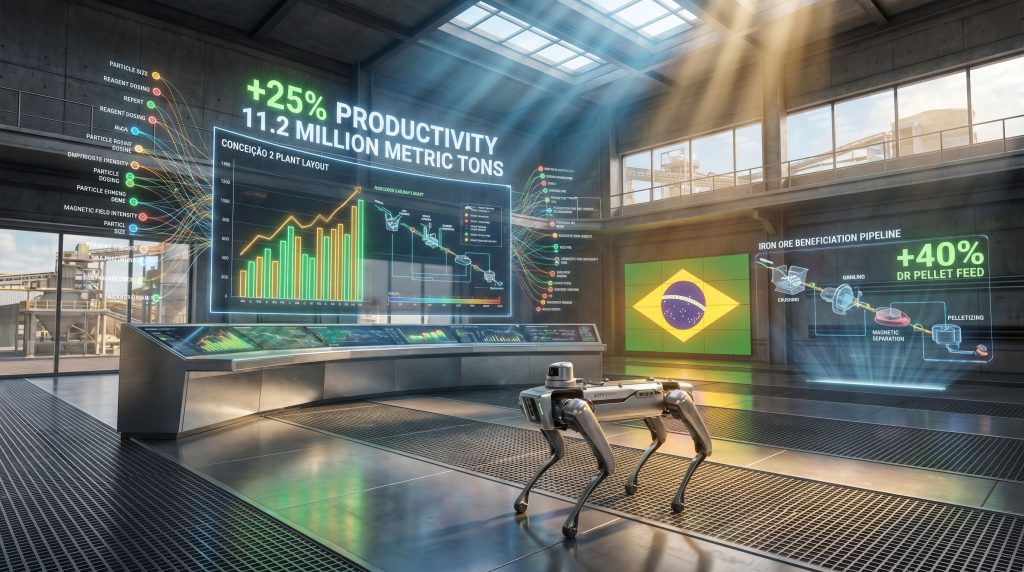
The scale of the optimisation challenge at Conceição 2 is best understood through the breadth of variables being managed simultaneously:
- Ore feed characteristics: Grade variability, particle size distribution, moisture content, and mineralogical composition fluctuate continuously as different ore parcels enter the plant
- Grinding circuit parameters: Mill load, water addition rates, grinding media consumption, and discharge density all interact to determine particle liberation efficiency
- Magnetic separation settings: Field intensity, belt speed, and splitter positions must be tuned dynamically to maximise iron recovery while minimising silica and alumina contamination
- Flotation circuit variables: Reagent dosing rates, froth depth, airflow, and pH control each affect separation selectivity and recovery in the flotation stage
- Energy consumption metrics: Real-time power draw across grinding, pumping, and separation circuits enables the AI to trade off throughput against energy cost
- Equipment health indicators: Vibration signatures, bearing temperatures, and motor current draw feed predictive maintenance models that schedule interventions before failures occur
Technical Note: Managing 400+ variables simultaneously through AI represents a qualitative leap beyond what distributed control systems alone can achieve. The AI layer introduces predictive and adaptive intelligence that static automation cannot replicate, particularly in handling the non-linear interactions between process stages.
Conceição 2: The Numbers Behind the Transformation
Capacity, Output, and the Compounding Effect of Optimisation
Vale commissioned the modernised Conceição 2 facility in June 2026 after a comprehensive upgrade programme that integrated advanced automation, centralised data monitoring infrastructure, and AI-driven process optimisation across the full beneficiation workflow.
The results were measurable and significant:
| Metric | Pre-Modernisation (2024) | Post-AI Integration (2026) |
|---|---|---|
| Annual Production Capacity | 9 million metric tons | 11.2 million metric tons |
| Productivity Improvement | Baseline | +25% |
| Variables Optimised | Limited manual oversight | 400+ automated variables |
| DR Pellet Feed Share | Baseline | +40% increase |
| Manual Intervention Frequency | High | Significantly reduced |
| Remote Operation Capability | Limited | Fully integrated |
The incremental capacity gain of approximately 2.2 million metric tons per year was achieved without expanding the physical footprint of the plant, without accessing additional ore reserves, and without proportional increases in labour headcount. The entire productivity gain is attributable to how the existing asset is operated, not to what it was built from.
To contextualise the volume: 2.2 million metric tons of additional iron ore output annually is sufficient to support the production of roughly 1.4 million metric tons of crude steel, a volume capable of supplying structural steel for approximately 190,000 average-sized residential buildings each year.
Why the Direct Reduction Pellet Feed Increase Matters More Than the Throughput Gain
Among the outcomes of the Conceição 2 modernisation, the 40% increase in direct reduction (DR) pellet feed as a share of output may carry greater long-term strategic weight than the productivity figure itself.
DR pellet feed is a distinct and more demanding product category than standard iron ore pellets. To qualify for use in direct reduction ironmaking, pellets must typically achieve iron content above 67% Fe, with tightly controlled silica, alumina, and phosphorus specifications. Producing higher volumes of DR-grade material requires superior mineralogical liberation and more precise downstream separation, both of which depend on fine-grained variable control that AI optimisation enables.
The commercial logic is clear. Direct reduction ironmaking, which uses natural gas or hydrogen iron reduction as a reductant rather than coking coal, is the most commercially advanced pathway to lower-carbon steel production. As steel producers across Europe, Asia, and North America accelerate investment in electric arc furnace capacity fed by directly reduced iron (DRI), demand for DR-grade pellet feed is structurally growing. Consequently, producers who can supply higher volumes of specification-grade material at reliable quality will occupy a preferential position in that emerging market.
Strategic Insight: The link between AI process optimisation and DR pellet feed yield is not incidental. Tighter variable control across the separation and pelletising circuits directly enables higher iron content and lower impurity profiles in the finished pellet, making AI a production quality tool as much as a throughput tool.
The Steel Decarbonisation Connection
Why Iron Ore Quality Is Central to Green Steelmaking
The global steel industry is responsible for approximately 7 to 9% of global CO₂ emissions, making it one of the most consequential sectors in any credible industrial decarbonisation pathway. The dominant production route, blast furnace-basic oxygen furnace (BF-BOF) steelmaking, requires coking coal as both a reductant and an energy source and is structurally difficult to decarbonise at the furnace level.
Direct reduction ironmaking changes this equation. In a DR plant, a shaft furnace reduces iron ore pellets using a reducing gas, historically natural gas-derived syngas, and increasingly hydrogen or hydrogen-rich blends. The output is directly reduced iron, which is then fed to an electric arc furnace (EAF) to produce steel with a fraction of the carbon intensity of conventional BF-BOF steelmaking.
The critical constraint in scaling this pathway is feedstock quality. DR processes require pellets with high iron content and low gangue mineral concentrations because the shaft furnace environment is less tolerant of impurity variability than a blast furnace. This is why DR pellet feed commands a structural price premium over blast furnace pellets, and why the ability to produce larger volumes of DR-grade material at Conceição 2 represents a commercially meaningful shift in Vale's product mix. In addition, developments in green steelmaking technology are accelerating the demand for precisely this type of high-specification feedstock.
Vale's 2030 Carbon Target and the Operational Contribution
Vale has committed to a 33% reduction in carbon emissions by 2030, a target that requires progress across multiple operational dimensions. The Conceição 2 AI plant contributes through three distinct mechanisms:
- Scope 1 and 2 emissions reduction through energy efficiency improvements: optimised grinding and separation parameters reduce energy consumption per tonne of processed ore, directly lowering the plant's operational carbon intensity
- Scope 3 emissions reduction through DR pellet feed expansion: by supplying more DR-grade material to steel producers, Vale enables its customers to shift toward lower-carbon ironmaking pathways, reducing the downstream emissions associated with Vale's products
- Waste and rework reduction: higher mineral recovery rates mean fewer ore tonnes need to be processed to achieve equivalent iron output, reducing the total energy and water footprint of the beneficiation operation
The broader mining decarbonisation benefits of these operational shifts extend well beyond a single facility, reinforcing the case for industry-wide adoption of AI-driven approaches.
Vale's Broader Minas Gerais Digitalisation Architecture
The ANYmal Robotics Deployment at Cauê
The Vale AI-powered iron ore plant in Minas Gerais does not exist in isolation. Across Vale's Minas Gerais operational network, a parallel programme of autonomous robotic inspection is underway. At the Cauê iron ore processing plant in Itabira, Vale completed a proof-of-concept deployment of the ANYmal quadrupedal robot, an autonomous inspection platform developed by ANYbotics.
This platform is capable of navigating stairways and uneven terrain, generating detailed 3D facility maps, conducting thermal imaging of equipment, and transmitting real-time visual data to remote operators. Following the successful Cauê trial, Vale committed to acquiring the ANYmal unit for ongoing operational deployment, assigning it to grinding unit inspections and 3D mine mapping tasks.
This is technically significant because grinding circuits are among the highest-energy and highest-wear components in any beneficiation plant, and regular inspection of grinding mills, trunnion bearings, and discharge systems is both essential and hazardous for human workers. The integration of robotic inspection with AI process control creates a layered operational architecture:
- The AI optimisation layer governs process variables continuously, adjusting operating parameters in real time
- The robotics layer conducts physical inspection of equipment in hazardous or difficult-access zones without human exposure
- The centralised monitoring infrastructure integrates data from both layers into a unified operational picture
The Barão de Cocais Tailings Processing Plant
A further dimension of Vale's Minas Gerais innovation programme is the planned tailings-based iron ore processing facility at Barão de Cocais, targeted to produce 2 million metric tons of iron ore annually with operations scheduled to begin in 2027.
This facility would process iron ore from historical tailings deposits, material left over from earlier mining operations that was uneconomic to process under previous technological conditions. Advances in fine particle separation and beneficiation technology have made lower-grade tailings increasingly viable as a secondary feed source, and the Barão de Cocais project represents an attempt to capture this value while simultaneously rehabilitating a legacy environmental liability.
The combination of AI-driven primary processing optimisation at Conceição 2 and tailings reprocessing at Barão de Cocais illustrates a dual-track approach to resource productivity: extracting more value from existing operations while recovering value from historical waste streams.
Industry Benchmarks and Competitive Implications
Where Vale's Results Sit Within the Broader AI Mining Landscape
Vale's 25% productivity improvement at Conceição 2 is consistent with, and at the upper end of, the productivity improvement ranges reported for AI and advanced automation deployments across the global mining industry. Independent industry analysis suggests that AI-driven process optimisation in mineral processing can deliver throughput improvements in the 15% to 30% range depending on the complexity of the ore body, the maturity of the existing control infrastructure, and the quality of the historical data available for model training.
| Technology Application | Operational Domain | Estimated Productivity Impact |
|---|---|---|
| AI-driven process optimisation | Mineral processing plants | 15 to 30% throughput improvement |
| Autonomous haulage systems | Surface mining logistics | 10 to 20% cost reduction |
| Predictive maintenance platforms | Equipment reliability | 20 to 40% reduction in unplanned downtime |
| Remote operations centres | Multi-site management | 5 to 15% labour efficiency gain |
| Robotic inspection systems | Safety and maintenance | Significant reduction in high-risk manual tasks |
The fact that Conceição 2 achieved results at the upper boundary of this range within a sub-two-year modernisation window strengthens the case for replication across Vale's broader processing network. It also intensifies competitive pressure on peer producers including Rio Tinto, BHP, and Fortescue to demonstrate equivalent or superior digitalisation outcomes at their own processing facilities.
The Replication Potential and Its Scale Implications
Vale's Vice President of Operations, Carlos Medeiros, characterised the Conceição 2 modernisation as representing a fundamentally new operational methodology, not simply a facility upgrade. This framing is commercially important because it signals organisational intent to codify and export the model to other sites rather than treat it as a contained experiment.
Vale operates processing infrastructure across both the Minas Gerais iron ore system and the Carajás system in Pará state, the latter being one of the highest-grade large-scale iron ore deposits in the world, with ore grades typically exceeding 65% Fe in situ. Applying equivalent AI optimisation productivity gains across even a portion of this broader network would generate output and cost impacts that dwarf the Conceição 2 results in absolute terms.
Furthermore, shifts in China steel demand patterns will play a critical role in determining how quickly Vale and its peers move to replicate this model at scale. Greater market pressure tends to accelerate technological adoption across the supply chain.
Forward-Looking Note: The following observations involve forecasts and assumptions about future operational outcomes and market conditions. They should not be interpreted as guarantees of future performance. Investors and analysts should conduct independent due diligence before drawing investment conclusions.
If Vale successfully replicates a 20 to 25% productivity improvement across five comparable processing units, the cumulative incremental output could exceed 10 million metric tons annually. This represents a capacity addition equivalent to a mid-tier iron ore producer, achieved entirely through operational intelligence rather than greenfield development capital. For further context on Vale's broader dry processing investments, the scale of commitment across the company is considerable.
The next major ASX story will hit our subscribers first
Key Data Summary
| Data Point | Value |
|---|---|
| Productivity improvement at Conceição 2 | +25% |
| New annual production capacity | 11.2 million metric tons |
| Previous annual capacity (2024) | 9 million metric tons |
| Incremental annual output gain | ~2.2 million metric tons |
| Variables optimised by AI system | 400+ |
| DR pellet feed share increase | +40% |
| Vale carbon reduction target by 2030 | 33% |
| Barão de Cocais tailings plant capacity (planned 2027) | 2 million metric tons/year |
| Typical DR pellet feed iron content requirement | >67% Fe |
| Steel industry share of global CO₂ emissions | 7 to 9% |
Frequently Asked Questions
What makes the Conceição 2 plant different from a conventional automated processing facility?
The distinction lies in the nature of the control system. Conventional automated plants use rule-based distributed control systems that execute predefined responses to predefined conditions. Conceição 2 uses machine learning models that continuously learn from real-time sensor data across 400+ process variables, identifying and correcting inefficiencies that static automation cannot detect. This adaptive intelligence is what produces the 25% productivity improvement.
Why does DR pellet feed command a premium over standard iron ore pellets?
DR pellet feed must meet tighter iron grade and impurity specifications than blast furnace pellets, typically requiring iron content above 67% Fe with strictly controlled silica, alumina, and phosphorus levels. These requirements reflect the operational demands of shaft furnace direct reduction processes, which are less tolerant of feedstock variability than blast furnaces. Higher specifications command higher prices, and the ability to produce larger volumes of DR-grade material strengthens Vale's commercial positioning in a market segment expected to grow as green steelmaking capacity expands globally.
What role does the ANYmal robot play alongside the AI process optimisation system?
The ANYmal quadrupedal robot handles physical inspection tasks in environments that are hazardous or difficult for human workers to access, including grinding circuits, elevated platforms, and areas with high vibration or thermal exposure. Its ability to generate 3D facility maps and conduct thermal imaging provides data that complements the AI process optimisation layer, creating a more complete operational intelligence picture and reducing worker exposure in high-risk zones.
Is Vale planning to apply this model to other processing facilities?
Vale has explicitly stated its intention to use the Vale AI-powered iron ore plant in Minas Gerais as a reference model for modernising other units across its processing network. The organisational language used, describing the facility as representing a new operational methodology rather than a project, signals institutional commitment to system-wide replication rather than a contained pilot.
Want To Know When The Next Major Mineral Discovery Hits The ASX?
Discovery Alert's proprietary Discovery IQ model delivers real-time alerts on significant ASX mineral discoveries, transforming complex data across 30+ commodities into clear, actionable insights for investors at every level — explore the historic returns major discoveries have generated and begin your 14-day free trial at Discovery Alert to position yourself ahead of the market.