June 10, 2026
The Hidden Economics of Western Smelting and Why Governments Are Paying to Keep Them Alive
Across the developed world, a quiet infrastructure crisis is unfolding inside ageing metals processing facilities. Zinc smelters, lead refineries, and polymetallic processing plants built during the mid-twentieth century industrial boom are now caught between two brutal realities: the prohibitive cost of modernisation and the near-impossibility of competing with lower-cost Asian producers on operating economics alone. The result is a slow attrition of Western processing capacity that, until recently, attracted little policy attention. That is changing rapidly, and the decisions now being made about Trafigura funding for Australian smelters offer a revealing window into how governments are attempting to arrest that decline.
When big ASX news breaks, our subscribers know first
Understanding the A$240 Million Commitment to Nyrstar Australia
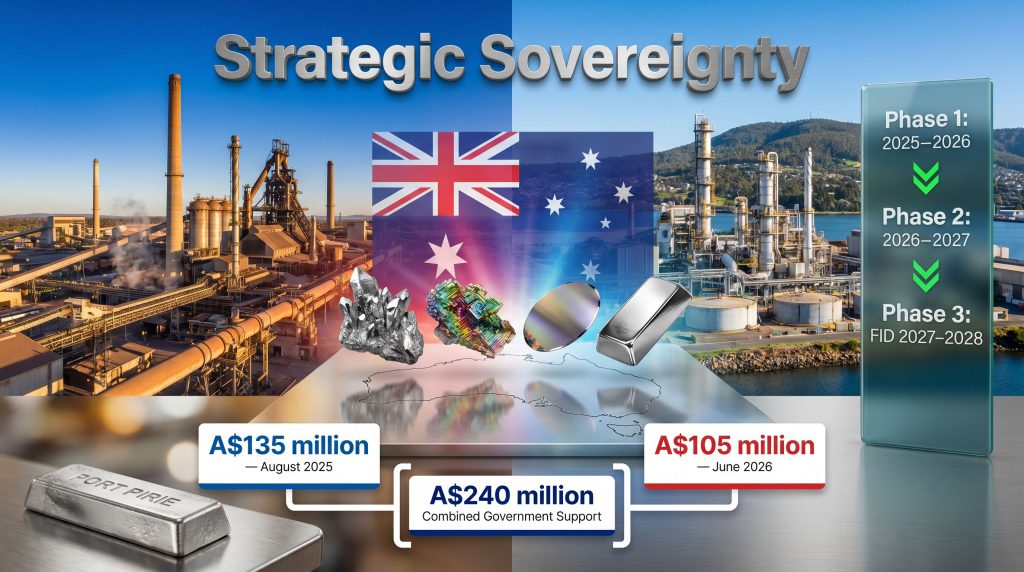
The Australian government's total financial commitment to Nyrstar Australia's smelting operations has reached A$240 million, structured across two separate tranches. The first, worth A$135 million, was announced in August 2025. A second tranche of A$105 million followed in June 2026, with both rounds directed at maintaining operational continuity and progressing engineering and feasibility studies at the Port Pirie facility in South Australia and the Hobart Zinc Works in Tasmania.
Overview: Nyrstar Australia Funding Snapshot
| Parameter | Detail |
|---|---|
| Initial Commitment | A$135 million (August 2025) |
| Additional Funding Round | A$105 million (June 2026) |
| Total Combined Support | A$240 million (~USD $168 million) |
| Facilities Covered | Port Pirie (South Australia) and Hobart Zinc Works (Tasmania) |
| Parent Entity | Nyrstar Australia (subsidiary of Trafigura) |
| Critical Minerals Targeted | Antimony, Bismuth, Germanium, Indium |
| Feasibility Timeline | Minimum two years |
It is important to understand what this capital is and is not. This is not a long-term viability guarantee, a nationalisation, or an open-ended subsidy commitment. The funding is structured around three operational purposes:
- Operational continuity through 2026, keeping both smelters running while longer-term decisions are evaluated
- Engineering planning and deferred maintenance, addressing the backlog of capital expenditure on infrastructure that has not received adequate reinvestment for years
- Critical minerals feasibility studies, commissioning technical assessments for commercial-scale production of antimony, bismuth, germanium, and indium
The funding is explicitly transitionary in nature. Feasibility studies alone are expected to take a minimum of two years, meaning no final investment decision on full modernisation is anticipated before 2027 at the earliest.
Why Trafigura's Global Profitability Doesn't Solve the Local Problem
A common misconception surrounds the financial logic of this situation. Trafigura is one of the world's largest commodity trading groups, with revenues running into hundreds of billions of dollars annually. Why, the question naturally arises, does its Australian smelting subsidiary require public funding?
The answer lies in understanding that commodity trading margins and legacy smelting economics are entirely different business models. Trading operations profit from price differentials, logistics optimisation, and market access. Smelting in a high-cost jurisdiction is a capital-intensive, operationally complex manufacturing business where the economics are driven by treatment and refining charges (TC/RCs), energy input costs, and labour rates.
Australian smelting operations face a structural cost disadvantage that no amount of parent-company profitability can automatically offset. Furthermore, it is worth noting that Glencore's smelter bailout at Mount Isa illustrates how widespread this pressure has become across the sector:
- Industrial electricity pricing in South Australia and Tasmania ranks among the highest in the developed world for energy-intensive manufacturing
- Post-pandemic wage escalation in Australian resources-adjacent industries has significantly increased the labour cost base
- Global zinc and lead TC/RCs have remained under sustained pressure as mine supply tightens and competing smelter capacity, particularly in Asia, absorbs market share
- Decades of deferred capital maintenance have created compounding reinvestment requirements that make each passing year more expensive to address
TC/RCs represent the fees smelters charge mining companies to process ore concentrates into refined metal. When these fees fall, smelter margins compress directly. The current global environment of subdued TC/RCs, combined with elevated input costs in Australia, creates a squeeze that operates independently of Trafigura's group-level financial performance.
The Critical Minerals Dimension: What These Smelters Could Actually Produce
The strategic rationale behind Trafigura funding for Australian smelters extends well beyond keeping existing zinc and lead operations alive. The more consequential argument centres on the potential to produce a suite of critical minerals that Western supply chains are currently heavily dependent on sourcing from China. This aligns directly with the broader critical minerals demand surge reshaping global industrial policy.
Targeted Critical Mineral Output by Facility
| Facility | Location | Target Critical Minerals | Key End Uses |
|---|---|---|---|
| Hobart Zinc Works | Tasmania | Germanium, Indium | Semiconductors, fibre optics, solar PV cells |
| Port Pirie Smelter | South Australia | Antimony, Bismuth | Defence applications, flame retardants, pharmaceuticals |
Each of these four minerals carries significant strategic weight:
- Germanium is a semiconductor material essential for infrared optics, fibre optic cables, and next-generation photovoltaic technology. China controls the overwhelming majority of global refined germanium output, and in 2023 introduced export controls on the material that sent supply chain alarm bells ringing across allied nations.
- Indium is primarily used in producing indium tin oxide (ITO), the transparent conductive coating found in flat panel displays and touchscreens. Like germanium, production is heavily concentrated in China and a handful of other East Asian countries.
- Antimony has critical applications in defence manufacturing, including hardening lead for ammunition, and as a flame retardant in electronics and textiles. The antimony supply risks facing Western nations have intensified considerably as Chinese export restrictions tighten.
- Bismuth, while less prominently discussed, serves important roles in pharmaceuticals, speciality alloys, and as a non-toxic replacement for lead in certain applications. In addition, bismuth export controls have already begun to affect global pricing dynamics, making domestic processing capacity even more strategically valuable.
Nyrstar completed its first antimony shipment in early 2026, representing a meaningful proof-of-concept milestone that validates the technical feasibility of the Port Pirie facility's expanded mineral production capability. This was not a trivial achievement: producing antimony from a polymetallic smelter feedstock requires specific process chemistry adjustments and separation infrastructure that not all facilities can accommodate.
The significance of that first antimony shipment extends beyond its commercial volume. It demonstrates that the engineering pathway from feasibility to initial output is achievable at Port Pirie, which strengthens the investment case for proceeding with broader modernisation.
How Does the Port Pirie Facility Fit Into the Broader Picture?
The Port Pirie transformation programme has long positioned the facility as a polymetallic processing hub rather than a single-commodity smelter. However, realising that ambition requires sustained capital investment, which is precisely what the current funding tranches are intended to support during the feasibility period.
Why Australia's Smelting Cost Problem Is Structural, Not Cyclical
The most important analytical distinction to make about the pressures facing Australian smelters is that they are structural in nature, not simply reflections of a difficult commodity cycle. This matters enormously for assessing how much capital would actually be required to create long-term viability.
Key Structural Cost Pressure Drivers
- Energy costs — South Australia and Tasmania have among the highest industrial electricity tariffs in the OECD, a product of grid configuration, renewable transition costs, and limited interconnection capacity with lower-cost generation regions
- Labour market dynamics — Skilled trades wages in Australian industrial settings have risen sharply, with resources-adjacent sectors seeing particularly acute cost escalation since 2022
- TC/RC compression — Global zinc and lead treatment charges have remained structurally depressed as smelter overcapacity in Asia, particularly in China, keeps a ceiling on fees that Western operators can charge
- Capital expenditure backlog — Both the Port Pirie and Hobart facilities are operating with ageing plant that has not received the level of reinvestment required to maintain long-term operational reliability
- Competitor scale advantages — Chinese, South Korean, and Indian smelters benefit from lower input costs, greater scale, integrated supply chain positioning, and in some cases implicit government support through cheaper energy and industrial land
This combination of pressures is why multiple European zinc smelters curtailed or idled operations between 2022 and 2025, following the energy price shocks that accompanied the Russian invasion of Ukraine. The Nyrstar Group itself temporarily suspended operations at its Budel facility in the Netherlands and reduced output at its Balen plant in Belgium during this period. Those European experiences provide a direct precedent for understanding the vulnerability of Australian smelting economics. Consequently, Europe's critical raw materials push has accelerated in direct response to these vulnerabilities.
The Public Investment Debate: Legitimate Strategy or Moral Hazard?
The decision to direct A$240 million in taxpayer capital toward a smelting business ultimately owned by a globally profitable commodity trading group raises questions that deserve honest examination. Indeed, analysts at the AFR have noted that these smelters have become a test case for how governments approach industrial bailouts more broadly.
Arguments Supporting the Funding Rationale
- Once a smelter closes, the industrial knowledge base, skilled workforce, and physical infrastructure cannot be rapidly reconstituted. Closure is effectively irreversible within any politically meaningful timeframe
- Port Pirie and Hobart provide direct employment and industrial anchoring in regional economies that have limited alternative industrial bases to absorb job losses
- Building a sovereign critical minerals supply chain requires maintaining processing infrastructure, not just mining rights. Ore in the ground has no strategic value without the capacity to refine it
- Australia's positioning as a reliable critical minerals supplier to Western allied nations requires demonstrable and operating processing capability
Arguments Questioning the Funding Structure
- Trafigura's global scale and profitability raise legitimate questions about the necessity of public subsidy without stringent conditionality and binding private co-investment commitments
- Transitionary funding without enforceable modernisation milestones and long-term operational guarantees from the private operator creates the conditions for recurring requests for public support
- The two-year feasibility timeline means public capital is fully deployed before any confirmed commercial pathway for critical minerals production exists
- BMO analysts noted in June 2026 that the capital required to modernise Australia's ageing smelter fleet will significantly exceed current government commitments, raising the prospect of further calls on public funds
Mapping the Decision Timeline: What Happens Over the Next Two Years
The current funding package provides a defined operational window within which engineering and feasibility work must advance to a point that supports a final investment decision (FID).
Phase Structure for Nyrstar Australia Modernisation
| Phase | Primary Activity | Approximate Timeframe |
|---|---|---|
| Phase 1 | Transitionary operations and maintenance | 2025 to 2026 |
| Phase 2 | Engineering studies and feasibility assessments | 2026 to 2027 |
| Phase 3 | Final investment decision | 2027 to 2028 (estimated) |
| Phase 4 | Modernisation works and critical minerals production ramp | Post-FID |
The feasibility studies will need to establish technical viability, capital cost estimates, and projected commercial returns for each critical mineral production stream at both facilities. These are not simple engineering exercises. Producing high-purity germanium or indium from a polymetallic smelter feedstock involves complex hydrometallurgical processing steps, and the economics are highly sensitive to future metal pricing assumptions that carry significant uncertainty.
Government funding beyond the current envelope would logically require demonstrated positive feasibility outcomes and binding commitments of private co-investment from Trafigura. Without the latter, the political sustainability of further public support becomes increasingly difficult to defend.
If the feasibility studies return a negative or marginal result for critical minerals production economics, the entire strategic rationale for the funding package comes under serious pressure. Both facilities would then face difficult decisions about reduced scope or managed closure.
The next major ASX story will hit our subscribers first
The Nyrstar Case as a Global Policy Template
What is unfolding at Port Pirie and Hobart is not an isolated industrial policy experiment. It reflects a systemic challenge confronting legacy smelting and processing infrastructure across Western economies more broadly.
North American lead and zinc processing capacity has contracted steadily over two decades, with investment flowing instead toward lower-cost jurisdictions. Multiple European smelters made the difficult decision to curtail output between 2022 and 2025 as energy costs rendered marginal operations unviable. The gap between the economics of operating existing Western smelters and the cost of building equivalent capacity in lower-cost regions continues to widen.
The policy response emerging across multiple jurisdictions — of which Trafigura funding for Australian smelters is one example — combines transitionary financial support with requirements for private co-investment, feasibility-gated funding releases, and explicit linkage to critical minerals supply chain objectives. Reuters has reported that this framework is likely to become a template for how allied governments approach similar situations at other legacy processing facilities.
The critical variable that will determine whether the Nyrstar Australia model succeeds as a policy template is whether the feasibility work translates into a commercially viable, privately co-funded modernisation programme. If it does, Australia will have demonstrated that transitionary industrial support can catalyse genuine long-term processing capability. If it does not, the A$240 million will be recorded as the cost of buying time for decisions that ultimately could not be avoided.
For ongoing developments in Australian metals processing and critical minerals policy, Mining.com provides detailed coverage of the sector at mining.com.
This article contains forward-looking statements and analytical assessments based on publicly available information. Feasibility timelines, investment decisions, and cost estimates are subject to change. Nothing in this article constitutes financial or investment advice.
Want to Know Which ASX Critical Minerals Discoveries Could Deliver Outsized Returns?
As Western governments race to secure domestic processing and supply chains for antimony, germanium, indium, and bismuth, the exploration companies identifying new sources of these strategic materials represent some of the most compelling opportunities on the ASX. Discovery Alert's proprietary Discovery IQ model scans ASX announcements in real time, instantly translating complex mineral discovery data into actionable insights — explore historic discoveries and their remarkable returns, then begin your 14-day free trial to position yourself ahead of the broader market.