
June 10, 2026
The Geology Beneath the Grant: Why Exploration Funding Decisions Reveal More Than They First Appear
When a government consistently increases the size of its exploration grant program across successive rounds, it is not simply responding to industry lobbying. It is signalling something more fundamental: a belief that the ground beneath its jurisdiction holds assets the world increasingly cannot do without. Northern Territory mineral exploration grants reflect this escalating commitment, and understanding them requires looking beyond the headline dollar figures toward the geological, economic, and strategic forces that make the NT's resource endowment genuinely distinctive.
The Territory sits atop one of the most geologically complex and mineralogically diverse terrains on the continent. Ancient Proterozoic basement rocks, some dating back nearly two billion years, have been subjected to the kinds of tectonic, hydrothermal, and metamorphic processes that concentrate metals into economically viable deposits. Yet vast portions of this terrain remain systematically underexplored, largely because the combination of remote access, thin cover sequences concealing mineralisation, and high early-stage costs has historically deterred the sustained capital commitment required to prove up resources. Grant programs exist, in large part, to dismantle exactly this barrier.
When big ASX news breaks, our subscribers know first
Understanding the Resourcing the Territory Program
The NT Government's Resourcing the Territory program operates as the central mechanism through which public funds are deployed to stimulate private exploration activity. Its design reflects a well-understood principle in frontier exploration economics: the biggest barrier to discovery is not the absence of mineralisation, but the absence of sufficient geoscientific information to justify the investment required to find it.
The program targets this knowledge gap directly by co-funding the most information-generating activities in the exploration workflow, principally drilling and geophysical surveys. These are also the most expensive line items in any early-stage exploration budget, which means that even partial co-funding can be the deciding factor in whether a junior company proceeds with a program or defers it indefinitely. The Northern Territory exploration initiative has, furthermore, grown in scope precisely because the evidence base for NT prospectivity continues to strengthen with each successive exploration campaign.
The Two Principal Grant Streams
The program operates through two complementary funding pathways:
- Exploration and Development Grants are designed for companies at varying project stages, covering activities from initial ground sampling through to advanced drilling and feasibility studies.
- Geophysics and Drilling Collaborations target the specific technical bottleneck of geoscientific data acquisition, providing co-funding for geophysical surveys and drill programs in under-explored corridors where baseline data is genuinely scarce.
Both streams are structured to leverage private capital rather than replace it, meaning grant recipients are expected to commit their own funds alongside government co-funding. This design intentionally filters for companies with genuine project conviction rather than opportunistic grant seekers.
How Much Funding Is Available and Where It Is Going
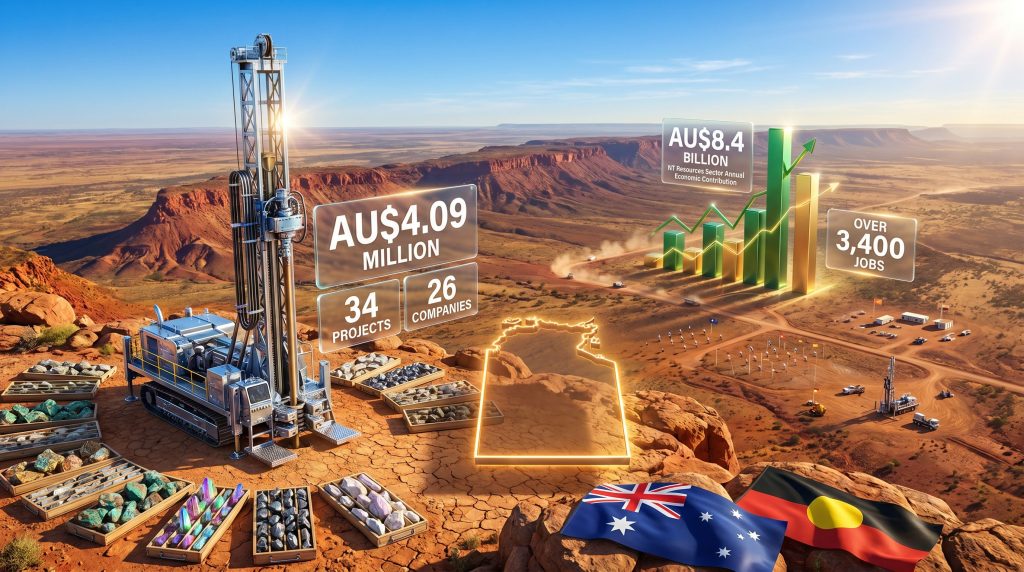
The most recent round of Northern Territory mineral exploration grants has set a new benchmark for the program, with the NT Government committing AU$4.09 million across 34 projects involving 26 separate companies. This surpasses the previous round's AU$4 million allocation, which itself supported 41 projects across 29 companies.
| Grant Round | Total Funding | Projects Supported | Companies Involved | Primary Activities |
|---|---|---|---|---|
| Most Recent Exploration & Development Round | AU$4.09 million (record) | 34 projects | 26 companies | Drilling, geophysics, critical minerals |
| Prior Resourcing the Territory Round | AU$4 million | 41 projects | 29 companies | Broad exploration and development |
| Round 17 – Geophysics and Drilling Collaborations | Up to AU$3 million | Open applications | Multiple companies | Geoscience data, co-funded drilling |
The composition of the funded project portfolio is revealing. Nearly 60% of approved projects involve drill programs, a proportion that reflects genuine industry confidence in NT prospectivity rather than an appetite for lower-cost desktop studies. Drilling is capital-intensive and generates irreversible subsurface commitments; when more than half a grant portfolio is drill-dominated, it indicates companies believe the ground will reward the investment.
The Territory Supplier Incentive
An often-overlooked component of the program is the Territory Supplier Incentive, which directs an additional AU$110,594 specifically toward NT-based contractors providing services such as earthworks, drilling support, and laboratory analysis. This is not simply an economic nationalism measure. It reflects a structural understanding that the long-term sustainability of any exploration jurisdiction depends on the depth and quality of its local service industry.
A jurisdiction with a thin service contractor base imposes higher logistics costs and longer mobilisation timelines on operators, which directly undermines exploration economics. By directing supplementary funding toward local suppliers, the program is consequently investing in the competitiveness of the entire NT exploration ecosystem, not just individual projects.
What Commodities Are Attracting the Most Attention
The commodity mix within the funded project portfolio is not accidental. It reflects both the geological reality of the NT's mineral endowment and the deliberate prioritisation choices embedded in the grant assessment criteria. Understanding the broader mineral exploration importance helps contextualise why these funding decisions carry strategic weight well beyond the Territory's borders.
Critical minerals now account for more than half of recent grant allocations. The commodities driving this weighting include:
- Copper, driven by electrification demand across grid infrastructure, electric vehicles, and industrial motors
- Rare earth elements, where Western supply chain diversification has become a policy priority
- Tungsten, a high-density metal critical to defence applications and industrial tooling, with very limited production concentrated outside Western-aligned nations
- Lithium, the foundational battery mineral underpinning the energy transition
- Uranium, experiencing renewed global interest as nuclear energy re-enters the low-emissions conversation
Gold exploration continues to attract meaningful funding, with the Tanami Region specifically identified as a highly prospective corridor. The Tanami is already host to world-class gold endowment and remains incompletely explored at depth and along structural extensions, providing legitimate discovery potential for well-resourced exploration campaigns.
Notable grant recipients include Tivan Ltd., whose 2026 drill program at the Molyhil Tungsten Project will be advanced with grant co-funding, and Prodigy Gold NL, which will use funding to accelerate exploration in the Tanami. Other confirmed recipients include Core Lithium, Daly Resources, and Agnico Eagle NT, representing a mix of development-stage and more advanced operators.
Tungsten is a commodity that receives substantially less mainstream attention than lithium or rare earths, yet tungsten's strategic importance is arguably comparable. With more than 80% of global tungsten supply historically concentrated in China, any Western-hosted tungsten deposit carries a supply chain premium that is not always reflected in junior company valuations.
A Step-by-Step Guide to Applying for NT Exploration Grants
For exploration companies evaluating whether to participate in the Resourcing the Territory program, the application process involves several distinct stages. Understanding each stage reduces the risk of disqualification on procedural grounds. Companies can find detailed eligibility criteria and application guidelines through the NT Government's exploration grants portal.
-
Determine eligibility. Applicants must hold a valid exploration licence or equivalent tenure under the NT's Mineral Titles Act. Both domestic and internationally registered companies can apply, provided they maintain compliant NT tenure and demonstrate the operational capacity to execute their proposed program.
-
Select the appropriate grant stream. Early-stage companies focused on geoscience data gaps should evaluate the Geophysics and Drilling Collaborations pathway. Companies with more advanced project status and defined drill targets are better aligned with the Exploration and Development Grant stream.
-
Prepare the technical submission. Grant assessors prioritise applications that demonstrate clear geological rationale, supported by existing geoscientific evidence such as geochemical sampling, historical drilling data, or geophysical anomalies. Submissions that cannot articulate a coherent targeting methodology are unlikely to compete successfully.
-
Address the Territory Supplier Incentive requirement. Applications that identify NT-based service contractors for drilling, earthworks, or analytical services gain access to the supplementary AU$110,594 allocation. Companies that fail to engage with local suppliers miss this additional funding component entirely.
-
Submit and engage with the assessment process. The NT Department of Industry, Tourism and Trade administers grant assessments through a structured review process. Timelines vary depending on application volume and round-specific parameters.
-
Comply with grant conditions. Successful recipients must meet milestone reporting obligations, submit technical data to the NT Geological Survey, and comply with all conditions of their exploration licence under the Mineral Titles Act and environmental requirements under the Mining Management Act.
Round 17: The Geophysics and Drilling Collaborations Program
Round 17 of the Geophysics and Drilling Collaborations program currently has up to AU$3 million available for qualifying applicants. This stream is specifically engineered to address the geoscientific knowledge deficit that characterises frontier exploration terrains.
The logic is straightforward. In established mining jurisdictions, decades of historical exploration have generated dense grids of geophysical data, drillhole databases, and geochemical surveys that significantly reduce the targeting uncertainty facing new entrants. In under-explored NT corridors, this background data either does not exist or exists only in fragmented, inaccessible form.
Techniques commonly co-funded under this stream include airborne electromagnetic (AEM) surveys and downhole geophysics, which are particularly effective at detecting conductive sulphide mineralisation beneath cover sequences. Ground gravity surveys capable of identifying density contrasts associated with iron-oxide-copper-gold (IOCG) and intrusion-related mineral systems are also supported. The data generated by these programs enters the public domain through the NT Geological Survey, compounding the benefit by informing future exploration decisions across the entire jurisdiction.
The next major ASX story will hit our subscribers first
How NT Grants Compare Across Australian Jurisdictions
The NT program does not operate in isolation. Every major Australian mining jurisdiction runs some form of exploration co-funding initiative, and companies with tenure across multiple states routinely make comparative assessments when allocating exploration budgets. A comprehensive guide to mineral exploration in the NT illustrates the full range of statutory and co-funding frameworks available to operators.
| Jurisdiction | Program | Approximate Funding Pool | Primary Focus |
|---|---|---|---|
| Northern Territory | Resourcing the Territory | AU$4.09M per round | Critical minerals, drilling, geophysics |
| Western Australia | Exploration Incentive Scheme (EIS) | AU$8-10M per year | Co-funded drilling, geoscience |
| Queensland | Collaborative Exploration Initiative | Varies by round | Greenfields exploration |
| South Australia | PACE Program | Varies | Drilling, geophysics |
Western Australia's Exploration Incentive Scheme commands a larger total funding pool, reflecting both the scale of WA's resources sector and the longer institutional history of the program. However, the NT offers structural advantages that pure dollar comparisons obscure.
Where the NT holds competitive edges:
- Lower historical exploration intensity across much of the Territory means discovery probability per drill hole can be higher in genuinely underexplored areas
- The Aileron geological province and McArthur Basin remain incompletely evaluated for critical mineral systems, providing genuine greenfield discovery potential
- The combination of co-funding streams and the Territory Supplier Incentive creates a more layered support structure than most comparable programs
- The NT's developing project pipeline, currently 16 projects representing AU$6 billion in combined capital, signals that discovery-to-development conversion is a realistic outcome, not merely a theoretical aspiration
The Regulatory Framework Every Applicant Must Understand
Participation in NT exploration grant programs does not exempt companies from their statutory obligations. Two pieces of legislation govern the core compliance environment:
- The Mineral Titles Act governs exploration licence applications, renewals, expenditure commitments, and reporting obligations. Licence holders must meet minimum expenditure requirements and submit annual technical reports, data from which is incorporated into the NT Geological Survey's public database.
- The Mining Management Act establishes the environmental management framework, requiring operators to prepare and maintain approved Mining Management Plans before commencing ground-disturbing activities.
Native title considerations add an additional layer of complexity for many NT tenements. A substantial proportion of the Territory is subject to native title determinations or registered claims, meaning land access negotiations under the Native Title Act 1993 and the Aboriginal Land Rights (Northern Territory) Act 1976 form a material part of the pre-exploration workflow. Companies unfamiliar with these frameworks should, therefore, factor legal and engagement costs into their project budgets.
The Economic Context: Why This Funding Matters Beyond Individual Projects
The NT resources sector contributes AU$8.4 billion annually to the Territory economy and supports more than 3,400 direct jobs. These are not trivial numbers for a jurisdiction with a total population of approximately 250,000 people. The resources sector is, by almost any metric, the single most important driver of NT economic activity.
Every successful exploration discovery that converts to a producing mine represents a multi-decade economic asset for the Territory. The pipeline value embedded in current NT exploration activity extends well beyond the immediate grant dollar amounts.
With 16 developing mining projects currently carrying a combined capital investment estimate of AU$6 billion, the downstream return on exploration grant expenditure is structurally significant. If even a fraction of current NT exploration activity translates to pre-feasibility stage projects over the next decade, the grant program's economic return will dwarf its nominal cost many times over.
The multiplier effect operates through several channels simultaneously:
- Direct contractor and labour spend during exploration campaigns circulates through regional NT communities and Darwin's service economy
- Geoscientific data entered into public databases reduces the information cost for future explorers, compounding the value of each funded program
- Successful discoveries attract follow-on private investment that requires no government co-funding, multiplying the initial grant allocation significantly
- Development-stage projects attract infrastructure investment that benefits entire regions, not just individual tenements
Evaluating the NT as an Exploration Destination
The honest risk-reward assessment of NT exploration requires acknowledging both the opportunity and the structural challenges. Remote access costs, long mobilisation distances, wet season operational constraints, and complex land access requirements all add to the cost base relative to more established Australian mining regions. For many junior companies operating on tight budgets, these factors can be decisive.
At the same time, the NT's competitive advantages are real and measurable. The combination of genuinely underexplored geological terrain, a supportive Northern Territory mineral exploration grants environment, a growing local services industry, and a development pipeline that demonstrates commercially viable outcomes creates an investment thesis that deserves serious consideration from both junior explorers and larger companies seeking to add discovery optionality to their portfolios.
The NT Government's explicit ambition to make the Territory Australia's most attractive destination for mineral exploration is not simply rhetorical positioning. It reflects the recognition that exploration capital is globally mobile and that jurisdictions failing to compete aggressively for that capital will cede discovery opportunities to those that do.
Frequently Asked Questions: NT Mineral Exploration Grants
What is the maximum grant amount available under the Resourcing the Territory program?
Individual grant allocations vary by project and program stream. The total pool in the most recent round was AU$4.09 million spread across 34 projects, suggesting average allocations in the range of AU$100,000–AU$200,000, though individual amounts will differ based on project scope and assessment outcomes.
Can overseas-registered companies apply for NT mineral exploration grants?
International companies can apply provided they hold compliant NT exploration tenure and can demonstrate operational capacity to execute the proposed program within the Territory.
Are grants available for early-stage geochemical sampling, or only drilling and geophysics?
The Exploration and Development Grant stream accommodates a range of project stages. However, given that drilling-dominant projects represent nearly 60% of funded activities, applications centred on more advanced technical programs tend to be more competitive.
How long does the NT grant assessment process typically take?
Assessment timelines are not publicly standardised and can vary depending on application volumes and round-specific administrative requirements. Applicants should plan for multi-week assessment periods when scheduling exploration programs.
What reporting obligations apply once a grant is awarded?
Recipients must submit technical milestone reports, comply with NT Geological Survey data lodgement requirements, and maintain compliance with all conditions attached to their exploration licence and Mining Management Plan. Furthermore, interpreting drill results accurately is essential for satisfying these reporting obligations and demonstrating program progress to grant administrators.
Can a company apply for multiple grant streams simultaneously?
The program terms should be reviewed directly with the NT Department of Industry, Tourism and Trade, as eligibility for concurrent applications across streams may depend on project-specific circumstances.
What happens if a funded project does not meet its milestone targets?
Grant conditions typically include provisions for milestone non-compliance, which may involve partial grant recovery or restrictions on future applications. Companies should treat milestone commitments as binding obligations rather than indicative targets.
Key Takeaways for the 2026 Exploration Season
- AU$4.09 million has been committed across 34 projects involving 26 companies, setting a new record for the NT's exploration grant program
- Nearly 60% of funded projects are drilling-focused, indicating strong industry confidence in NT mineralisation potential
- Round 17 of the Geophysics and Drilling Collaborations program has up to AU$3 million available for qualifying applicants seeking geoscience data co-funding
- Critical minerals including copper, rare earths, tungsten, and lithium account for more than half of recent allocations, reflecting the global supply chain context driving exploration prioritisation
- The Territory Supplier Incentive directs an additional AU$110,594 toward NT-based contractors, strengthening the local service ecosystem
- 16 active NT development projects worth AU$6 billion collectively represent the tangible downstream return on sustained exploration investment
- The NT resources sector contributes AU$8.4 billion annually and supports over 3,400 direct jobs, providing the economic context within which grant program decisions are made
This article is intended for informational purposes only and does not constitute financial or investment advice. Readers should conduct their own due diligence and consult qualified advisers before making any investment decisions related to exploration companies or mining sector activities referenced herein. Grant program details, funding amounts, and eligibility criteria are subject to change and should be verified directly with the NT Department of Industry, Tourism and Trade.
Want to Know Which ASX Explorer Could Be Sitting on the Next Major NT Discovery?
Discovery Alert's proprietary Discovery IQ model scans ASX announcements in real time, instantly identifying significant mineral discoveries across critical commodities like copper, tungsten, and rare earths before the broader market has a chance to react — exactly the kind of edge that matters when exploration capital is moving fast. Explore historic discoveries and the returns they generated, then begin a 14-day free trial to position yourself ahead of the next major ASX mineral announcement.