June 10, 2026
The Invisible Chokepoint in Western Industrial Strategy
Most discussions about critical minerals focus on where they are mined. Far less attention is paid to where they are processed. Yet it is at the processing stage, specifically the smelting and refining of raw ore into usable industrial material, that the most consequential supply chain vulnerabilities exist. For four minerals in particular, germanium, indium, antimony, and bismuth, the processing chokepoint is overwhelmingly located within a single country: China.
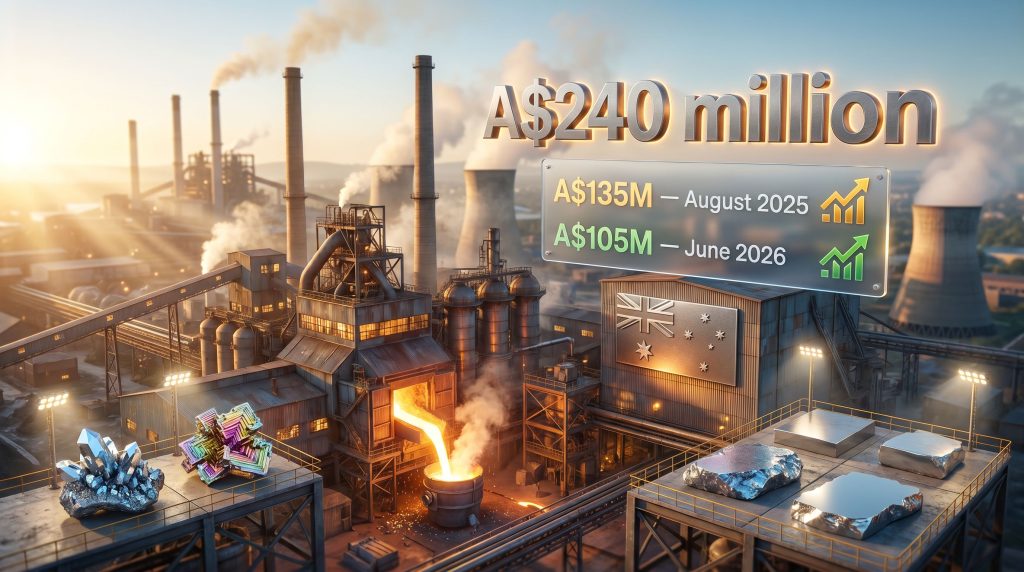
This is the strategic reality driving Australia's escalating financial commitment to Nyrstar's smelting operations. The Australian government funding for Nyrstar smelter modernisation, specifically the decision to direct a combined A$240 million across two tranches in 2025 and 2026 toward Nyrstar's Port Pirie and Hobart facilities, is not primarily a commercial investment. It is an attempt to rebuild sovereign processing capability in a domain where Western nations have allowed capacity to atrophy for decades.
When big ASX news breaks, our subscribers know first
Understanding the Full Scope of Australian Government Funding for Nyrstar Smelter Modernisation
The financial architecture underpinning this initiative is layered across multiple government tiers and spans more than a decade of public commitment.
| Funding Round | Amount (AUD) | Approximate USD | Date | Primary Purpose |
|---|---|---|---|---|
| SA Government Loan | A$291.25 million | N/A | 2015 | Port Pirie TSL furnace and emissions upgrade |
| Federal/State Package | A$135 million | ~$87.4 million | August 2025 | Operational continuity, Port Pirie and Hobart |
| Second Federal Tranche | A$105 million | ~$73.7 million | June 2026 | Modernisation feasibility studies |
| 2025-2026 Combined | A$240 million | ~$161 million | 2025-2026 | Dual-site critical minerals pivot |
The 2015 South Australian loan is particularly instructive as historical context. That facility, structured as a taxpayer-guaranteed arrangement, funded the installation of a top submerged lance (TSL) furnace at Port Pirie, a pyrometallurgical technology that significantly expanded the site's multi-metal processing capability. Without that earlier infrastructure investment, the current critical minerals pivot would likely not be technically feasible.
The June 2026 tranche of A$105 million (approximately $73.7 million USD), reported by the federal industry minister, is specifically designated for modernisation studies rather than construction. This is a meaningful distinction. It signals that the government is not yet committed to full capital expenditure, but is funding the engineering and feasibility work required to make that decision with confidence.
Four Minerals, Two Facilities, One Strategic Thesis
Nyrstar operates two Australian smelting sites, each being assessed for distinct critical minerals output:
- Hobart, Tasmania: Targeted for germanium and indium production capability
- Port Pirie, South Australia: Earmarked for antimony and bismuth output
Understanding why these four minerals matter requires stepping outside conventional commodity thinking. Furthermore, the broader context of critical minerals demand surging globally makes the case for domestic processing capacity all the more compelling.
Germanium: The Invisible Backbone of Defence Electronics
Germanium is a metalloid semiconductor recovered as a byproduct of zinc smelting, which makes Nyrstar's existing zinc processing infrastructure particularly relevant. It is used in fibre optic cables, infrared imaging systems, night-vision equipment, and satellite solar cells. China controls an estimated 80% or more of global germanium output, and in 2023 introduced export restrictions on the material, sending procurement signals to Western defence ministries that had largely ignored supply chain exposure until that point.
Indium: Solar and Display Technology's Quiet Dependency
Indium, also a zinc smelting byproduct, is a critical input for indium tin oxide (ITO), the transparent conductive coating used in touchscreens, flat-panel displays, and thin-film photovoltaic cells. Global indium production is highly concentrated, with the majority of refined output again flowing through Chinese processing facilities.
Antimony: From Ammunition to Energy Storage
Antimony has one of the most strategically diverse applications profiles of any critical mineral. It is used in:
- Lead-acid battery hardening agents
- Military-grade flame retardants and tracer ammunition
- Semiconductor production
- Emerging liquid metal battery technologies being explored for grid-scale energy storage
China's dominance in antimony processing exceeds 85% of global refined output by some industry estimates. Consequently, antimony shortage risks are increasingly concerning Western defence planners and industrial strategists alike. Nyrstar completed its first commercial antimony shipment from Port Pirie in early 2026, marking a tangible proof-of-concept milestone for the broader modernisation programme.
Bismuth: The Underappreciated Industrial Workhorse
Bismuth is often overlooked in critical minerals discussions despite its expanding application base. As a non-toxic substitute for lead in pharmaceuticals, cosmetics, and speciality alloys, bismuth demand is growing alongside tightening environmental regulations on lead use across multiple jurisdictions. However, China's bismuth controls are reshaping global supply dynamics, and bismuth is also being investigated as a cathode material in next-generation battery chemistries. In addition, bismuth export controls are already influencing pricing signals across downstream industries.
The Structural Pressures Threatening Australian Smelter Economics
The strategic logic behind the funding commitment becomes clearer when the commercial headwinds facing Australian smelting operations are examined directly. Australia's metal smelters operate under a triple cost burden that their Asian and South American counterparts do not face at the same intensity:
-
Energy cost exposure: Industrial electricity prices in Australia rank among the highest in the developed world. Smelting is inherently energy-intensive, and margin compression becomes severe when commodity prices are weak and power costs remain stubbornly elevated.
-
Labour cost differentials: Wage structures in Australia create a significant competitiveness gap relative to processing facilities in China, South Korea, and parts of South America, where comparable skilled labour commands substantially lower compensation.
-
Ageing infrastructure: Both the Port Pirie and Hobart facilities require meaningful capital reinvestment simply to maintain current throughput levels, before any modernisation or capability expansion is contemplated.
These structural disadvantages explain why the Australian government's industry minister has publicly acknowledged that full modernisation of the country's smelting fleet will require significantly more capital than what has been committed to date, framing the A$240 million as a bridge rather than a destination.
Stage-Gate Funding: Why the Tranche Structure Is Deliberate Policy Design
The decision to release funding in tranches rather than as a single upfront commitment reflects a disciplined approach to sovereign industrial capital allocation. The stage-gate model works as follows:
- Initial tranche covers operational continuity, preventing facility closure while studies are commissioned
- Second tranche funds the engineering and feasibility work required to produce credible capital cost estimates
- Study outcomes are reviewed against commercial viability thresholds and strategic imperatives
- A decision is made on whether to proceed to full modernisation funding, likely requiring a third tranche or a formal public-private co-investment structure
This mirrors the financing discipline applied to large infrastructure projects globally, including LNG developments, where governments and co-investors require front-end engineering and design (FEED) studies to be completed before committing to full capital expenditure.
The Trafigura Ownership Question: Sovereign Capital Meets Private Commodity Trading
Nyrstar Australia operates as a subsidiary of Trafigura, one of the world's largest privately held commodity trading and logistics companies, headquartered in Geneva, Switzerland. This ownership structure introduces a persistent tension that Australian policymakers must navigate carefully.
| Perspective | Argument |
|---|---|
| Pro-funding | Domestic processing capacity has national security value regardless of ownership structure |
| Anti-funding | Taxpayer capital is effectively subsidising a Swiss-headquartered private commodity trader's Australian asset base |
| Neutral/Pragmatic | No alternative domestic owner exists; capacity loss would be irreversible on any policy-relevant timeframe |
Nyrstar has confirmed that the transitionary funding secures its Australian critical metals processing operations in the near term. However, the 2015 South Australian loan was structured as a taxpayer-guaranteed facility, meaning the state carries contingent liability if the asset fails commercially. No publicly disclosed government exit mechanism exists, creating the possibility of ongoing fiscal dependency as the programme scales toward full modernisation.
The next major ASX story will hit our subscribers first
Comparable Sovereign Industrial Policy Frameworks
Australia's approach is not without international precedent. Comparable programmes include:
- The United States Inflation Reduction Act, which directs significant capital toward domestic critical minerals processing through tax credits and direct grants
- The European Union Critical Raw Materials Act, which establishes processing capacity benchmarks that member states are expected to meet domestically or through allied supply chains
- Canadian federal and provincial co-investment in battery materials processing, structured through a combination of grants, loans, and off-take commitments
Furthermore, Australia's critical minerals strategy positions the country as a key supplier to Western allies seeking to diversify away from Chinese processing infrastructure. What distinguishes Australia's situation is the concentrated nature of the assets involved. Port Pirie and Hobart represent two of the country's very few remaining commercial-scale base and specialty metals processing facilities. The irreversibility of capacity loss, measured in decades of reinvestment required to rebuild what would be lost, strengthens the policy case for intervention even where the commercial case is marginal.
What Full Modernisation Might Actually Cost
The current A$240 million commitment covers operational continuity and feasibility studies. Full smelter modernisation, encompassing capital upgrades, new processing circuits for critical minerals extraction, and infrastructure renewal, sits in an entirely different order of magnitude.
Based on comparable smelter modernisation programmes internationally, and the scale of the existing Port Pirie and Hobart operations, a full dual-site modernisation programme could plausibly require upward of A$1 to A$2 billion in total capital expenditure. At that scale, financing would almost certainly require a combination of:
- Federal government grants or concessional loans
- State co-investment from South Australia and Tasmania
- Equity contribution from Trafigura as the asset owner
- Potentially, export-linked offtake agreements with allied governments seeking to secure non-Chinese critical minerals supply
Disclaimer: The capital cost estimate above is speculative and based on industry comparables, not any publicly disclosed engineering assessment. Investors and policymakers should treat this figure as illustrative only pending the outcomes of the feasibility studies being funded by the June 2026 tranche.
Key Milestones to Watch
For those tracking the progress of Australian government funding for Nyrstar smelter modernisation, the following decision points will be determinative:
- Completion of germanium and indium feasibility studies for the Hobart facility
- Finalisation of the antimony pilot plant design and cost estimate at Port Pirie
- Government review of study outcomes and determination of full modernisation funding requirements
- Potential announcement of a third funding tranche or a formal co-investment framework involving Trafigura and state partners
- Assessment of whether Port Pirie's existing TSL furnace infrastructure can be economically adapted for expanded bismuth and antimony circuits, or whether new capital plant is required
The first antimony shipment from Port Pirie in early 2026 provides early operational validation. However, shipment of a pilot-scale product and sustained commercial-scale production of four distinct critical minerals from ageing infrastructure are separated by an enormous gulf of engineering complexity, capital expenditure, and operational risk.
Frequently Asked Questions
How much has the Australian government committed to Nyrstar smelter modernisation?
A combined A$240 million across two tranches in 2025 and 2026, comprising an initial A$135 million announced in August 2025 and a further A$105 million announced in June 2026. The South Australian government provided an additional A$291.25 million in a taxpayer-guaranteed loan in 2015 for earlier infrastructure works at Port Pirie.
What critical minerals will Nyrstar's smelters produce?
The Hobart smelter is being assessed for germanium and indium production, while Port Pirie is targeting antimony and bismuth output. Nyrstar completed its first commercial antimony shipment in early 2026.
Is full modernisation funded?
No. The current funding covers operational continuity through 2026 and the engineering and feasibility studies required to determine the cost of full modernisation. The full capital requirement remains undisclosed and unfunded pending study outcomes.
Who owns Nyrstar Australia?
Nyrstar Australia is a wholly owned subsidiary of Trafigura, a privately held commodity trading and logistics company headquartered in Geneva, Switzerland.
Why is Australia funding a privately owned smelter?
The rationale is primarily strategic. Australia has committed to supplying critical minerals to Western allies as part of broader supply chain diversification efforts. Maintaining domestic smelting capacity is considered essential to fulfilling those commitments and reducing dependence on Chinese processing infrastructure, regardless of the ownership structure of the assets involved.
Want to Track the Next Major Critical Minerals Discovery Before the Market Does?
Discovery Alert's proprietary Discovery IQ model scans ASX announcements in real time, instantly alerting subscribers to significant mineral discoveries across critical commodities — including those at the centre of Australia's sovereign processing strategy — transforming complex geological data into actionable investment insights. Explore how historic mineral discoveries have generated extraordinary returns and begin a 14-day free trial to position yourself ahead of the broader market.