June 10, 2026
The Industrial Reckoning Driving Africa's Biggest Utility Into a Structural Reinvention
Energy transitions rarely begin cleanly. They tend to emerge from the accumulation of pressures that legacy systems can no longer absorb: rising debt, ageing infrastructure, shifting regulatory frameworks, and the slow erosion of a captive customer base. South Africa's electricity sector has been living through exactly this convergence for the better part of a decade, and the conditions it has created are now forcing a response that would have seemed implausible during the era of cheap coal and unchallenged state power monopoly.
The Eskom Green launch, announced in June 2026, is the most concrete institutional expression of this reckoning yet. It signals not merely a product diversification but a structural reimagination of what Africa's largest power utility is actually for, and who it intends to serve in the decades ahead.
When big ASX news breaks, our subscribers know first
Eskom Green Explained: Structure, Mandate, and Market Positioning
What Eskom Green Actually Is, and What It Is Not
Eskom Green is a dedicated renewable energy business unit established within Eskom Holdings, with a mandate to develop, finance, and operate large-scale clean energy generation assets. Its primary commercial focus is on serving South Africa's heavy industrial sector rather than the broader retail electricity market. This distinction matters enormously: the unit is not a rebranded tariff product or a green labelling exercise.
It is a structurally distinct entity designed to own generation assets, enter into long-term supply contracts, and eventually operate with an independent governance framework. Furthermore, renewable energy in mining contexts makes this focus particularly significant given the sector's scale of electricity consumption.
The roadmap involves Eskom Green operating within the Eskom Holdings corporate structure initially, before transitioning into a wholly owned subsidiary with its own board of directors. This design serves a specific financial logic: ring-fencing project-level risk away from the parent entity's balance sheet while preserving the ability to attract private capital and concessional finance into individual project vehicles.
Target Customers: Industrial Decarbonisation as the Core Value Proposition
The customer profile Eskom Green is designed around is defined by three overlapping pressures:
- Mining sector operators facing escalating international ESG compliance requirements tied to export market access
- Manufacturing exporters directly exposed to carbon-border adjustment mechanisms, particularly the European Union's Carbon Border Adjustment Mechanism (CBAM)
- Large industrial users seeking long-term, price-stable electricity contracts backed by verifiable low-carbon generation
How Eskom Green Compares to Earlier Renewable Tariff Pilots
| Feature | Earlier Green Tariff Pilot | Eskom Green (2026) |
|---|---|---|
| Structure | Tariff-based customer offering | Dedicated business unit transitioning to subsidiary |
| Customer Focus | Broad customer base | Heavy industry: mining and manufacturing |
| Renewable Sourcing | Up to 100% from Eskom renewables | Owned generation assets and integrated storage |
| Capital Model | Internal Eskom funding | Ring-fenced project vehicles with private and concessional finance |
| Governance | Within existing Eskom structure | Independent board of directors upon subsidiary transition |
The structural gap between a tariff offering and an asset-owning subsidiary is significant. The former creates commercial exposure for customers if Eskom's renewable portfolio underperforms. The latter builds contractual certainty directly into the generation ownership chain, which is the level of assurance that large industrial offtakers increasingly require.
What Are the Headline Targets Behind the Eskom Green Strategy?
The 2040 Vision: A Thirtyfold Expansion in Renewable Capacity
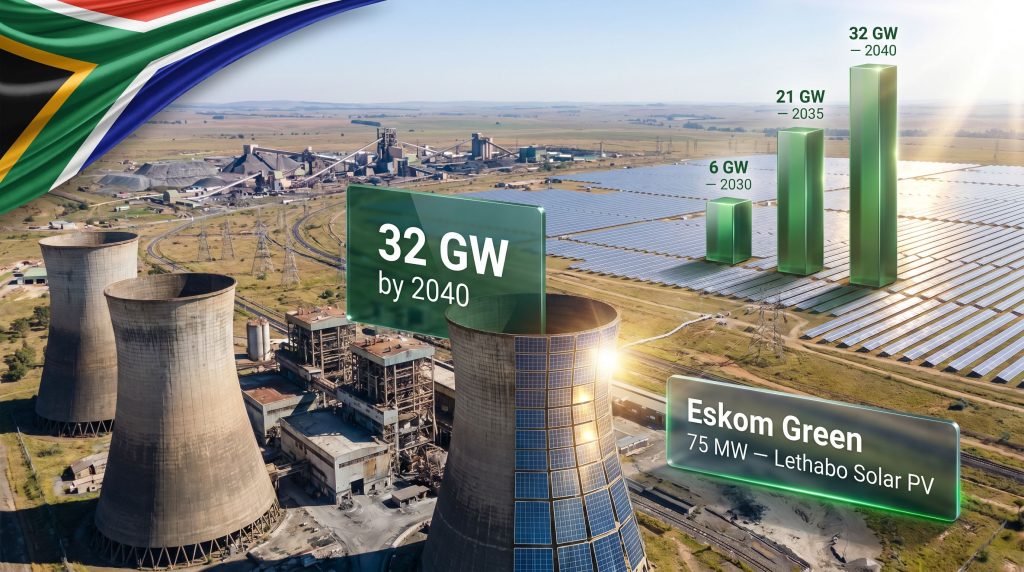
The scale of ambition embedded in Eskom's renewable energy strategy is striking in the context of African utility transitions. When Eskom announced its energy transition roadmap in July 2025, it held less than 1 gigawatt of operational renewable capacity. The target is to reach 32 GW of installed clean energy capacity by 2040, representing a more than thirtyfold increase over approximately fifteen years (Ecofin Agency, June 2026).
Simultaneously, coal-fired generation capacity would undergo a managed contraction from roughly 39 GW to 18 GW over the same period, meaning more than half of Eskom's existing thermal fleet would be decommissioned or repurposed. Against the backdrop of South Africa historically deriving 80 to 85 percent of its electricity from coal (Eskom Integrated Report, 2023), this represents a fundamental portfolio restructuring, not an incremental adjustment.
Staged Capacity Milestones Across Three Planning Horizons
| Planning Horizon | National Renewable Requirement (IRP 2025) | Eskom Green Contribution Target |
|---|---|---|
| By 2030 | 5.6 GW | ~6 GW of low-carbon supply available |
| By 2035 | 21 GW | Accelerated project pipeline under development |
| By 2040 | 32 GW | Full strategic transition endpoint |
In the near term, Eskom has committed to making approximately 6 GW of low-carbon electricity available by 2030 through a portfolio of renewable generation and storage projects. Of this, at least 2 GW of projects are expected to enter construction from 2026 onward, providing a measurable near-term delivery test against which the unit's execution credibility will be assessed.
The IRP 2025 projections represent national planning targets embedded in South Africa's electricity sector framework. Eskom's internal targets for Eskom Green are designed to align with and contribute to these national milestones, though delivery is subject to financing, permitting, and grid integration variables outside any single entity's control.
How Will Eskom Green Actually Build Its Project Pipeline?
The 17 Priority Projects: Brownfield Conversion as a Capital Efficiency Strategy
One of the most structurally intelligent aspects of the Eskom Green model is its emphasis on existing infrastructure. The utility has identified 17 priority projects to be developed at current or transitioning coal-fired power station sites. This brownfield approach to renewable deployment carries several compounding advantages:
- Existing grid connection infrastructure eliminates one of the most capital-intensive and time-consuming aspects of greenfield renewable development
- Land already owned by Eskom reduces acquisition costs and removes a common source of project delay
- Established network nodes maintain grid resilience during the transition rather than creating new points of vulnerability
- Existing access roads, water infrastructure, and site services reduce development capital expenditure significantly
This strategy mirrors approaches taken by several European utilities during their own coal-to-renewables transitions, where repurposing thermal generation sites proved substantially faster and cheaper than developing equivalent greenfield capacity.
Lethabo and Komati: The First Concrete Proof Points
Among the first developments under this pipeline is a 75 MW solar photovoltaic plant planned for the Lethabo power station site in Free State province. Lethabo represents the brownfield conversion model in its earliest practical form: a functioning coal station site being partially reimagined as a solar generation facility while grid infrastructure remains in place.
The Komati complex, already the subject of considerable attention as a just transition demonstration site, is also expected to host one of the next renewable energy developments in the Eskom Green pipeline. Komati's prior decommissioning has made it a symbolic as well as practical candidate for renewable repurposing, and its development trajectory will be closely watched by both domestic and international observers of South Africa's energy transition.
The Role of Battery Storage and Hybrid Systems
Industrial customers cannot accept intermittency. The inclusion of storage systems and hybrid generation technologies within the Eskom Green supply proposition is not a peripheral feature: it is the mechanism that makes the proposition viable for heavy industrial offtakers operating continuous processes. Without firm, dispatchable power delivery, low-carbon electricity contracts carry unacceptable operational risk for mining and manufacturing customers. Storage integration is therefore central to the commercial model, not supplementary to it.
What Financial and Structural Barriers Could Derail Eskom Green's Ambitions?
Navigating Transition Under a $22 Billion Debt Load
The Eskom Green launch takes place against a financial backdrop that cannot be understated. Eskom carries estimated financial obligations exceeding $22 billion, a burden that has historically constrained capital deployment, delayed maintenance programmes, and limited the utility's strategic flexibility (Ecofin Agency, June 2026).
The weight of this debt makes the ring-fenced project vehicle model not merely a governance preference but a financial necessity. Without structural separation between Eskom Green's project financing and the parent entity's balance sheet, the cost of capital for renewable projects would likely be prohibitive.
The initial phases of Eskom Green's project pipeline will be funded through capital expenditure already approved within Eskom Holdings' budget, with the longer-term intent to establish dedicated project vehicles capable of drawing in private-sector and concessional financing independently.
The Implementation Gap: A Track Record That Demands Scrutiny
One of the most sobering data points in Eskom's own analysis is the implementation record under the 2019 Integrated Resource Plan. According to Eskom's assessment, only approximately half of the renewable projects that secured grid allocations and power purchase agreements under the IRP 2019 were actually constructed (Ecofin Agency, June 2026). This statistic is critical context for any assessment of Eskom Green's targets.
The failure to convert secured agreements into operational capacity reflects a cluster of structural problems:
- Grid allocation and power purchase agreements reached contractual stage but were not converted to construction commencement
- Coordination failures between public sector planning bodies and private sector execution parties created timeline slippage
- Financing bottlenecks at the project development phase, where early-stage capital is most difficult to secure, repeatedly stalled progress
The Self-Generation Disruption: A Shrinking Customer Base
Eskom Green faces an additional structural challenge from within its own market. Following years of damaging load-shedding that peaked in 2022 and 2023, South African households and businesses invested heavily in rooftop solar and hybrid photovoltaic systems. This shift has structurally altered electricity consumption patterns on the national grid, reducing demand from precisely the customer segments that Eskom historically depended on for cost recovery.
For Eskom Green specifically, this dynamic creates a competitive tension: the industrial customers it is targeting are simultaneously evaluating whether to source renewable power from Eskom Green or to build captive renewable generation behind the meter. The utility's ability to offer superior scale, reliability, and price certainty relative to captive alternatives will be a defining competitive test.
How Does Eskom Green Fit Within South Africa's Industrial Competitiveness Agenda?
CBAM and the Export Imperative
The European Union's Carbon Border Adjustment Mechanism creates a direct financial penalty on carbon-intensive inputs embedded in exported goods. For South African mining and metals exporters, the electricity intensity of their production processes makes the carbon content of their grid power a direct cost variable in European market access calculations. As CBAM expands in scope and similar frameworks emerge in other jurisdictions, access to verified low-carbon electricity shifts from an ESG aspiration to a commercial necessity.
The broader context of critical minerals demand further amplifies this urgency, given that mining operations producing battery metals and transition-critical resources face the steepest scrutiny over their carbon footprints. A comparative review of more than 20 power utility transitions globally found that successful renewable expansion at scale consistently required more agile organisational models capable of accessing diversified capital sources and compressing project delivery timelines (Ecofin Agency, June 2026). This finding reinforces the structural logic behind Eskom Green's subsidiary design.
In addition, the mining decarbonisation benefits case has strengthened considerably as carbon border mechanisms become more punitive, making clean electricity supply contracts a genuine competitive advantage for exporters rather than a voluntary commitment. The green transition materials agenda similarly elevates South Africa's strategic position, provided its industrial base can credibly demonstrate low-carbon production credentials. Furthermore, green metals leadership models from comparable resource economies offer instructive precedents for how verified clean electricity can be leveraged as a national export advantage.
The next major ASX story will hit our subscribers first
Financing the Transition: Beyond the Eskom Balance Sheet
A Two-Phase Capital Architecture
Eskom's financing model for Eskom Green is structured in sequential phases:
- Phase One draws on capital expenditure already approved within the Eskom Holdings budget, providing near-term project funding without requiring external capital markets access
- Phase Two involves establishing ring-fenced project vehicles designed to attract private-sector investment, concessional development finance, and potentially green bond capital from international markets, reducing pressure on the parent entity's constrained balance sheet
Development finance institutions active in African energy markets represent a logical capital source for Phase Two, given their mandate to support low-carbon infrastructure and their appetite for blended finance structures in emerging markets. Green bond markets, which have grown substantially in depth and liquidity over the past five years, offer another potential avenue for Eskom Green to access international capital once the subsidiary governance structure is fully established and a credible project track record exists.
Three Scenarios for Eskom Green Over the Next Decade
| Scenario | Key Assumptions | Likely Outcome |
|---|---|---|
| Accelerated Delivery | Private capital mobilised early; IRP 2025 targets met on schedule | 6 GW+ operational by 2030; Eskom Green becomes anchor of national clean grid |
| Moderate Progress | Partial financing secured; some project delays repeat | 3 to 4 GW delivered by 2030; industrial customers partially served |
| Structural Stall | Debt constraints bind capital deployment; implementation gaps recur | Less than 2 GW by 2030; industrial decarbonisation demand captured by private IPPs |
The gap between the accelerated and structural stall scenarios is not merely a question of technical capacity. It is primarily a question of whether the financing architecture can be made operational quickly enough to convert the 2026 pipeline into construction-phase projects before the window of industrial customer demand is captured by competing private independent power producers.
Frequently Asked Questions: Eskom Green Launch
What is Eskom Green?
Eskom Green is a newly established renewable energy business unit within Eskom Holdings, created to develop, finance, and operate large-scale clean energy generation assets with a primary focus on South Africa's heavy industrial sector, particularly mining and manufacturing.
When will Eskom Green become a standalone subsidiary?
The unit will initially operate within Eskom Holdings before transitioning to a wholly owned subsidiary governed by an independent board of directors. A precise timeline for full structural separation has not been publicly confirmed.
What renewable capacity is Eskom targeting by 2040?
Eskom's energy transition strategy targets 32 GW of installed renewable capacity by 2040, with approximately 6 GW of low-carbon supply targeted by 2030 and an intermediate national planning requirement of 21 GW by 2035 under IRP 2025.
Which industries does Eskom Green primarily serve?
The commercial focus is on large industrial customers in mining and manufacturing, where demand for verified low-carbon electricity is accelerating in response to international carbon-border adjustment frameworks and ESG compliance pressures.
What is the Lethabo solar project?
The Lethabo solar project is a planned 75 MW photovoltaic installation at the existing Lethabo coal power station site in Free State province, representing one of the first concrete developments under Eskom's brownfield renewable conversion strategy.
How does Eskom Green differ from the previous green tariff programme?
Unlike the earlier tariff-based pilot that allowed customers to source electricity from Eskom's renewable portfolio through a pricing mechanism, Eskom Green is a structurally distinct entity with owned generation assets, integrated storage systems, dedicated financing vehicles, and an independent governance framework, offering industrial customers a fundamentally more robust and contractually certain supply proposition.
Readers seeking additional context on South Africa's energy transition and Eskom's restructuring journey may find related reporting from Ecofin Agency a useful reference point for tracking ongoing developments in African energy policy and utility reform. This article contains forward-looking projections and scenario analysis based on publicly available information. Actual outcomes may differ materially from those described, and nothing in this article constitutes financial or investment advice.
Want to Track ASX Opportunities in the Minerals Driving Africa's Energy Transition?
As demand for copper, lithium, and other transition-critical commodities intensifies alongside industrial decarbonisation programmes like Eskom Green, Discovery Alert's proprietary Discovery IQ model delivers real-time alerts on significant ASX mineral discoveries, turning complex exploration data into actionable investment insights — explore historic discovery returns and begin your 14-day free trial to position yourself ahead of the market.