
August 25, 2026
When the Deal Breaks Down: Understanding the Structural Vulnerability of Traditional Owner Royalty Rights in Australian Mining
Resource extraction in remote Australia has always operated within a web of competing interests, legal obligations, and cultural responsibilities. For decades, the dominant narrative framed mining agreements with traditional owners as a fair exchange: access to country in return for economic participation, employment, and ongoing consultation. However, when that exchange breaks down — as it has with devastating clarity in the collapse of Nathan River Resources — it exposes something far more troubling than a single company's financial failure. It reveals a systemic fragility at the heart of how Australia manages its social compact with Indigenous communities on native title land.
The story of Nathan River Resources unpaid royalties to traditional owners is not simply a story about corporate insolvency. It is a study in what happens when legal frameworks designed to protect Indigenous rights meet the harsh realities of mining sector economics, inadequate regulatory oversight, and an insolvency system that was never built with traditional owner interests in mind.
When big ASX news breaks, our subscribers know first
The Architecture of Consent: What Are Traditional Owners Actually Agreeing To?
To understand why the collapse of Nathan River Resources matters beyond its immediate financial figures, it is important to first understand what native title agreements actually represent. Under the Native Title Act 1993 (Cth), resource companies seeking access to land subject to native title must negotiate formal agreements with traditional owner groups. These agreements, commonly structured as Indigenous Land Use Agreements (ILUAs), are legally binding instruments that codify a set of reciprocal obligations.
The obligations typically include:
- Royalty payments calculated as a proportion of economic benefit generated from resource extraction
- Employment and training commitments for community members living near the operation
- Environmental rehabilitation requirements to restore land after operations conclude, in line with mine reclamation obligations increasingly scrutinised across the sector
- Ongoing consultation rights throughout the full operational life of the mine
What is often misunderstood is that these arrangements are not discretionary goodwill gestures. They represent the agreed consideration exchanged for access to country. The royalties, in particular, function as the economic backbone of the consent given by traditional owners to industrial activity on their land.
The Roper Bar open-pit iron ore mine, situated approximately 600 kilometres south-east of Darwin in the Northern Territory, sits within a region of deep cultural and ecological significance to Aboriginal communities, including those in the nearby town of Borroloola. It is against this backdrop that Nathan River Resources' failure to honour its obligations carries such profound weight.
The Scale of the Collapse: Breaking Down a $360 Million Creditor Liability
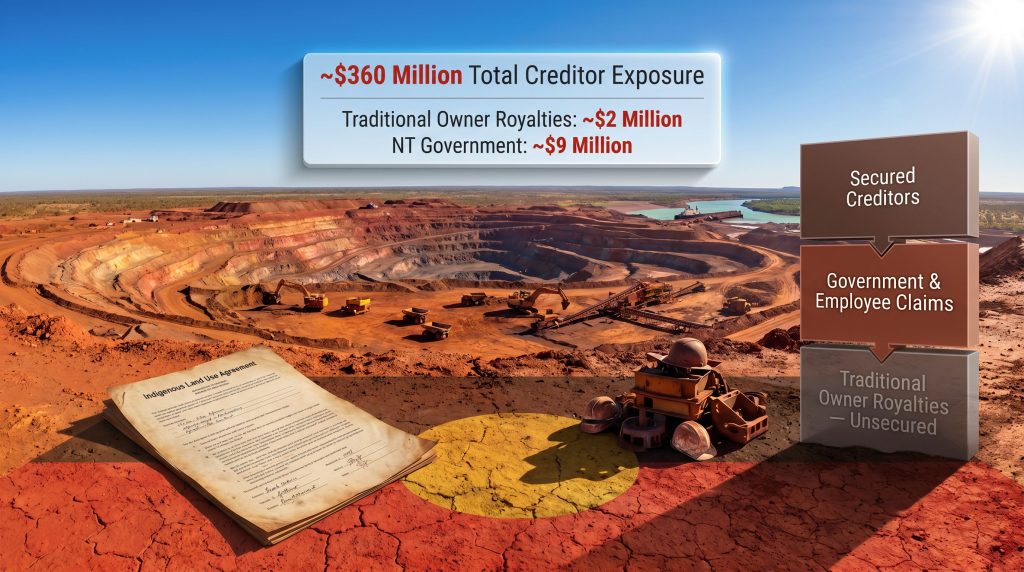
When Nathan River Resources entered voluntary administration in late May 2026, the full scope of its financial obligations became public. The total creditor exposure reached approximately $360 million, spanning government bodies, private contractors, employees, and traditional owners.
| Creditor Category | Estimated Amount Owed |
|---|---|
| Total creditor exposure | ~$360 million |
| Traditional owner royalties (via Northern Land Council) | ~$2 million |
| NT Government (royalties and payroll tax) | ~$9 million |
| Aboriginal workers in Borroloola (unpaid wages) | Multiple weeks (undisclosed amount) |
| Contractors and remaining private creditors | Remainder of ~$360 million |
The $2 million owed to traditional owners through the Northern Land Council must be contextualised carefully. In the remote communities of the Northern Territory, royalty distributions frequently provide funding for essential services, cultural programs, and economic development initiatives that have no viable alternative funding source.
Borroloola ranks among Australia's most socioeconomically disadvantaged communities, meaning the loss of even modest royalty income has consequences that are disproportionate to the nominal dollar figure. Furthermore, Aboriginal workers employed by Nathan River Resources in the Borroloola region were reportedly owed multiple weeks of unpaid wages at the time the company entered administration, creating a compounded impact on a single community already operating with limited economic buffers.
A Slow-Motion Collapse: What Were the Warning Signs?
The entry into administration was not a sudden event. Consequently, a pattern of financial and operational deterioration unfolded across several months, raising serious questions about when regulatory intervention should have occurred.
- April 2026 — Workers at the Roper Bar site were stood down without pay. The company attributed this decision to a fuel supply crisis affecting operations.
- April 2026 — Concurrent with the worker stand-downs, pollution and safety concerns emerged, with staff raising allegations of environmental contamination near the loading, barging, and mining areas. Photographic evidence of discoloured water near the operation became public.
- Late May 2026 — Nathan River Resources formally entered voluntary administration.
- June 2026 — ASIC documents and Northern Land Council statements confirmed the full scope of unpaid royalties, government debts, and worker entitlements.
Unions and contractors affected by the collapse publicly stated that government intervention in mining oversight should have occurred far earlier, given the visible and well-documented signs of operational distress. The government's position — that employment compliance was the company's own responsibility — drew considerable criticism for what observers characterised as a passive regulatory posture.
It is worth noting that the fuel crisis explanation for the worker stand-downs was widely questioned at the time. Critics argued it functioned as a convenient explanation that obscured deeper and longer-standing financial instability within the company's operations.
The Northern Land Council's Position: More Than a Financial Dispute
The Northern Land Council, which represents traditional owners in these matters, made clear through its public statements that the royalty failure was not merely a debt recovery issue. NLC CEO Yuseph Deen articulated a position centred on the fundamental principle that native title holders had agreed to mining activities specifically on the basis that companies would comply with their agreed obligations, including making scheduled payments.
This framing is critically important. It shifts the analysis from a purely financial question to a question about the integrity of the consent framework itself. The NLC's position identified harm across three distinct dimensions:
- Economic harm — Direct loss of royalty income that would otherwise fund community programs, economic participation, and essential services
- Environmental harm — Risk of long-term land degradation if rehabilitation obligations are abandoned in the wake of insolvency
- Structural harm — Erosion of trust in the native title agreement framework, with potential downstream effects on community willingness to consent to future resource projects
When a company fails to deliver on the economic commitments that underpinned community consent, it does not simply create a debt. It retroactively changes the character of the access that was granted, stripping away the agreed consideration and leaving traditional owners with the burdens of industrial activity on their land without the promised benefits.
The Environmental Rehabilitation Problem: An Unresolved Liability
Beyond the royalty shortfall, the environmental dimension of Nathan River Resources' collapse presents its own set of unresolved risks. Staff allegations of pollution near the Roper Bar loading, barging, and mining operations raised serious concerns about the site's current environmental condition, independent of any future rehabilitation questions.
The NLC explicitly called on the NT government to ensure that adequate financial security arrangements are in place so that site rehabilitation can proceed even if the company becomes fully insolvent. This highlights a well-known structural gap in Australian mining governance: the adequacy of rehabilitation bonds and security deposits. In addition, mining project feasibility studies have long identified rehabilitation cost modelling as a common area of underestimation in remote-region operations.
A comparison of rehabilitation security models across relevant jurisdictions illustrates how significant the policy gap can be:
| Jurisdiction | Rehabilitation Security Model | Key Feature |
|---|---|---|
| Northern Territory (current) | Operator-funded bonds | Adequacy questioned in insolvency scenarios |
| Queensland | Progressive rehabilitation requirements | Staged rehabilitation during operational life |
| Western Australia | Mine Rehabilitation Fund (MRF) | Industry-wide pooled fund for orphaned sites |
| British Columbia, Canada | Full-cost security requirement | 100% of estimated rehabilitation cost held upfront |
The NT government confirmed it would continue to monitor NRR's operations to ensure environmental obligations were met, and that the Department of Mining and Energy had engaged with the Fair Work Ombudsman regarding affected employees. However, no specific public commitment to funding rehabilitation in the event of full insolvency had been made at the time of reporting.
The next major ASX story will hit our subscribers first
The Insolvency Law Gap: Why Are Traditional Owners Structurally Exposed?
Perhaps the most consequential systemic issue exposed by the Nathan River Resources unpaid royalties to traditional owners situation is the position of traditional owner royalty claims within Australian insolvency law. Under current frameworks, royalty recipients are treated as unsecured creditors in administration proceedings. This means they rank behind secured lenders, priority employee entitlements, and government tax claims when recovering what is owed.
There is currently no specific legislative mechanism within Australian insolvency law that assigns a protected or preferential status to traditional owner royalty obligations. Advocates have long argued that royalties negotiated under native title agreements carry a unique legal and cultural character that distinguishes them from ordinary commercial debts, and that this distinction should be reflected in their treatment during insolvency proceedings.
This structural vulnerability is not unique to this case. A broader pattern exists across Australian mining history where Indigenous communities have been left at the back of the creditor queue when operators fail. Furthermore, the Indigenous mining claims framework applied in comparable jurisdictions demonstrates that alternative legal architectures — ones offering stronger protections — are entirely workable:
- Royalty obligations are typically classified as unsecured claims, competing with banks and trade creditors for a share of depleted assets
- The concentration of Aboriginal employment within single remote mining operations creates amplified economic shock when those operations collapse
- Environmental liabilities in remote regions frequently remain unaddressed following operator insolvency, with costs either borne by government or left unresolved for future generations
Reform Pathways: What Would Actually Protect Traditional Owners?
Policy and legal discussions in Australia have identified several reform mechanisms that could meaningfully reduce the exposure of traditional owner communities to the kind of harm experienced in the Nathan River Resources unpaid royalties to traditional owners collapse. However, addressing mining permitting risks alongside insolvency frameworks will ultimately be necessary for any comprehensive solution.
- Royalty trust accounts — Mandating that mining companies deposit royalty payments into quarantined trust accounts on a rolling basis, preventing the accumulation of arrears that become unrecoverable in insolvency
- Enhanced rehabilitation bonds — Recalibrating financial security requirements to reflect genuine full-cost rehabilitation estimates, particularly for remote and ecologically sensitive sites
- Preferential creditor status — Legislatively elevating traditional owner royalty claims above general unsecured creditor status in insolvency proceedings, recognising their unique legal character
- Early regulatory intervention triggers — Establishing defined financial and operational indicators (such as worker stand-downs or missed royalty payments) that automatically trigger mandatory regulatory scrutiny
- Enforceable community benefit agreements — Strengthening the legal enforceability of commitments made to traditional owners beyond what current ILUA frameworks provide, including penalty mechanisms for non-compliance
The NT government's dual role in this situation deserves particular scrutiny. As both a royalty creditor owed approximately $9 million and the primary regulatory authority responsible for environmental and employment oversight, questions arise about whether conflicting interests affected the timeliness of regulatory intervention. Unions and contractors have been explicit in their view that earlier action could have materially reduced the scale of harm experienced by workers and communities.
Frequently Asked Questions
What are mining royalties paid to traditional owners?
Mining royalties paid to traditional owners are financial payments made by resource companies in exchange for rights to extract minerals from land subject to native title claims. They are typically negotiated through formal ILUAs, administered by land councils, and distributed to traditional owner groups as agreed economic consideration for access to country.
How much did Nathan River Resources owe in unpaid royalties?
Nathan River Resources owed approximately $2 million in unpaid royalties to traditional owners at the time it entered voluntary administration in late May 2026. These funds were to be distributed through the Northern Land Council.
What happens to royalty claims when a mining company enters administration?
Royalty recipients are generally classified as unsecured creditors in voluntary administration proceedings, meaning they rank behind secured lenders and priority creditors in the distribution of recovered assets. Recovery may be partial or nil depending on the outcome of the administration process.
Are Aboriginal workers also affected by the NRR collapse?
Yes. Aboriginal workers employed by Nathan River Resources in the Borroloola region were reportedly owed multiple weeks of unpaid wages when the company entered administration, compounding the financial impact on the community beyond the royalty shortfall alone.
Key Takeaways
- Nathan River Resources entered voluntary administration in late May 2026 with a total creditor liability of approximately $360 million
- Traditional owners were owed roughly $2 million in unpaid royalties through the Northern Land Council, while the NT government was separately owed approximately $9 million in royalties and payroll tax
- The Northern Land Council framed the failure to pay Nathan River Resources unpaid royalties to traditional owners as a structural breach of the consent framework underlying native title agreements, not merely a financial dispute
- Aboriginal workers in Borroloola were also owed multiple weeks of unpaid wages, amplifying the economic impact on an already disadvantaged community
- Environmental rehabilitation at the Roper Bar site remains unresolved, with no confirmed funding mechanism in the event of full insolvency
- Australian insolvency law currently provides no preferential protection for traditional owner royalty claims, creating structural vulnerability that reform advocates argue must be urgently addressed
- Reform options including royalty trust accounts, enhanced bonds, and preferential creditor status represent viable pathways to preventing the recurrence of outcomes like those experienced in the NRR collapse
This article is intended for informational purposes only and does not constitute legal or financial advice. Readers should seek independent professional guidance on matters relating to native title law, mining regulation, or investment decisions. Information relating to the administration of Nathan River Resources is based on publicly available reporting as of June 2026.
Want to Stay Ahead of Significant ASX Mineral Discoveries as They Happen?
Discovery Alert's proprietary Discovery IQ model delivers real-time alerts the moment significant ASX mineral discoveries are announced, transforming complex data across more than 30 commodities into clear, actionable insights for investors at every level — explore historic examples of major discovery returns to understand the opportunity, then begin a 14-day free trial at Discovery Alert to position yourself ahead of the broader market.