June 10, 2026
The Hidden Economics of Sovereign Smelting: Why Processing Infrastructure Has Become a National Security Asset
For most of the twentieth century, the value of a smelter was measured almost exclusively in tonnes processed and margins earned. Governments viewed these facilities as private industrial assets, occasionally significant to regional employment but rarely elevated to the level of strategic national concern. That framing has changed dramatically. The Nyrstar government funding to modernise Port Pirie and Hobart smelters is, consequently, one of the clearest expressions of this shift, as policymakers reassess legacy processing infrastructure not as relics of an industrial past but as critical nodes in a contested global supply chain.
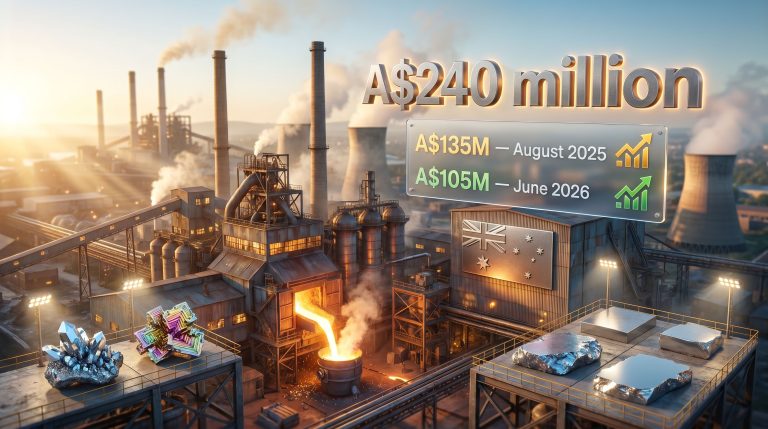
This shift forms the essential backdrop for understanding the multi-year, multi-government funding commitment now being directed at Nyrstar's Australian smelting operations at Port Pirie in South Australia and Hobart in Tasmania. The latest tranche of A$105 million in transitionary funding, directed toward feasibility studies and ongoing maintenance works, is not an isolated policy decision. It is the most recent chapter in a decade-long and increasingly substantial public investment in facilities that sit at the intersection of industrial legacy and critical minerals opportunity.
When big ASX news breaks, our subscribers know first
Understanding Transitionary Funding as an Industrial Policy Instrument
What Separates Transitionary Funding from an Outright Subsidy?
The term "transitionary funding" is used with increasing frequency in Australian industrial policy, but its precise meaning is often poorly understood. Unlike a direct subsidy, which transfers public money to a private operator without conditions tied to transformation, transitionary funding is designed as a bridge instrument.
Its defining characteristics include:
- A time-limited horizon, with funding tied to the advancement of a defined modernisation or feasibility pathway
- Milestone conditionality, meaning subsequent tranches are typically linked to demonstrated progress on engineering or operational targets
- An explicit expectation that private capital will co-invest in the rebuild phase once feasibility outcomes are established
- A defined exit logic, whereby the government's financial exposure is expected to diminish as commercial revenues from new production streams grow
In Nyrstar's case, the A$105 million tranche is structured to simultaneously maintain operational continuity at both sites while financing the engineering studies that will determine whether a full-scale capital rebuild is commercially viable. Without this dual function, either the feasibility studies stall for lack of funding or the physical assets deteriorate to the point where no rebuild is technically feasible.
The Cumulative Scale of Public Investment in Nyrstar's Australian Operations
The current funding round does not exist in isolation. Government financial involvement with these facilities stretches back well over a decade and represents a cumulative public commitment of considerable scale.
| Year | Funding Program | Contribution | Purpose |
|---|---|---|---|
| 2015 | SA Government taxpayer-guaranteed loan | A$291.25 million | TSL furnace upgrade at Port Pirie |
| 2022 onwards | SA Government Lead Action Plan | A$20.43 million | Community health and environmental measures |
| August 2025 | Federal + State transitionary package | A$135 million | Operational continuity and feasibility planning |
| 2026 | Additional transitionary tranche | A$105 million | Feasibility studies and maintenance works |
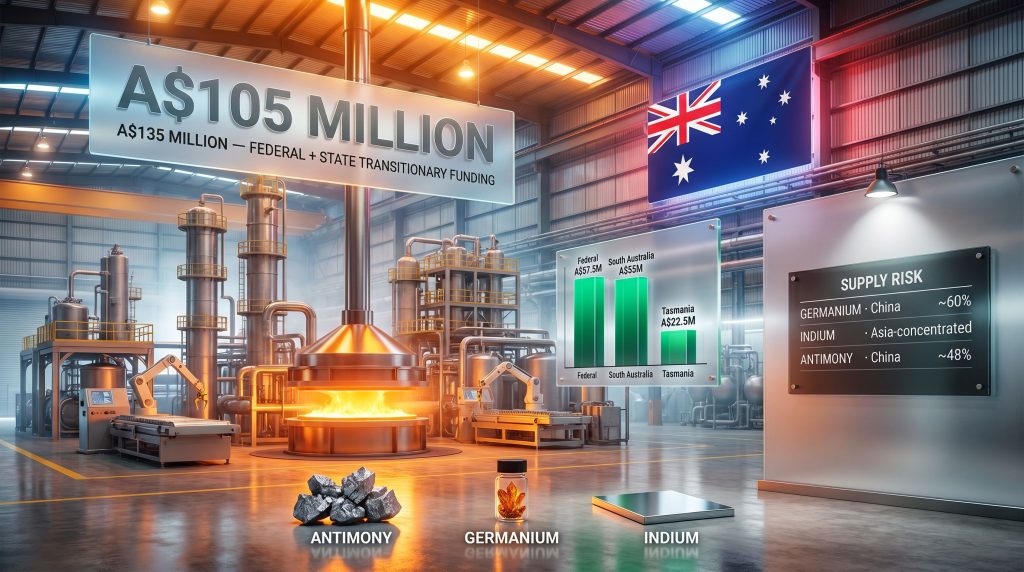
The August 2025 package was itself divided across three levels of government:
| Funding Source | Contribution |
|---|---|
| Australian Federal Government | A$57.5 million |
| South Australian Government | A$55 million |
| Tasmanian Government | A$22.5 million |
| Total | A$135 million |
When the 2015 loan guarantee and Lead Action Plan funding are added to the two recent transitionary tranches, the total public financial exposure across all levels of government exceeds A$550 million. This scale of commitment demands scrutiny not just of the strategic rationale but also of the policy design, milestone accountability, and contingency frameworks that govern its deployment.
The Critical Minerals Thesis: Why These Smelters Matter Beyond Zinc and Lead
Antimony at Port Pirie: From Industrial Byproduct to Strategic Priority
Port Pirie has operated for more than a century as one of the world's largest lead smelting complexes, processing polymetallic concentrates from mines across Australia and internationally. Its conventional output profile, centred on lead and zinc, tells only part of the story. The concentrates processed at Port Pirie have always contained a range of co-occurring metals, including antimony, which has historically been managed as a process impurity rather than recovered as a commercial product.
The modernisation strategy fundamentally reframes this. The first priority capital project under the current funding structure is the development of an antimony pilot plant, which would demonstrate the technical and economic viability of recovering antimony as a standalone commercial output.
Antimony's elevation from process nuisance to strategic target reflects its critical mineral classification across multiple Western government frameworks. Furthermore, antimony shortage risks have become increasingly pressing as its applications span:
- Flame retardants for electronics, textiles, and construction materials
- Lead-acid battery hardening, where antimony improves plate rigidity and battery longevity
- Emerging energy storage technologies, particularly antimony-based flow batteries being developed for grid-scale applications
- Military and defence systems, including infrared sensors, night vision equipment, and certain munitions components
China currently controls approximately 48% of global antimony supply, and its critical metals export controls, introduced in late 2024, have triggered significant price volatility and urgent interest from Western governments in establishing alternative supply chains. For Port Pirie, this creates a rare alignment between existing process chemistry and an acute geopolitical supply gap.
Hobart: Unlocking Germanium and Indium from Zinc Smelting Streams
The Hobart zinc smelter presents a different but equally compelling critical minerals opportunity. Germanium and indium are both technology metals that occur naturally as trace constituents in zinc sulphide ores. They are chemically similar to zinc in their ore-forming behaviour, which means they follow zinc concentrates through the smelting process and report to intermediate process streams where, with appropriate recovery circuits, they can be isolated and refined.
| Metal | Primary Industrial Applications | Global Supply Concentration |
|---|---|---|
| Germanium | Fibre optic cables, infrared optical systems, semiconductors, satellite solar cells | China controls approximately 60% of global refined output |
| Indium | Indium tin oxide for LCD and touchscreen displays, thin-film photovoltaic cells, semiconductors | Heavily concentrated in China, South Korea, and Japan |
| Antimony | Energy storage, flame retardants, defence electronics | China controls approximately 48% of global mine supply |
What makes the Hobart opportunity particularly technically interesting is that these metals do not require a separate mining operation. They are present in the ore feeds already being processed. The capital investment required is in downstream recovery and refining circuits rather than in new mine development, which significantly reduces the complexity and cost of establishing domestic supply. This is a defining characteristic of by-product critical mineral recovery at existing smelters: the sovereign supply chain benefit can be achieved at a fraction of the cost of building a greenfield mine and processing facility.
Technical context: Germanium recovery from zinc smelting typically involves directing specific intermediate leach residues through germanium-selective precipitation or solvent extraction circuits. The technology is well-established in Chinese and European zinc smelters but has limited deployment in Australia, making Hobart's feasibility work genuinely novel in a domestic context.
Prior Capital Works at Hobart: A Foundation for Modernisation
What Has Already Been Invested at the Hobart Facility?
A key piece of context that is often absent from discussions of the Hobart smelter is the extent of capital improvements that have already been made at the facility in preceding years. The smelter is considerably more technically advanced than its age might suggest. Prior upgrade works have included:
- Modernisation of gas purification systems to improve sulphur dioxide capture efficiency
- Expansion and improvement of sulfuric acid plant infrastructure, which processes off-gases into commercial-grade acid
- Enhanced leaching and purification circuits for improved zinc recovery from complex feed materials
- Introduction of mechanised zinc stripping technology, which improves cathode recovery rates and reduces labour intensity
- Deployment of casting automation systems that improve product consistency and throughput
These investments collectively mean that the current feasibility work is building on a technically capable foundation rather than starting from a deteriorated base. The outstanding question is whether the addition of critical mineral recovery circuits for germanium and indium can be integrated into the existing process flow in a way that is economically viable at commercial scale.
Feasibility Studies: The Decision Architecture That Will Determine Everything
How Engineering Feasibility Studies Progress Through Decision Gates
The A$105 million tranche is heavily oriented toward engineering-grade feasibility studies, which represent the analytical backbone of any major capital investment decision. In the mining and processing industry, a definitive feasibility study sits at the top of a defined hierarchy of increasing technical resolution and cost certainty:
- Scoping study — high-level assessment of technical viability and order-of-magnitude cost estimates, typically with cost accuracy of plus or minus 40 to 50 percent
- Pre-feasibility study (PFS) — refined process design, updated resource and cost estimates, with accuracy improving to plus or minus 20 to 25 percent
- Definitive feasibility study (DFS) — bankable-grade analysis with detailed engineering, firm cost estimates, and sufficient rigour to support investment decisions and project financing, typically at plus or minus 10 to 15 percent accuracy
Each stage involves progressively greater expenditure and is typically subject to a formal decision gate before proceeding. The outcome of the DFS will ultimately determine whether a full-scale capital rebuild is recommended, at what capital cost, and on what timeline. If the studies return an unfavourable investment case, the government faces difficult choices about whether to continue operational support, accept closure, or seek alternative operators.
Maintenance and Asset Integrity: The Parallel Priority
Running alongside the feasibility work, the funding also supports critical asset integrity and maintenance programs that are essential to keeping both smelters operational during the study period. Key maintenance priorities include:
- Furnace maintenance and refurbishment at Hobart to ensure process continuity
- Wharf infrastructure investment at Hobart to maintain concentrate logistics capability
- General plant maintenance at Port Pirie to sustain operational reliability throughout the transition period
This dual focus matters strategically. Feasibility studies take time, and a deteriorated or closed asset cannot be the subject of a meaningful rebuild decision. Maintenance investment during the study period is what keeps the option alive.
The Ownership Question and the Moral Hazard Debate
Trafigura's Role and the Private Capital Question
Nyrstar is wholly owned by Trafigura, one of the world's largest commodity trading and logistics companies, with annual revenues in excess of US$300 billion and operations spanning more than 150 countries. Trafigura acquired full control of Nyrstar in 2019 following a financial restructuring of the smelting company.
This ownership structure sits at the centre of the most legitimate criticism of the government funding framework. Critics argue that a highly capitalised private entity capable of deploying its own balance sheet is instead receiving sustained public support to maintain assets it owns commercially. The moral hazard concern is that repeated government interventions reduce the incentive for private owners to commit their own capital to facilities that carry genuine commercial and technical risk.
Proponents of the funding counter that the strategic value of retaining sovereign smelting capability justifies public co-investment, and that the transitionary nature of the funding is designed to catalyse rather than replace private capital in the eventual rebuild phase. The tension between these positions is real and unresolved, and it is sharpened by the absence of detailed public disclosure about the milestone conditions and co-investment obligations attached to the funding.
Port Pirie's Community Health Legacy and the Environmental Accountability Imperative
Any assessment of the Port Pirie modernisation must engage seriously with the facility's community health legacy. Port Pirie has recorded elevated blood lead levels in its residential population for decades, a direct consequence of a century of lead smelting operations in close proximity to residential areas. The South Australian Government's transformation project, alongside the Lead Action Plan funded at A$20.43 million since 2022, represents an institutional acknowledgment of this legacy.
The critical question for the modernisation program is whether the rebuilt or upgraded facility will deliver measurable improvements in emissions performance and community health outcomes, or whether the addition of new process streams introduces new environmental compliance obligations that must be carefully managed. Any viable long-term future for Port Pirie must demonstrate genuine progress on this dimension, not merely operational continuity.
The next major ASX story will hit our subscribers first
Australia's Processing Gap and the Long Road to Industrial Policy Maturity
Resource Exporter to Processing Nation: The Structural Challenge
Australia's position as one of the world's most resource-endowed economies but one of its least developed processing nations is well documented. The country exports enormous volumes of raw and partially processed ore while capturing a relatively small share of the value generated further along the processing and manufacturing chain. In addition, Australia's critical minerals strategy highlights the cost disadvantages of processing domestically relative to Asia, and the underinvestment in mid-stream infrastructure that converts mine output into refined materials.
The Nyrstar funding packages represent one of the most concrete operational expressions of the policy ambition to change this. However, the scale of public funding required merely to maintain existing smelting capacity highlights the depth of the structural challenge. Building a genuinely competitive mid-stream processing sector requires not just transitionary funding for individual assets but a coherent long-term framework capable of attracting sustained private capital at scale. Indeed, the broader challenge of strengthening critical minerals supply chains extends well beyond any single facility or funding round.
Policy benchmark: The true measure of success for Australia's smelter modernisation program will not be the cumulative quantum of public money committed. It will be the degree to which that public investment catalyses durable private capital commitment and establishes commercially self-sustaining sovereign processing capability in critical mineral streams.
What a Successful Outcome Looks Like
A genuinely successful outcome from the current funding and feasibility program would need to demonstrate several interconnected achievements:
- Commercially viable antimony recovery operations at Port Pirie, progressing from pilot plant through to full-scale production
- Proven and operating germanium and indium recovery circuits at Hobart, contributing to domestic supply chains for these technology metals
- A defined and funded capital investment pathway for full-scale smelter rebuilds, with meaningful private co-investment alongside any residual public support
- Measurable and verified improvements in environmental emissions and community health outcomes at Port Pirie
- A clear reduction in ongoing government transitionary support as commercial revenues from new production streams mature
Whether the feasibility studies now being funded will deliver the technical and commercial confidence required to reach these outcomes remains genuinely uncertain. The Nyrstar government funding to modernise Port Pirie and Hobart smelters has, however, committed substantial public resources to finding out.
This article contains forward-looking assessments about feasibility outcomes, government policy directions, and commercial viability of proposed processing operations. These assessments involve material uncertainty and should not be interpreted as investment advice or as confirmation of future project outcomes.
Want to Stay Ahead of the Next Major ASX Mineral Discovery?
Discovery Alert's proprietary Discovery IQ model delivers real-time alerts on significant ASX mineral discoveries — including critical minerals like antimony, germanium, and indium — instantly transforming complex data into actionable investment insights for both short-term traders and long-term investors. Explore historic examples of exceptional discovery returns or start your 14-day free trial today to position yourself ahead of the broader market.