June 10, 2026
The Hidden Complexity of Smelter Economics: Why Processing Capacity Is the Bottleneck Nobody Talks About
The global race to secure critical minerals has almost exclusively focused on the mining end of the supply chain. Exploration budgets, resource estimates, and drilling results dominate investor conversations, while the downstream processing infrastructure that transforms raw ore into usable metal quietly deteriorates. This imbalance creates a structural vulnerability that is only now being recognised by policymakers: you can mine all the zinc, antimony, and indium in the world, but without functioning smelters, those resources remain commercially inert.
This is the industrial reality underpinning the multi-jurisdictional funding package secured for Nyrstar smelter support amid legal troubles, and it explains why governments are willing to extend financial support to a company simultaneously navigating serious criminal scrutiny in Belgium.
When big ASX news breaks, our subscribers know first
The Strategic Minerals Imperative: Why Smelter Continuity Matters
What Makes Zinc and Multi-Metal Smelting Strategically Critical in 2026?
Zinc smelting rarely captures headlines, yet the metal underpins some of the most essential industrial processes in modern economies. Galvanisation, which protects steel from corrosion, accounts for roughly half of global zinc consumption. Beyond that headline use, zinc is a component in brass alloys, pharmaceuticals, and agricultural micronutrients. However, the more compelling strategic argument in 2026 centres on the by-products of zinc smelting operations rather than zinc itself.
Complex polymetallic smelters, particularly facilities processing secondary feeds and concentrates from multiple ore sources, yield a suite of critical metals as co-products. These include:
- Antimony – increasingly critical for flame retardants, ammunition, and emerging energy storage applications, with antimony shortage risks becoming a genuine geopolitical concern
- Indium – essential for flat-panel displays, thin-film solar cells, and semiconductor manufacturing
- Germanium – a semiconductor material used in fibre optics, infrared optics, and solar energy systems
- Bismuth – a relatively non-toxic replacement for lead in pharmaceuticals, cosmetics, and some alloys, though bismuth export controls are reshaping supply dynamics
Each of these metals is produced in relatively small global volumes. Their supply chains are geographically concentrated, primarily in China, which creates significant leverage risk for Western nations dependent on high-technology manufacturing. The ability to produce even modest quantities domestically carries outsized strategic value.
The Role of Hobart and Port Pirie in Australia's Domestic Metals Processing Capacity
Nyrstar's Hobart facility in Tasmania operates as one of the largest zinc smelters in the world by output capacity. Port Pirie in South Australia functions differently, as a multi-metals processing facility capable of handling complex, polymetallic feed materials that simpler smelters cannot economically process. Together, these two sites represent the backbone of Australia's domestic base and critical metals processing capability.
Losing either facility would not simply mean reduced zinc output. It would represent the permanent dismantling of specialised pyrometallurgical infrastructure that takes decades and billions of dollars to rebuild. The institutional knowledge embedded in the workforces at both sites, refined over generations of operations, is itself an irreplaceable asset.
Breaking Down the A$135 Million Government Support Package
How Much Did Each Government Contribute?
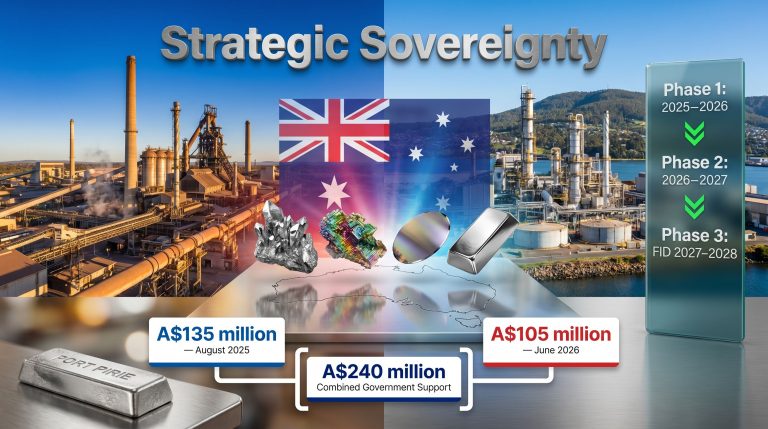
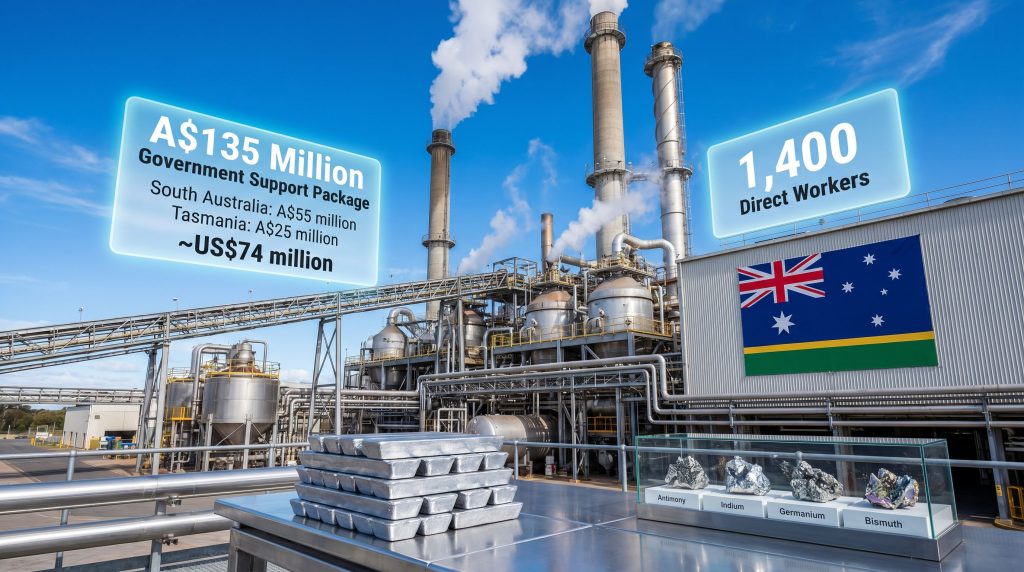
The funding structure involves contributions from three levels of Australian government, totalling approximately A$135 million (roughly US$74 million). The breakdown reflects the geographic distribution of the assets being supported:
| Government Level | Jurisdiction | Contribution |
|---|---|---|
| Federal Government | Australia | Remainder of total package (~A$55 million) |
| State Government | South Australia | A$55 million |
| State Government | Tasmania | A$25 million |
| Total Package | Multi-jurisdictional | ~A$135 million (approx. US$74 million) |
Note: The precise federal government contribution figure has not been independently confirmed at the time of publication. The total package figure of approximately A$135 million has been reported across multiple sources. Readers should verify individual contribution amounts through official government announcements.
What Is the Funding Designed to Achieve?
The package is not structured as a simple operational bailout. According to Nyrstar's public statements, the funding serves several distinct purposes:
- Short-term operational continuity and the preservation of asset integrity at both facilities
- Funding of feasibility studies to assess the full scope of large-scale smelter modernisation
- Expansion of critical and strategic minerals output across Australian operations
- Investment in essential maintenance and reliability programs to support safe and efficient ongoing operations
The distinction between immediate stability funding and longer-term feasibility work is important. Governments are not simply keeping the lights on; they are financing the analytical groundwork required to determine whether a full-scale modernisation investment is commercially and technically viable.
Why Were the Smelters at Risk Without Intervention?
Without financial intervention from government partners, Nyrstar's Australian smelting operations were reportedly losing tens of millions of dollars per month. The prospect of closure placed approximately 1,400 direct workers across Hobart and Port Pirie at immediate risk of unemployment, with significant downstream consequences for regional economies in Tasmania and South Australia.
The financial deterioration of these facilities reflects a broader structural challenge facing ageing smelting infrastructure globally. Many of the world's zinc smelters were built in the mid-twentieth century using technologies that, while functional, are no longer competitive against modern facilities with higher energy efficiency and greater metals recovery rates. Retrofitting or rebuilding requires capital commitments that private markets are reluctant to make unilaterally in the absence of long-term offtake certainty.
Furthermore, this challenge is not unique to Nyrstar. For instance, the Mount Isa smelter bailout demonstrated a similar pattern of ageing processing assets requiring government intervention to remain viable in competitive global markets.
What Is the Nyrstar Smelter Modernisation Program?
Feasibility Studies: Scope and Strategic Objectives
The feasibility studies being funded by the government package will assess two distinct but complementary modernisation pathways.
At Hobart, the focus is on upgrading the existing zinc smelting circuit to improve energy efficiency, increase throughput, and potentially expand the recovery of by-product metals. Modern zinc smelting technologies, including Outotec's roast-leach-electrowinning processes and more advanced Imperial Smelting Furnace configurations, offer substantially better recovery rates than legacy infrastructure.
At Port Pirie, the modernisation scope is arguably more ambitious. The facility already underwent a significant transformation through the Port Pirie Transformation project, which repositioned it as a multi-metals recovery hub rather than a single-commodity lead smelter. The current feasibility work appears aimed at deepening that diversification, particularly around the recovery of antimony, bismuth, and other specialty metals from complex feed materials. This aligns closely with developments in copper smelting expansion strategies being pursued across the broader industry.
Nyrstar's First Commercial Antimony Output: A Milestone Worth Examining
Earlier in 2026, Nyrstar announced the first shipment of commercially produced antimony metal from Port Pirie. This development is more significant than it might initially appear.
Why antimony matters in 2026:
- China controls an estimated 48% of global antimony mine supply and a dominant share of refined antimony output, according to the US Geological Survey
- Antimony trioxide is a primary flame retardant synergist used in plastics, textiles, and electronics manufacturing
- Antimony is being investigated as a cathode material in next-generation sodium-ion batteries, potentially opening a substantial new demand vector
- Western nations have moved to restrict or review antimony exports from China, creating acute supply chain anxiety among manufacturers
The fact that Port Pirie has achieved commercial-grade antimony output positions Nyrstar as one of very few Western-world producers at a moment of genuine supply stress. This milestone is not merely symbolic; it demonstrates the technical capability of the facility to extract value from metals that were previously considered waste streams or minor by-products.
An often-overlooked aspect of polymetallic smelting economics is that the profitability calculus changes dramatically when by-product credits are applied. A facility processing zinc concentrate that also recovers antimony, indium, and germanium is operating with a fundamentally different cost structure than one treating the same feed as a single-metal operation. The by-product revenue can, in favourable market conditions, effectively subsidise the primary smelting circuit.
The Legal Landscape: What Charges and Investigations Is Nyrstar Facing?
Antwerp Examining Magistrate's Office: Current Allegations
In June 2026, Nyrstar disclosed that the Antwerp examining magistrate's office had placed the company under suspicion on several charges. The allegations relate to suspected forgery and the use of forged documents in annual accounts, as well as alleged misuse of corporate assets. These are serious allegations under Belgian law, though it is critical to understand that being placed under suspicion by an examining magistrate is a procedural step within the Belgian criminal investigation system, not a conviction or even a formal charge in the common-law sense.
Nyrstar has publicly confirmed that it has not yet been granted access to the criminal file and is therefore unable to comment on the specific allegations or underlying facts at this stage. The company has stated it is cooperating fully with the ongoing investigation.
A Multi-Year Legal Timeline
Nyrstar's current legal difficulties cannot be understood without reference to the 2019 financial restructuring that fundamentally changed the company's ownership and control structure. That transaction transferred operational control of Nyrstar's assets to commodities trader Trafigura, a move that generated significant controversy among minority shareholders.
| Legal Event | Year | Outcome |
|---|---|---|
| Financial restructuring; Trafigura takes operating control | 2019 | Operating assets transferred |
| Minority shareholders file criminal complaints in Brussels | Post-2019 | Criminal investigation launched |
| Brussels criminal investigation dismissed | 2024 | Insufficient evidence to prosecute |
| Dismissal upheld on appeal | 2025 | Courts confirmed no prosecution warranted |
| Belgium FSMA Sanctions Committee ruling | 2025 | €80,000 (~US$92,000) fine issued |
| Antwerp magistrate places company under suspicion | 2026 | Investigation ongoing |
The Belgium Financial Services and Markets Authority Sanctions Committee finding in 2025 is particularly noteworthy from a disclosure governance perspective. The committee identified two separate infringements related to market-abuse and disclosure rules surrounding the Trafigura transaction, resulting in a fine of €80,000 (approximately US$92,000). While the fine itself is immaterial relative to Nyrstar's operational scale, the finding confirms that regulatory bodies identified shortcomings in how the company communicated with markets about a transformational corporate event.
How Do Governments Justify Supporting a Company Under Criminal Scrutiny?
Industrial Policy vs. Corporate Governance: The Tension Explained
Governments regularly face situations where strategically important industrial assets are controlled by entities with governance deficiencies or legal complications. The policy calculus in these situations involves weighing several competing considerations:
-
Asset irreplaceability: Can the industrial capability be preserved or rebuilt if the operator fails? For complex smelting infrastructure, the answer is almost always no, at least not within a politically relevant timeframe.
-
Separation of asset and operator: Funding directed at maintaining physical infrastructure and conducting feasibility studies is structurally different from underwriting the legal or financial liabilities of corporate leadership.
-
Employment and regional economics: The concentration of 1,400 direct jobs across two regional centres in Tasmania and South Australia carries substantial political weight. The economic multiplier effect of large industrial employers in non-metropolitan regions typically amplifies the true employment impact significantly.
-
Supply chain sovereignty: The ability to produce antimony, indium, germanium, and bismuth domestically is valued independently of the financial health of the current operator.
Workforce and Regional Economic Considerations
The 1,400 direct employment figure understates the true economic exposure. Industrial smelting operations of this scale typically support a contractor workforce that can equal or exceed the direct headcount, alongside significant indirect employment in logistics, consumables supply, maintenance services, and local retail and hospitality sectors.
Port Pirie, with a population of approximately 14,000, has historically been shaped almost entirely by smelting activity. The closure of major processing operations in similarly sized regional towns has produced generational economic scarring that takes decades to reverse. Tasmania's economic geography presents analogous dynamics around Hobart's industrial precincts.
Critical Minerals Supply Chain Security
Australia's broader policy framework around critical minerals processing is relevant context here, though it is important to distinguish between general policy settings and specific project-level commitments. The development of a critical raw materials facility model in Europe offers a useful parallel for how governments can structure long-term processing commitments. Whether Australia's alignment with similar objectives translates into sustained long-term public investment remains to be seen.
The next major ASX story will hit our subscribers first
Is the Government Support Package a Long-Term Fix or a Temporary Lifeline?
Scenario Analysis: What Happens Next?
The transitional nature of the current funding package means stakeholders must consider multiple outcome pathways. Each carries distinct implications for the approximately 1,400 workers at the sites and for Australia's domestic critical minerals processing capacity.
| Scenario | Likelihood | Outcome for Workers | Outcome for Critical Minerals Supply |
|---|---|---|---|
| Modernisation feasibility studies lead to full rebuild commitment | Moderate | Jobs secured long-term | Expanded critical minerals output across multiple metals |
| Funding expires without further commitment | Possible | ~1,400 direct jobs at risk | Domestic smelting and processing capacity permanently lost |
| Partial upgrade with reduced operational footprint | Moderate | Some job losses, core workforce retained | Constrained but continued output; some by-products deprioritised |
| Strategic acquisition or partnership secured | Lower probability | Workforce generally stabilised | Production continuity maintained under new capital structure |
Disclaimer: The above scenarios represent analytical projections based on publicly available information and general industry dynamics. They do not constitute financial advice and should not be relied upon for investment decisions.
What Milestones Must Be Met for Further Investment?
The feasibility studies will need to demonstrate several things before either governments or private capital will commit to a full modernisation program:
- Technical viability of the proposed modernisation pathways given existing site configurations
- A credible long-term concentrate supply agreement to justify capital expenditure
- Energy cost structures that make modernised operations internationally competitive
- Demonstrated recovery economics for by-product critical metals that improve overall facility margins
- Resolution, or at minimum containment, of the ongoing Belgian legal proceedings to reduce governance risk perceptions among potential co-investors
Frequently Asked Questions: Nyrstar Smelter Support and Legal Troubles
How much government funding has Nyrstar received for its Australian smelters?
Nyrstar has received approximately A$135 million (roughly US$74 million) from a combination of the Australian federal government, the South Australian state government (A$55 million), and the Tasmanian state government (A$25 million).
What is Nyrstar accused of by the Antwerp examining magistrate's office?
The Antwerp examining magistrate's office placed Nyrstar under suspicion in 2026 on allegations including forgery and use of forged documents in annual accounts, and alleged misuse of corporate assets. The company has not yet been granted access to the criminal file and has confirmed it is cooperating with the investigation.
How many workers are employed at Nyrstar's Hobart and Port Pirie operations?
Approximately 1,400 direct workers are employed across the two Australian facilities, with additional contractor and indirect employment substantially increasing the total economic exposure of these operations to their respective regional communities.
What critical minerals does Nyrstar produce at Port Pirie?
Port Pirie produces a range of metals beyond its primary operations, including antimony, bismuth, indium, and germanium. In early 2026, Nyrstar completed its first commercial-grade antimony shipment from the facility, representing a significant operational milestone.
Has Nyrstar been convicted of any criminal offences?
No. The Brussels criminal investigation launched following minority shareholder complaints was dismissed in 2024 and again on appeal in 2025. The Antwerp investigation is ongoing. The Belgium FSMA Sanctions Committee issued a €80,000 fine in 2025 related to market-abuse and disclosure infringements, but this was a regulatory sanction, not a criminal conviction.
What is the connection between Nyrstar and Trafigura?
In 2019, Nyrstar underwent a financial restructuring that transferred operational control of its assets to Trafigura, one of the world's largest commodity trading firms. This transaction became the focal point of subsequent minority shareholder complaints and regulatory investigations regarding the adequacy of disclosures made to markets at the time.
Is the Australian government funding permanent or temporary?
The current package is explicitly framed as transitional and bridge funding. Its purpose is to maintain operational stability while feasibility studies determine whether a larger, long-term modernisation investment is justified. No permanent funding commitment has been announced.
Key Takeaways: Industrial Strategy at the Intersection of Corporate Accountability
What This Case Reveals About Critical Minerals Policy and Governance
The Nyrstar smelter support amid legal troubles crystallises a dilemma that will become increasingly common as governments pursue domestic critical minerals processing ambitions: the most strategically valuable industrial assets are frequently those with the most complex corporate histories. Ageing smelters, incumbent operators with balance sheet stress, and the irreplaceable nature of processing infrastructure create a policy environment where waiting for governance perfection before acting means accepting the permanent loss of the asset.
This does not mean governance concerns are irrelevant. The structure of the funding package, directed at physical asset maintenance and analytical feasibility work rather than operational subsidies or balance sheet repair, reflects a deliberate attempt to separate legitimate public interest investments from corporate financial support.
The Broader Lesson for Governments Navigating Strategic Asset Support
Across multiple jurisdictions, the pattern is becoming familiar. Governments in the United States, Canada, the European Union, and now Australia are finding themselves in the position of either accepting the loss of critical processing infrastructure or deploying public capital to prevent it. The long-term cost of losing that infrastructure, measured in supply chain dependence, rearmament of geopolitical leverage, and the decades required to rebuild, typically dwarfs the short-term cost of intervention.
The more difficult policy question is not whether to intervene, but how to structure that intervention to maximise public interest outcomes while minimising the moral hazard of underwriting private operators whose corporate conduct has fallen short of expected standards.
What to Watch in the Months Ahead
Several developments will shape how this situation of Nyrstar smelter support amid legal troubles evolves in the coming months:
- The progress and preliminary findings of the feasibility studies at Hobart and Port Pirie
- The trajectory of the Antwerp criminal investigation and whether formal charges are ultimately laid
- Commercial performance of the antimony production programme at Port Pirie, and whether additional by-product streams are activated
- Any announcements regarding private sector co-investment or strategic partnership for the modernisation programme
- Evolving antimony, indium, and germanium market conditions, which will materially influence the economics underlying any modernisation business case
The intersection of strategic industrial assets, complex corporate governance histories, and genuine critical minerals supply chain imperatives makes the Nyrstar situation one of the more instructive case studies in contemporary resources policy. How it resolves will offer useful precedent for governments and investors navigating similar decisions across the global critical minerals landscape.
Want To Capitalise On The Next Major Critical Minerals Discovery Before The Market Does?
Discovery Alert's proprietary Discovery IQ model delivers real-time alerts on significant ASX mineral discoveries — including critical metals like antimony, indium, and germanium — transforming complex geological data into actionable investment insights the moment they hit the exchange. Explore historic discoveries and the returns they generated, then begin your 14-day free trial at Discovery Alert to position yourself ahead of the broader market.