August 2, 2026
The Hidden Cost of Fragmented Mining Software: Why Integration Is Now a Competitive Necessity
For decades, mine operators have tolerated a fundamental inefficiency baked into the way digital tools are deployed across their operations. Geology teams work in one system, planners in another, scheduling teams in a third, and underground operations managers in yet another. Each system generates valuable data, but the handoffs between them are manual, error-prone, and slow.
The operational blind spots created by these fragmented workflows are not just an inconvenience — they translate directly into suboptimal resource decisions, delayed production responses, and compounding cost overruns.
The mining industry's response to this challenge has been gathering momentum for several years, but 2026 represents a meaningful inflection point. The Micromine half-year release connected mining ecosystem signals a deliberate architectural shift away from a collection of capable but siloed tools and toward a genuinely connected platform — one where data flows between geological modelling, mine planning, scheduling, and operational monitoring without manual intervention or version conflict.
Understanding what this means in practice requires looking beyond the feature list and examining the structural logic underpinning the release.
When big ASX news breaks, our subscribers know first
What Makes a Mining Ecosystem Genuinely "Connected"?
The word "connected" gets used loosely in mining technology marketing. A more precise definition matters for operators evaluating platforms. Furthermore, data-driven mining operations are increasingly revealing just how costly disconnected systems can be in practice.
A genuinely connected mining ecosystem requires three things working simultaneously:
- Shared data infrastructure — a common layer where objects such as block models, grids, triangulations, and geological layers exist in a single authoritative version accessible across multiple software products
- Controlled collaboration mechanisms — access control, version tracking, and object locking that prevent simultaneous editing conflicts without restricting legitimate multi-team workflows
- Workflow continuity across functional domains — the ability for a design change made in one product to propagate into scheduling, planning, or operational monitoring environments without requiring manual re-entry
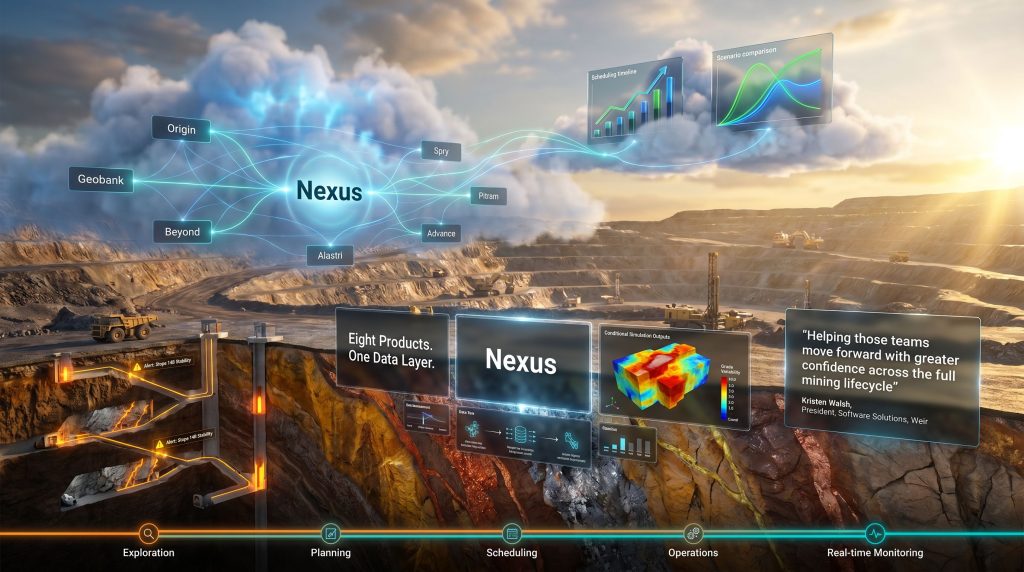
Micromine's Nexus cloud platform is the component designed to deliver all three simultaneously. Rather than bolting integration onto the surface of existing products, Nexus functions as the central data and workflow layer that individual products connect into. The 2026 half-year release represents the most substantial expansion of Nexus-anchored integration across the portfolio to date, with eight products receiving updates that deepen their connectivity through this shared infrastructure.
Key architectural insight: The Nexus-Spry integration introduced in this release is described explicitly as a first step toward broader cross-product connectivity. This framing signals that the 2026 release is a foundation, not a destination.
Nexus and the Eight-Product Integration Framework
The scope of the 2026 half-year release is best understood through the breadth of products it touches and the specific connectivity each gains through Nexus.
| Micromine Product | Primary Function | Nexus Integration Added in 2026 |
|---|---|---|
| Nexus | Cloud integration platform | Expanded licensing consolidation, access control |
| Spry | Short-term scheduling | Workspace linking, object sync, upload/download, object locking |
| Geobank | Geological database management | Deep integration for field-to-model data continuity |
| Origin | Geological estimation and modelling | Connected geological data flow, Conditional Simulation |
| Beyond | Open pit optimisation and design | Unified pit design and optimisation database |
| Alastri | Strategic mine planning | Scenario data access, Electrical Infrastructure Modeler |
| Advance | Underground planning | Controlled data synchronisation, Stope Optimizer |
| Pitram | Underground fleet and operations management | Real-time monitoring feeds into broader ecosystem |
The Nexus licensing consolidation deserves particular attention. By centralising access control across a larger portion of the portfolio, operations can manage exactly who has permission to view, modify, or publish shared objects — a capability that becomes critically important as teams grow larger, more distributed, and more dependent on common data assets.
Geological Decision Quality: Where Integration Pays Its First Dividends
Geobank: Stopping Errors Before They Reach the Model
One of the most consequential improvements in the release is also one of the least visible from the outside: early error detection in Geobank at the point of data entry.
In practice, geological data quality issues have a compounding effect. A mislabelled sample, an inconsistent assay record, or a stratigraphic misclassification entered into a field database may not surface until it has already influenced a resource estimate, informed a mine plan, or shaped a capital allocation decision. By the time the error is identified, unwinding its downstream effects is expensive and time-consuming.
Geobank's enhanced validation capabilities flag inconsistencies before they propagate through the data chain. Combined with Nexus integration that creates a single source of truth connecting field collection teams, database managers, and 3D modelling specialists, the data environment becomes both more reliable and more auditable. In addition, 3D geological modelling has become an increasingly critical layer in communicating these decisions effectively to stakeholders.
Origin: Conditional Simulation and the Shift to Probabilistic Geology
The addition of Conditional Simulation to Micromine Origin addresses a deeper challenge in geological decision-making that is less widely understood outside technical circles.
Traditional resource estimation methods produce a single "best estimate" of ore grade across a deposit. This deterministic output is computationally clean and easy to communicate, but it conceals something important: the actual grade distribution within any mining block is uncertain, and different realisations of that uncertainty can lead to materially different production outcomes.
What is Conditional Simulation in mining geology?
Conditional Simulation is a geostatistical technique that generates multiple equally probable representations of a geological attribute, such as ore grade, honouring the actual data at sampled locations. Rather than producing one estimated value, it creates a distribution of possible outcomes. This enables mine planners to understand the range of grade variability they might encounter, not just the most likely value.
The practical value is significant. A production schedule built on a deterministic grade model assumes a level of certainty that the underlying geology rarely supports. When actual grades deviate from the single estimate — which they routinely do — the production plan must be revised reactively. Conditional Simulation equips geological teams to communicate uncertainty quantitatively before planning decisions are made, shifting the error from a production surprise to a planning input.
Planning and Design: Speed, Integration, and Electrification
Beyond: Consolidating Pit Optimisation and Design
Micromine Beyond addresses a workflow friction point that affects nearly every open pit operation: the disconnect between optimisation outputs and the CAD environment where detailed pit designs are constructed.
Historically, mine planners have needed to export optimisation results from one system and manually reconstruct design elements in another. Each transfer introduces the possibility of version inconsistency and consumes engineering time that could be spent on higher-order analysis. By consolidating pit optimisation and design within a single database environment, Beyond eliminates this handoff and accelerates the iteration cycle between concept and executable design.
Alastri: Visual Scenario Comparison and the Electrification Imperative
Two capabilities in Micromine Alastri stand out for different reasons.
The Animated Scenario Comparison feature transforms how planning trade-offs are evaluated. Rather than comparing static outputs side by side, planners can visualise the progression of different planning scenarios in real time — a change that shifts decision-making from a document-review exercise to a dynamic analytical process.
The Electrical Infrastructure Modeler represents something more strategically significant. As mining operations globally accelerate the adoption of battery-electric vehicles and electric haulage systems as part of decarbonisation commitments, the electrical infrastructure requirements of those fleets must be planned at the mine design stage, not retrofitted after construction. Consequently, mining's electrification transition is reshaping what integrated mine planning software must deliver.
The implications of failing to model electrical infrastructure early are substantial:
- Undersized power distribution systems create operational bottlenecks for electric fleets operating underground or in remote open pit environments
- Charging infrastructure placement affects traffic flow, cycle times, and productivity in ways that compound across shifts
- Capital costs for post-construction electrical upgrades can be significantly higher than integrated upfront design
By embedding electrical infrastructure modelling directly into the mine planning workflow, Alastri positions Micromine as a software provider actively building for the operational realities of the energy transition rather than treating decarbonisation as a future problem.
Spry: Closing the Gap Between Design and Scheduling
The integration of Design Actions directly within Spry is operationally significant because it removes one of the most persistent handoff gaps in short-term mine management: the disconnect between what the mine design team has approved and what the scheduling team is actually working from.
When design changes are not synchronised to scheduling environments in a controlled way, schedulers either work from outdated designs or spend considerable time manually reconciling updates. Customisable Workflows in Spry add a further layer of operational ownership, allowing individual operations to define and standardise their own scheduling processes rather than adapting to a generic system logic.
Underground Operations: Automation and Real-Time Intelligence
Advance: Stope Optimisation and Automated Decline Design
Underground mine planning is computationally intensive, and execution time in tools like Stope Optimizer directly affects how quickly planners can respond to changing ore body conditions. The significant reduction in Stope Optimizer execution times delivered in this release is not a minor usability improvement — it changes the planning cadence available to underground engineers.
The Automated Decline Design Toolset goes further by generating complete ramp design alternatives without requiring manual CAD construction. For operations evaluating multiple decline configurations — whether driven by geotechnical constraints, ventilation requirements, or capital sequencing — the ability to generate and compare alternatives quickly reshapes what is practically achievable within a planning cycle. Automation has transformed what is considered a standard planning cycle in underground environments.
Pitram: Proactive Underground Monitoring
Real-time operational visibility in underground environments has historically lagged behind surface operations. The narrow response windows available in underground settings make reactive monitoring particularly costly — by the time a stockpile condition or extraction deviation is identified post-event, the opportunity for low-cost correction has often passed.
| Monitoring Approach | Detection Timing | Operational Consequence |
|---|---|---|
| Reactive (post-event analysis) | After disruption has occurred | Production loss, safety risk, recovery cost |
| Threshold-based Stockpile Alarms | Before critical condition is reached | Preventive intervention, reduced downtime |
| Material Draw Monitoring | During active extraction | Real-time correction, improved recovery rates |
Pitram's Stockpile Alarms allow operations to set configurable thresholds for ore pass and stockpile conditions, triggering alerts before disruptions occur. Material Draw Monitoring identifies over-draw, under-draw, or extraction deviations from stopes while corrective action remains feasible. Together, these capabilities represent a shift from monitoring as a historical record to monitoring as an operational decision-support tool.
The next major ASX story will hit our subscribers first
The Weir Group Context: Why Ownership Structure Shapes Software Capability
Micromine's position within the Weir Group matters for understanding the trajectory of the Micromine half-year release connected mining ecosystem strategy. Weir's broader mining technology portfolio includes hardware-adjacent technologies such as MOTION METRICS, which applies machine vision and sensor systems to equipment performance monitoring, and Fast2Mine, which addresses process simulation.
The strategic logic of combining process equipment intelligence with mine lifecycle software is that the operational picture available to mine operators becomes more complete. A platform that can connect geological estimates, mine designs, production schedules, underground monitoring data, and equipment performance metrics across a shared data environment is qualitatively different from any combination of point solutions that operators must integrate themselves.
Kristen Walsh, President of Software Solutions at Weir, has articulated the direction as one where every stage of the mining lifecycle is supported by intelligent, integrated technology built on a platform designed to scale with the operation. The emphasis on decision support under operational pressure — rather than data management as an end in itself — reflects an understanding that the user value proposition must translate to outcomes in the control room and at the face, not just in the data model. However, the broader AI-powered efficiency gains now emerging across mining software underscore just how rapidly this landscape is evolving.
What Mine Operators Should Evaluate When Comparing Connected Mining Platforms
The growth of integrated mine lifecycle software platforms creates genuine evaluation complexity for operators. Several dimensions matter:
- Data governance depth: How granular is access control? Can permissions be managed at the object level, or only at the product level?
- Workflow configurability: Is the system genuinely programmable for operation-specific processes, or does configurability mean selecting from a fixed menu of options?
- Integration breadth: Does connectivity span from exploration-stage geological data through to real-time operational monitoring, or does it cover only a portion of the lifecycle?
- Conflict resolution mechanisms: How does the platform handle simultaneous edits or version conflicts in shared data objects — and what is the audit trail when conflicts occur?
- Scalability architecture: Does the platform support growth from a single-site deployment to a multi-asset enterprise environment without requiring architectural changes?
The Nexus-anchored architecture in the Micromine half-year release connected mining ecosystem addresses several of these dimensions directly, with object-level locking and sync-status tracking as the primary conflict resolution mechanisms, and cloud infrastructure as the scalability foundation.
FAQ: Micromine Half-Year Release and Connected Mining
What is the Micromine 2026 half-year release?
It is a coordinated update across eight Micromine mining software products, centred on expanding integration through the Nexus cloud platform and strengthening capabilities in geological modelling, mine planning, scheduling, and underground operations management.
Which products were updated in this release?
Updates span Nexus, Geobank, Origin, Beyond, Alastri, Spry, Advance, and Pitram, covering exploration through to real-time operational monitoring.
What does the Electrical Infrastructure Modeler in Alastri do?
It enables mine planners to model the electrical infrastructure requirements of electric equipment fleets directly within the mine planning workflow, supporting decarbonisation planning at the design stage rather than as a retrofit.
Is the 2026 half-year release the completion of the connected ecosystem?
No. The Spry-Nexus integration is explicitly framed as a first step, indicating that further cross-product connectivity is planned in subsequent releases.
Where can users access the release?
The Micromine half-year release is available now for current platform users. Further details are available at micromine.com.
This article contains forward-looking descriptions of software capabilities and strategic directions based on publicly available information. Readers should conduct independent assessment before making technology procurement decisions. Platform capabilities and roadmap timelines are subject to change.
Want to Know Which ASX Mining Companies Are Benefiting From the Next Wave of Discovery Technology?
As integrated mining software transforms how deposits are identified and evaluated, Discovery Alert's proprietary Discovery IQ model scans ASX announcements in real time, delivering instant alerts on significant mineral discoveries so investors can act before the broader market catches on — explore the historic returns major discoveries have generated and begin your 14-day free trial today.