June 11, 2026
When Climate Events Collide With Critical Mineral Supply Chains
The global mining industry has long understood that geography is destiny. Where the world's most critical mineral deposits exist is rarely negotiated on favourable terms with nature. Laterite nickel deposits, which form through millions of years of tropical weathering in humid equatorial climates, are concentrated in precisely the regions most exposed to extreme weather events. Madagascar, the Philippines, Indonesia, New Caledonia, the Pacific Islands: these are both the world's great laterite nickel provinces and some of its most cyclone-vulnerable territories. Understanding this tension is essential context for evaluating what Ambatovy resumes nickel production after cyclone actually represents in the context of global supply chains.
When Cyclone Gezani forced a halt at Ambatovy's Toamasina processing facility in February 2026, causing material structural damage, it did not simply interrupt one mine's output. It stress-tested a fundamental assumption embedded in global battery supply chain planning: that large-scale High-Pressure Acid Leach (HPAL) operations in tropical jurisdictions can maintain consistent production throughput across full calendar years. The answer, as Ambatovy's four-month recovery period confirms, is complicated.
When big ASX news breaks, our subscribers know first
Understanding HPAL Technology and Why It Makes Restarts So Complex
To appreciate the significance of Ambatovy resumes nickel production after cyclone, it helps to understand what actually happens inside an HPAL facility. Unlike conventional sulphide nickel mines, which process ore using relatively straightforward flotation and smelting techniques, laterite operations require an entirely different metallurgical pathway. Furthermore, the cobalt mining industry is deeply intertwined with these same HPAL processes, making any operational disruption felt across multiple metal markets simultaneously.
What Happens Inside an HPAL Facility?
Laterite nickel ores contain nickel bound within iron and magnesium silicate minerals. To extract the metal economically, HPAL facilities subject slurried ore to temperatures exceeding 250 degrees Celsius and pressures above 40 atmospheres in the presence of concentrated sulphuric acid. This dissolves nickel and cobalt selectively from the ore matrix, allowing downstream precipitation and refining circuits to recover both metals in high-purity briquette form.
The critical engineering challenge here is that every component in this process chain operates under extreme thermodynamic conditions. Autoclaves, heat exchangers, acid storage systems, and tailings neutralisation circuits are all interconnected. Consequently, a cyclone that causes structural damage at any node in this chain does not simply knock out one piece of equipment: it potentially compromises the integrity of adjacent systems.
"HPAL facilities cannot simply be switched back on after physical damage. They require sequential recommissioning, environmental containment verification, and phased reintroduction of ore feed under controlled conditions before normal throughput can resume."
This is precisely why Ambatovy's recovery timeline, while appearing lengthy to outside observers, is actually a reflection of responsible recommissioning practice rather than operational failure.
The Step-by-Step Path Back to Full Production
Ambatovy's recommissioning sequence following Cyclone Gezani followed a structured methodology that is broadly consistent with industry best practice for HPAL restart scenarios:
- Structural integrity and safety assessment across all processing infrastructure before personnel re-entered operational zones.
- Environmental containment verification of acid storage, process streams, and tailings management systems to confirm no release pathways existed.
- Cold commissioning of the first acid plant, testing mechanical and instrumentation systems without live process materials.
- Hot commissioning of the first acid plant, reintroducing sulphuric acid and ore slurry under tightly controlled process conditions.
- Stabilisation of downstream nickel and cobalt circuits, including the mixed sulphide precipitation and refining stages.
- Recommissioning of the second acid plant, expanding total throughput capacity toward design levels.
- Full production normalisation, with both acid plants operating in parallel at target throughput.
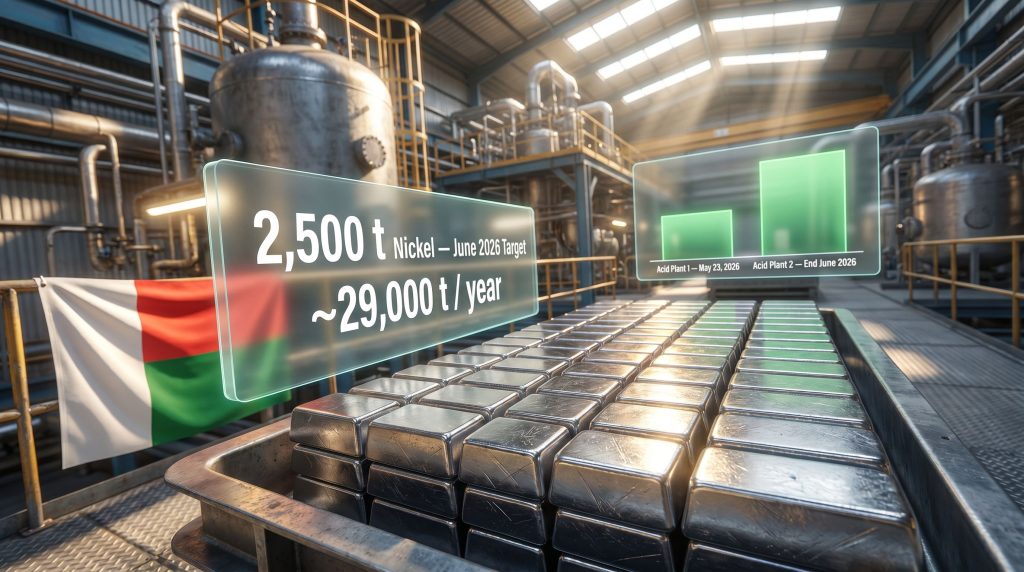
The first acid plant was restarted on May 23, 2026, with the second targeted for commissioning by end of June 2026. Against this backdrop, Ambatovy set a production target of approximately 2,500 metric tons of nickel and 250 metric tons of cobalt for June 2026 alone.
Production Numbers in Context: What the Data Actually Shows
To place the June 2026 targets in perspective, consider Ambatovy's 2025 baseline performance and what the recovery trajectory implies:
| Production Metric | 2025 Full-Year Output | June 2026 Target | Implied Monthly Run Rate | Annualised Recovery Rate |
|---|---|---|---|---|
| Nickel | ~29,000 metric tons | 2,500 metric tons | 2,500 t/month | ~30,000 t/year |
| Cobalt | ~2,700 metric tons | ~250 metric tons | ~250 t/month | ~3,000 t/year |
The implied annualised run rate from the June targets slightly exceeds 2025 full-year production, which suggests Ambatovy was targeting an operating rate at or above normal capacity as both acid plants reach full throughput. However, full-year 2026 output will be materially lower than 2025 given the approximately four months of lost production during the shutdown window.
A rough estimate of lost nickel output during the outage period sits around 9,600 metric tons, assuming linear production distribution across 2025. In addition, understanding global cobalt production supply dynamics helps contextualise why even a temporary loss of this scale reverberates through downstream battery material markets.
This article contains forward-looking production targets and market estimates. Actual outcomes may differ materially from projections based on operational, weather, regulatory, and market variables.
Ownership Transition and the Capital Architecture of Recovery
One of the more unusual dimensions of Ambatovy's post-cyclone rebuild involves its ownership structure at the time of the recovery. KOMIR (Korea Mine Rehabilitation and Mineral Resources Corporation), Ambatovy's current majority shareholder, contributed funding for the post-cyclone rebuild. Notably, Sumitomo Corporation, the Japanese trading house that sold its 54% stake in Ambatovy to a group of investors in May 2026, also contributed rebuild capital despite executing its divestment in the same timeframe.
Why Did a Departing Shareholder Help Fund the Rebuild?
This co-funding arrangement between a departing majority shareholder and an incoming ownership structure is unusual in large-scale mining. It raises several questions worth examining:
- Why would Sumitomo commit rebuild capital to an asset it was simultaneously divesting?
- Does the funding contribution reflect contractual obligations negotiated as part of the sale agreement?
- What does the incoming investor group's capital base suggest about long-term development ambitions for the operation?
While definitive answers to these questions are not publicly available, the arrangement underscores how complex ownership transitions in HPAL assets can become, particularly when weather events impose capital requirements mid-transaction.
KOMIR's continued involvement as the anchor shareholder carries strategic logic that extends well beyond pure commercial returns. South Korea is one of the world's most significant lithium-ion battery manufacturing nations, with companies such as LG Energy Solution, Samsung SDI, and SK On requiring stable, long-term access to battery-grade nickel and cobalt. Furthermore, the battery metals investment landscape increasingly reflects how state-backed entities like KOMIR are positioning themselves upstream to secure reliable cathode material supply chains.
Cobalt: The Less-Discussed but Strategically Critical Output
Global cobalt market commentary frequently focuses on the Democratic Republic of Congo, which accounts for over 70% of mined cobalt supply worldwide. This concentration creates substantial supply chain vulnerability for manufacturers seeking to reduce DRC dependency. Ambatovy's approximately 2,700 metric tons of annual cobalt output is therefore disproportionately significant relative to its share of total global cobalt production.
Several characteristics make Ambatovy's cobalt output particularly valuable:
- Briquette form factor: Ambatovy's cobalt briquettes are a highly processable feed material for cobalt sulphate refining, a key intermediate in battery cathode manufacturing.
- Non-DRC provenance: Western battery manufacturers and EV producers increasingly face supply chain due diligence obligations regarding DRC cobalt, making non-DRC sources command a structural premium in certain procurement frameworks.
- Co-product economics: Because cobalt is recovered as a co-product of nickel HPAL processing at Ambatovy, its marginal production cost is relatively low compared to standalone cobalt operations.
It is worth noting that cobalt demand dynamics are more nuanced than simple volume metrics suggest. The accelerating adoption of lithium iron phosphate (LFP) battery chemistry in Chinese passenger EVs has reduced cobalt intensity per kilowatt-hour for that segment. However, high-energy-density applications in premium EVs, consumer electronics, and aerospace continue to rely on nickel manganese cobalt (NMC) cathode chemistries, sustaining robust demand for refined cobalt. For instance, critical minerals in the energy transition are increasingly shaped by exactly these kinds of chemistry-level shifts in downstream demand.
The next major ASX story will hit our subscribers first
Madagascar's Cyclone Risk Profile: A Structural Challenge for HPAL Operations
Madagascar occupies a position in the southern Indian Ocean that places it directly in the path of tropical cyclones generated in the Mascarene High pressure system. The island experiences peak cyclone exposure between November and April, with February historically among the most active months for intense landfalling systems.
This seasonal risk window creates a recurring operational planning challenge for Ambatovy that has no straightforward engineering solution. HPAL facilities cannot be economically mothballed and recommissioned annually around cyclone season. The capital cost of maintaining hot standby across acid plants, autoclaves, and downstream circuits between seasons would be prohibitive.
How Does the Industry Manage Cyclone Risk at HPAL Sites?
Industry operators managing cyclone-exposed HPAL assets typically rely on a combination of approaches:
- Structural hardening of processing buildings and containment infrastructure to higher wind load specifications.
- Business interruption insurance to offset revenue loss during weather-related shutdowns.
- Pre-positioned emergency spares to accelerate equipment replacement after storm damage.
- Detailed recommissioning playbooks that reduce decision latency when restarts are authorised.
- Acid and tailings containment redundancy engineered to prevent environmental release during extreme weather events.
Cyclone Gezani's February 2026 strike, and Ambatovy's approximately three-month recovery to initial production, will likely inform revised cyclone preparedness standards not just at Toamasina but across the broader HPAL industry globally.
What Ambatovy's Recovery Signals for the Broader HPAL Sector
HPAL technology has a historically difficult track record. Projects at Murrin Murrin in Australia, Coral Bay and Taganito in the Philippines, and Ambatovy itself have each experienced periods of significant commissioning and operational difficulty. Ambatovy's capital cost at completion exceeded initial estimates substantially, and the project required ownership restructuring on multiple occasions before reaching operational stability.
Against that history, Ambatovy's production restart within roughly three months of a significant cyclone strike — and targeting near-normal monthly run rates on re-entry — is a meaningful indicator of operational maturity. It suggests that Ambatovy's technical and operational teams have developed meaningful institutional knowledge about their process, its failure modes, and its recovery pathways.
This matters for the broader industry context because the global nickel supply outlook increasingly depends on expanding HPAL capacity to process laterite deposits, particularly in Indonesia. Every operational data point from existing HPAL facilities, including post-weather-event recommissioning experiences, contributes to the industry's collective learning base. In addition, developments in lithium brine processing and other battery metal extraction technologies are being watched alongside HPAL advances as the energy transition accelerates demand across the board.
Frequently Asked Questions: Ambatovy Nickel Production Restart
What caused Ambatovy to stop producing nickel in 2026?
Cyclone Gezani struck Madagascar in February 2026, causing structural damage to the Toamasina processing facility. Operations were suspended while safety assessments, structural repairs, and environmental containment verification were completed.
When did Ambatovy restart nickel production after the cyclone?
The first acid plant was brought back online on May 23, 2026. The second acid plant was targeted for recommissioning by end of June 2026, with a June production target of approximately 2,500 metric tons of nickel and 250 metric tons of cobalt.
Who owns Ambatovy and who funded the rebuild?
KOMIR is the current majority shareholder and contributed rebuild funding. Sumitomo Corporation, which divested its 54% stake in May 2026, also contributed capital toward the post-cyclone recovery despite completing its exit in the same period.
Why is Ambatovy's cobalt output strategically important?
Ambatovy is one of relatively few large-scale cobalt producers operating outside the Democratic Republic of Congo. Its non-DRC cobalt output carries strategic value for battery manufacturers seeking supply chain diversification from DRC-concentrated sources.
What processing technology does Ambatovy use?
Ambatovy uses High-Pressure Acid Leach (HPAL) technology to process laterite nickel ore, recovering both nickel and cobalt in briquette form suitable for battery-grade refining pathways.
Want to Track the Next Major Critical Mineral Discovery Before the Market Does?
Discovery Alert's proprietary Discovery IQ model scans ASX announcements in real time, instantly identifying significant mineral discoveries across nickel, cobalt, and more than 30 other commodities — turning complex data into clear, actionable opportunities for investors at every level. Explore historic discoveries and their returns, then start your 14-day free trial at Discovery Alert to position yourself ahead of the market.