August 23, 2026
The Race to Own Africa's Critical Mineral Value Chain
The global mining industry is undergoing a structural transformation that extends far beyond commodity price cycles. For decades, African nations supplied raw ore to be processed elsewhere, with the economic value of refining captured by consuming nations. That model is fracturing. A combination of host government policy reforms, energy transition demand pressures, and deliberate capital deployment by Chinese resource companies is shifting the processing equation toward African soil itself.
The result is an emerging architecture of in-country beneficiation that is reshaping who controls the critical mineral supply chains underpinning the modern economy. Furthermore, critical minerals demand continues to surge as the energy transition accelerates, intensifying competition for African assets.
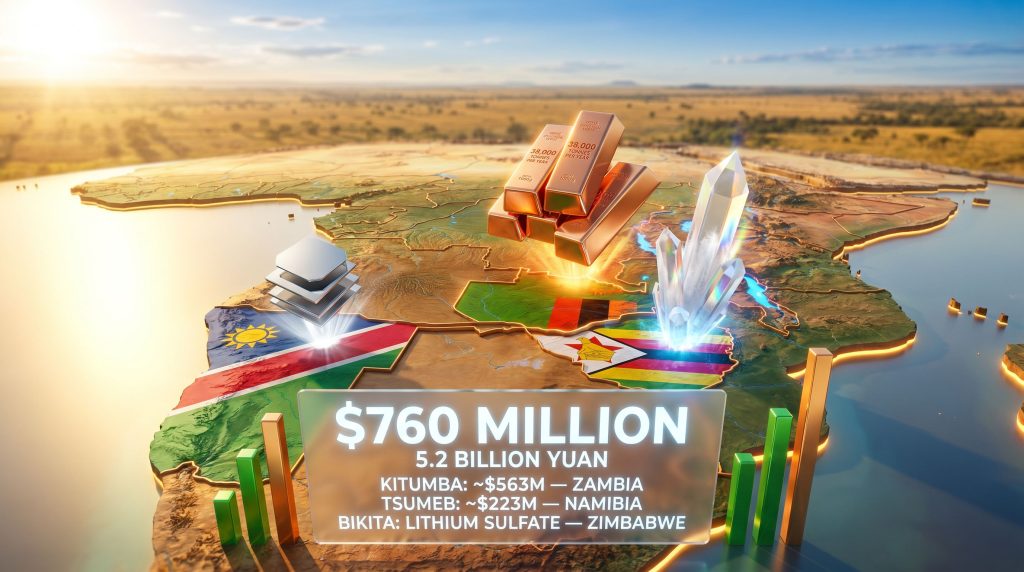
Against this backdrop, Sinomine seeks $760 million for African lithium and copper projects through a domestic Chinese private placement of approximately 5.2 billion yuan (around $760–764 million USD). This is more than a corporate financing event. It is a window into how Chinese mining capital is being systematically deployed to secure multi-mineral African supply chains at scale, spanning lithium, copper, and a category of specialty metals that most Western investors have barely begun to price into their strategic frameworks.
When big ASX news breaks, our subscribers know first
Why African Beneficiation Is the New Battleground
Understanding why Sinomine seeks $760 million for African lithium and copper projects requires understanding a shift in African resource governance that has been building for years. Across Zimbabwe, Zambia, Namibia, and the Democratic Republic of Congo, governments are progressively tightening raw material export frameworks to capture more downstream value domestically. This is not a uniform policy wave but rather a series of jurisdiction-specific experiments in resource nationalism, each shaped by local fiscal pressures and development objectives.
Zimbabwe's introduction of export controls on critical minerals such as raw lithium concentrate is the most visible example. The policy effectively mandates domestic processing before lithium can leave the country, creating a structural incentive for mining companies to invest in in-country refining capacity. For operators already present in Zimbabwe, this is both a constraint and an opportunity: those who build processing infrastructure gain export access and margin uplift simultaneously, while those who cannot finance the transition face curtailed operations.
Zambia's approach has been more gradualist, but the country's positioning within the Central African Copperbelt gives it extraordinary leverage. The Copperbelt, straddling Zambia and the southern DRC, contains some of the highest-grade copper deposits remaining on Earth. Access to this geology increasingly requires demonstrating integrated processing commitments rather than simple extraction proposals.
Namibia, by contrast, is leveraging its established industrial infrastructure at Tsumeb to position itself as a hub for secondary critical mineral recovery, particularly for metals that flow through existing smelter operations. This triangulation of three distinct African resource governance models is precisely what makes Sinomine's multi-country, multi-commodity program structurally interesting. In addition, African mining finance trends in 2025 suggest this kind of integrated capital approach is becoming increasingly common among Chinese operators.
Sinomine's Capital Program: What $760 Million Actually Buys
The capital raise is structured as a private placement directed at Chinese domestic institutional and qualified investors, keeping the fundraising entirely within the Chinese capital ecosystem. This has a practical consequence: the program operates outside the ESG-linked financing conditions that increasingly govern Western capital markets access, giving Sinomine greater execution flexibility on timelines and operational approaches.
The allocation across the program's components reflects distinct strategic priorities:
| Project | Location | Estimated Capital | Primary Commodity |
|---|---|---|---|
| Kitumba Copper Mine expansion | Zambia | ~$563 million | Copper |
| Rare metals recovery facility | Tsumeb, Namibia | ~$223 million | Germanium, Gallium |
| Bikita lithium sulfate plant | Zimbabwe | ~$400 million | Lithium sulfate |
| Cesium and rubidium project | Jiangxi, China | Domestic allocation | Specialty minerals |
| Working capital improvements | Corporate-level | Unspecified | General operations |
It is worth noting that reported total figures range from $760 million to $789 million depending on the currency conversion timing applied. The most granular project-level breakdown yields approximately $786 million when Kitumba and Tsumeb are added directly, suggesting the yuan-denominated figure of 5.2 billion yuan is the authoritative reference point. According to Yicai Global, Sinomine's total African investment commitment across these two primary projects sits at $789 million.
The Kitumba Copper Mine: Building a Full-Stack Copper Operation
The centrepiece of the Zambian commitment is Sinomine's decision to increase its total capital allocation to the Kitumba copper mine specifically to accelerate development velocity rather than expand scope. This distinction matters: the additional capital is being deployed to compress timelines and build out integrated mining, beneficiation, and smelting infrastructure concurrently rather than sequentially.
The production targets are substantive. Kitumba is projected to deliver an average of 38,000 tonnes of copper per year over a 15-year operational life, with first production targeted by the end of 2026. To contextualise this figure, global copper mine output totalled approximately 22 million tonnes in 2024, meaning Kitumba at full run-rate would represent roughly 0.17% of global supply from a single mine. For a mid-tier operation developed by a company not historically known as a primary copper miner, this is a significant production commitment.
The Copperbelt's geological endowment is genuinely exceptional. Ore grades in parts of the Zambian and Congolese Copperbelt regularly exceed 2–3% copper, compared to global average grades at major mines that have declined to below 0.6% in many jurisdictions. Higher grades translate directly to lower processing costs per unit of metal produced, improving project economics even in periods of copper price softness.
The full-stack model at Kitumba, incorporating smelting rather than simply concentrate production, positions Sinomine to deliver refined copper rather than intermediate product. This captures additional margin and reduces the company's exposure to treatment and refining charge negotiations with third-party smelters. However, the copper supply crunch facing global markets means integrated producers like Sinomine stand to benefit materially from tightening concentrate economics.
The Bikita Lithium Sulfate Plant: Downstream Margin Capture in Practice
Sinomine's Zimbabwean subsidiary, Bikita Minerals Ltd., operates one of the world's notable hard-rock lithium deposits. The $400 million lithium sulfate processing plant represents a deliberate move up the value chain from spodumene concentrate toward a processed intermediate that commands materially higher pricing relative to raw ore.
Lithium sulfate occupies an interesting position in the lithium processing hierarchy. Unlike lithium carbonate or lithium hydroxide, which are the terminal battery-grade products most commonly referenced in price benchmarks, lithium sulfate is an intermediate product used in further chemical processing. Its value proposition for Sinomine lies in converting a commodity that Zimbabwe's export controls restrict into a product category that can move freely through international trade channels.
Bikita Minerals has secured regulatory approval to resume exports under Zimbabwe's quota framework while the sulfate plant remains under construction, providing near-term revenue continuity. Once the plant reaches operational status, the company will be positioned to export a higher-margin product while simultaneously complying with Zimbabwe's beneficiation mandate. This dual-track approach reflects sophisticated regulatory navigation in a jurisdiction where policy consistency cannot be taken for granted.
Lithium prices experienced a severe correction through 2023 and into 2024 following the speculative demand-pull of 2022. Recovery is now underway, driven by structural EV adoption growth and grid storage deployment. Consequently, the global lithium market is tightening once more, and Zimbabwe's quota regime introduces an additional layer of artificial tightness in raw concentrate markets. Sinomine's downstream positioning therefore benefits from both commodity market recovery and policy-induced supply constraint simultaneously.
The Tsumeb Rare Metals Facility: The Most Underappreciated Component
The $223 million investment in germanium and gallium recovery at Tsumeb, Namibia, receives considerably less coverage than the lithium and copper programs, yet arguably carries the highest strategic significance on a per-dollar basis.
Both metals are classified as critical raw materials by the European Union, the United States, and China itself. Their applications span:
- Germanium: infrared optics, fiber optic cables, solar cells, satellite technology, and semiconductor substrates
- Gallium: compound semiconductors, LEDs, 5G radio frequency components, military-grade electronics, and solar panel manufacturing
What makes the Tsumeb model particularly distinctive is its feedstock source. Rather than developing a new mine, Sinomine is recovering germanium and gallium from industrial waste streams and smelter tailings generated by existing Tsumeb operations. This circular economy approach to critical mineral recovery has several advantages that conventional mine development cannot replicate:
- No geological discovery risk: the feedstock resource is already characterised
- Lower capital intensity: no mine development, shaft sinking, or primary crushing required
- Faster permitting profile: operating within an existing industrial site reduces new environmental assessment scope
- Circular economy credentials: waste stream monetisation aligns with ESG frameworks even if the capital is Chinese-sourced
The geopolitical dimension of this investment is acute. China introduced export restrictions on germanium and gallium in August 2023, requiring export licences for both metals in a move widely interpreted as a counter-measure to Western semiconductor export controls targeting China. The restrictions triggered immediate supply anxiety among Western defence contractors, telecommunications equipment manufacturers, and solar panel producers. Non-Chinese supply development became a strategic priority almost overnight.
Sinomine's Tsumeb facility extends Chinese dominance in these metals rather than reducing it, adding African secondary supply under Chinese corporate control. For Western governments attempting to diversify away from Chinese-controlled germanium and gallium supply, this is precisely the dynamic they are trying to prevent. A detailed Resource Justice report on Chinese mining expansion in Africa further contextualises the scale of this strategic challenge for policymakers.
Comparative Positioning Among Chinese African Mining Operators
Sinomine does not operate in isolation. The Chinese mining presence in Africa has become sufficiently large and diverse that meaningful competitive comparisons are now possible.
| Company | Primary African Focus | Key Countries | Commodity Mix | Integration Level |
|---|---|---|---|---|
| Sinomine Resource Group | Lithium, copper, rare metals | Zimbabwe, Zambia, Namibia | Multi-mineral | Mining to smelting |
| CMOC Group | Copper, cobalt | DRC, Zambia | Copper-cobalt | Mining to concentrate |
| Zijin Mining | Gold, copper | DRC, South Africa, Eritrea | Gold-copper | Mining to refining |
| Ganfeng Lithium | Lithium | Mali, Zimbabwe | Lithium | Mining to battery materials |
Sinomine's differentiating characteristic is breadth combined with processing ambition. While CMOC and Zijin have each achieved enormous scale in their primary commodities, Sinomine is pursuing simultaneous multi-commodity, multi-country development with a full-stack processing mandate across all three programs. No comparable Chinese operator is currently attempting to build out integrated processing capacity across lithium, copper, and rare metals in three different African jurisdictions under a single capital program.
This ambition also introduces risk. Executing three capital-intensive construction projects across three sovereign jurisdictions concurrently demands extraordinary management bandwidth, supply chain coordination, and regulatory relationship management. Construction cost inflation in the global mining sector has been substantial since 2021, and budget overruns at even one project could create material pressure on the consolidated program.
Risk Dimensions That Investors Should Not Ignore
Sovereign and Regulatory Exposure
Each of the three African jurisdictions presents distinct sovereign risk profiles:
-
Zimbabwe carries the highest political risk, with a history of policy reversals and a regulatory environment where export quota frameworks can change without extended notice. The beneficiation mandate that currently aligns with Sinomine's investment strategy could theoretically evolve in ways that alter the economics of the sulfate plant before it reaches full production.
-
Zambia offers a more predictable regulatory environment but has periodically adjusted royalty and tax regimes for mining operations. The country also manages significant external debt obligations, which can translate into fiscal pressure on foreign operators during periods of commodity price softness.
-
Namibia presents the most stable governance profile of the three, but the Tsumeb operation involves environmental sensitivity around industrial waste processing and tailings management that could attract regulatory scrutiny as environmental standards evolve.
The Multi-Project Execution Challenge
Simultaneous development of major capital projects across multiple jurisdictions is among the most operationally demanding undertakings in the mining industry. The risk of schedule compression in one project diverting management focus and capital from another is real, and the 2026 production target for Kitumba should be treated as aspirational rather than assured given the infrastructure scope required.
Geopolitical Headwinds
Growing Western concern about Chinese control of critical mineral supply chains in Africa is generating diplomatic friction that could eventually manifest as downstream product access restrictions or sanctions-adjacent measures. Western battery manufacturers, defence contractors, and technology companies increasingly face pressure to demonstrate supply chain independence from Chinese-controlled sources. Products flowing from Chinese-operated African facilities may encounter resistance in Western procurement processes, particularly for defence and semiconductor applications.
The next major ASX story will hit our subscribers first
What This Means for Global Supply Chain Architecture
The Sinomine program, viewed alongside the broader pattern of Chinese mining investment in Africa, signals an accelerating divergence in global critical mineral supply chain architecture. Chinese-controlled processing capacity in Africa is expanding rapidly, while Western-aligned supply development faces persistent challenges around permitting timelines, capital costs, and ESG compliance complexity.
The EU's Critical Raw Materials Act and the US Inflation Reduction Act's mineral provisions represent legislative attempts to incentivise non-Chinese supply development, but both face the fundamental challenge that Chinese firms have a multi-year first-mover advantage in African processing infrastructure. Building equivalent Western-aligned capacity from greenfield positions requires timelines of a decade or more in most jurisdictions.
The multi-mineral model that Sinomine exemplifies is increasingly being recognised as strategically superior to single-commodity exposure. Companies positioned across copper, lithium, and rare metals simultaneously can capture energy transition demand across multiple vectors while reducing the earnings volatility that comes with concentration in any single commodity cycle. Western majors including Rio Tinto and BHP have recognised this dynamic and are adjusting capital allocation accordingly, but from a position of relative disadvantage in African multi-mineral processing infrastructure.
For the countries hosting these investments, the calculus is more nuanced. Domestic processing creates jobs and retains more economic value in-country, fulfilling development objectives. However, processing infrastructure dominated by Chinese corporate ownership means the strategic leverage of that infrastructure ultimately sits with Beijing rather than Harare, Lusaka, or Windhoek. This tension between industrialisation goals and resource sovereignty is likely to define African mining diplomacy for the decade ahead. Sinomine seeks $760 million for African lithium and copper projects at precisely the moment this tension is reaching its most consequential inflection point.
This article contains forward-looking statements and projections related to production targets, capital timelines, and commodity market conditions. These involve inherent uncertainties and should not be construed as investment advice. Actual outcomes may differ materially from those described. Readers are encouraged to conduct independent research before making any investment decisions.
Want to Track the Next Major Mineral Discovery Before the Market Moves?
Discovery Alert's proprietary Discovery IQ model delivers real-time alerts on significant ASX mineral discoveries across copper, lithium, and critical minerals — instantly translating complex data into actionable investment insights for traders and long-term investors alike. Explore how historic mineral discoveries have generated extraordinary returns on Discovery Alert's dedicated discoveries page, and begin your 14-day free trial today to position yourself ahead of the market.