August 2, 2026
The Slow Collapse of a Diamond Empire: How Russia's Export Duty Gamble Reveals a Deeper Crisis
The diamond industry operates on timescales that most commodity markets would find unrecognisable. A cutting workforce built over generations can dissolve within a few years of market dislocation. The geological endowment that makes a nation a dominant producer means nothing if the skilled hands required to unlock its value have already moved on. This is the quiet emergency unfolding inside Russia's diamond sector, and it is the precise context in which Russia diamond export duties must be understood.
Rather than a revenue play or a protectionist reflex, Russia's proposed tariff framework on rough diamond exports represents something more structurally significant: an acknowledgement that sanctions have done lasting industrial damage, and that the window to reverse it may already be closing.
When big ASX news breaks, our subscribers know first
What the Export Duty Is Actually Trying to Save
Russia's diamond industry has long been vertically integrated in a way that few other producing nations can match. From the vast kimberlite pipes of the Sakha Republic, where temperatures drop below minus 50 degrees Celsius and mines operate year-round under permafrost conditions, through to cutting and polishing facilities in Moscow and other urban centres, the country developed an end-to-end diamond supply chain that was both a source of national income and a symbol of industrial sophistication.
The cutting and polishing segment of that chain is what is now at risk. Diamond craftsmanship is not a skill that can be taught quickly. Experienced polishers develop an intuitive understanding of how light moves through a rough crystal, how to orient a bruting wheel to maximise carat recovery, and how to navigate the internal fracture patterns that make each stone unique. These skills accumulate over careers, not semesters.
According to reporting by Reuters via Mining.com dated May 19, 2026, Russian Deputy Finance Minister Alexei Moiseev articulated this concern directly, stating that further delay risks the permanent loss of cutting expertise that Russia still retains. His framing made clear that the policy is fundamentally about human capital preservation, not tariff revenue generation.
The proposed framework would not apply uniformly to all rough exports. Duties would target only stones considered economically viable for domestic processing, a selective mechanism that reflects awareness of Russia's competitive limitations in the cutting segment relative to established hubs like India's Surat district, where labour costs and processing volumes create structural advantages that tariffs alone cannot overcome.
Alrosa's Production Decline: Reading Between the Numbers
To understand the urgency behind the export duty proposal, Alrosa's production trajectory tells a story of accelerating contraction.
| Year | Estimated Production | Year-on-Year Change |
|---|---|---|
| 2024 | ~33 million carats | Baseline reference |
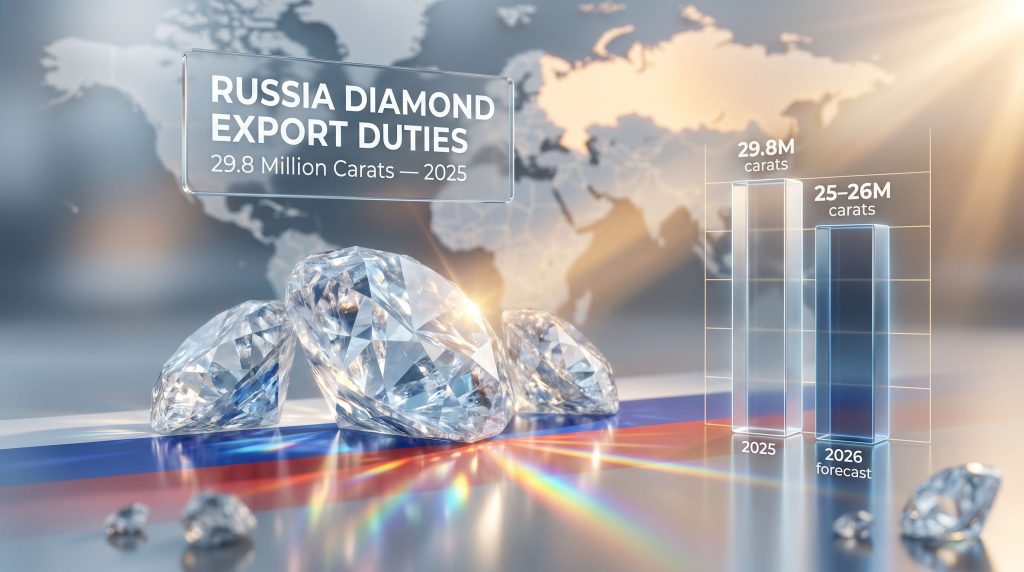
| 2025 | 29.8 million carats | -10% |
| 2026 (forecast) | 25 to 26 million carats | Further decline |
Source: Alrosa production data as reported by Reuters via Mining.com, May 19, 2026.
A 10% reduction in a single year is significant for any mining operation. For the world's largest diamond producer by carat volume, it signals something more than operational adjustment. Alrosa has been operating under US sanctions since 2022, a constraint that preceded the more comprehensive January 2024 G7 ban on Russian diamond imports. Together, these measures effectively closed off Western-facing demand channels that had historically absorbed the premium end of Russia's production.
The production curtailment is a rational response to diminished addressable markets, but it creates a secondary problem: smaller volumes of rough flowing through Russia mean fewer economically viable stones available for domestic cutters to work with. The export duty is partly an attempt to ensure that whatever rough is produced gets directed toward domestic processors before leaving the country, preventing a scenario where cutting facilities sit idle not because of sanctions but because all viable rough is being exported in unprocessed form.
Notably, despite Alrosa's extended financial difficulties, Russia's finance ministry has indicated it sees no current need to purchase diamonds for Gokhran, the state-owned precious stones and metals repository. This signals a preference for industrial policy instruments over direct state procurement as a support mechanism. Moiseev's accompanying observation that conditions at Alrosa are not as dire as perceived, and that signs of market stabilisation are emerging, suggests the government views the situation as manageable in the short term while remaining concerned about longer-term structural decay.
The Sanctions Architecture That Changed Everything
The Western sanctions regime targeting Russian diamonds has been built in coordinated layers, with each expansion designed to close circumvention pathways identified in the previous iteration. Furthermore, the broader geopolitical mining landscape has made such layered enforcement approaches increasingly common across multiple commodity sectors.
| Jurisdiction | Initial Measure | Key Expansion | Scope |
|---|---|---|---|
| United States | Executive Order 14068 banning non-industrial Russian diamonds | 2024 extension to third-country processed stones | Broad commodity scope including jewellery |
| United Kingdom | Ban on Russian-origin diamonds | March 2024 and September 2024 expansions | Third-country processing hubs targeted |
| G7 / European Union | Coordinated import ban effective January 2024 | Ongoing tightening to prevent routing | Applies across member jurisdictions |
The most consequential development in this framework has been the extension of restrictions to cover diamonds of Russian origin that have subsequently been cut or processed in third countries. This closed what had been a commercially significant workaround, where Russian rough was exported to cutting centres in India, the UAE, or other jurisdictions and then re-exported as finished goods to Western markets without triggering the origin-based restrictions.
Under current US OFAC guidelines, specifically FAQ 1164, import prohibitions extend to diamonds of Russian origin that have been processed in third countries. Country of cutting is no longer a safe harbour for importers, placing significant compliance obligations on midstream processors worldwide.
This regulatory evolution has placed enormous pressure on Indian cutting centres in particular. Surat processes approximately 90% of the world's rough diamonds by volume, and Russian rough represented a meaningful share of that input supply. The compliance burden now falls on processors who must demonstrate origin traceability across supply chains that were historically opaque by design.
The UK Government's guidance on third-country processed Russian diamond measures, along with the Antwerp World Diamond Centre's published G7/EU sanctions FAQ, provide practical compliance frameworks for trade participants navigating these restrictions. These documents collectively signal that the sanctions architecture is designed to be durable rather than temporary, and that ongoing tightening should be anticipated rather than treated as exceptional.
Trade Flow Restructuring: Who Gains, Who Loses
The combination of russia diamond export duties and an existing sanctions environment creates a complex reconfiguration of global rough diamond trade flows. The directional effects are already visible in the global diamond producers landscape, though their ultimate magnitude depends on how aggressively duties are implemented and whether Russia's domestic cutting sector can respond with sufficient scale.
Parties Likely to Benefit
- Botswana and African producers that supply Western-facing channels now face less competition for premium rough allocations in those markets
- Canadian producers operating assets like the Ekati and Diavik mines benefit from a clear ethical sourcing narrative that commands premiums in consumer markets increasingly attentive to provenance
- Synthetic diamond manufacturers face a structural tailwind as supply uncertainty in natural rough increases buyer experimentation with lab-grown alternatives
Parties Facing Headwinds
- Indian cutting centres that previously processed Russian rough now face both input supply constraints and compliance obligations that add cost and friction to their operations
- Smaller Western retailers that benefited from competitively priced Russian-origin stones now face a narrower supply universe and upward pressure on acquisition costs
The Non-Western Market Dynamic
China, India, and Gulf state markets operate outside the G7 sanctions perimeter and continue to absorb Russian rough. Consequently, if export duties increase the cost of Russian rough even in these channels, the net effect could be a modest price floor for Russian supply in non-sanctioning markets. This would partially compensate Alrosa for Western market losses while not recovering the full revenue gap that premium Western-facing prices historically provided. The tariff impacts on supply chains across multiple commodity sectors suggest this kind of trade flow bifurcation is becoming a recurring feature of the post-2022 global economy.
The Lab-Grown Wildcard: A Compounding Structural Risk
The natural diamond sector's challenges extend well beyond geopolitics. Lab-grown diamonds, produced through either High Pressure High Temperature or Chemical Vapour Deposition methods, have undergone dramatic price compression over the past several years, with retail prices for lab-grown stones now representing a fraction of their natural equivalents in comparable size and quality grades.
This price divergence has created a bifurcated consumer market where lab-grown products attract value-conscious buyers while natural diamonds retain premiums among collectors and traditionalists. The critical question for producers like Alrosa is whether sanctions-induced supply disruption is accelerating retailer experimentation with lab-grown sourcing at a pace that permanently shifts market share rather than causing temporary substitution.
There is a plausible case that supply uncertainty in natural rough is functioning as a forcing function for downstream players to develop lab-grown supply chain competencies they would otherwise have built more gradually. Once those competencies are established, the incentive to revert to natural rough, even if supply normalises, diminishes significantly. This represents a compounding risk that operates independently of any geopolitical resolution.
The next major ASX story will hit our subscribers first
Three Scenarios for Russia's Export Duty Policy Outcome
Scenario 1: Successful Domestic Revival
Duties are calibrated at levels that make domestic cutting commercially viable for a meaningful subset of Alrosa's production. Skilled labour is retained, facilities are modernised, and Russia develops a sustainable polished diamond export capability serving non-Western luxury markets. This outcome requires both sufficient rough volumes directed domestically and accessible export channels for finished goods, the latter being constrained by sanctions on Russian polished stones in Western markets.
Scenario 2: Policy Insufficient to Reverse Attrition
Duty rates fail to bridge the cost gap between Russian cutting and competitive centres. Skilled workers continue dispersing, facilities remain underutilised, and Russia gradually defaults to being a rough exporter serving non-Western markets without meaningful downstream value capture. This mirrors outcomes seen in other resource sectors where downstream processing incentives were introduced too late or at insufficient scale to reverse established workforce migration patterns.
Scenario 3: Bifurcated Global Diamond Architecture
Russia deepens trade relationships with China, India, and Gulf markets outside the G7 sanctions perimeter, effectively operating within a parallel rough diamond economy. Russia diamond export duties become a pricing mechanism within this bifurcated system rather than a tool for reviving Western-market integration. Over time, this could create two distinct global rough diamond pricing benchmarks: one reflecting Western-facing supply from African and Canadian producers, and another reflecting Russian-supply dynamics in non-sanctioning markets.
The long-term implications for natural diamond pricing transparency and market efficiency under this scenario remain genuinely uncertain. In addition, understanding the broader global mining landscape helps contextualise how such structural bifurcations tend to evolve across resource sectors more generally. Furthermore, the commodity price impacts for producers operating across all three scenarios will vary considerably depending on which direction the market ultimately settles.
Frequently Asked Questions
What are Russia's diamond export duties designed to achieve?
The duties are an industrial policy mechanism intended to redirect economically viable rough diamonds toward Russian domestic cutting facilities, preserving specialised labour and processing expertise before that capability is permanently lost to market attrition.
Will all Russian rough diamond exports be subject to duties?
No. The proposed framework applies selectively to stones deemed cost-effective for domestic processing, rather than across all export categories.
How do export duties interact with existing Western sanctions?
The duties operate as a domestic supply management instrument, functioning independently of sanctions. Sanctions restrict Russian diamond access to Western markets, while the duties aim to redirect domestically available rough toward local processors rather than expanding export volumes.
What is Alrosa's current production outlook?
Alrosa produced 29.8 million carats in 2025, a 10% reduction from the prior year, and has forecast further production declines to 25 to 26 million carats in 2026.
Are diamonds cut in third countries from Russian rough still restricted in Western markets?
Yes. Both US and UK sanctions frameworks have been expanded to cover diamonds of Russian origin subsequently processed in third countries, removing country of cutting as a permissible safe harbour for importers.
Why is Russia not using Gokhran to support Alrosa?
Russia's finance ministry has indicated no current intention to purchase diamonds for Gokhran reserves, citing early signs of market stabilisation and a preference for tariff-based industrial policy over direct state procurement as the primary support mechanism for the sector.
Disclaimer: This article is intended for informational purposes only and does not constitute financial or investment advice. Forward-looking statements, scenario projections, and market forecasts involve inherent uncertainty and should not be relied upon as predictions of future outcomes. Readers should conduct independent research and consult qualified advisers before making investment decisions. Regulatory frameworks described are subject to ongoing change and should be verified against current official guidance from relevant authorities including the US Treasury OFAC, UK Government, and the Antwerp World Diamond Centre.
Want to Identify the Next Major Mineral Discovery Before the Broader Market?
Discovery Alert's proprietary Discovery IQ model scans ASX announcements in real time, instantly converting complex geological data across 30-plus commodities into clear, actionable insights — explore historic discoveries and their exceptional market returns to understand the opportunity, then begin a 14-day free trial at Discovery Alert to position yourself ahead of the next significant find.